-
-
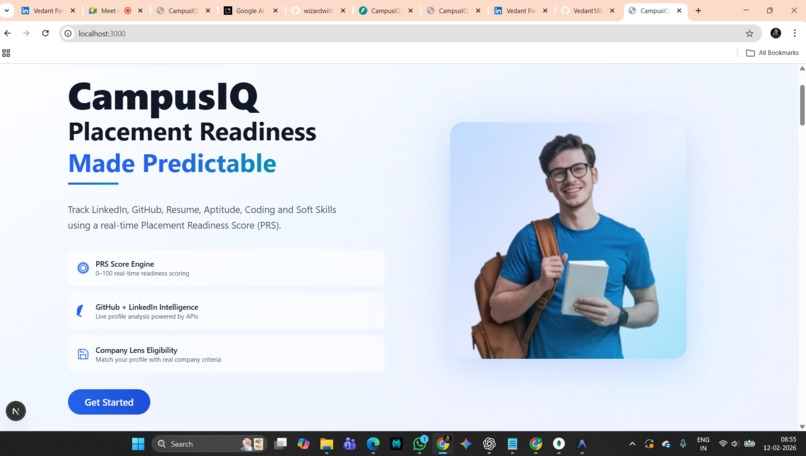
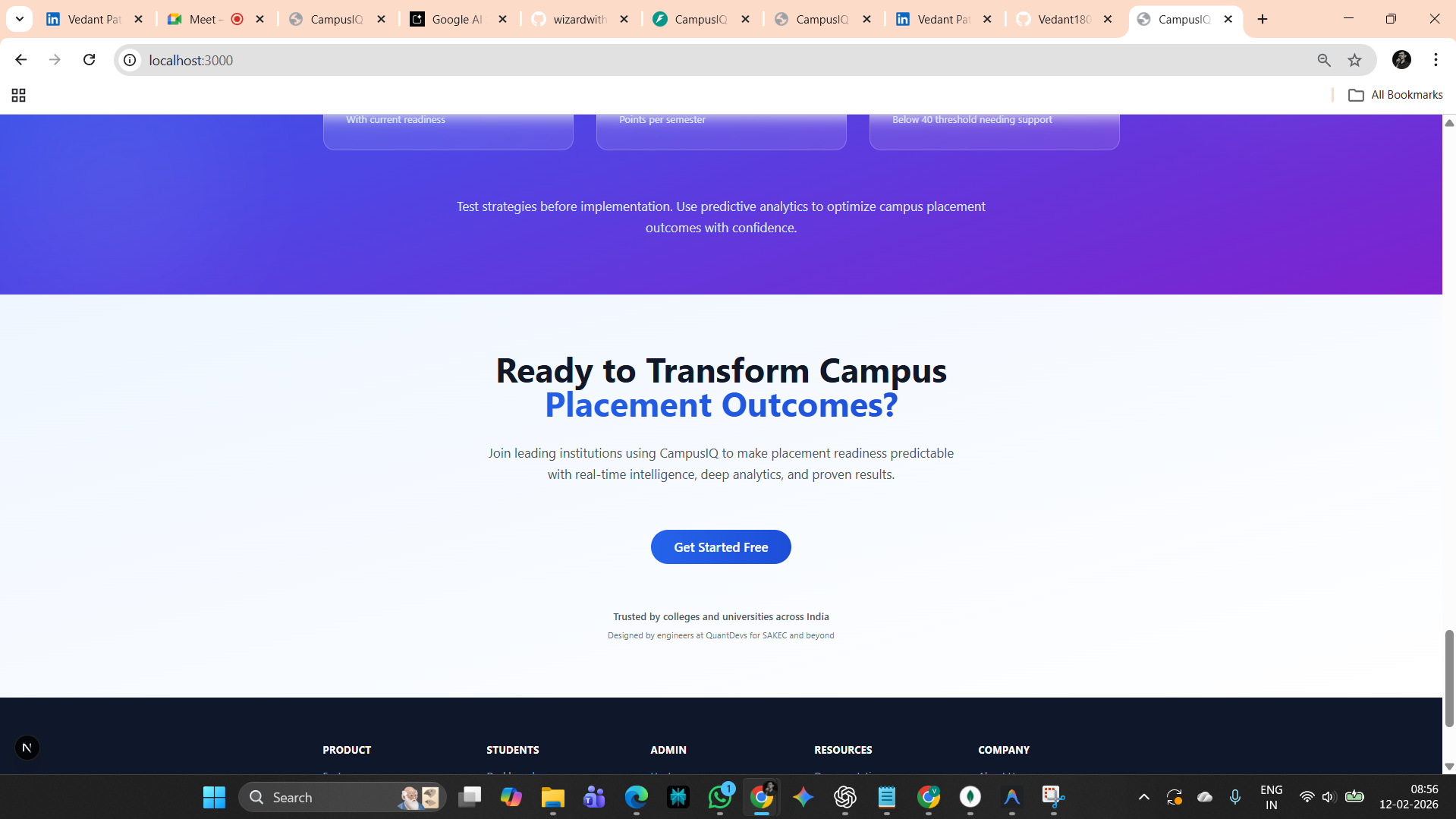
The Landing Page
-
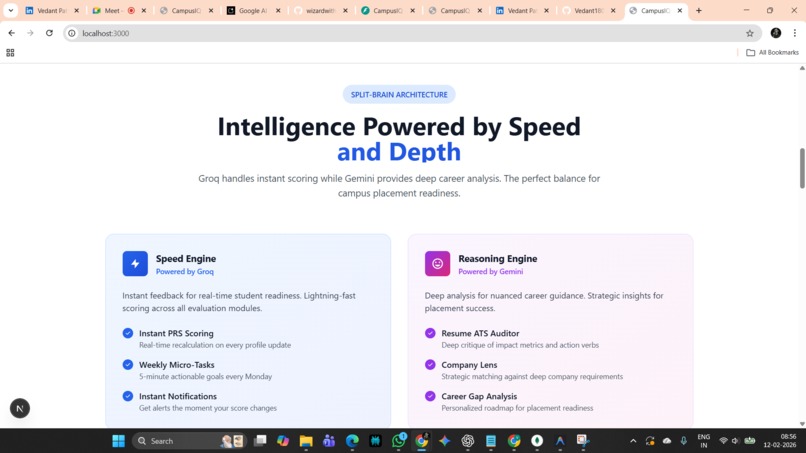
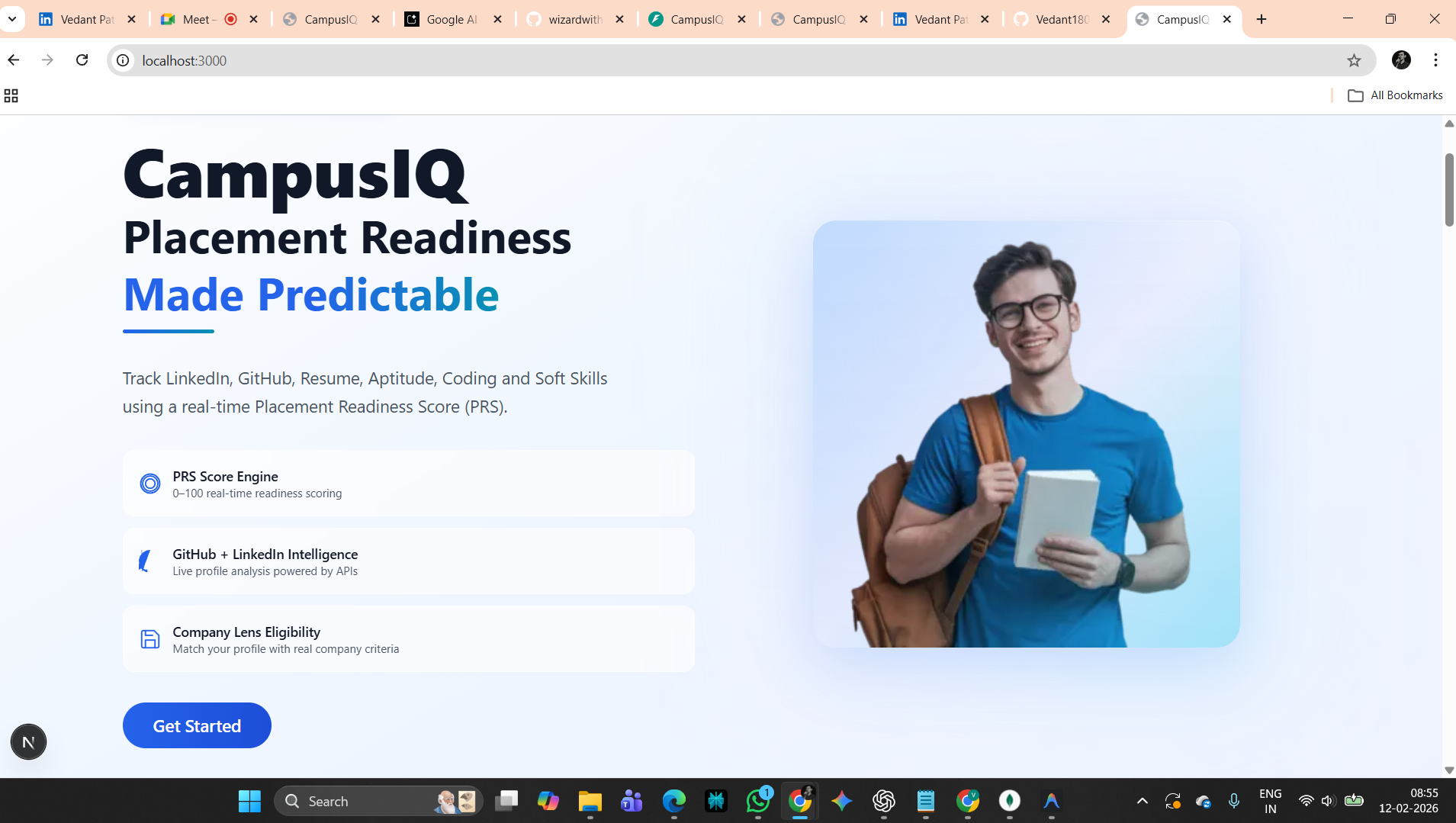
Landing Page UI-1
-
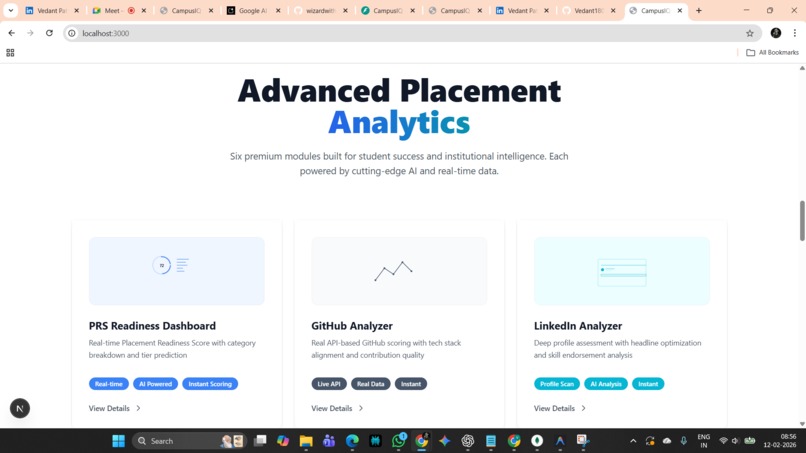
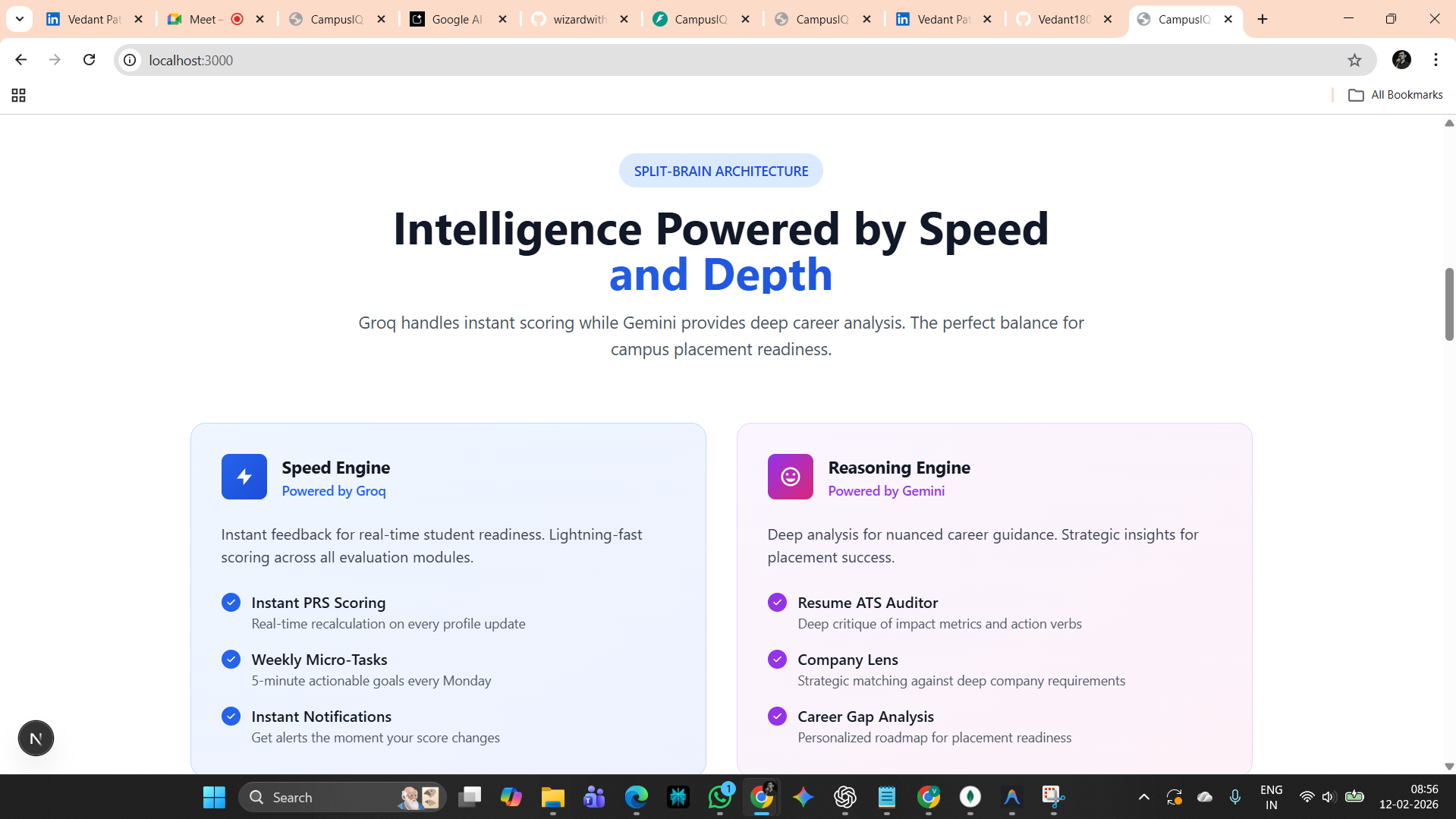
Landing Page UI-2
-
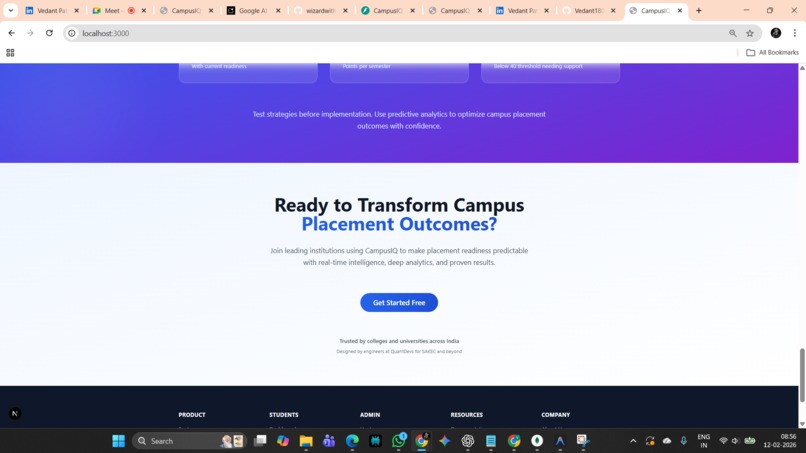
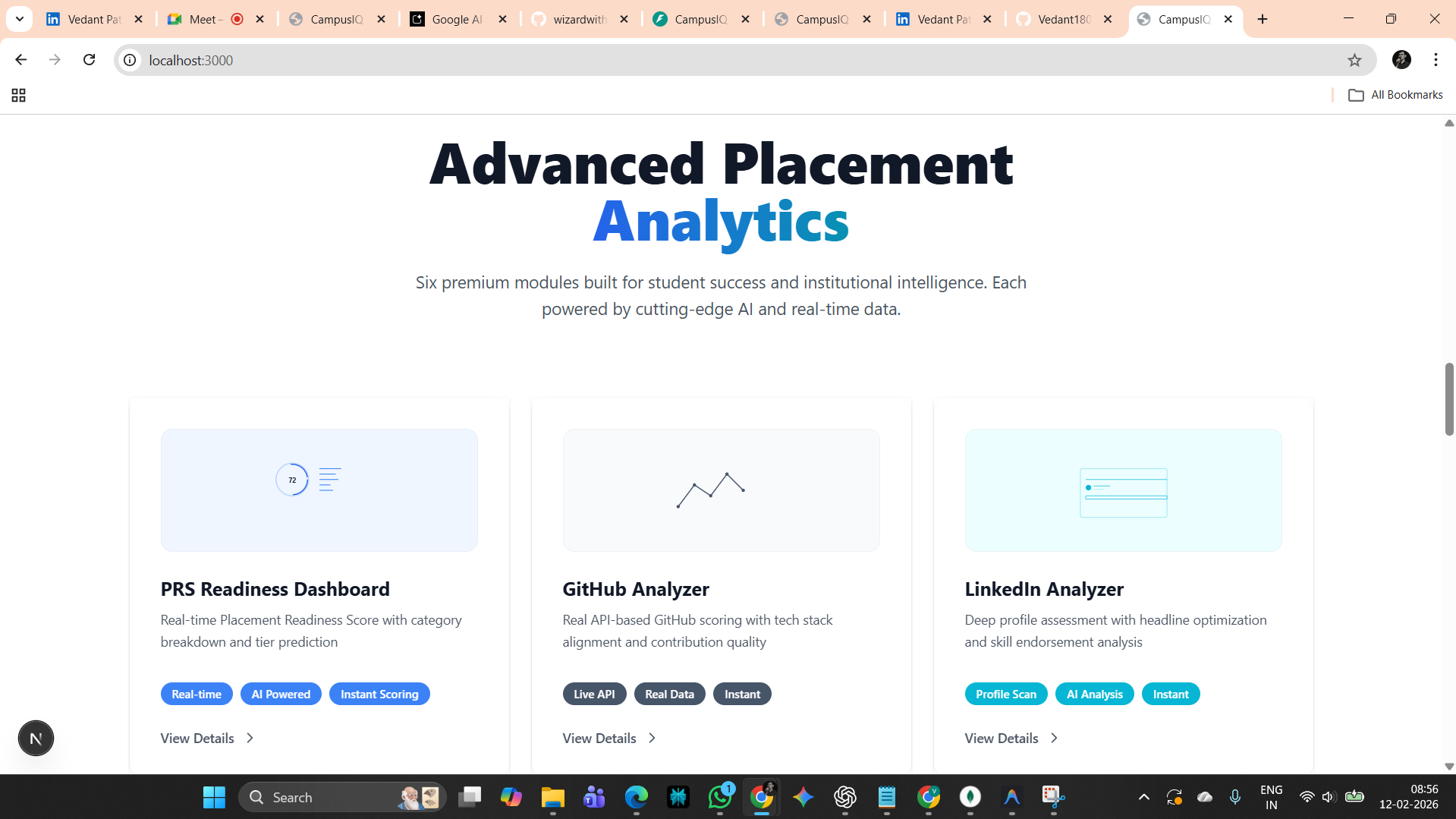
Landing Page UI-3
-
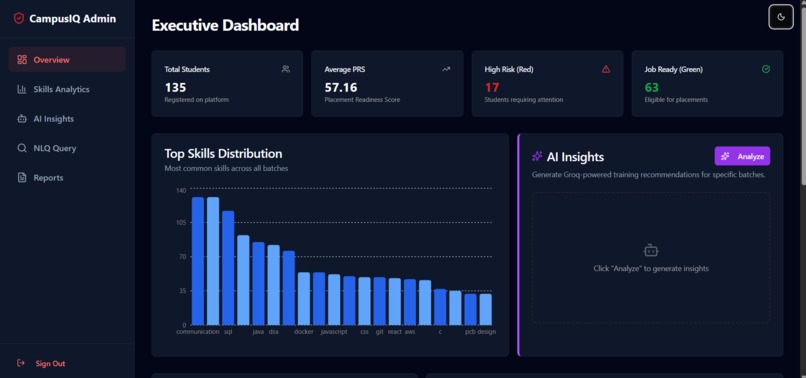
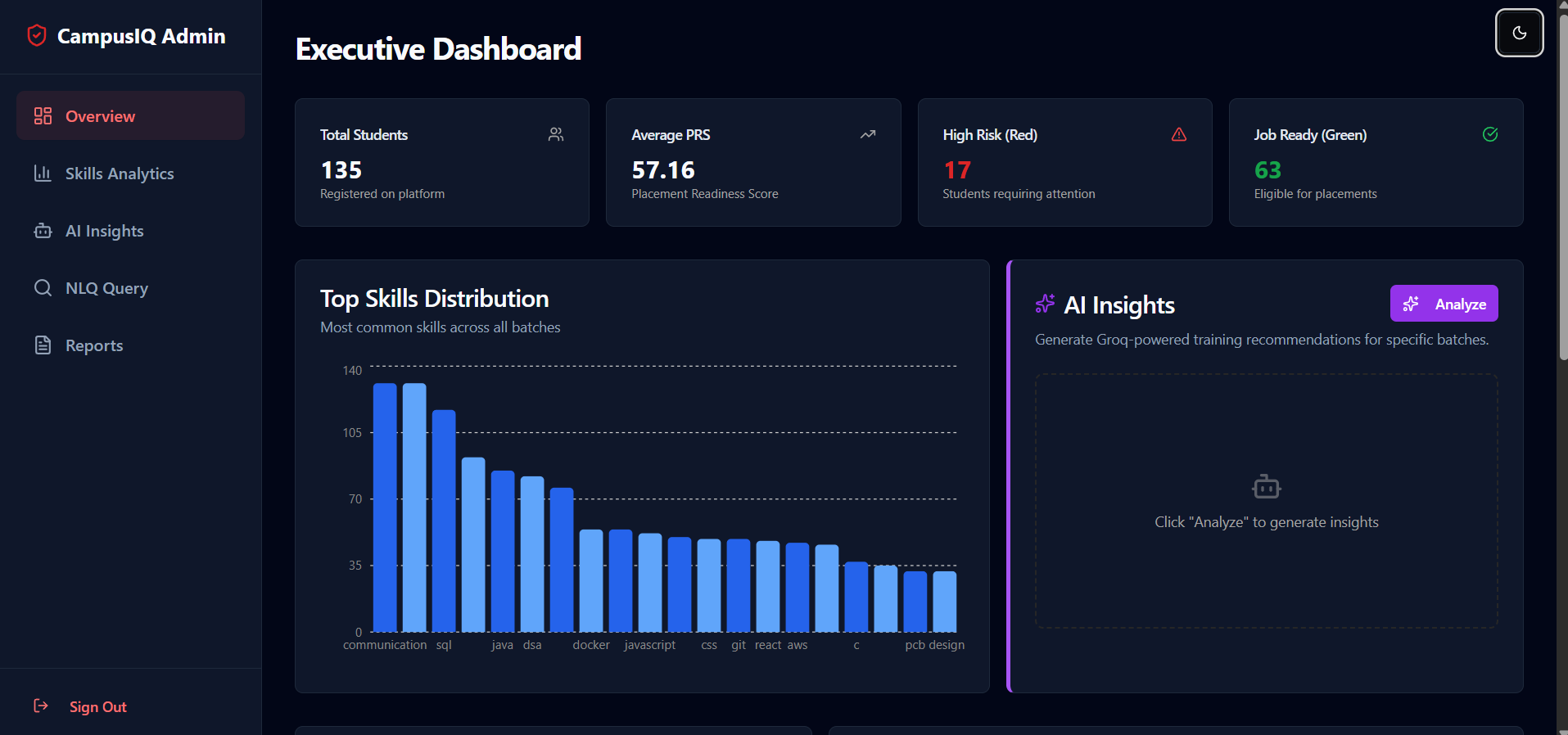
Admin Dashboard
-
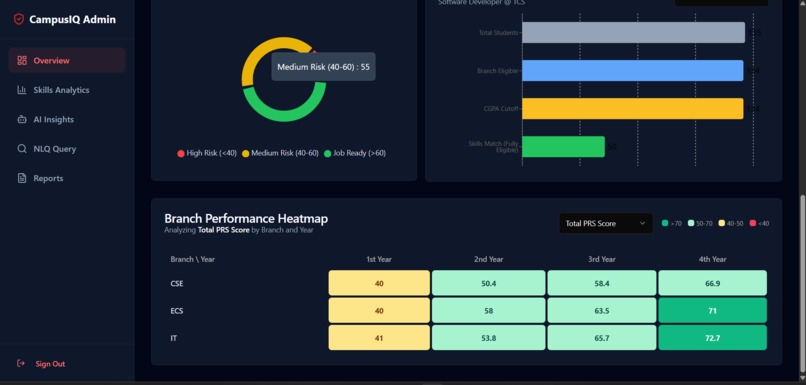
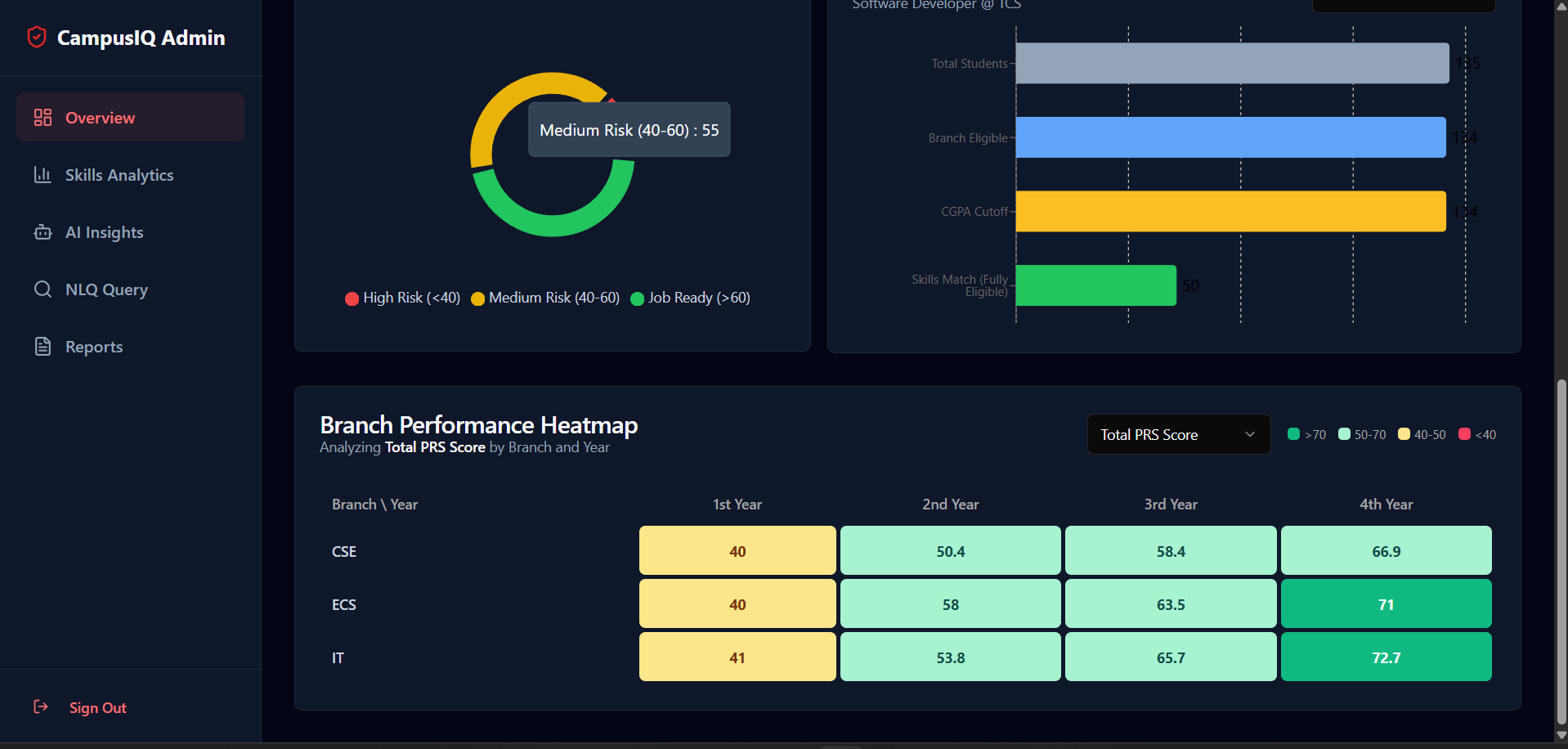
Admin Dashboard
-
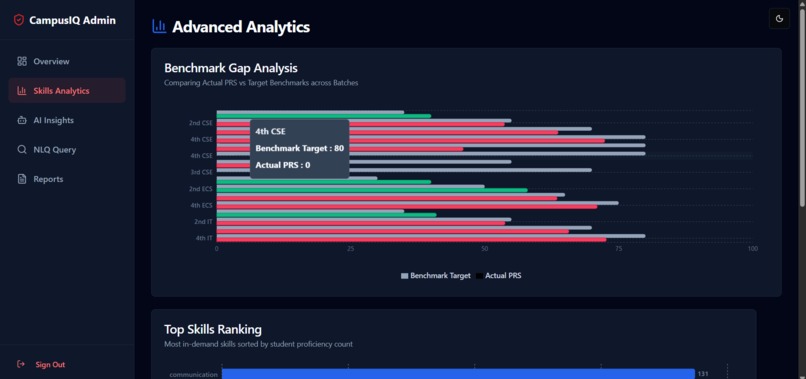
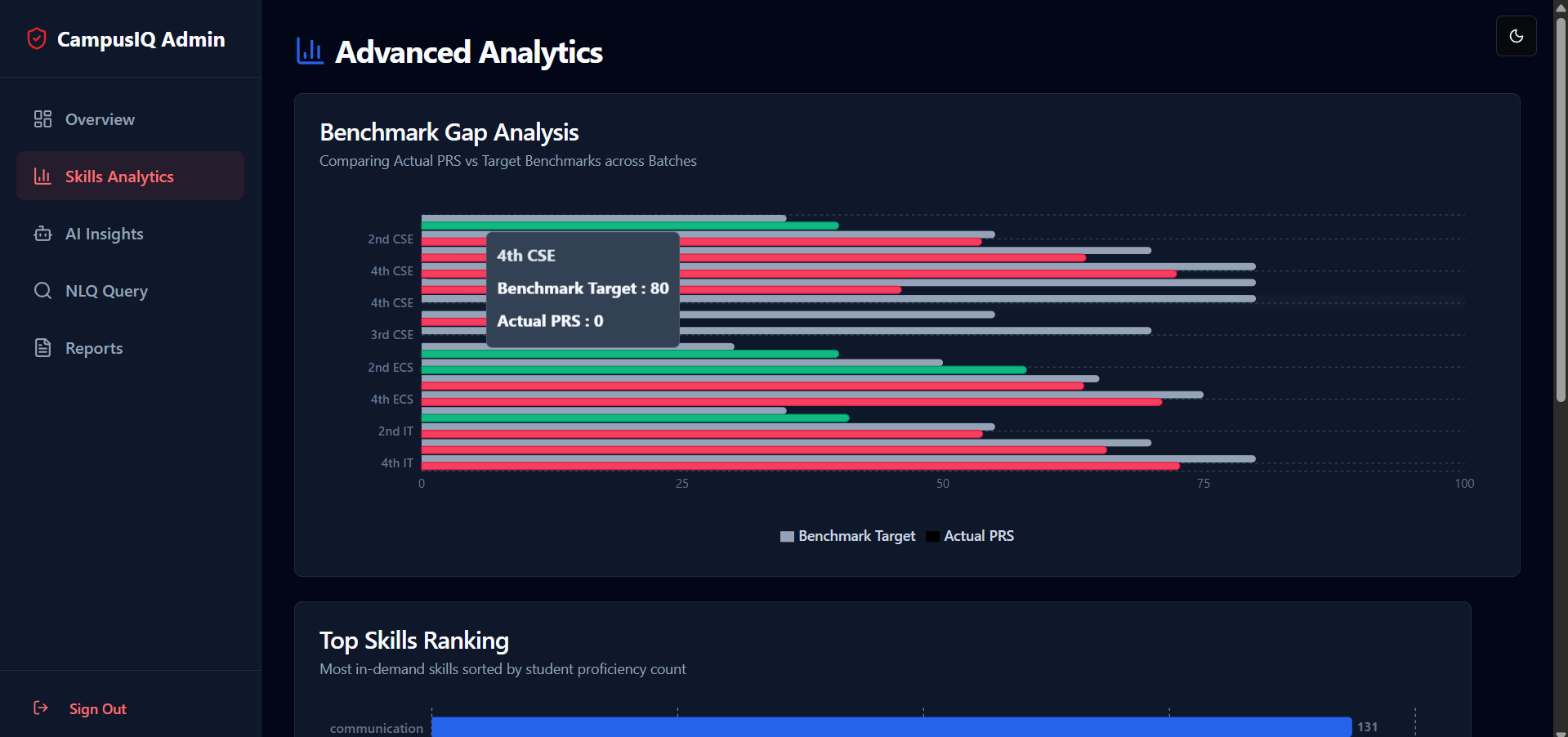
Advanced Analytics
-
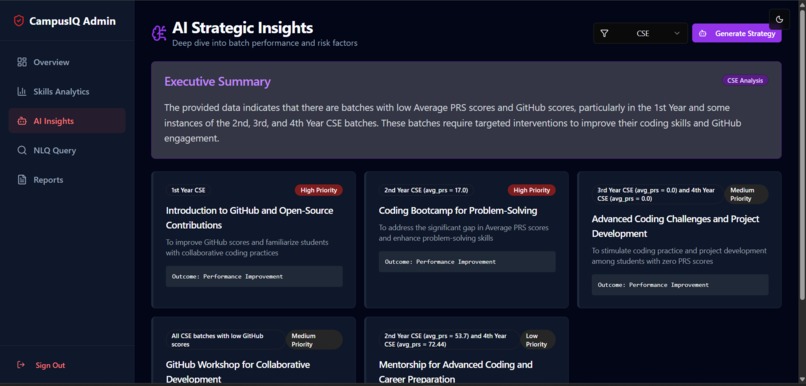
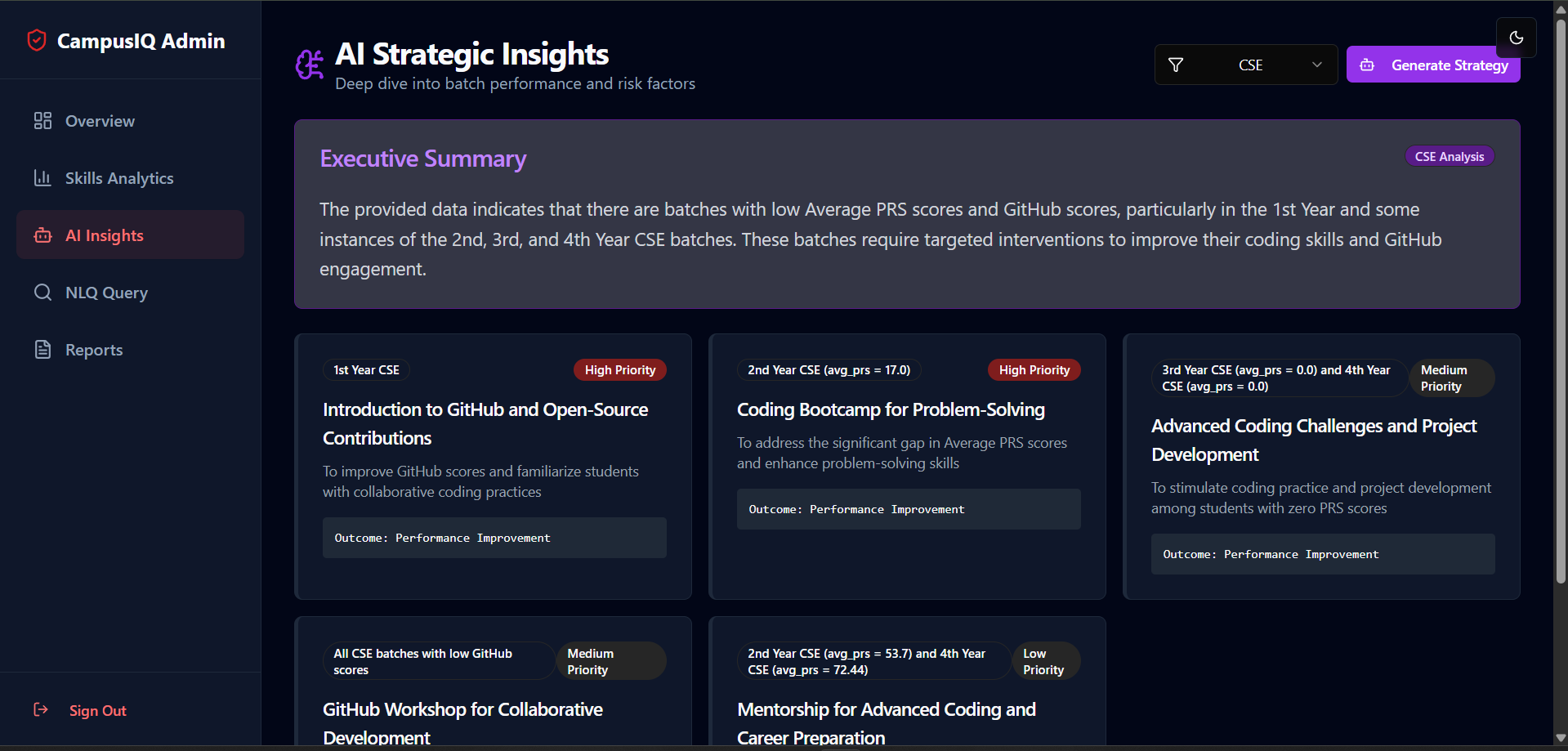
AI Strategic Insights
-
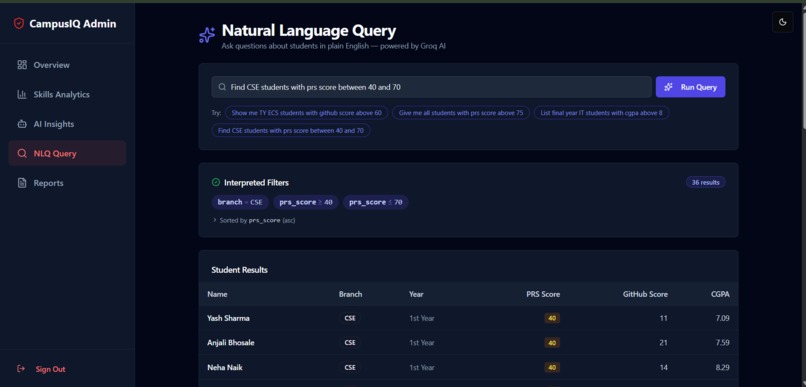
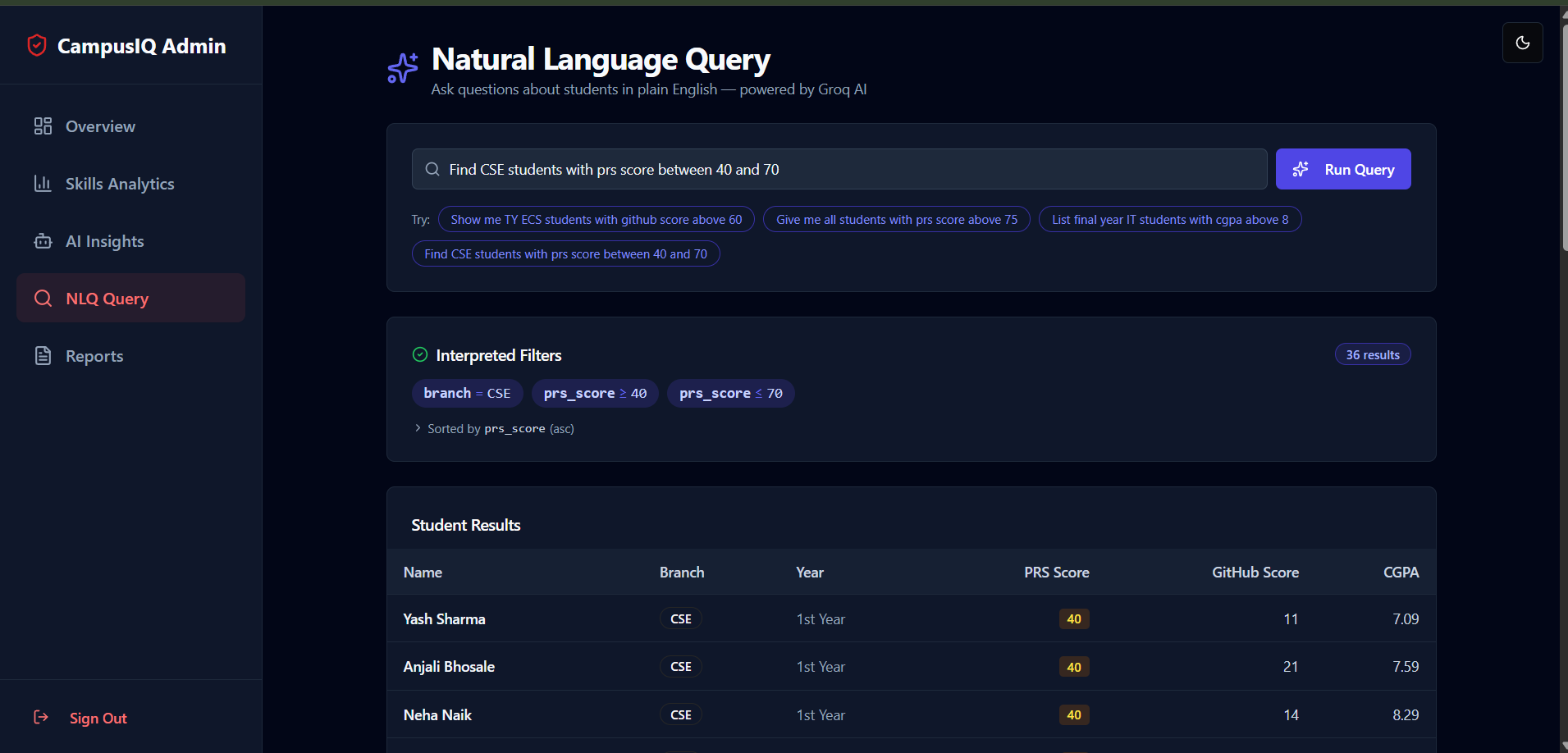
Natural Language Query
-
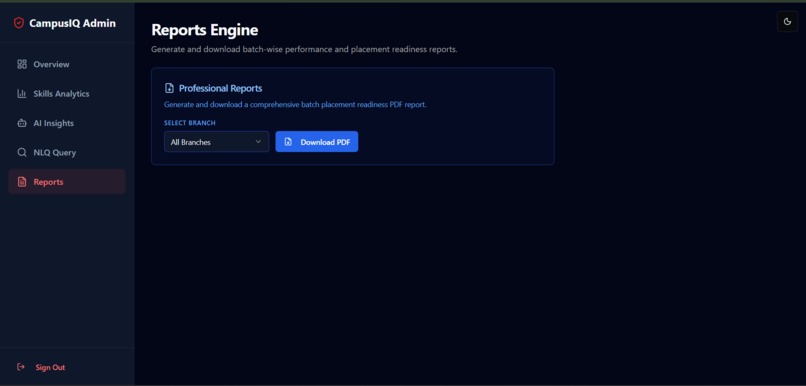
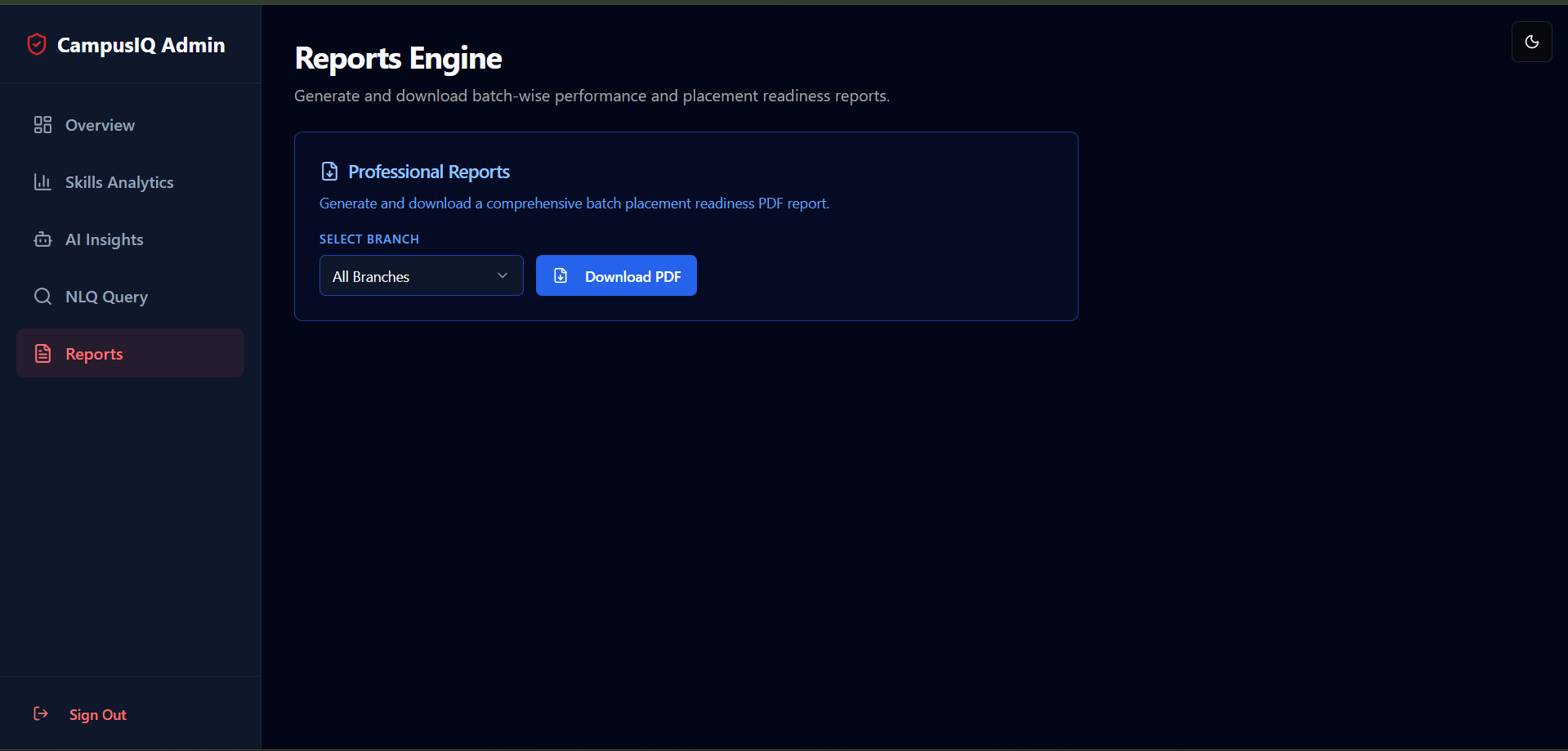
Report Generation
-
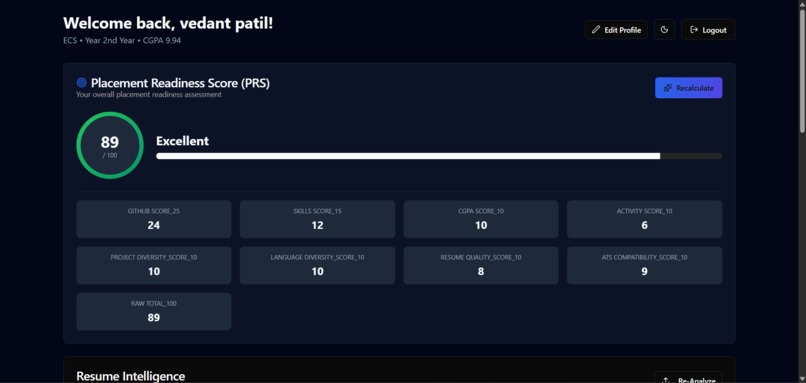
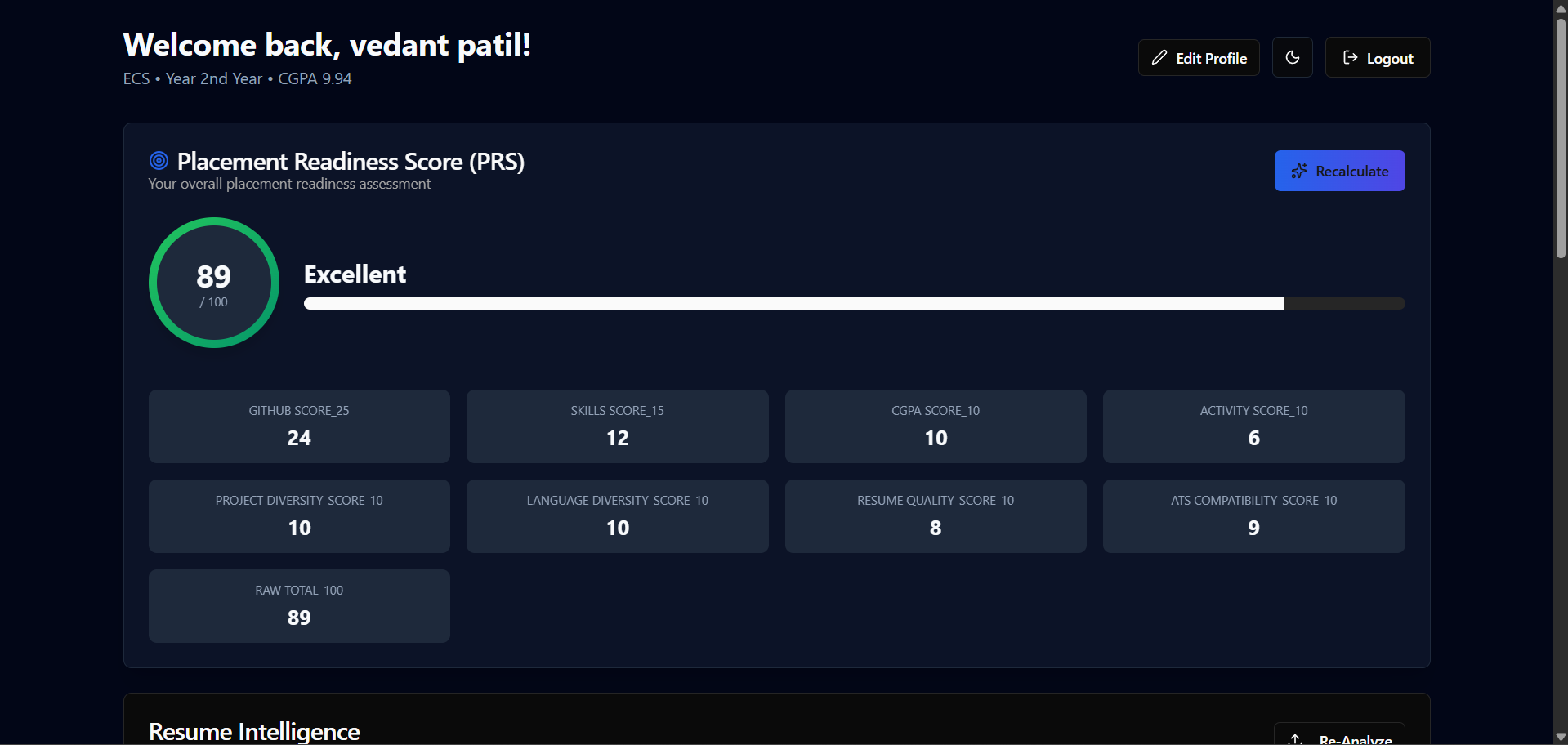
Student Dashboard
-
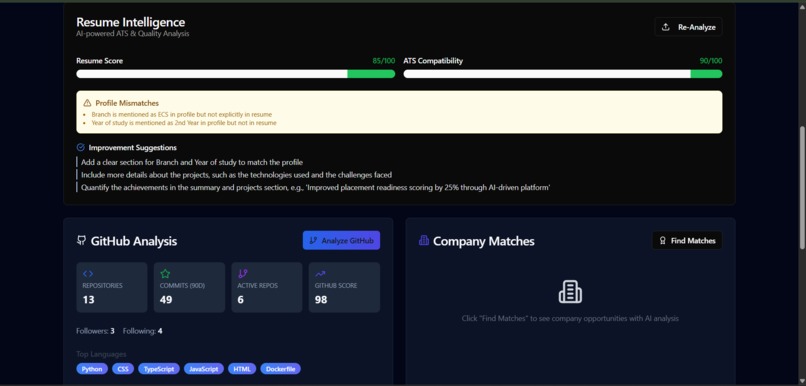
Student Dashboard-1
-
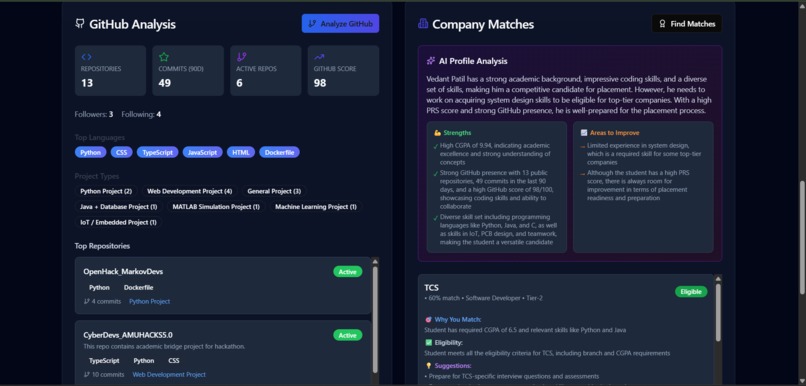
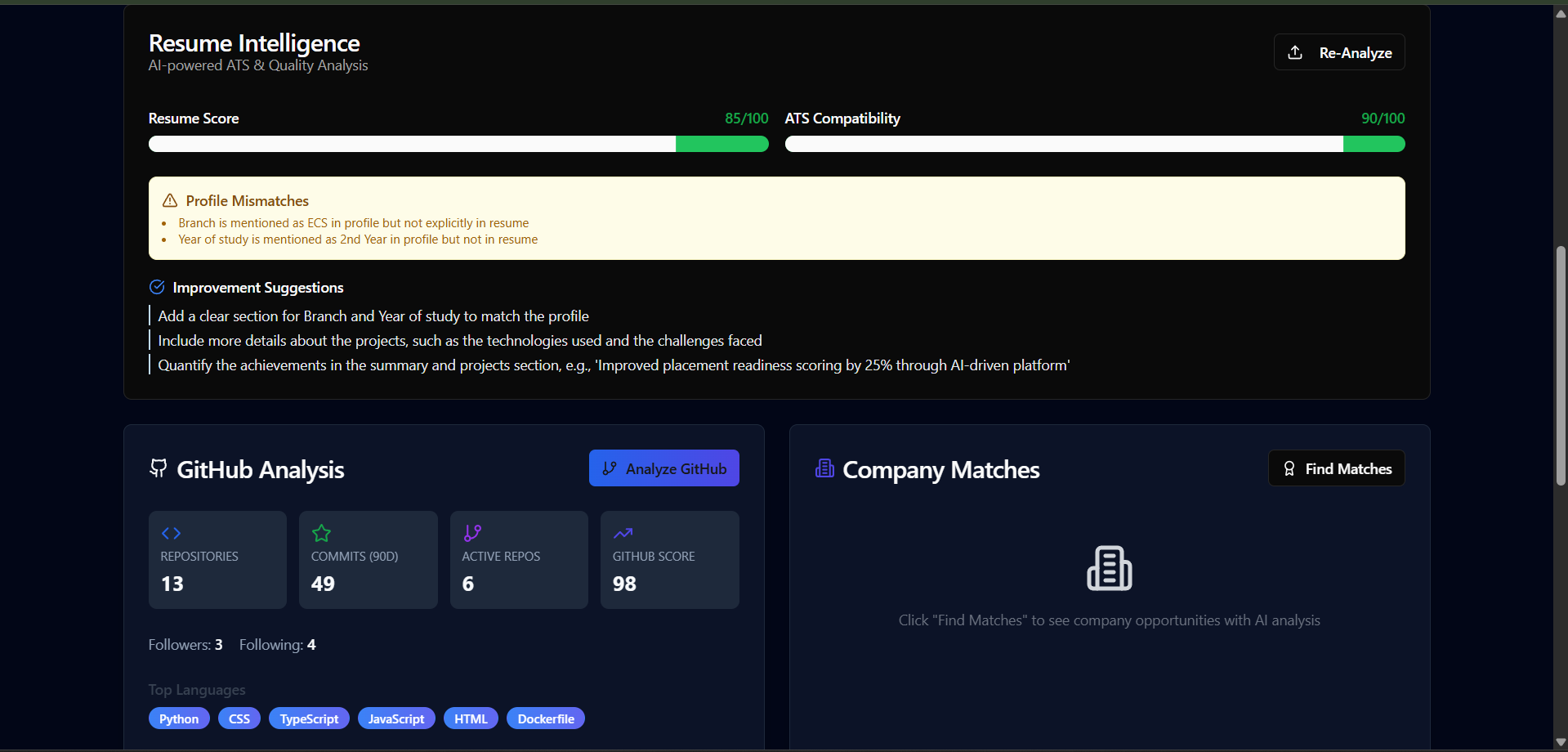
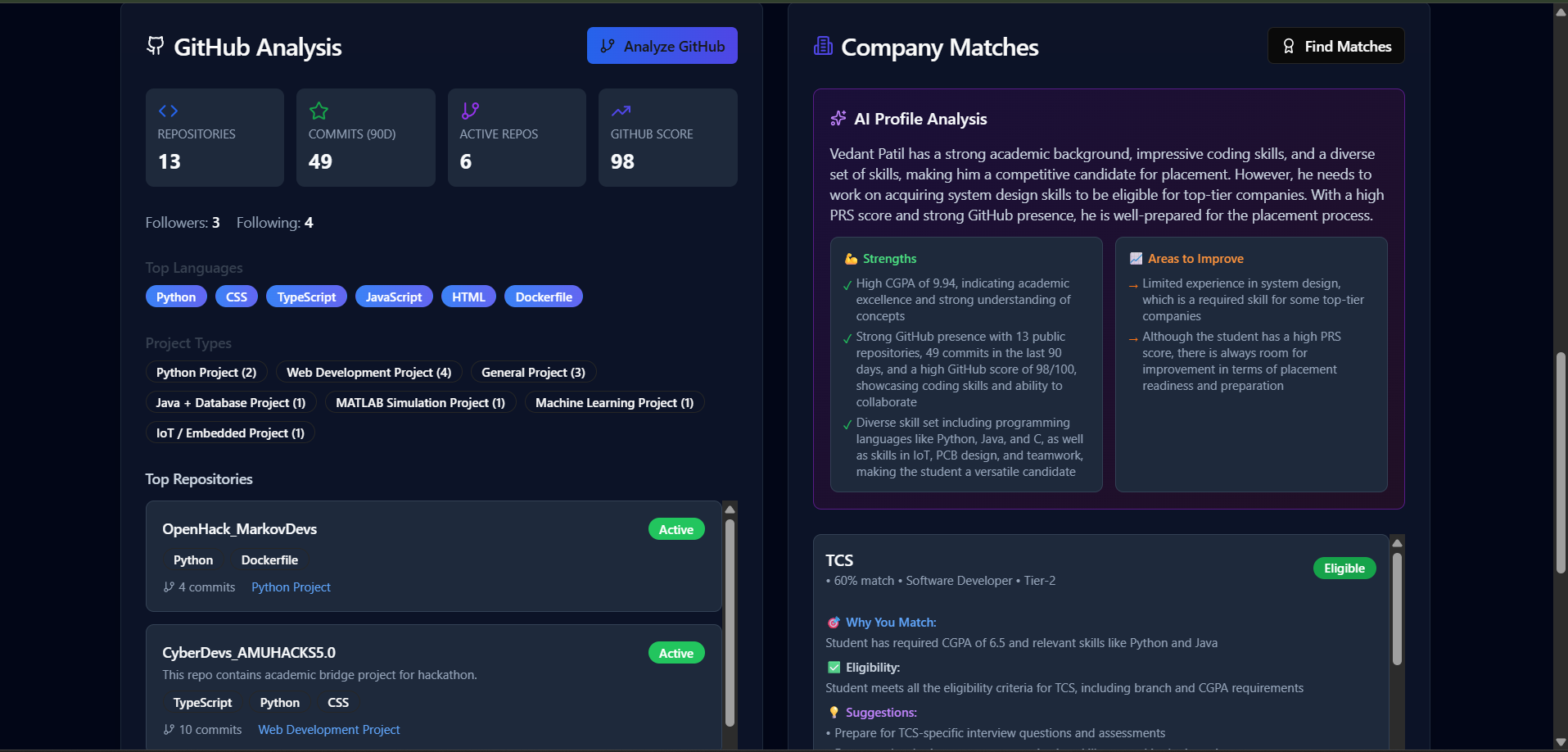
Student Insight
Inspiration
Every year, students walk into placement season underprepared — not because they lack talent, but because no one told them early enough what was missing. Placement cells manually sift through spreadsheets, resume stacks, and GitHub profiles weeks before D-day, while students scramble to patch skill gaps at the last minute.
We asked ourselves: What if a student knew exactly where they stood — 6 months before placements began?
That question became CampusIQ. We were inspired by the idea of making placement readiness predictable, not reactive — giving both students and Training & Placement Officers (TPOs) an AI-powered system that surfaces the right insights at the right time.
What it does
CampusIQ is a full-stack Placement Readiness Intelligence System that continuously evaluates students and provides institutions with data-driven strategies.
For Students:
- A real-time Placement Readiness Score (PRS) from 0–100, combining CGPA, GitHub activity, resume quality, and assessment performance into a single proprietary metric
- Resume ATS Auditor — deep analysis powered by Groq Llama-3 that scores resumes, identifies missing keywords, and recommends targeted improvements
- GitHub Deep Dive — automated analysis of code repositories to verify technical claims, assess project complexity, and measure language diversity
- Company Lens Mode — matches a student's profile against real company eligibility criteria to predict Tier-1 vs Tier-2 readiness
- Weekly Micro-Tasks — 5-minute personalized goals every Monday, aligned to the student's current readiness gaps
For Admins / TPOs:
- Branch-wise Heatmaps — campus-wide skill distribution visualized across departments and graduating batches, in the style of a Power BI command center
- Natural Language Querying (NLQ) — query student data in plain English (e.g., "Show me final year students with Python skills and PRS above 80") with no filters or SQL required
- Executive Analytics Dossier — a high-density, multi-page PDF report generated via a Finite State Machine engine, containing skill deficiency rosters, SME identification, and an AI-generated 3-month TPO strategic roadmap
- Placement Digital Twin — simulate campus-wide interventions and predict Tier-1 eligibility outcomes before implementing them
The Executive Analytics Dossier deserves particular attention. When a TPO requests a batch report, the FSM engine transitions through FETCH_DATA → ANALYZE_WITH_GROQ → RENDER_PDF → COMPLETE states asynchronously, aggregating data for hundreds of students and producing a structured, downloadable PDF that includes automatic skill gap flagging, top-student identification, and concrete training recommendations — all without any manual effort from the administrator.
How we built it
CampusIQ is built on a modern, high-performance full-stack architecture.
Frontend:
- Next.js 16 with TypeScript for a responsive, themeable UI
- Tailwind CSS for styling with purpose-built dashboard components for both student and admin personas
Backend:
- FastAPI (Python 3.10+) for a high-performance asynchronous REST API
- MongoDB Atlas for flexible, scalable student data storage
AI & Intelligence Layer:
- Groq LPU + Llama-3 as the Speed Engine — instant PRS scoring, real-time resume analysis, and batch recommendation generation
- Google Gemini as the Reasoning Engine — deep career gap analysis, company lens matching, and strategic roadmap generation
- PDFMiner.six + Tabula-py for robust resume text and table extraction before passing structured context to the AI layer
- GitHub REST API for live repository analysis
Key Engineering Decisions:
- Split-Brain Architecture — Groq handles all latency-sensitive operations (scoring, NLQ) while Gemini handles deep, nuanced reasoning tasks, giving each model the workload it is best suited for.
- FSM Report Engine — A Finite State Machine (
INIT → FETCH_DATA → ANALYZE_WITH_GROQ → RENDER_PDF → COMPLETE) manages large-scale executive report generation reliably without memory overflow. Each state is an independent asynchronous task, ensuring data integrity and AI context alignment before transitioning to the next phase. - PRS Algorithm — A weighted, dynamic scoring function in
prs_service.pythat prevents a high CGPA from masking poor technical skills.
# From prs_service.py
def calculate_prs(student):
    cgpa_weight      = 0.3
    github_weight    = 0.2
    resume_score     = 0.2
    assessment_score = 0.3
    # Dynamic normalization logic...
    return final_score
Challenges we ran into
1. Split-Brain Coordination Routing each request to the correct AI model — Groq for speed-sensitive tasks, Gemini for depth-intensive ones — without introducing latency required building a middleware classification layer that dispatches based on the nature and urgency of each request.
2. Resume Parsing Reliability Real-world resumes arrive in inconsistent formats: multi-column PDFs, embedded tables, and scanned images. PDFMiner handled text-heavy layouts well, but we had to layer in Tabula-py for tabular data and build fallback heuristics for edge cases to maintain consistent scoring reliability across all resume types.
3. Designing the FSM Report Engine Generating a high-density, multi-page analytical PDF for 500+ students is not a single API call. Designing the state machine so that each phase — data fetch, AI analysis, PDF rendering — could fail gracefully and retry independently without corrupting the final output required careful async coordination and state validation.
4. NLQ to MongoDB Query Translation Translating free-form English into structured, safe MongoDB filters with high accuracy proved more complex than anticipated. We achieved 95%+ accuracy on cohort filtering after extensive iteration on prompt design and output schema validation.
5. Building Two Full Dashboards Designing purpose-built interfaces for two fundamentally different user personas — students and TPOs — within hackathon constraints meant every UI and UX decision had to be deliberate and efficient.
Accomplishments that we're proud of
- End-to-end AI pipeline — from a raw resume PDF to a fully scored, actionable skill gap report in under 2 seconds using Groq
- 15x speed advantage over GPT-4 for batch analysis (0.8s vs 12.5s) by leveraging Groq's LPU architecture
- Executive Analytics Dossier — a production-quality, auto-generated PDF report complete with skill deficiency rosters, SME identification, and a 3-month AI-generated training roadmap, all driven by the FSM engine
- Natural Language Querying that enables non-technical TPOs to interrogate complex student databases in plain English, with no SQL or filter configuration required
- Placement Digital Twin — a predictive simulation layer for institutional decision-making, enabling data-backed intervention planning before execution
- Dual-persona product — two complete, polished dashboards serving fundamentally different needs under one cohesive system
What we learned
- Speed is a product decision. Choosing Groq over other LLM providers was not merely a technical preference — it determined which user experiences were feasible. Real-time PRS rescoring on every profile update is only possible when inference is measured in milliseconds.
- Prompt engineering is product design. The quality of NLQ results, resume scoring, and career recommendations was directly tied to how precisely prompts were framed and how tightly output schemas were constrained.
- State machines reduce complexity. The FSM pattern for report generation eliminated an entire class of async race conditions and produced a pipeline that was significantly easier to debug and extend than a chain of unstructured async calls.
- Dual-model architectures enable specialization. Using Groq and Gemini together — each for what it is genuinely best at — reinforced that AI models are tools with distinct tradeoffs, not interchangeable components.
- System design matters at every scale. Even within a hackathon, architectural decisions made early — schema design, async patterns, model routing — determined how far the product could be pushed before hitting limits.
What's next for CampusIQ
- LinkedIn Profile Analyzer — deep profile assessment with headline optimization, skill endorsement gap analysis, and profile strength scoring, feeding directly into the student's PRS
- Live LMS Integration — connect directly with college learning management systems such as Moodle and Google Classroom to automatically update PRS as students complete courses and assessments
- Mobile Application — a lightweight student companion app with push notifications for micro-task reminders and score change alerts
- Multi-college Federation — allow TPOs from multiple institutions to benchmark their campus readiness against anonymized, aggregated industry-wide data
- AI Mock Interview Module — voice-based interview simulation with real-time feedback powered by Gemini, with results feeding back into the student's PRS
- Recruiter Portal — allow companies to search and filter verified student profiles directly, evolving CampusIQ into a two-sided placement intelligence platform

Log in or sign up for Devpost to join the conversation.