Inspiration
Higher education institutions are goldmines of brilliant student ideas, research papers, and potential startups. However, these assets are often lost due to fragmented campus workflows, siloed departments, and a lack of structured guidance. Students struggle to find technical co-founders, researchers fail to commercialize their work, and campus incubators are bogged down by manual milestone tracking.
We built CampusForge to serve as an intelligent, unified digital infrastructure for modern universities. Inspired by the Education Track of the Multimodal AI Hackathon, our vision was to create an AI-first platform that actively orchestrates student ventures, streamlines research pipelines, and automates institutional bottlenecks using autonomous AI agents.
What it does
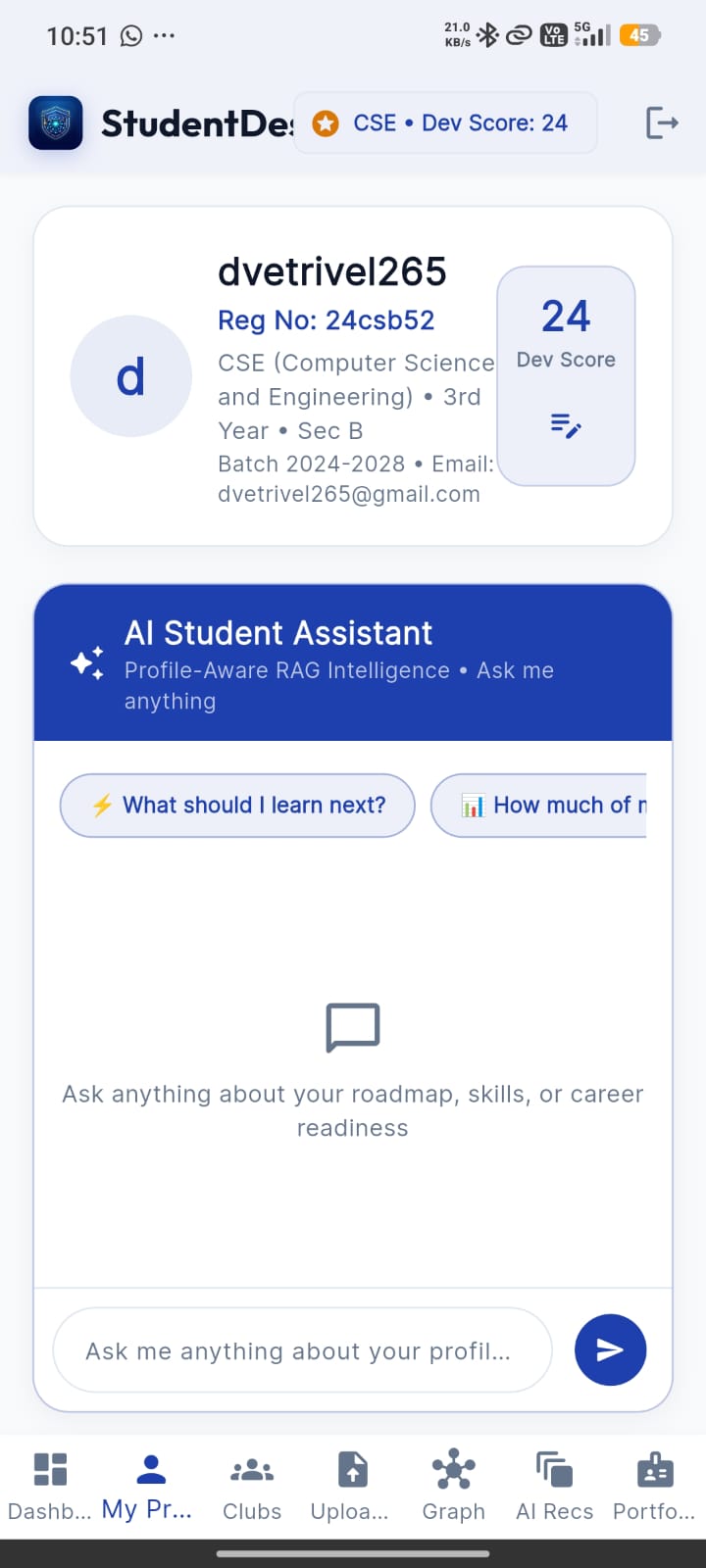
CampusForge transforms passive university portals into an active, automated incubation ecosystem. The application features three core AI-driven modules:
- VentureOS: Validates student business ideas, tracks incubation milestones, and auto-generates data-driven market viability reports.
- ResearchOS: Comprises an ingestion framework that evaluates academic drafts, cross-references internal repository themes, and highlights potential market pathways.
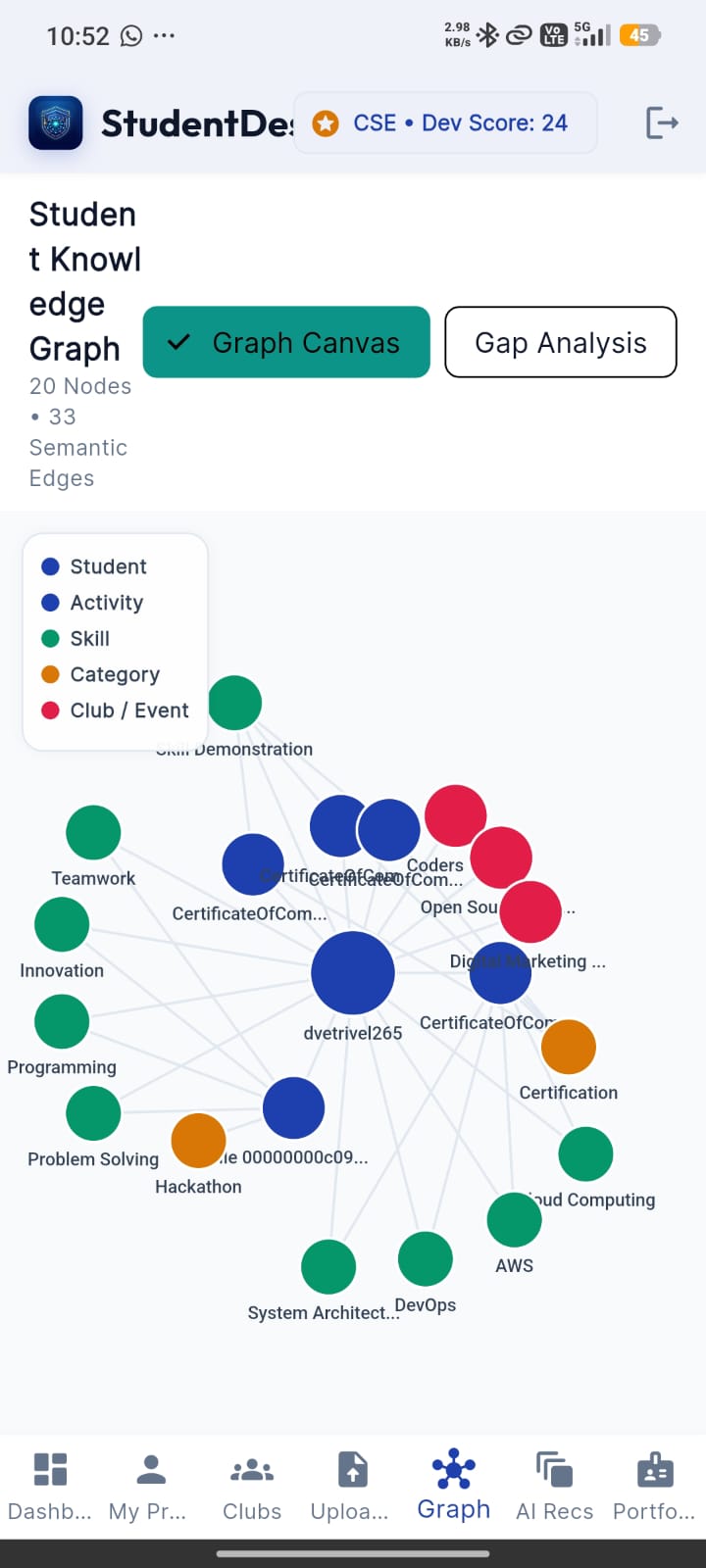
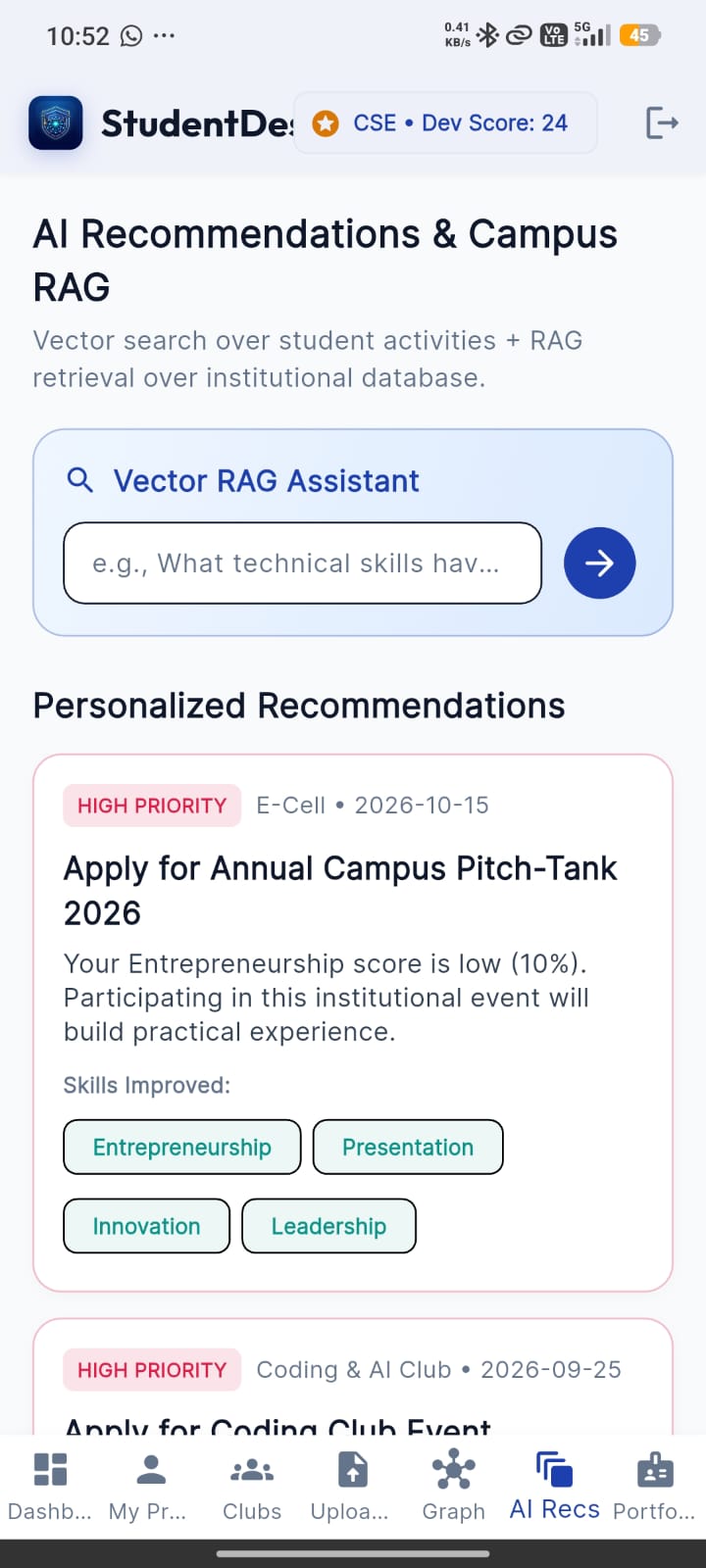
- CareerOS: Uses high-dimensional matching to connect student innovators with optimal cross-departmental co-founders and institutional resources.
How we built it
CampusForge is engineered as a robust full-stack web application designed for high scalability, real-time user collaboration, and complex agent orchestration.
The Tech Stack
- Frontend: React.js / Next.js with Tailwind CSS for a responsive, highly modular student and admin dashboard.
- Backend: Node.js with Express / Fastify to handle concurrent API requests and backend infrastructure logic.
- Database: PostgreSQL for structured relational data (student profiles, milestone tracking) alongside MongoDB for handling unstructured multimodal content like research logs and dynamic chat transcripts.
- AI & Agent Orchestration: Integrated OpenAI GPT-4o APIs for multimodal comprehension (parsing text documents, project slide decks, and structural charts). We leveraged specialized agentic frameworks (LangChain / CrewAI) to allow autonomous agents to execute independent background workflows.
AI Architecture & Mathematical Foundation
Our matching engine utilizes high-dimensional vector embeddings to connect student innovators with optimal co-founders and resources. The system maps student skills and project profiles into a vector space, evaluating compatibility using Cosine Similarity:
\( \text{Similarity}(A, B) = \frac{A \cdot B}{\Vert{}A\Vert{} \Vert{}B\Vert{}} = \frac{\sum_{i=1}^{n} A_i B_i}{\sqrt{\sum_{i=1}^{n} A_i^2} \sqrt{\sum_{i=1}^{n} B_i^2}} \)
When a student uploads a multimodal file (such as a pitch deck containing diagrams and text data), our backend splits the semantic chunks, generates embeddings, and passes them through an internal scoring function to predict project success benchmarks based on historical institutional data:
$$ P(\text{Success}) = \frac{1}{1 + e^{-(\beta_0 + \beta_1 x_1 + \beta_2 x_2 + \dots + \beta_n x_n)}} $$
Where \( x_1, x_2, \dots, x_n \) represent metrics generated by our AI agents (e.g., market size validation score, technical completeness, and resource alignment).
Challenges we ran into
- State Management in Multi-Agent Workflows: Managing asynchronous, long-running background tasks from AI agents (such as generating a comprehensive 10-page market research report) without blocking the main UI thread was difficult. We resolved this by implementing an event-driven architecture with Redis queues and WebSockets to stream live progress indicators to the user interface.
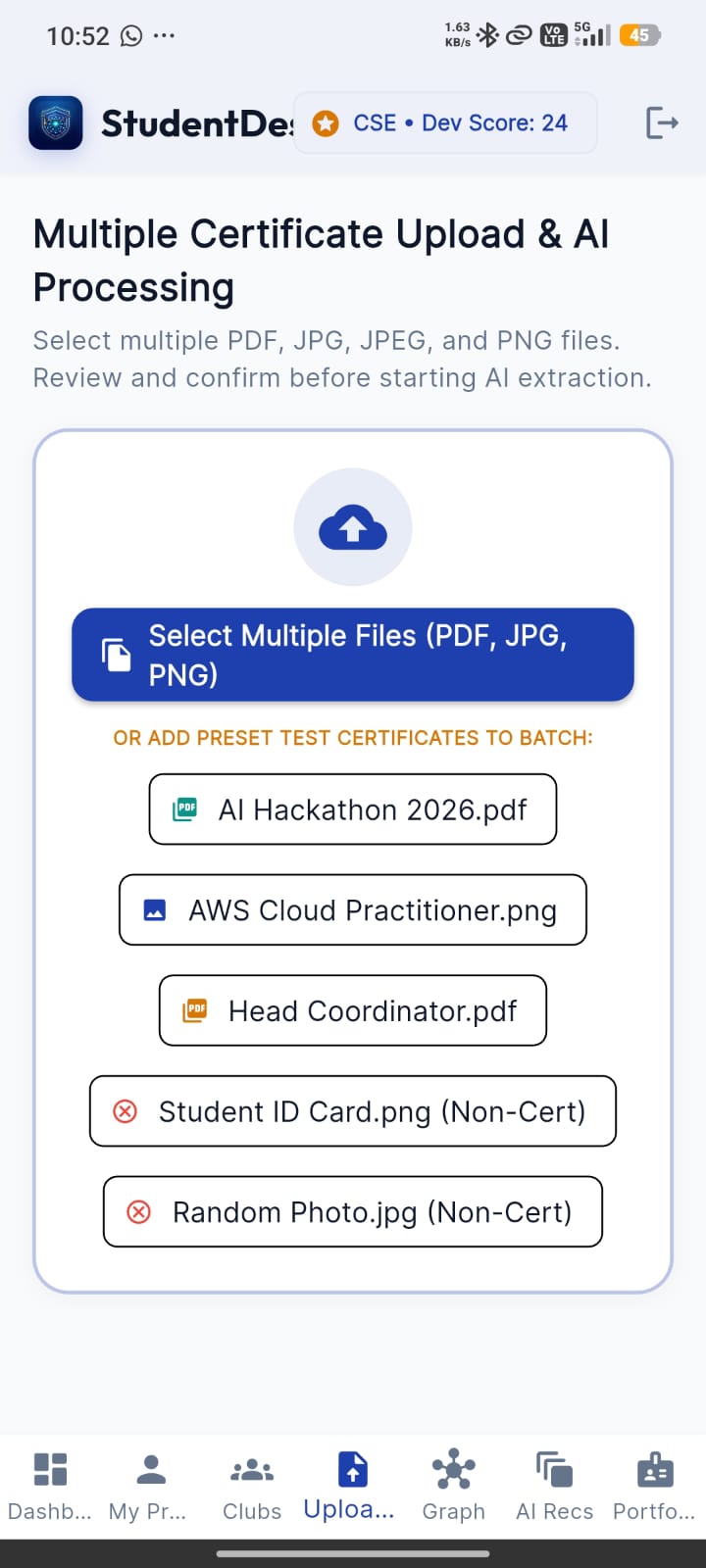
- Multimodal Parsing Reliability: Extracting structured data from student-uploaded PDFs containing non-standard charts, layouts, and data tables occasionally caused context fragmentation. We overcame this by building a custom ingestion pipeline that normalizes file structures before passing them to the multimodal model.
- Context Window Overload: As project timelines expanded, tracking entire chat histories and project updates exceeded standard token limits. We implemented an active semantic summarization layer that compresses historical interactions while preserving crucial context.
Accomplishments that we're proud of
- True Agentic Orchestration: Successfully transitioning from a basic linear chatbot to a multi-agent network where independent agents talk to each other to solve student execution problems.
- Seamless Multimodal Parsing: Engineering a frontend-to-backend pipeline that allows a user to drop a complex, unformatted PDF project deck and instantly see a populated data dashboard.
- High-Fidelity UI Execution: Crafting a clean, highly scannable dashboard UI that updates seamlessly via WebSockets without breaking or lagging.
What we learned
- Agentic Workflows > Linear Chat: We discovered that allowing AI models to think, plan, and invoke tools autonomously yields far superior outcomes for students compared to a static prompt-and-response chatbot interface.
- UI/UX for AI is Essential: Building highly intelligent backends is meaningless if users cannot track what the AI is doing. Designing intuitive progress boards for autonomous agent workflows is critical for user trust.
- Full-Stack Optimization Matters: Integrating heavy AI token streams requires tight, optimized network management, smart database caching, and efficient client-side rendering to maintain a seamless user experience.
What's next for CampusForge
- Cross-Institutional Networks: Expanding the infrastructure to allow inter-university resource matching, enabling student founders from different campuses to securely pool technical skills.
- Predictive Grant Matching: Fine-tuning an internal agent to track global venture capital metrics and state startup grants, automatically mapping matching projects to funding opportunities.
- Offline Local Models: Experimenting with local, open-source LLMs hosted directly on campus servers to reduce operational token costs while keeping sensitive student IP completely private.
Built With
- android
- cloud-firestore
- cloud-functions
- computer-vision
- cosine-similarity
- dart
- firebase
- firebase-authentication
- flutter
- git
- google-gemini-1.5
- json
- machine-learning
- material-design-3
- multi-agent-architecture
- node.js
- ocr-&-document-ai
- python
- rag-(retrieval-augmented-generation)
- rest-api
- semantic-search
- skill-gap-analysis
- vector-embeddings
- vector-search
- websockets

Log in or sign up for Devpost to join the conversation.