Project Story
Why we built CampusFix AI
A campus is a small community, but it has the same kind of operational problems that exist in much larger organizations.
A broken fan, leaking pipe, damaged infrastructure, network problem, or safety concern may look like a small issue individually. But when hundreds of students report problems through different channels, a simple maintenance request can become surprisingly difficult to manage.
We noticed a fundamental gap:
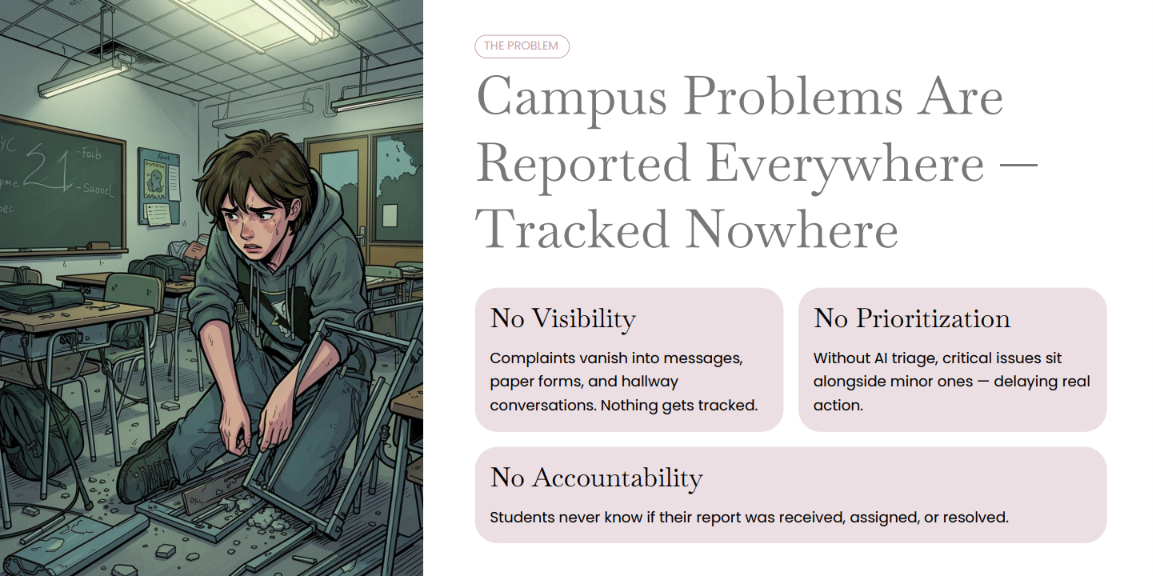
Students can report problems, but reporting does not always mean the problem becomes visible, prioritized, assigned, and resolved.
Complaints can end up in messages, forms, calls, or informal conversations. Students may not know whether anyone received their complaint, administrators may lack a complete picture of campus issues, and maintenance teams may spend time manually sorting and assigning requests.
That led us to ask:
What if a campus complaint could automatically become an actionable workflow?
That question became the foundation for CampusFix AI.
From complaint to resolution
Our goal was not to build another complaint form.
We wanted to create a system that understands the complaint and helps move it through the entire lifecycle.
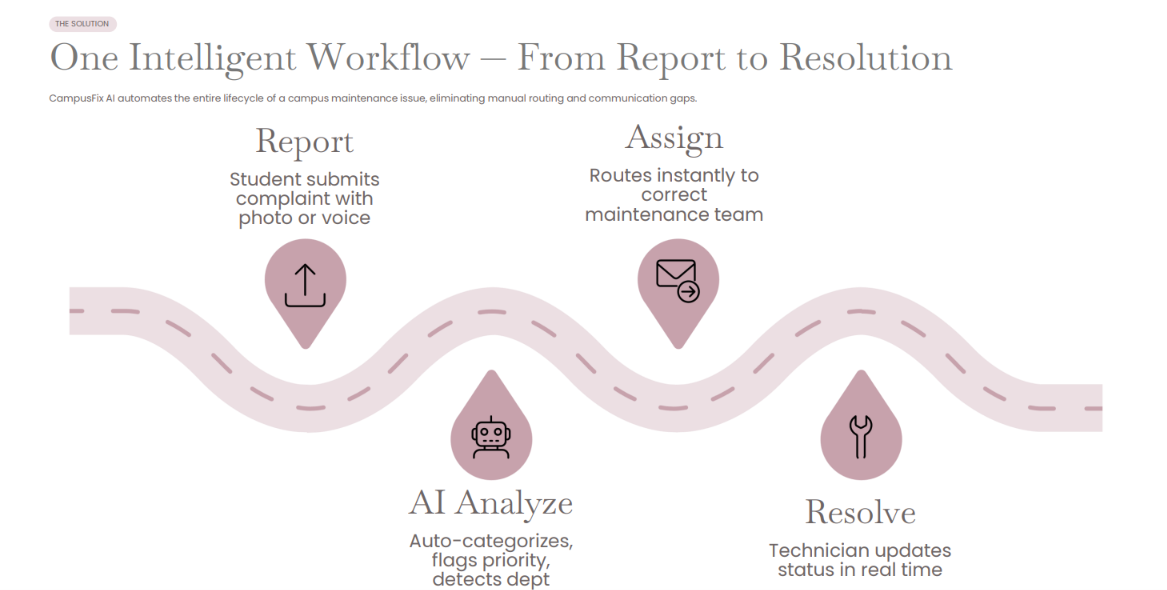
The workflow we designed is:
Report → Analyze → Prioritize → Detect duplicates → Assign → Resolve → Track
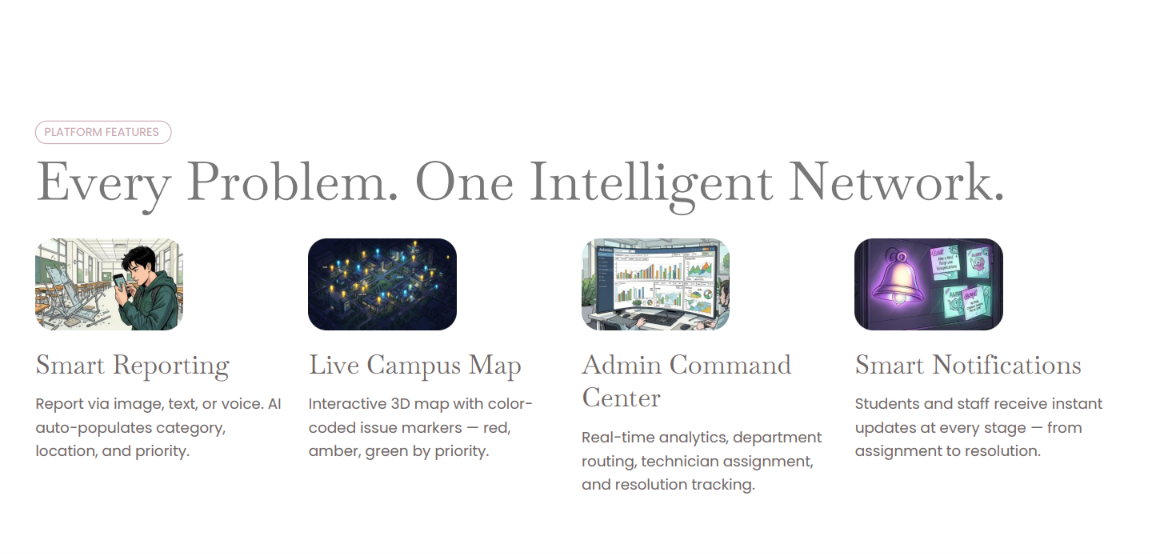
A student can describe an issue using text, voice, or an image. Instead of requiring the student to determine the correct department or technical category, the system can use AI-assisted analysis to interpret the report.
For example, a student might report:
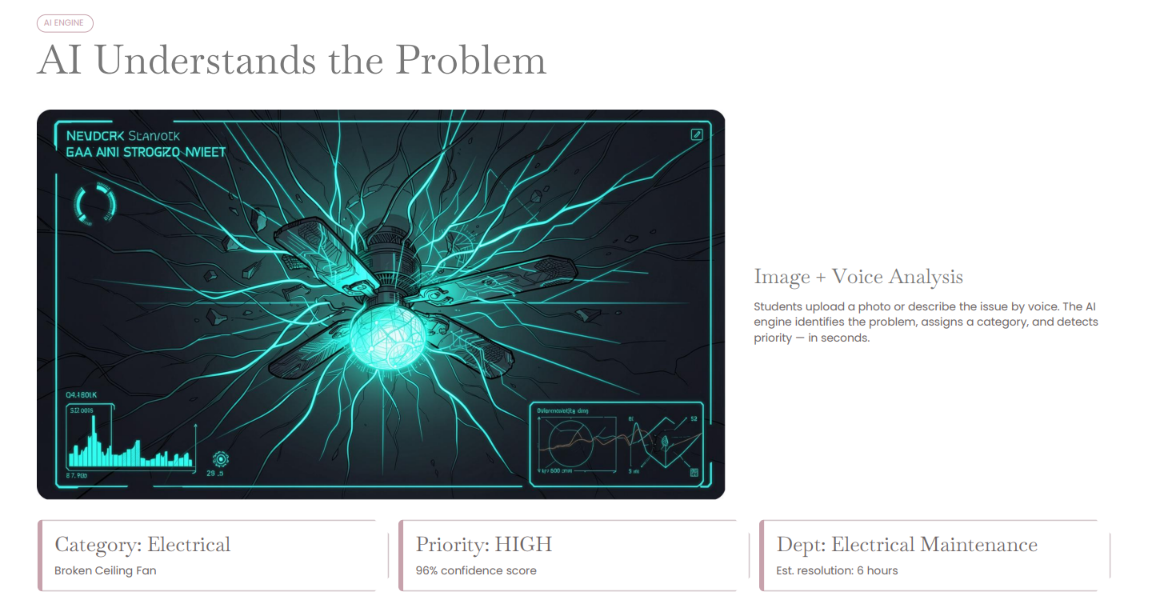
"The ceiling fan in our classroom is not working and it is making a strange noise."
CampusFix can turn that unstructured complaint into structured information such as:
- Category: Electrical
- Priority: High
- Relevant location
- Issue description
- Suggested department
- Estimated handling information
The goal is to reduce the distance between someone noticing a problem and the right person being able to act on it.
Building the AI workflow
We designed CampusFix AI around three major intelligence tasks.
1. Understanding the problem
Students should not have to know whether an issue belongs to electrical maintenance, plumbing, infrastructure, or another department.
The system interprets the available text, image, or voice input and helps classify the issue.
2. Deciding what matters first
Not every complaint deserves the same urgency.
A minor cosmetic issue and a potentially dangerous electrical problem should not enter the same queue with the same priority.
CampusFix AI therefore includes priority analysis to help administrators identify issues that may require faster attention.
3. Preventing duplicate work
We considered an important problem that is easy to overlook.
If one student reports a water leak and five other students report the same leak separately, the maintenance team does not necessarily have five problems.
It may be one problem reported five times.
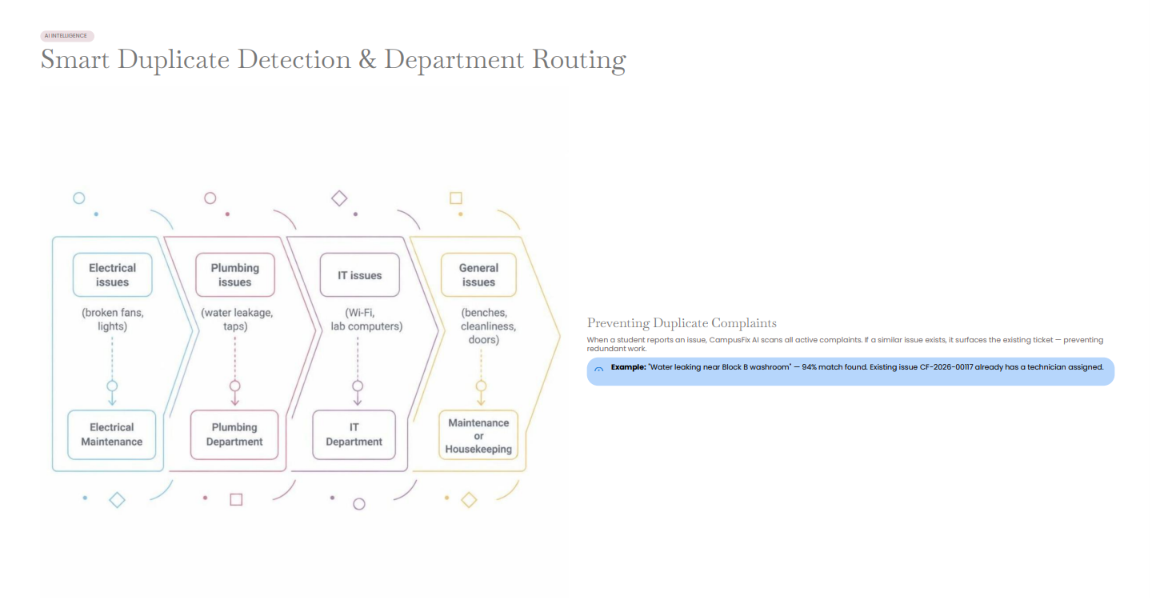
CampusFix AI compares new complaints against active issues and can surface a potentially matching existing ticket.
For example:
"Water leaking near Block B washroom"
could match an existing active issue and show that a technician has already been assigned.
This helps reduce duplicate work while keeping the original issue visible.
Designing for different people
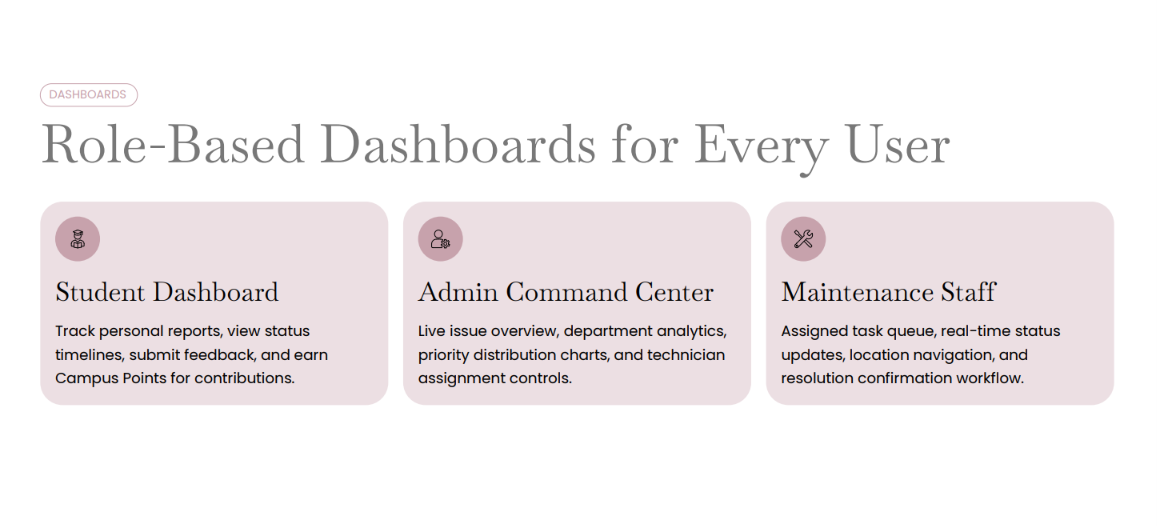
Another important part of the project was realizing that students, administrators, and maintenance staff need completely different interfaces.
Students need simplicity
A student should be able to report an issue without understanding the internal maintenance structure.
Their dashboard focuses on reporting, tracking, timelines, and feedback.
Administrators need visibility
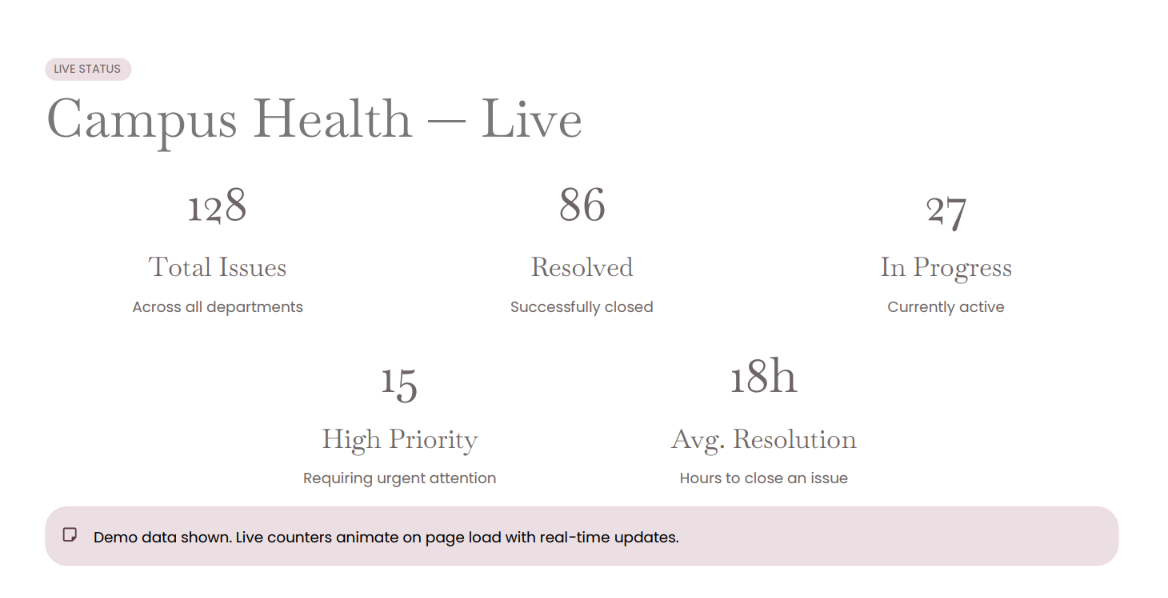
Administrators need to understand the overall health of the campus.
The Admin Command Center therefore focuses on issue volume, priority distribution, department activity, technician assignment, and resolution progress.
Maintenance teams need action
Maintenance staff need actionable tasks rather than analytics dashboards.
Their workflow focuses on assigned issues, locations, status updates, and resolution confirmation.
This resulted in a role-based platform where each person sees the information they actually need.
Making the campus visible
We also wanted to move beyond a list of tickets.
A campus problem has a location, and location can reveal patterns.
CampusFix AI therefore includes a campus map concept where issues can be represented through priority-based markers.
This gives administrators another way to answer questions such as:
- Where are problems concentrated?
- Which areas have recurring issues?
- Which locations currently have high-priority problems?
- What should maintenance teams look at first?
The map turns individual complaints into a broader picture of campus health.
Challenges we faced
Turning unstructured complaints into structured data
People rarely report problems in a standardized format.
One student might say:
"The AC isn't working."
Another might say:
"Room 204 is extremely hot because the air conditioner stopped working."
The system still needs to understand that both may represent the same general type of issue.
Designing the workflow around imperfect, natural-language input was one of the biggest challenges.
Avoiding false certainty
AI predictions can sound more confident than they actually are.
We therefore treated classifications, confidence values, and priority assessments as AI-assisted recommendations, rather than pretending that every prediction is guaranteed to be correct.
This is especially important when prioritization could affect real maintenance decisions.
Duplicate detection
Duplicate detection sounds simple until different people describe the same physical problem in completely different ways.
We had to think beyond exact text matching and consider semantic similarity, issue category, location, and whether the existing ticket was still active.
Designing multiple dashboards
A platform serving students, administrators, and maintenance teams can quickly become cluttered.
We had to decide what information belongs to each role and keep the workflows focused instead of putting every feature on every screen.
Balancing automation with human decisions
We wanted AI to remove repetitive work without pretending that humans are unnecessary.
The AI can help classify, prioritize, and route a complaint, but administrators and maintenance teams remain responsible for actual decisions and physical resolution.
What we learned
Building CampusFix AI changed how we think about AI-powered applications.
We learned that AI is most valuable when it is connected to a real workflow.
A model predicting that an issue is "Electrical" is useful, but the prediction becomes much more valuable when it automatically contributes to:
Classification → Priority → Department → Technician → Status → Resolution
We also learned that good product design is about more than adding features.
A student does not care how sophisticated the backend is. They care about whether they can report a problem quickly and know what happened afterward.
An administrator does not simply need more data. They need actionable visibility.
A maintenance worker does not need another complicated dashboard. They need to know what needs to be fixed, where it is, and what the current status is.
Those perspectives shaped the final product.
What we would improve next
CampusFix AI is a hackathon prototype, but the concept can be extended significantly.
Future versions could include:
- Integration with existing campus ERP or help-desk systems
- More advanced computer vision for infrastructure issues
- Better multilingual and voice-based reporting
- Historical maintenance analytics
- Predictive maintenance based on recurring issues
- Stronger location-aware issue clustering
- Automated escalation for unresolved high-priority issues
- Mobile applications for students and technicians
- More granular access control and audit logging
- Real-world evaluation using anonymized campus maintenance data
We would also want to measure the platform with actual deployment data rather than relying on projected targets.
The bigger idea
CampusFix AI started with a simple observation:
A complaint is only useful if it leads to action.
Reporting a broken fan should not mean sending a message and hoping someone notices it.
It should become a visible, prioritized, assigned, trackable workflow.
That is what we wanted CampusFix AI to demonstrate:
Every campus problem deserves a clear path from report to resolution.
By bringing students, administrators, and maintenance teams into one intelligent platform, CampusFix AI turns scattered complaints into actionable campus operations.
Built With
- access
- ai
- api
- computer
- css
- data
- express.js
- geospatial
- ibm
- language
- natural
- node.js
- processing
- python
- react
- rest
- role-based
- sqlite
- tailwind
- typescript
- vision
- visualization
- voice
- watsonx

Log in or sign up for Devpost to join the conversation.