Inspiration
Every semester, students get buried in the same kind of message:
“All students are hereby informed that the deadline for submission of…”
Long circulars on WhatsApp. Screenshots of notice boards. PDFs that are really walls of text. The information is often already there — but the meaning is buried.
Students don’t need more announcements. They need to know:
- What am I supposed to do?
- When is it due?
- Where do I go?
- What do I need to bring?
CampusCue started from that frustration: the problem isn’t missing information — it’s information overload. Critical deadlines get missed because a notice is too hard to parse quickly. I wanted to build the thing I wish existed when I opened a five-page circular and only needed four answers.
What it does
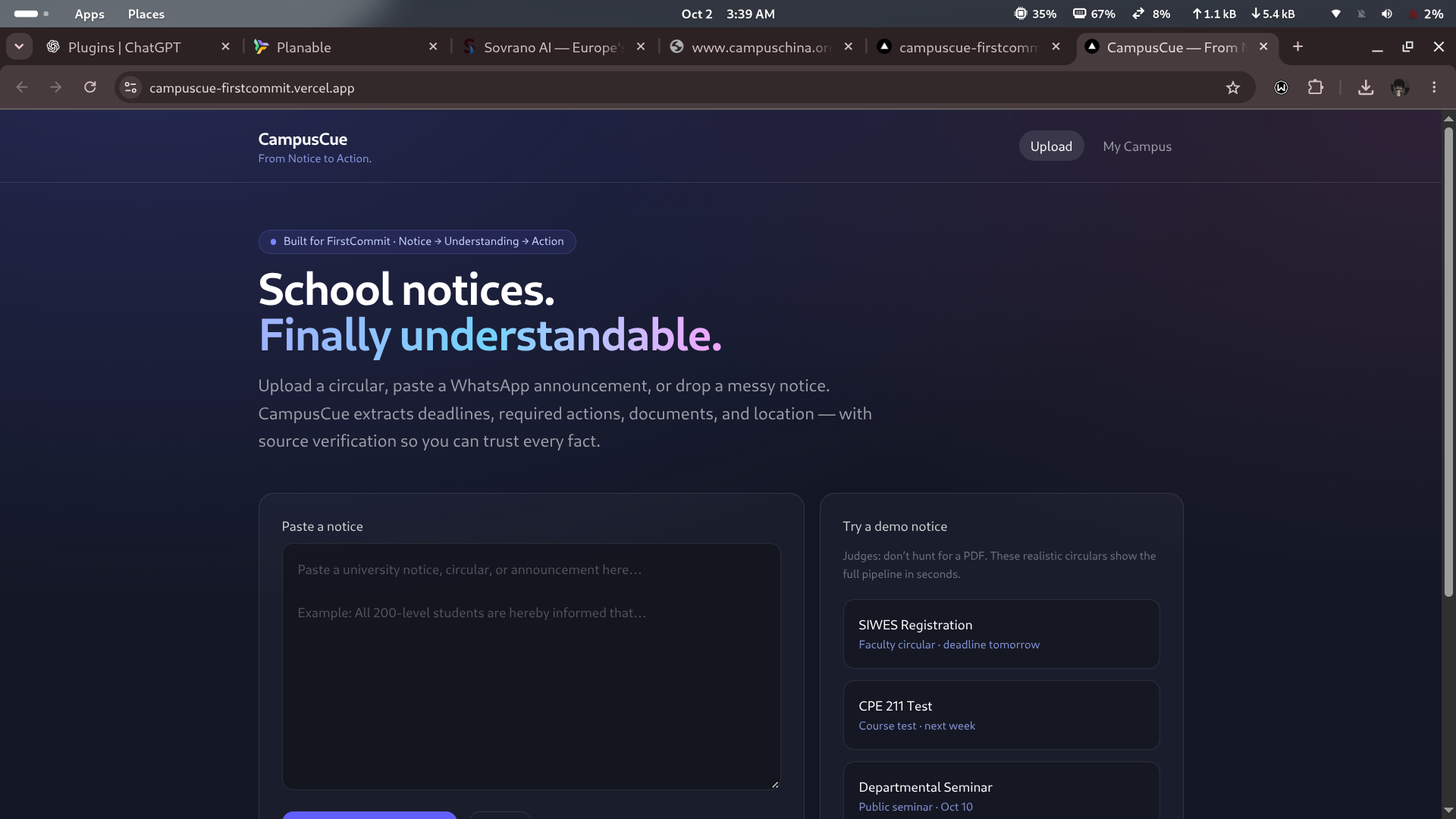
CampusCue — From Notice to Action.
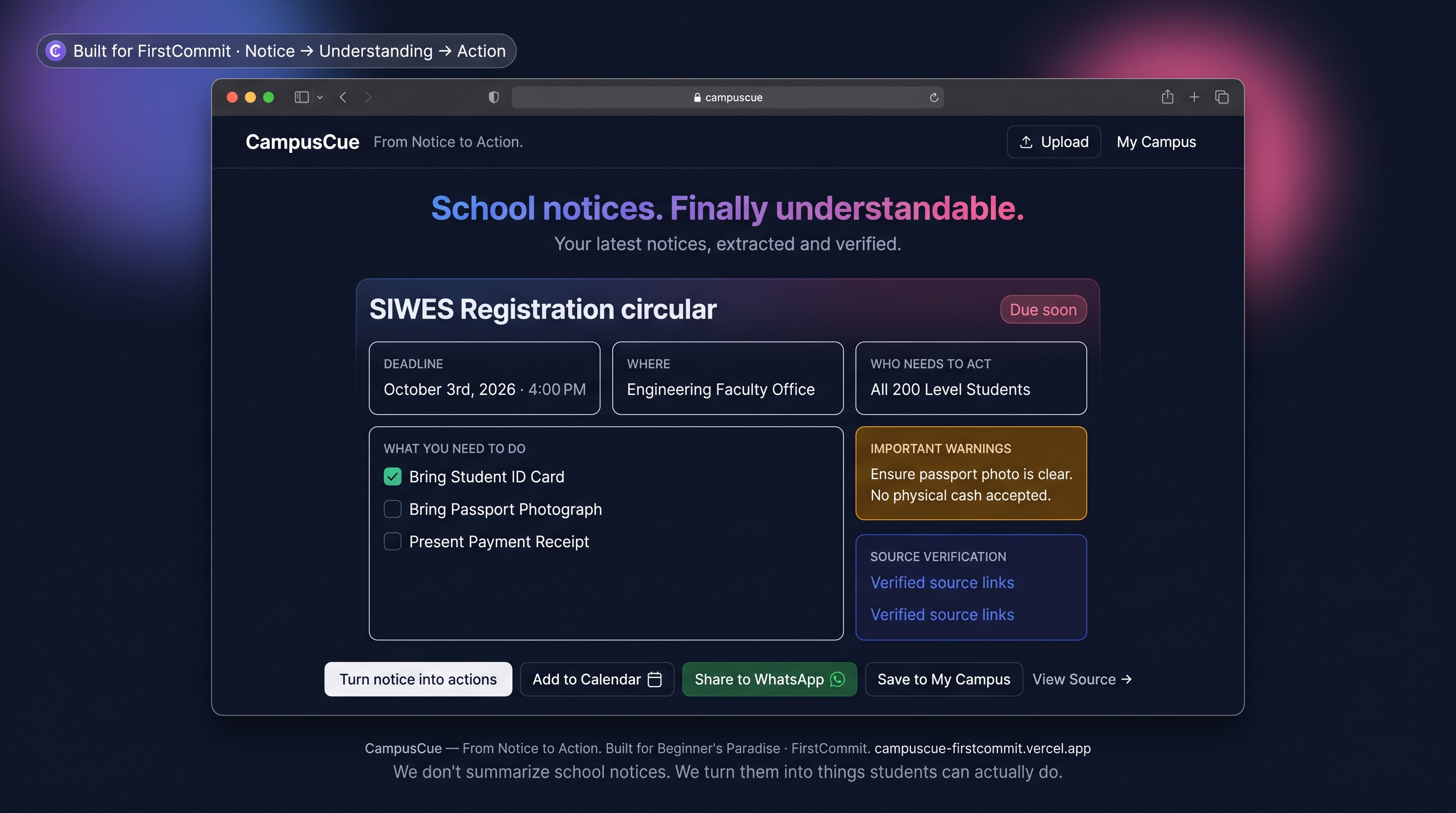
CampusCue turns confusing university notices into clear, actionable information.
Core loop:
Upload → Understand → Extract → Action → Remind → Share
What it does:
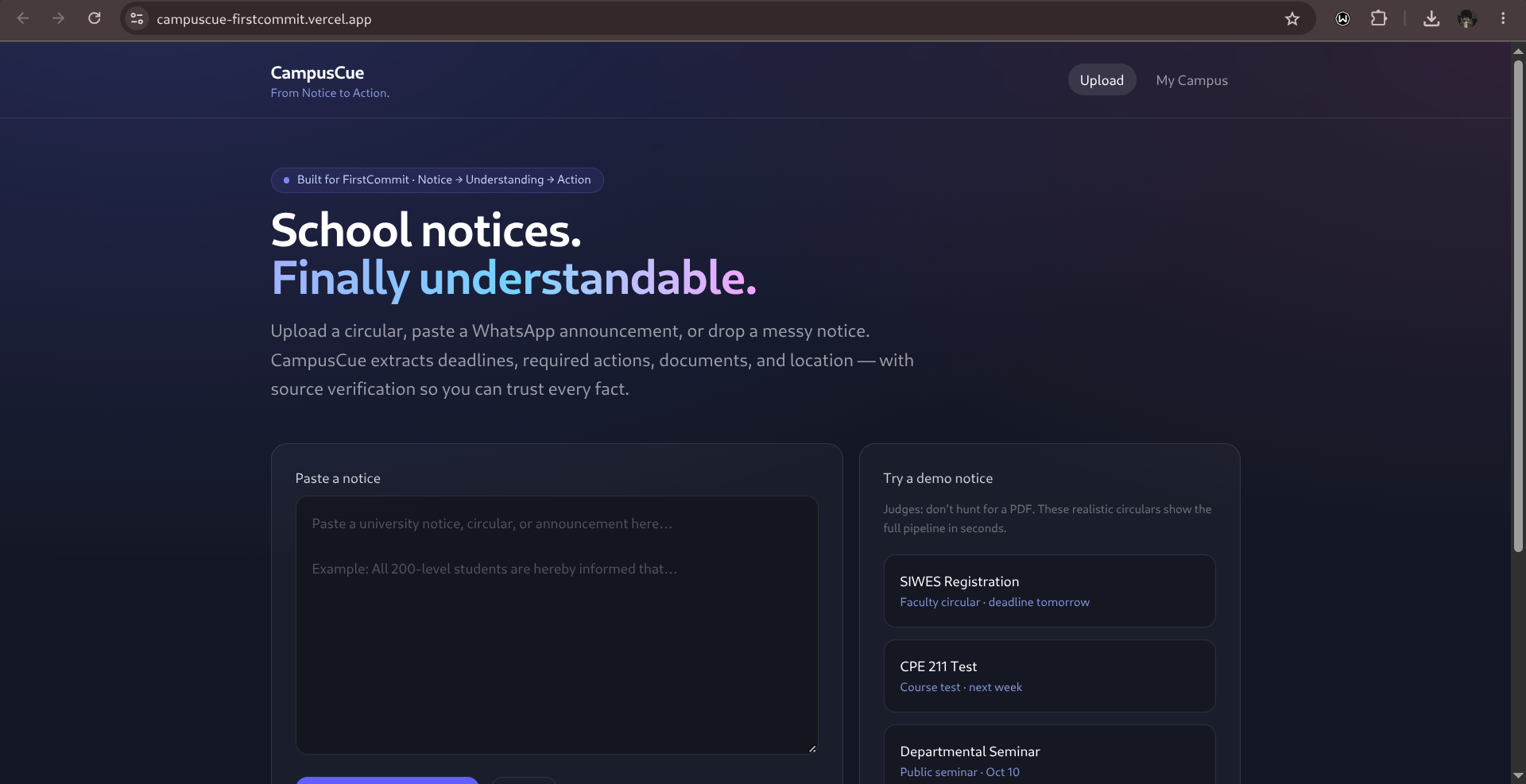
- Notice scanner — paste a circular, announcement, or load a realistic demo notice
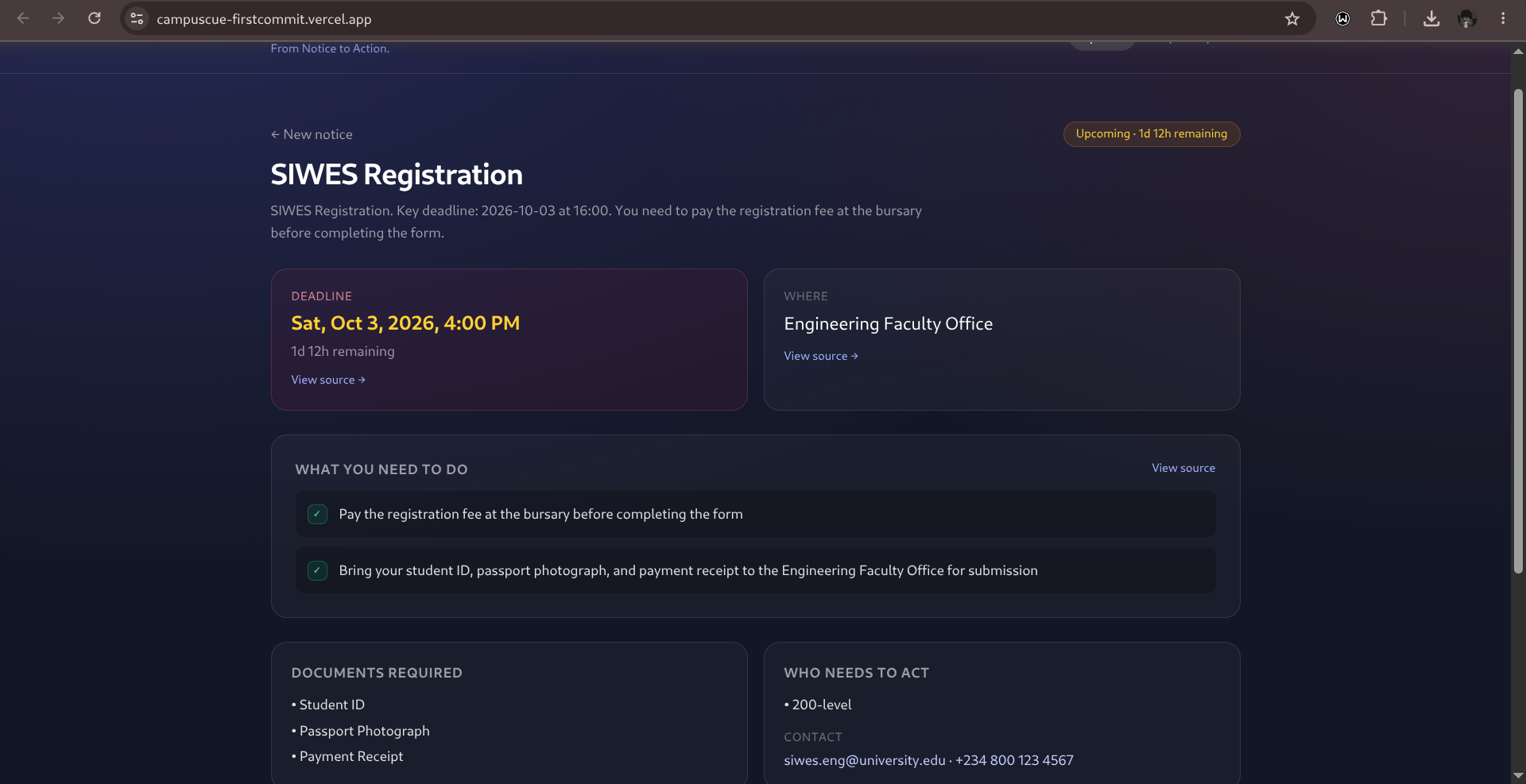
- Extraction — title, deadline, required actions, documents, location, audience, fees, contacts, warnings
- Action engine — turns the notice into a checklist students can actually follow
- Deadline intelligence — countdown + urgency (due soon / upcoming / expired)
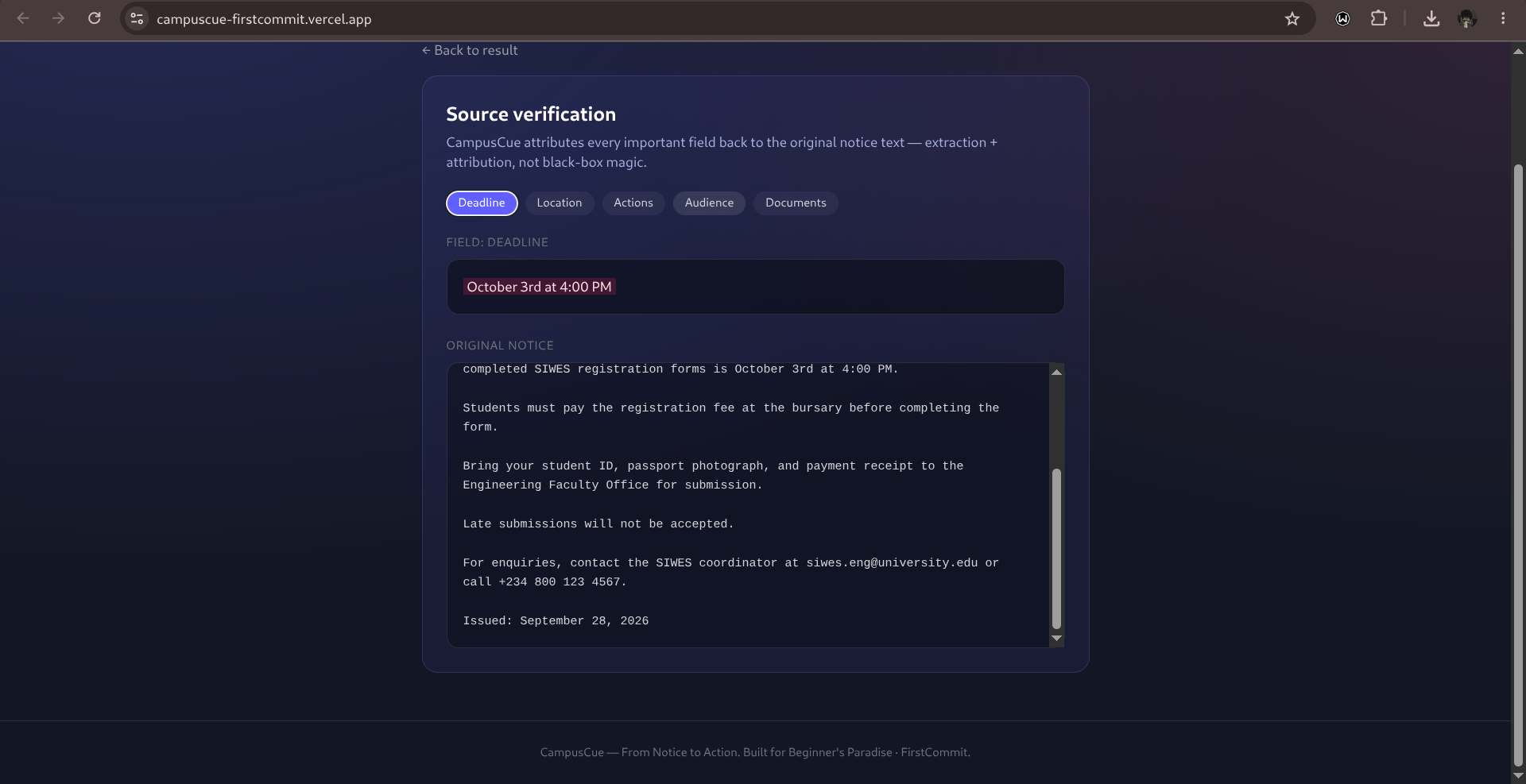
- Source verification — every key fact links back to the original sentence
- Calendar export — one click downloads a real
.icsfile - WhatsApp-ready share — copies a clean reminder for group chats
- My Campus — saved notices + deadline collision warnings when multiple events land on the same day
Positioning: CampusCue is not “another AI summarizer.” It turns institutional information into things students can actually do.
How we built it
Stack: Next.js 15 · React 19 · TypeScript · Tailwind CSS · localStorage · client-side iCalendar (.ics) generation
Architecture:
Paste / demo notice
        ↓
Heuristic extraction pipeline
(dates, actions, docs, audience, location)
        ↓
Structured JSON notice object
(+ source_evidence per field)
        ↓
UI renders actions / deadline / source
        ↓
.ics export · WhatsApp summary · localStorage
I designed a clear ExtractedNotice schema first, then built the parser, then the UI around that contract. Demo notices are seeded so the full pipeline is visible in seconds — judges never have to hunt for a PDF to understand the product.
Extraction is deterministic and offline-first:
- Dates:
October 3rd at 4:00 PM,Oct 7, 2026 at 10:00 AM,tomorrow at 5pm, slash dates, ISO-style - Actions: bullets + verbs like
must,should,bring,submit,pay,register - Documents, audience, location, fees, contacts, warnings via keyword + sentence rules
- Source evidence: the original sentence used for each important field
That means the core demo works without a live AI API — and the logic can be explained step by step instead of hidden in a black box.
Challenges we ran into
Messy real-world text
Notices don’t follow templates. Headers, paragraphs, bullet lists, and informal WhatsApp-style messages all mix together. I iterated the parser to handle both formal circulars and shorter announcements.Title and location noise
Early extraction grabbed the wrong lines (“Faculty of Engineering” instead of “SIWES Registration”). I refined ranking, keyword priority, and source-evidence rules so the demo output looks intentional and correct.Trust vs. convenience
AI-assisted extraction can be wrong. Instead of hiding that, I built View Source so every important field can be checked against the original notice. That became the product’s differentiator.Demo reliability under deadline pressure
A hackathon demo can’t depend on external API keys or flaky network calls. I made the pipeline local-first with seeded notices so the story always works on stage.Scope control
It was tempting to build a full student platform (auth, PDF OCR, notifications, accounts). I deliberately locked the MVP to one strong loop: notice → action → verify → remind → share.
Accomplishments that we're proud of
- A complete, working product — not a slide deck: paste notice → structured action plan → calendar file → shareable summary
- Source verification as a core feature — trust built into the product, not bolted on
- Deadline collision detection — CampusCue starts to feel like a student information layer, not a one-shot summarizer
- Explainable pipeline — schema, parser, UI, and export are modular and easy to walk through in a demo
- Demo-ready by design — seeded realistic notices (SIWES registration, course test, departmental seminar) so the transformation is obvious in the first 60 seconds
- Shipped with documentation — README with setup, architecture, AI disclosure, and credits
What we learned
This project was a steep learning curve in the best way:
- Structured data design — deciding what a “notice” is (schema) before writing UI made everything cleaner
- Heuristic extraction — teaching a parser to pull deadlines, actions, and locations out of messy English text
- Source attribution — making AI-assisted extraction trustworthy by always linking facts back to the original sentence
- Date normalization — converting relative and absolute dates into countdowns and calendar events
- iCalendar (
.ics) generation — enough of the format to produce real calendar files - MVP discipline — cutting features on purpose so the core loop could actually ship
- Shipping under pressure — prioritizing learning, clarity, and a reliable demo over feature count
What's next for CampusCue - From Notice to Action
CampusCue is the start of a student information layer, not a one-time AI tool.
Near term:
- PDF and image upload with client-side text extraction / OCR
- Optional AI enrichment targeting the same structured JSON schema
- Search, filters, and categories across saved notices
- Smart reminders before deadlines (not just calendar export)
- Share-to-WhatsApp deep links for student groups
Bigger vision: Instead of students juggling WhatsApp + PDFs + email + notice boards + Google Calendar, CampusCue becomes the place where announcements become:
Understandable → searchable → actionable → trackable.
The long-term goal is a semester-wide companion that understands institutional bureaucracy and turns it into clear next steps — for every department, every circular, every deadline.
Built With
- ai
- next.js
- typescript


Log in or sign up for Devpost to join the conversation.