Inspiration
Every year, billions of dollars in scholarships, grants, and financial aid go unclaimed — not because students don't qualify, but because they don't know the money exists. NYC college students face some of the highest costs of living in the country, yet the resources available to them are scattered across hundreds of websites, portals, and office bulletin boards.
We built CampusCompass because we've lived this problem. Finding financial support shouldn't require knowing the right person or spending hours Googling. It should take minutes.
What it does
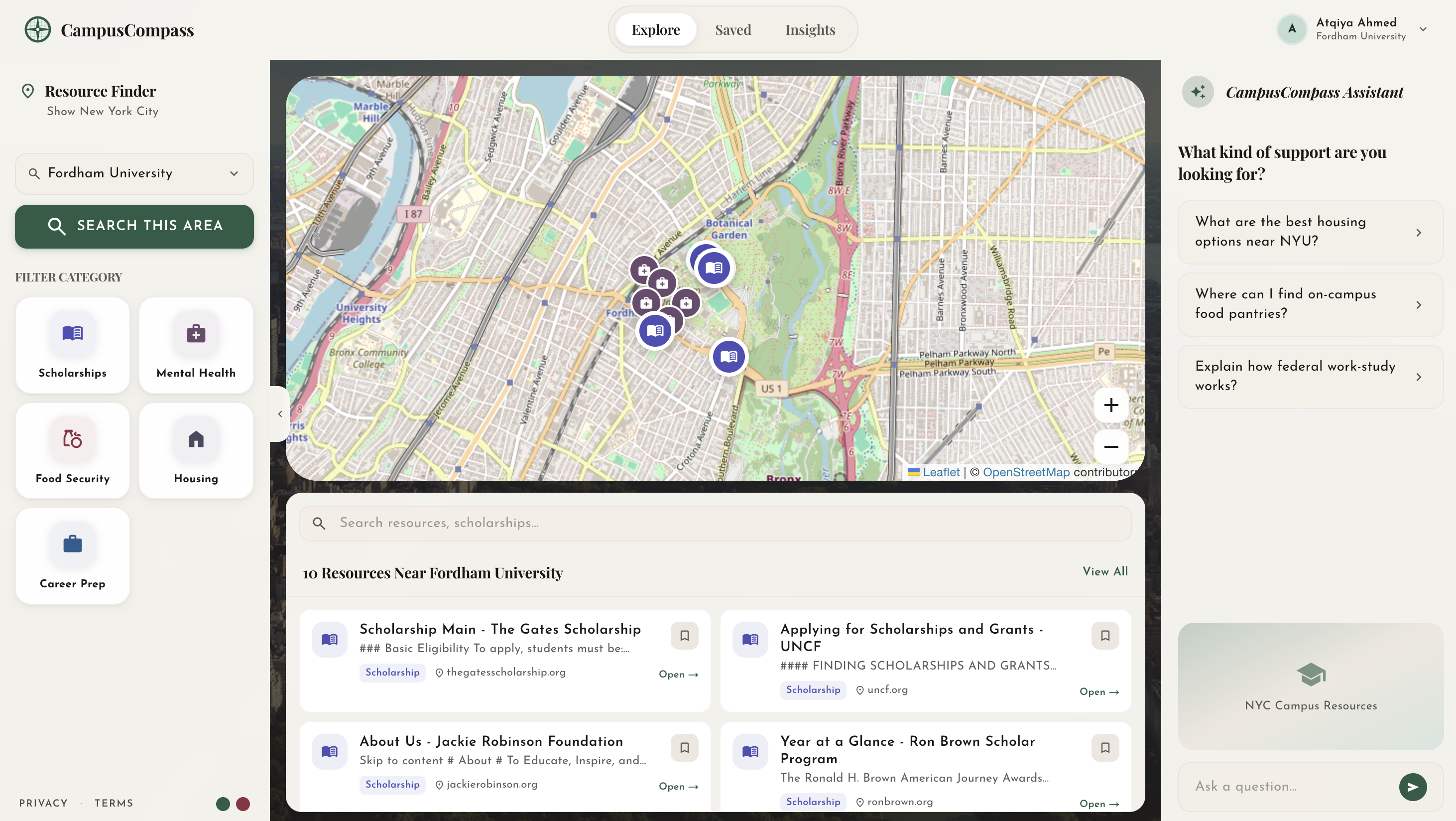
CampusCompass is an AI-powered financial navigator for NYC college students. Sign in once, tell us who you are, and instantly see a personalized interactive map of every scholarship, grant, food assistance program, housing resource, and career opportunity near you — filtered to your school, background, and identity.
- Personalized scholarship discovery — resources matched to your school, gender, and ethnicity
- Interactive map — every opportunity plotted by location across NYC's five boroughs
- AI financial mentor — ask natural language questions like "find grants for Latina women in nursing" and get real, sourced answers
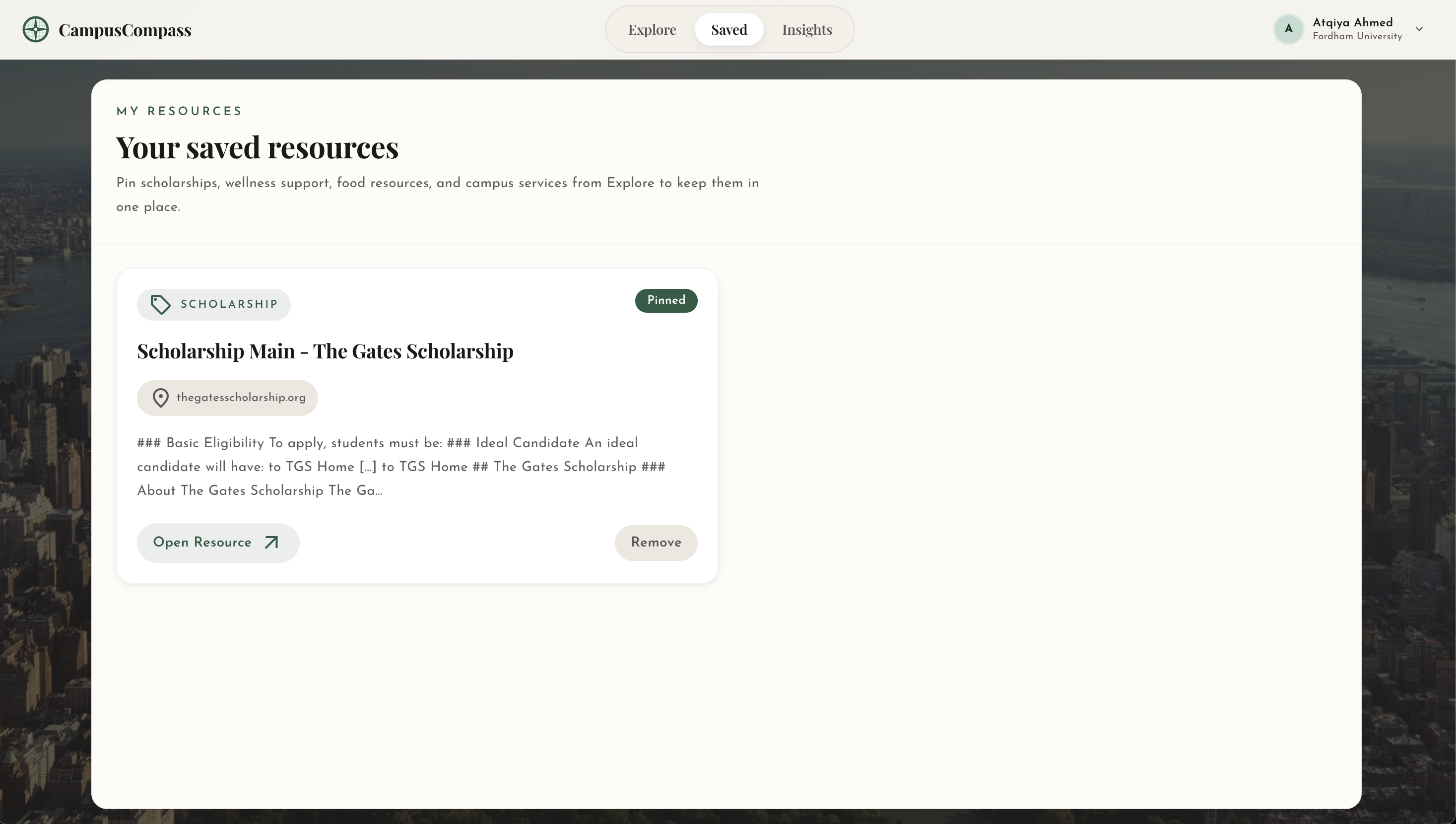
- Save & track — bookmark opportunities and revisit them anytime
- Insights dashboard — see where your opportunities are concentrated and what you haven't explored yet
How we built it
CampusCompass is built on Next.js 14 with a clean, modular component architecture. Authentication is handled by WorkOS AuthKit, giving us enterprise-grade SSO with zero custom login UI. User preferences are persisted locally and tied to the WorkOS user ID.
The resource discovery engine combines two AI layers:
- OpenRouter — routes queries to a language model that filters and personalizes a curated resource list based on the student's profile
- Tavily Search API — enriches results with live URLs, descriptions, and metadata from the real web
The interactive map is powered by React Leaflet with CartoDB Positron tiles
for a clean, on-brand look. The AI chat assistant calls our /api/chat endpoint,
extracts career and interest topics from the conversation, and automatically
re-queries /api/search to update the map in real time.
The frontend design system uses Tailwind CSS with a custom civic palette — warm off-whites, deep charcoals, and muted category accents — built to feel trustworthy and human rather than like a generic SaaS dashboard.
Challenges we faced
Real-time resource freshness was the hardest problem. Scholarship deadlines change, programs open and close, and URLs go stale. We used Tavily to pull live web data at query time rather than relying on a static database, which keeps results current without requiring manual curation.
Personalization without over-fitting — we wanted results that felt tailored without being so narrow that students missed opportunities. We tuned the OpenRouter prompt to balance specificity with breadth, always including a mix of identity-matched and general-eligibility resources.
Design for trust — financial aid is a high-stakes domain. Students need to trust the tool before they act on it. We invested heavily in the UI to feel intentional and credible rather than like a hackathon prototype.
What we learned
- Combining a semantic AI layer (OpenRouter) with a live search layer (Tavily) produces dramatically better results than either alone
- WorkOS makes production-grade auth accessible in a weekend build
- Design is a trust signal — especially for tools that touch students' finances
What's next
- Deadline tracking — push notifications when saved scholarships are closing
- Application assistant — AI drafts personalized scholarship essays based on the student's profile
- Counselor dashboard — let advisors see aggregate resource gaps across their student population
- Expand beyond NYC — the architecture scales to any metro area
Built With
- next.js
- openrouter
- react
- react-leaflet
- tailwind-css
- tavily
- typescript
- workos


Log in or sign up for Devpost to join the conversation.