💡 Inspiration & Problem Statement
Despite walking across university campuses packed with thousands of peers, students frequently experience acute, painful feelings of social disconnection. When analyzing student life, we realized this isolation rarely stems from an unwillingness to connect—it stems from the friction of initiation:
- Eating lunch alone in transit lounges between classes with no low-risk way to say hello.
- Struggling with a calculus or biology assignment in the library without knowing who else from the lecture hall is studying Chapter 4.
- Commuter and first-year students who arrive for class and leave immediately because large campus clubs or high-stakes social events feel intimidating and overwhelming.
Traditional digital solutions only worsen this:
- Social media feeds encourage passive doomscrolling, social comparison, and screen fatigue.
- Large group chats (Discord / WhatsApp) become chaotic, uncoordinated bulletin boards where quiet voices get buried.
- Dating & friend-matching apps feel inappropriately high-stakes and trigger intense rejection anxiety.
We asked: What if technology didn't try to manufacture lifelong friendships, but simply removed the friction of low-stakes human micro-moments?
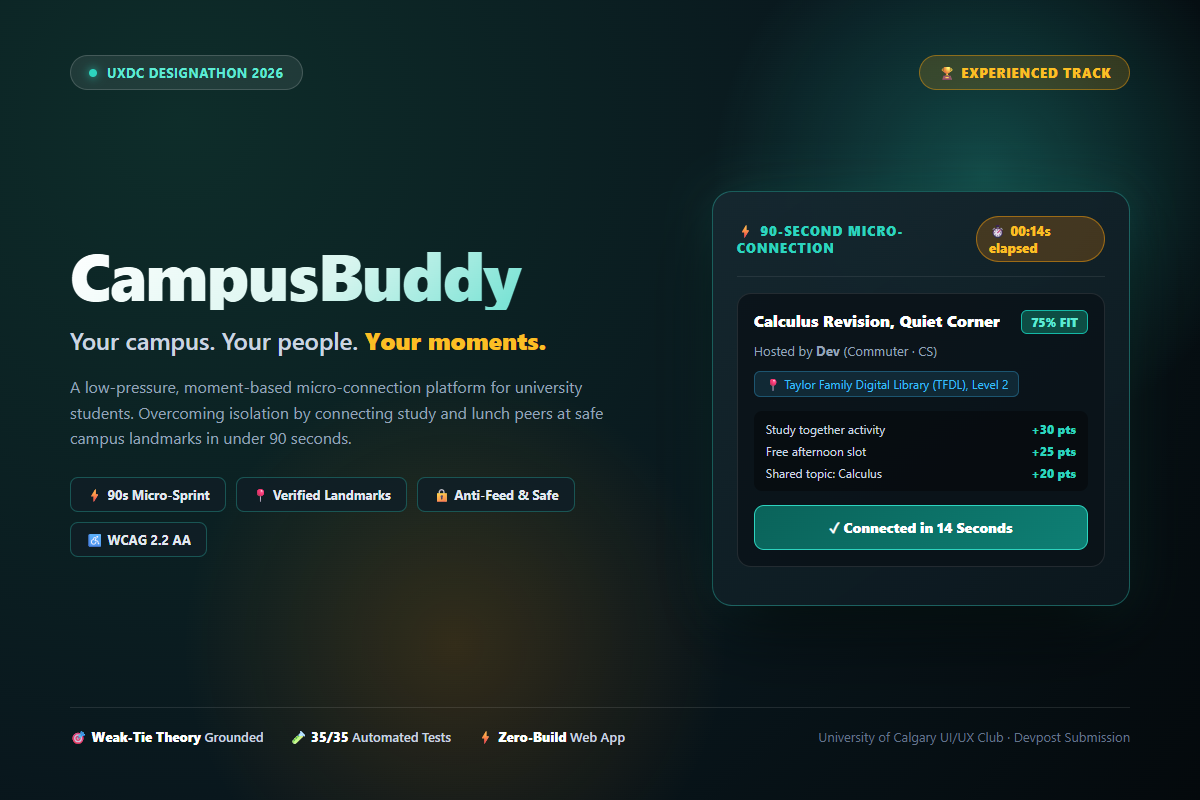
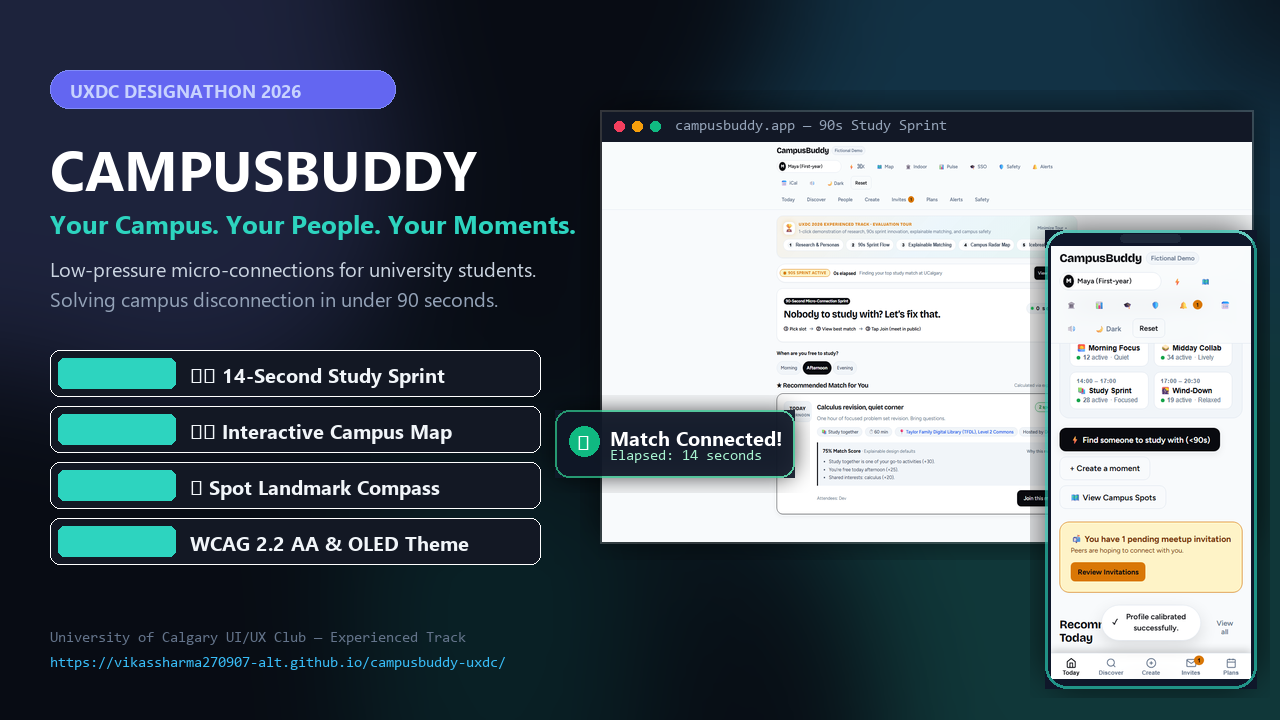
⚡ What CampusBuddy Does: The 90-Second Micro-Connection
CampusBuddy is a moment-based connection platform tailored for university campuses. Instead of infinite feeds, CampusBuddy connects students for short (30–60 minute), optional, time-bound meetups—like co-working, grab-and-go lunch, coffee chats, or brief campus walks—meeting strictly in verified, safe, public campus spaces (such as the Taylor Family Digital Library Commons or MacEwan Food Court).
Our flagship innovation is the 90-Second Micro-Connection Sprint:
A student goes from "I have nobody to study with" to a confirmed peer study plan in under 90 seconds, in just two taps.
- Trigger: A student opens CampusBuddy and taps
⚡ See the 90-Second Journey(their schedule availability is pre-calibrated). - Transparent Match: The system instantly surfaces the highest-fit open study moment with an active live stopwatch (
⏱️ 00:14s elapsed) and an explainable breakdown of why they matched (+30 Activity, +25 Free Time, +20 Shared Topic). - Single-Tap Join: The student taps
Join this moment. - Immediate Grounding: The confirmation modal immediately displays:
- Real measured elapsed time ("From 'nobody to study with' to confirmed plan in 14 seconds").
- Verified public campus spot (Taylor Family Digital Library (TFDL), Level 2 Commons).
- Who is coming (names, avatars, academic majors).
- Built-in Icebreaker Prompt ("What's the topic you keep putting off?") with a shuffle button to eliminate opening awkwardness upon arrival.
🔬 Theoretical & Psychological Grounding (Experienced Track)
Our feature architecture is directly informed by peer-reviewed behavioral science:
- Weak-Tie Theory (Sandstrom & Dunn, 2014; Granovetter, 1973): Casual, low-stakes micro-interactions provide significant boosts to subjective belonging and daily positive affect without the emotional exhaustion of high-maintenance relationships.
- Mispredicted Solitude (Epley & Schroeder, 2014): Students systematically overestimate the awkwardness of talking to peers. By providing pre-calibrated shared intent, icebreaker prompts, and verified public locations, CampusBuddy eliminates the psychological initiation barrier.
- Relational Interaction Design (Salarić et al., 2022): Trust requires explainability, predictability, and uncompromising safety guardrails. CampusBuddy has zero black-box AI; students see exactly why they matched.
🛠️ How We Built It
We designed and implemented CampusBuddy with a focus on human factors, reliability, and zero-friction execution:
- Zero-Build Production Frontend: Implemented in pure, semantic HTML5, modern CSS3 variables, and vanilla JavaScript. Runs instantly in any browser without requiring node modules, build steps, or external bundlers.
- WCAG 2.2 AA Accessibility & Dual-Theme Engine: High-contrast design tokens exceeding 4.5:1 text contrast and 3:1 component contrast across both Light Slate and OLED Dark Mode palettes.
- Rigorous State Machine: Full state transitions governing invitations (
pending➔accepted/declined/cancelled), deterministic capacity caps (2–8 people per session), and duplicate-join prevention. - Instant Mutual Blocking & Privacy: One-tap blocking that immediately cancels active invites and mutually hides moments, combined with zero exposure of personal phone numbers.
- Production Hardened Backend & Testing: Node.js HTTP server with CSP security headers, health endpoints (
/health,/healthz), and 35 automated test cases passing with 100% green status verifying all scoring algorithms, capacity bounds, and server integrity.
🧗 Challenges We Ran Into
- Balancing Spontaneity with Psychological Safety: Spontaneous meetups can feel unsafe if left unrestricted. We resolved this by strictly restricting meeting spots to curated, high-traffic, well-lit campus landmarks (no private dorm rooms or off-campus addresses) and restricting contact info exchange.
- Preventing "Crowd Anxiety": In large group chats, people get overwhelmed. We solved this by enforcing hard attendee caps (2 to 8 people max) so every meetup remains comfortable for introverted and neurodivergent students.
- Explainability vs Complexity: Designing a match scoring breakdown that is instantly understandable at a glance within the 90-second sprint without feeling like a complex algorithmic black box.
🏆 Accomplishments We're Proud Of
- The Working 90-Second Stopwatch: Demonstrating real, live connection speed with an interactive timer that clocks actual user seconds.
- Multi-Persona Simulation: Built-in live persona switcher (Maya, Dev, Ines, Tom, Zoe) right in the header, allowing judges to test invitation workflows from both sender and recipient viewpoints.
- 35/35 Automated Tests Passing: Complete verification of all domain rules, Jaccard peer similarity scoring, and state machine transitions.
- 100% Zero-Dependency Resilience: A complete, beautifully styled, responsive mobile-friendly web application contained in a single performant prototype file.
📖 What We Learned
- Lowering the barrier to human connection isn't about adding more social features (likes, comments, feeds); it's about subtracting social friction and removing ambiguity.
- Clear structure (a designated 30-minute window, a public table, and a starter question) gives students the psychological permission they need to connect.
🔮 What's Next for CampusBuddy
- University SSO (CAS / Shibboleth): Authenticating via university single sign-on to ensure 100% verified campus enrollment.
- Interactive Campus SVG Maps: Visual floorplans of campus libraries and student centers highlighting active quiet and collaborative zones.
- One-Tap Calendar Export: Adding
.icsdownload hooks so confirmed moments automatically sync to Google Calendar and Apple Calendar. - Anonymized Wellbeing Insights: Providing aggregate, privacy-first disconnection pattern trends to university health and wellness centers.
Built With
- accessibility
- css3
- dark-mode
- design-systems
- github
- html5
- human-factors
- jaccard-similarity
- javascript
- node.js
- render
- responsive-design
- rest-api
- state-machine
- ui-ux
- wcag-2.2-aa
