-
-
01_campus-ai_project-overview
-
02_campus-ai_dashboard
-
03_campus-ai_ask
-
04_campus-ai_companies
-
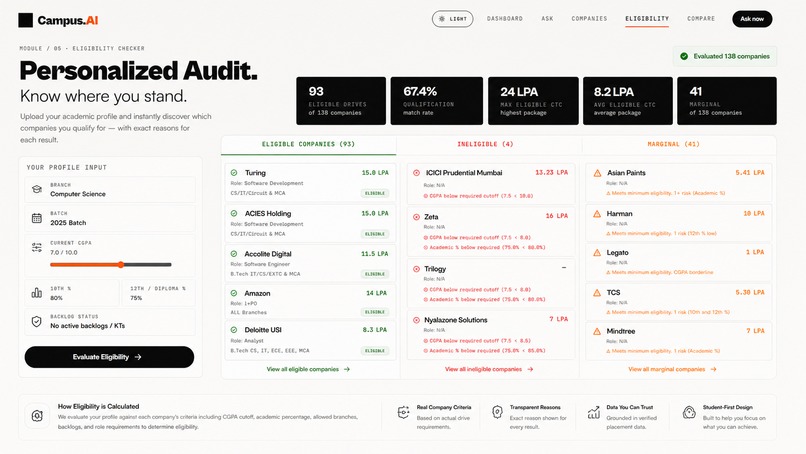
05_campus-ai_eligibility
-
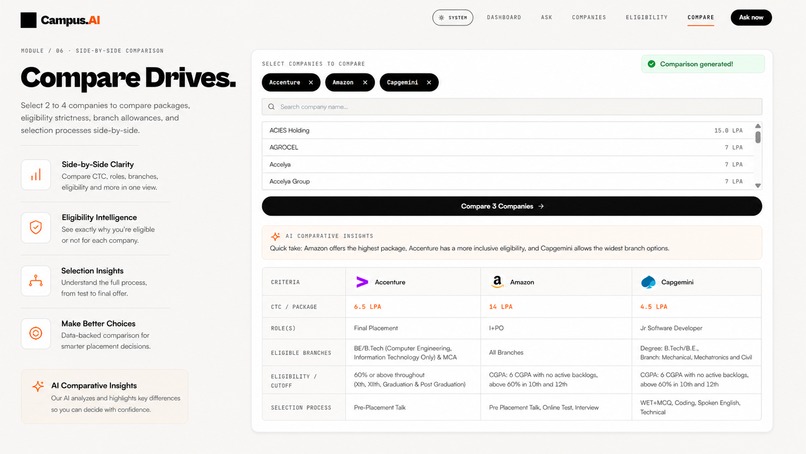
06_campus-ai_compare
-
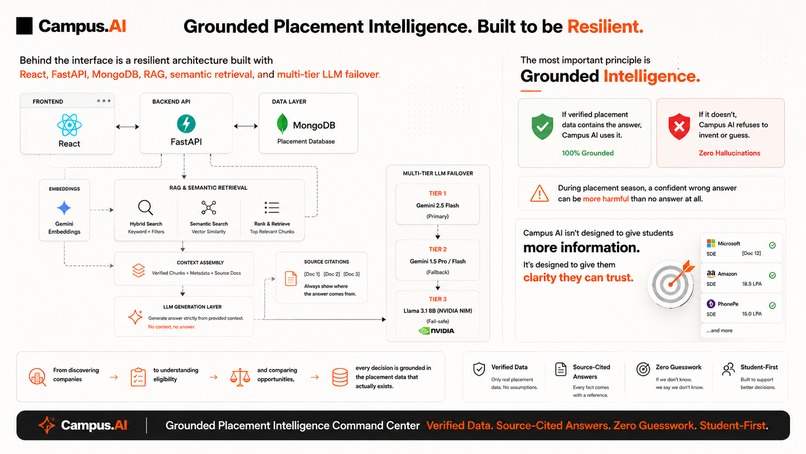
07_campus-ai_architecture-grounded-intelligence
-
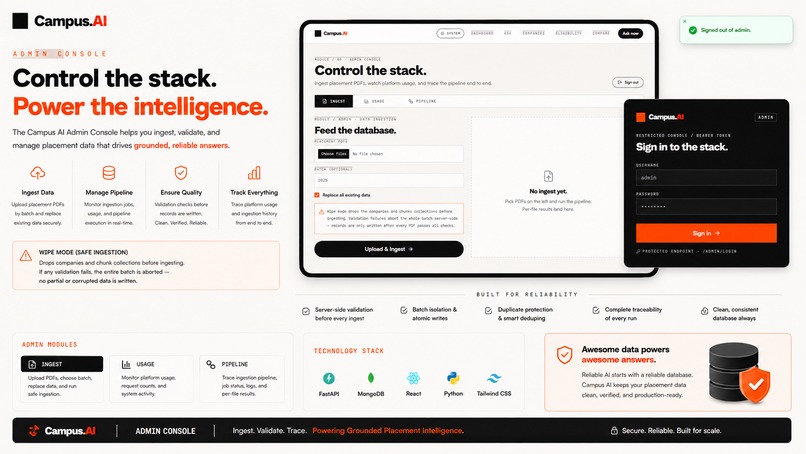
08_campus-ai_admin-panel
-
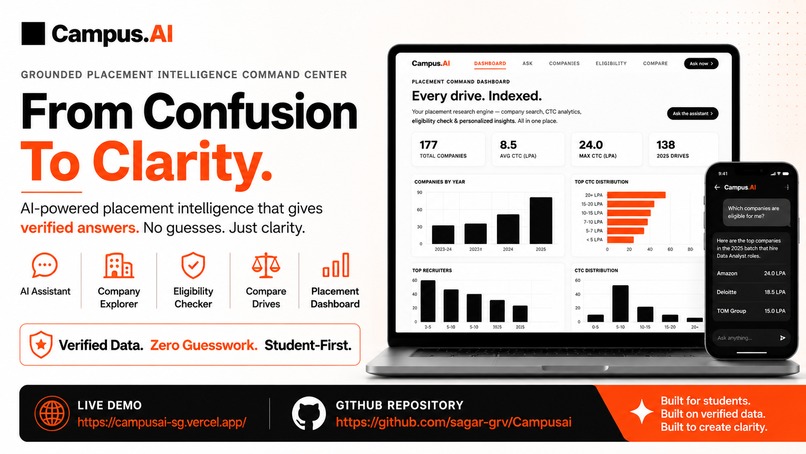
09_campus-ai_project-Thumbnail
Inspiration
Every placement season, students face the same problem: information is everywhere, but clarity is nowhere.
Placement brochures contain eligibility rules, CGPA cutoffs, branch restrictions, backlog policies, CTC structures, roles, and selection processes. But this information is often buried across PDFs and documents, making it difficult for students to determine what actually applies to them.
The problem becomes even more serious when students turn to generic AI assistants. A language model may confidently provide a salary, eligibility rule, or company requirement that was never present in the actual placement data.
We built Campus AI around a simple principle:
Students don't need more information. They need clarity they can trust.
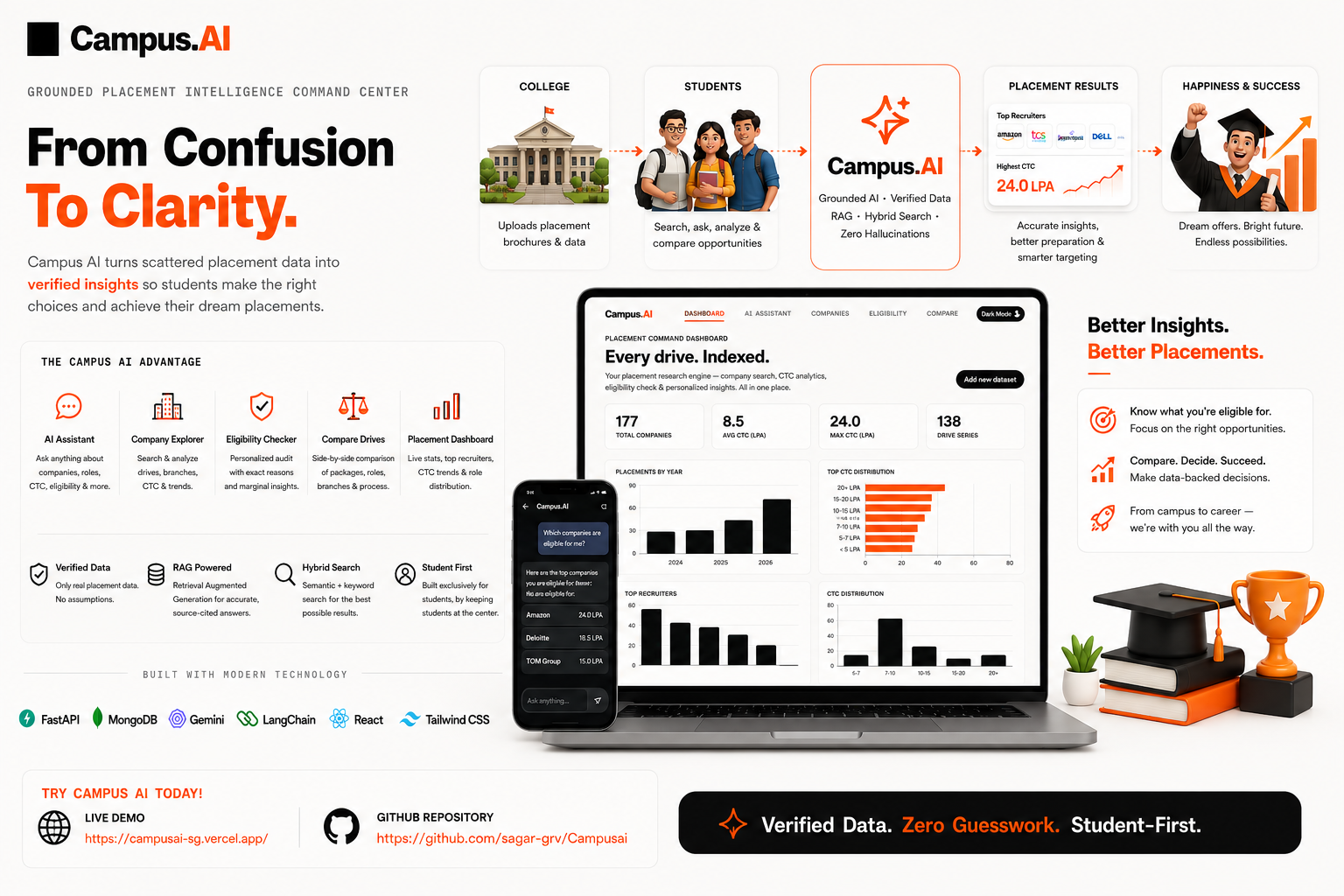
Campus AI transforms verified placement records into a student-first intelligence layer where students can discover companies, ask grounded questions, audit their eligibility, and compare opportunities without relying on guesswork.
What it does
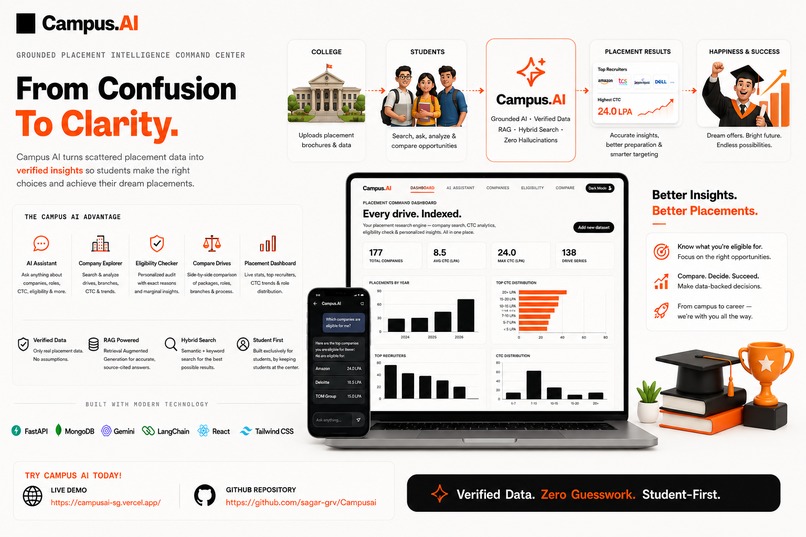
Campus AI — Grounded Placement Intelligence Command Center is an AI-powered placement research and decision-support platform.
It provides six interconnected capabilities:
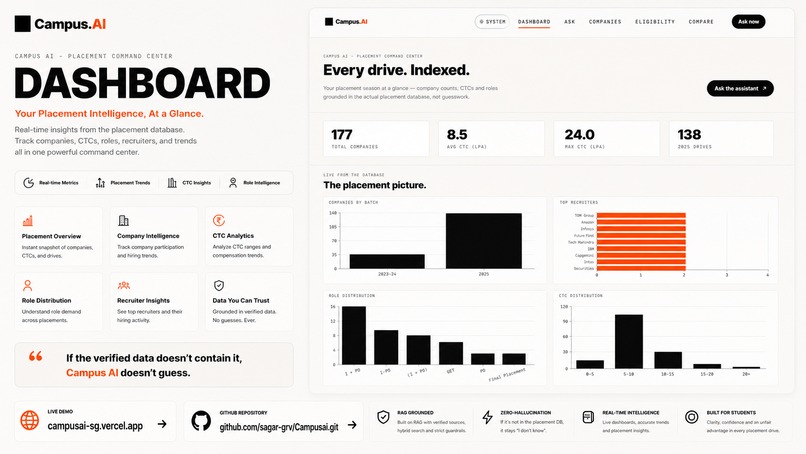
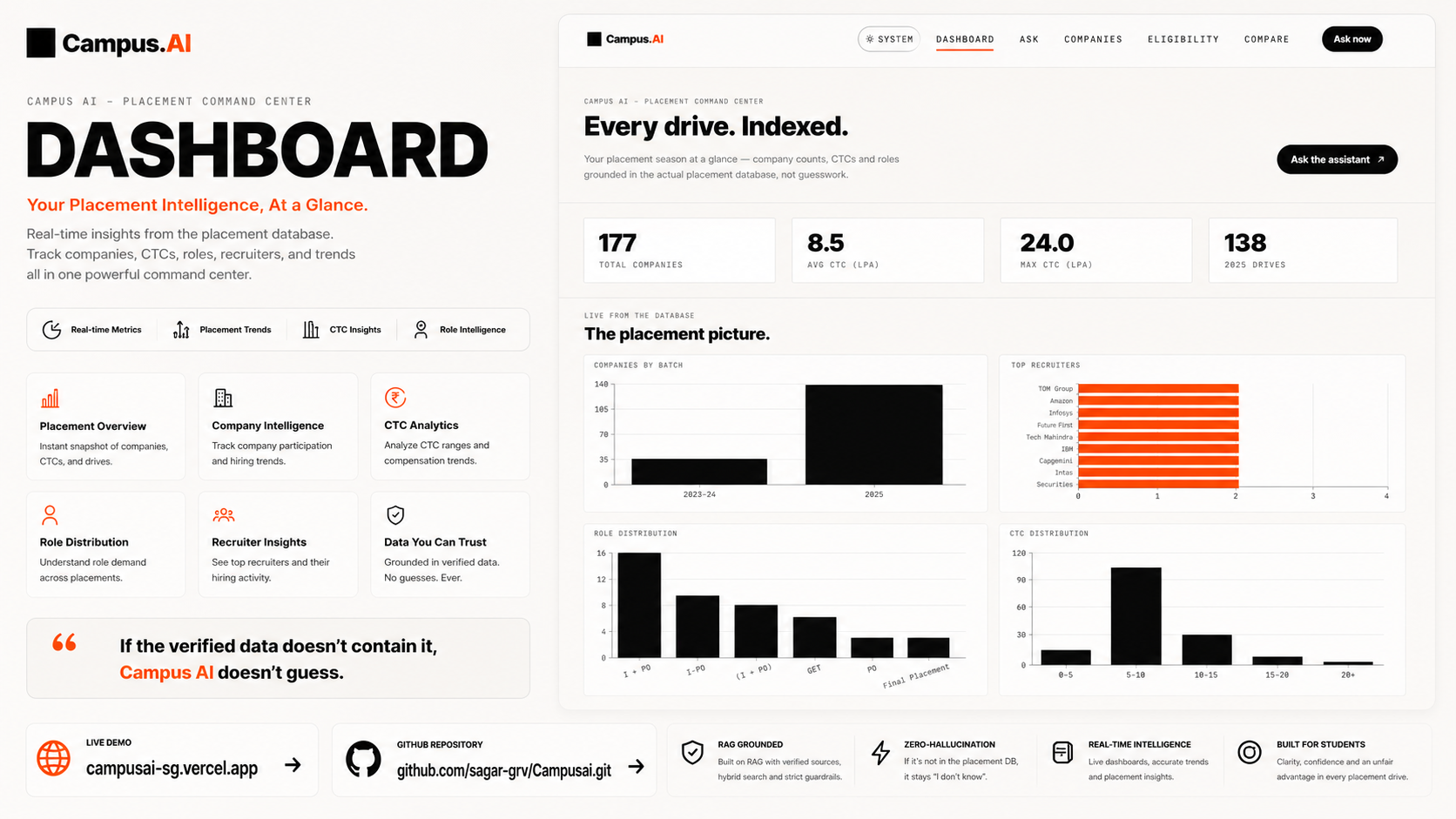
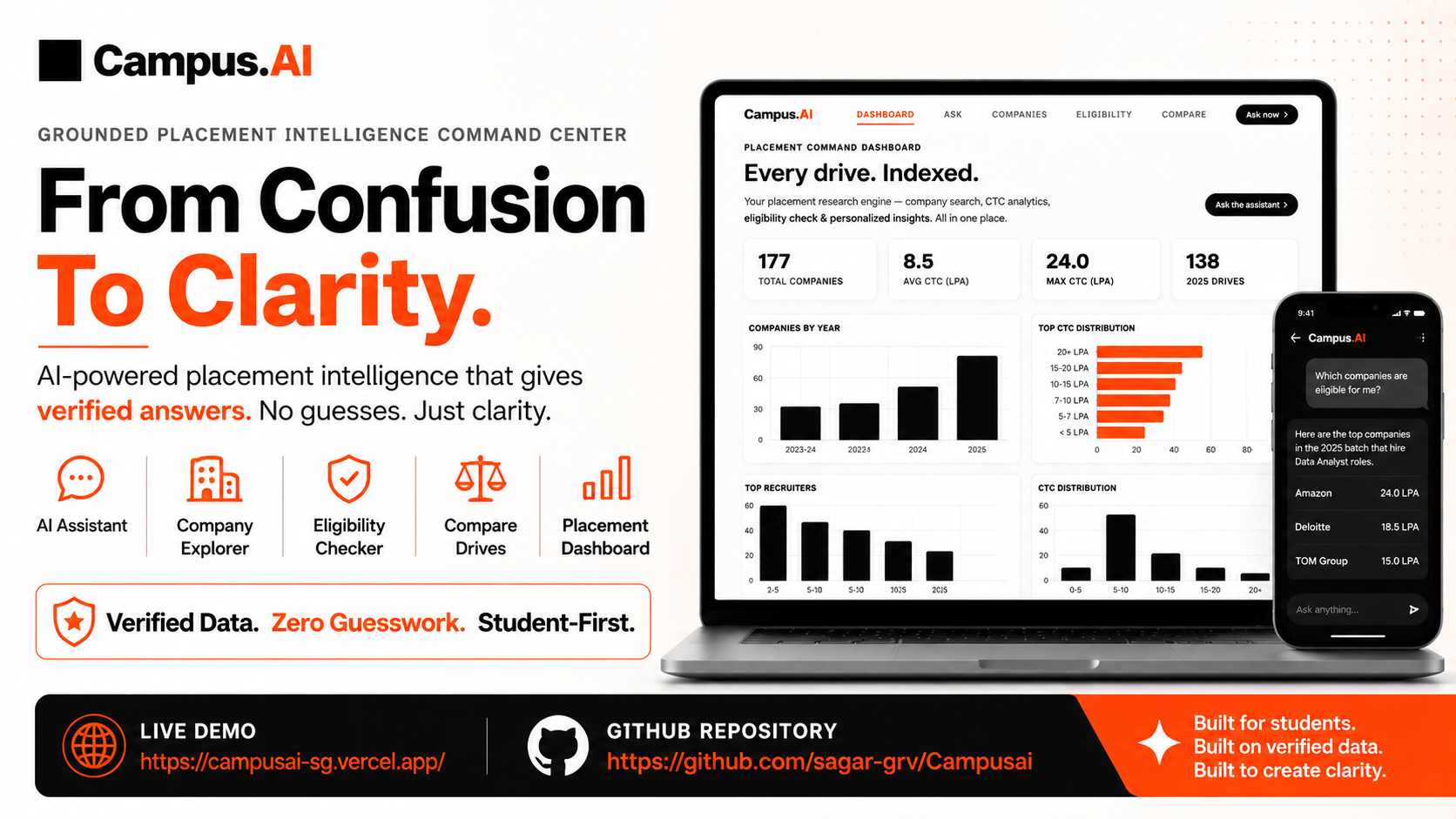
- Placement Command Dashboard — Gives students an overview of companies, placement drives, average and maximum CTC, recruiters, roles, and compensation distribution.
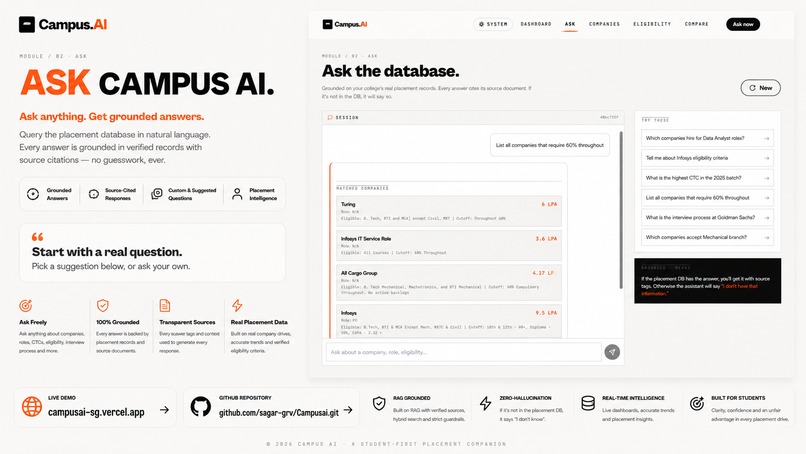
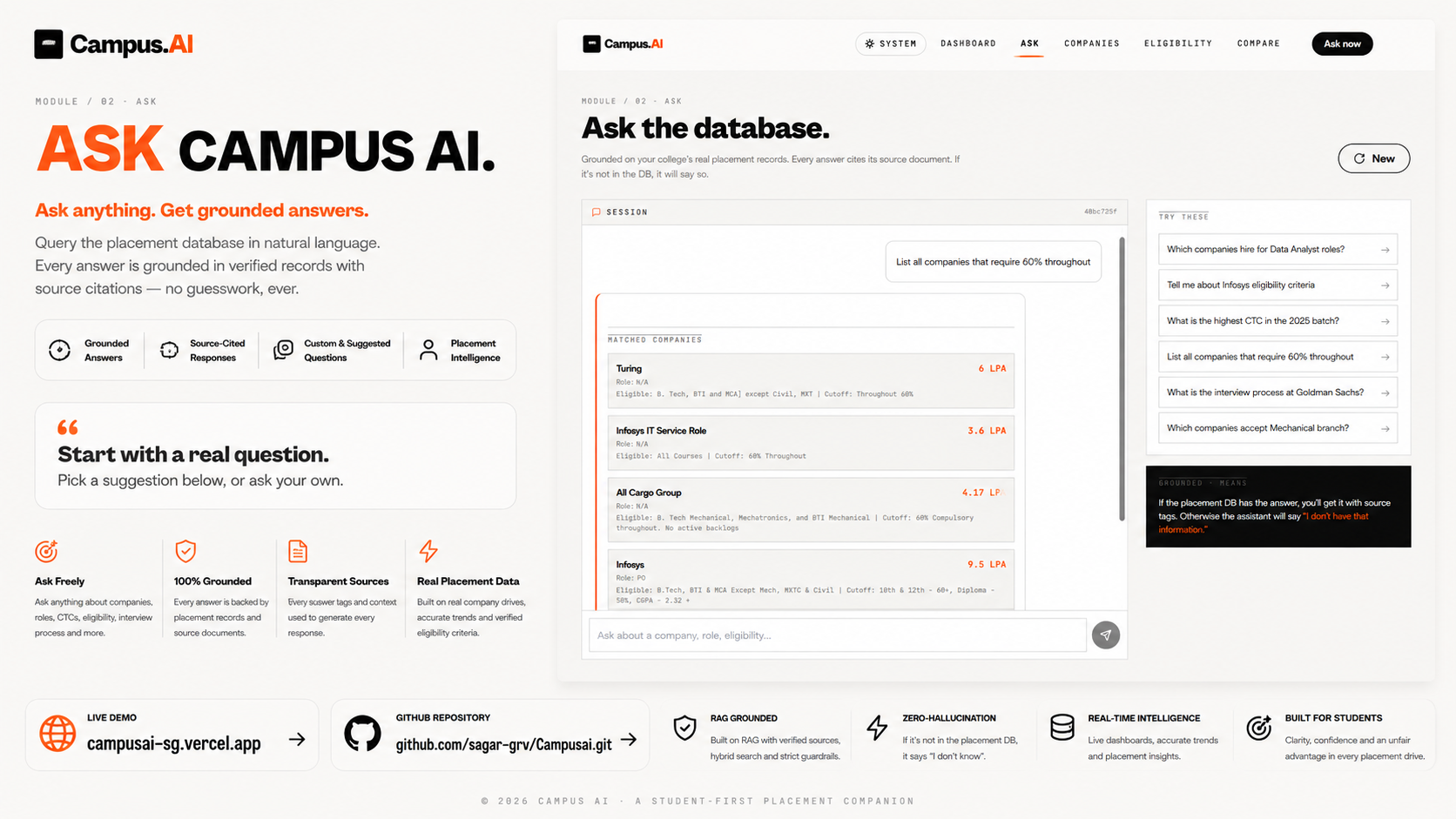
- Grounded AI Assistant — Allows students to ask natural-language questions about placement data using RAG, hybrid retrieval, semantic similarity, and source citations.
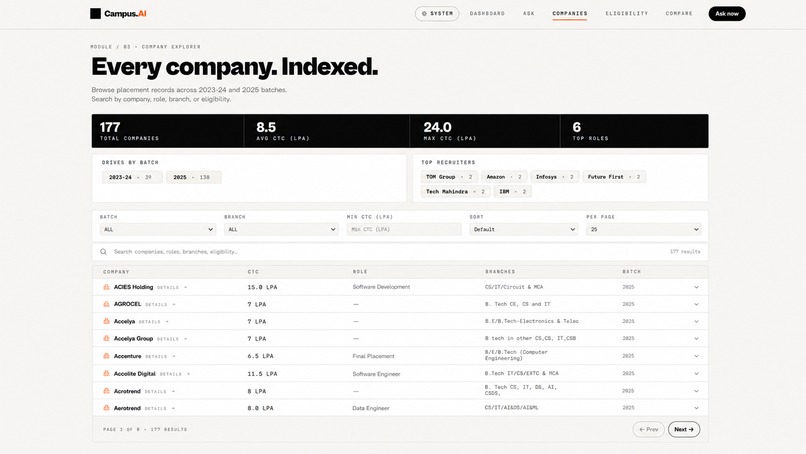
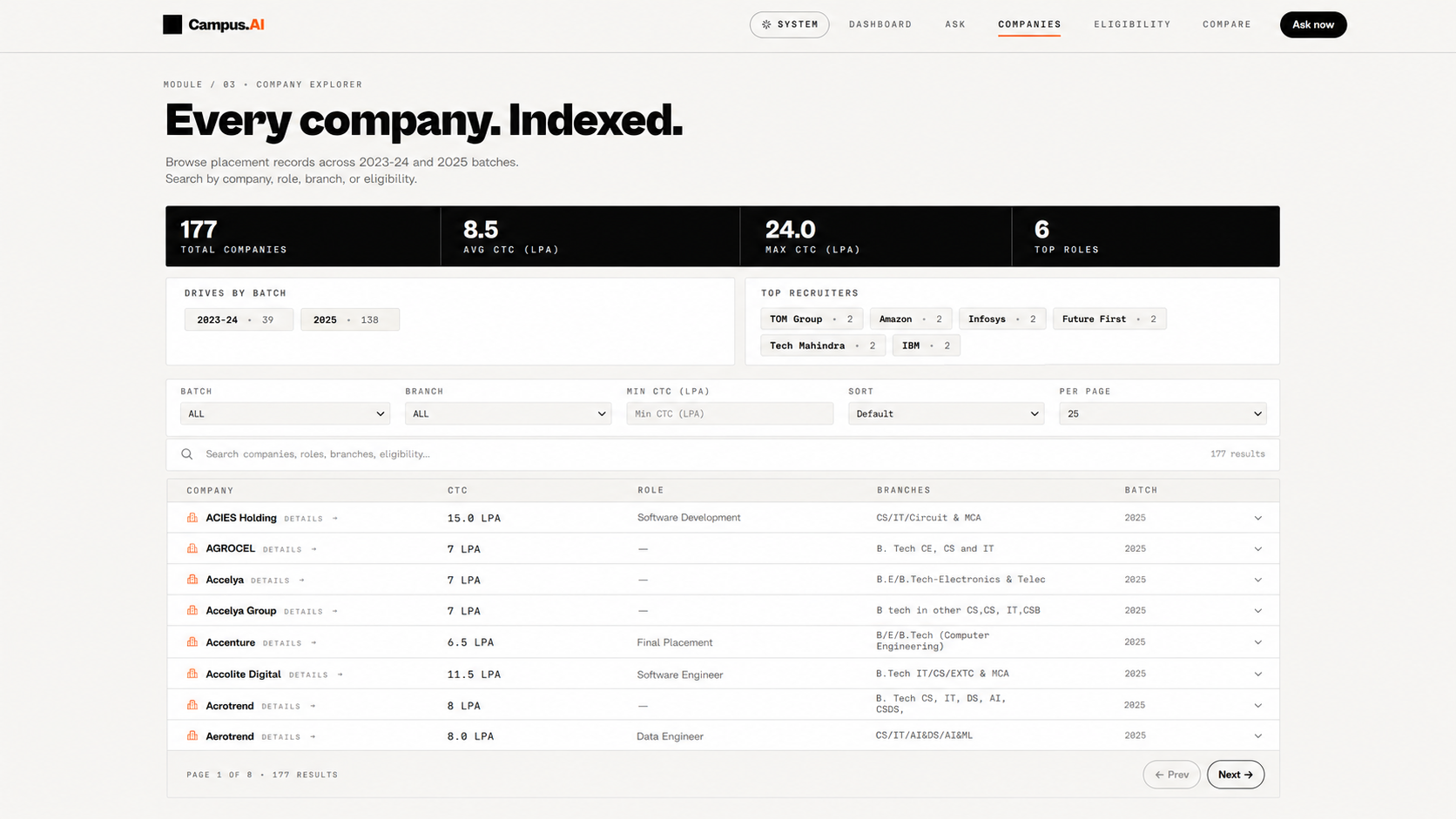
- Company Explorer — Provides searchable and filterable access to placement drives across batches, branches, CTC ranges, roles, and other attributes.
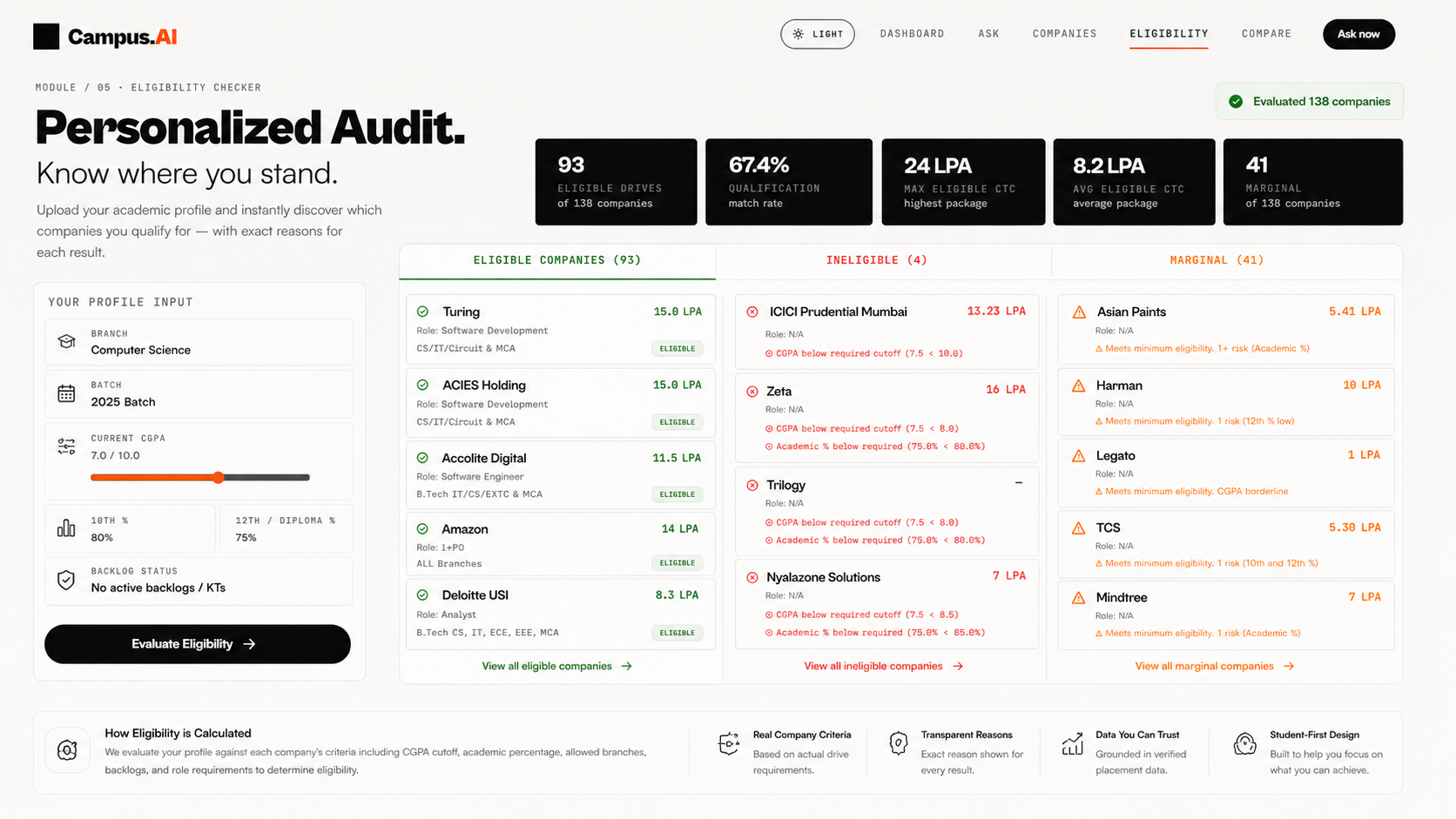
- Personalized Eligibility Auditor — Evaluates a student's CGPA, branch, academic percentages, batch, and backlog status against company-specific requirements.
- Eligible / Marginal / Ineligible Analysis — Explains not only whether a student qualifies, but also why they may be disqualified or close to qualifying.
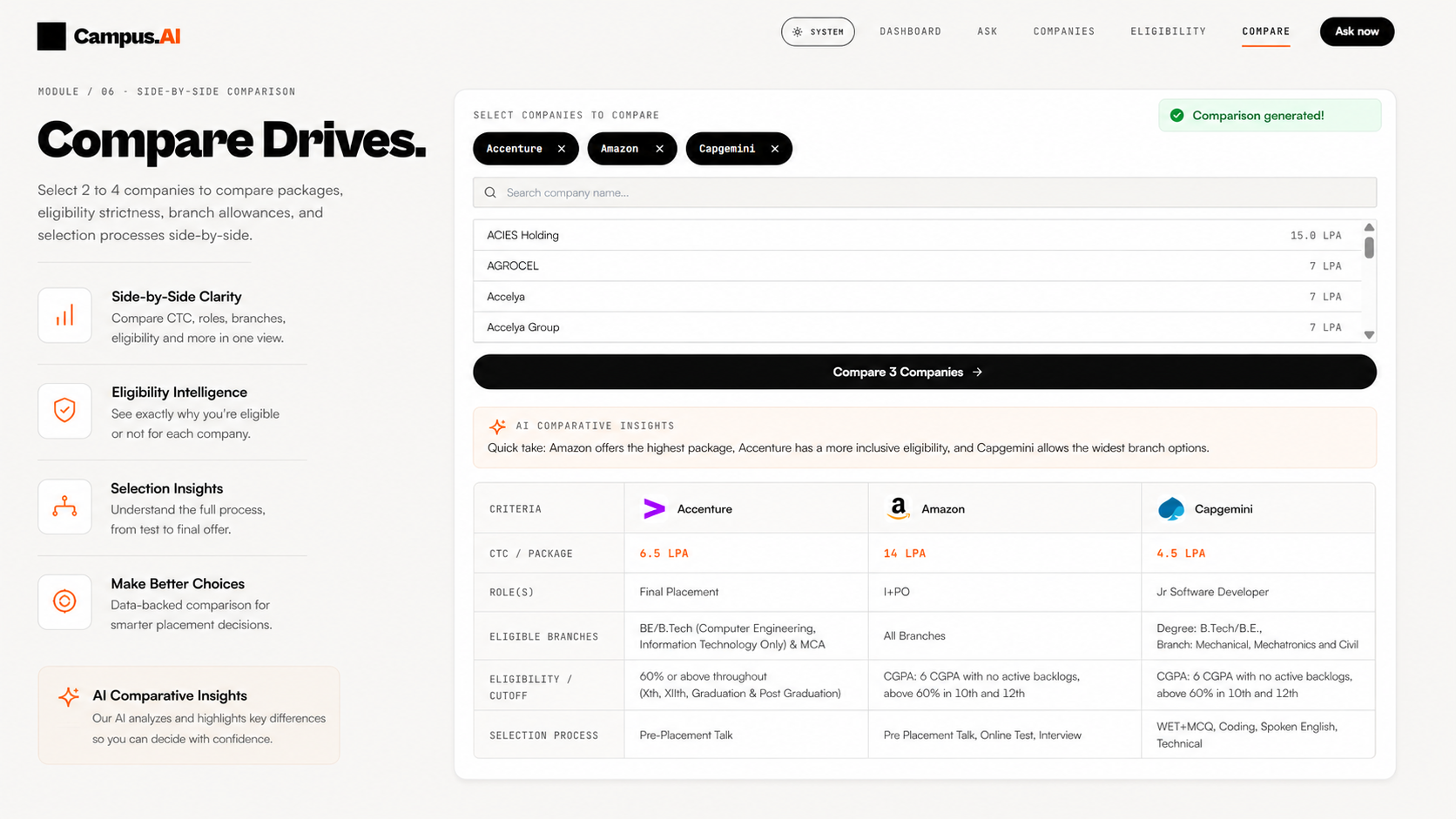
- Side-by-Side Company Compare — Lets students compare 2–4 placement drives across CTC, roles, branches, eligibility requirements, and selection processes.
The most important feature is the platform's grounding principle:
If the verified placement data doesn't contain it, Campus AI doesn't guess.
How we built it
Campus AI was designed as a full-stack AI system rather than simply connecting a chatbot to a database.
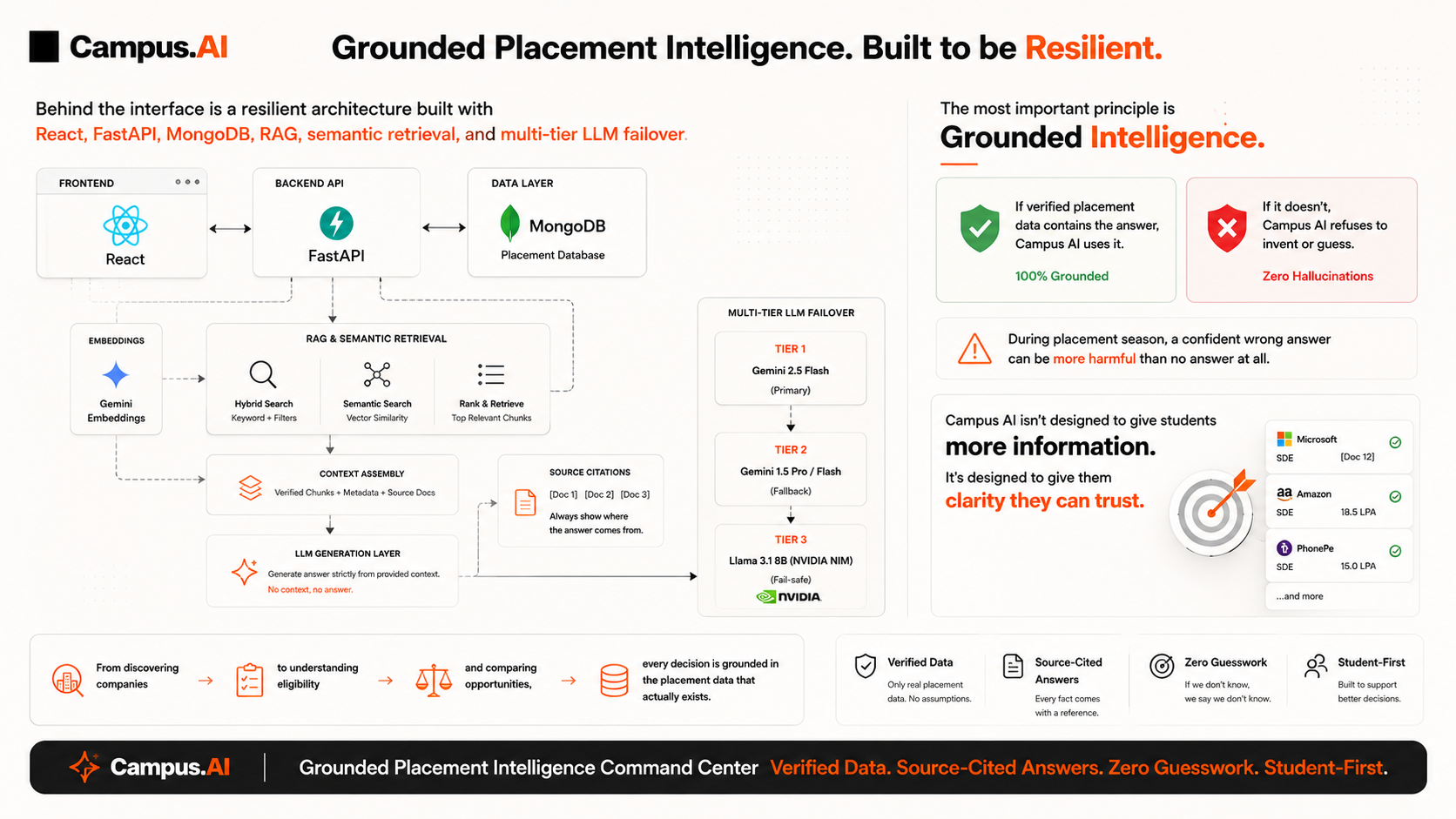
The frontend was built with React and Tailwind CSS, while FastAPI powers the backend APIs and application logic. Placement records are stored and queried through MongoDB.
For the AI Assistant, we built a Retrieval-Augmented Generation pipeline that combines structured retrieval with semantic similarity. Gemini embeddings are used to represent placement information, allowing relevant records to be retrieved before the language model generates an answer.
The retrieval pipeline follows a simple flow:
User Question → Retrieval → Relevant Placement Records → Context Assembly → LLM → Source-Cited Answer
We also implemented a multi-tier LLM failover architecture. Gemini serves as the primary model, with fallback models available when the primary provider reaches availability or quota limitations.
The eligibility engine works differently from the conversational AI. Instead of asking an LLM to determine eligibility, it evaluates structured student information against the actual eligibility rules stored in the placement data.
This allows Campus AI to separate results into:
Eligible → Marginal → Ineligible
The system also includes security and reliability measures such as endpoint-level rate limiting, prompt-injection protection, credential sanitization, and strict grounded refusal behavior.
Challenges we ran into
The biggest challenge was not building a chatbot. It was making the system trustworthy.
Placement data contains inconsistent formats, different terminology, varying eligibility rules, compensation structures, branch names, and backlog policies. Converting this information into a consistent dataset required careful normalization.
Another major challenge was preventing hallucinations. A normal LLM can produce a convincing answer even when the underlying information doesn't exist. We therefore designed the assistant around retrieval first and generation second.
Eligibility was another difficult problem. Simply checking a CGPA is not enough. Companies may have requirements involving branches, 10th and 12th percentages, graduation criteria, backlogs, or combinations of multiple conditions.
We also had to design the system to remain usable when AI providers become unavailable or reach their limits. This led to the multi-tier model failover architecture.
Finally, we had to balance a technically complex backend with a simple student-facing experience.
Accomplishments that we're proud of
We are proud that Campus AI evolved from a placement-data concept into a complete working intelligence platform.
Some of our key accomplishments include:
- Built a grounded RAG-based placement assistant instead of a generic chatbot.
- Implemented hybrid retrieval using structured filtering and semantic similarity.
- Added source-aware responses and strict refusal behavior.
- Built a personalized eligibility engine with Eligible, Marginal, and Ineligible results.
- Created a searchable company intelligence layer.
- Added side-by-side comparison for multiple placement drives.
- Implemented multi-tier LLM failover for improved resilience.
- Added security guardrails including rate limiting and prompt-injection protection.
- Built a complete React + FastAPI + MongoDB architecture.
- Deployed the application for real-world demonstration.
Most importantly, we built the system around a principle that matters in a high-stakes domain:
A confident wrong answer is worse than admitting that the data doesn't contain the answer.
What we learned
This project taught us that building useful AI is much more than connecting an LLM to an application.
We learned how important data quality, retrieval strategy, grounding, structured rules, and system reliability are when AI is used for real decisions.
We also learned that RAG is not simply about retrieving documents. The quality of the final answer depends heavily on how information is normalized, retrieved, ranked, assembled, and presented to the model.
Building the eligibility engine taught us when deterministic logic is better than generative AI. Not every problem needs an LLM.
We also learned how to design AI systems around failure — including model quotas, API failures, malicious prompts, and missing information.
Most importantly, we learned that the best AI experience isn't necessarily the one that says the most.
It's the one that helps the user make the right decision with confidence.
What's next for Campus AI
Campus AI is currently focused on placement intelligence, but the underlying architecture can evolve into a much broader student career intelligence platform.
Our next steps include:
- Resume-to-Eligibility Matching — Automatically compare a student's resume and profile against placement opportunities.
- Personalized Placement Roadmaps — Identify skill gaps and recommend preparation priorities based on target roles.
- Placement Trend Intelligence — Analyze historical drives to identify trends across companies, roles, branches, and compensation.
- Interview Intelligence — Connect company-specific placement information with targeted interview preparation.
- Smarter Opportunity Ranking — Help students prioritize opportunities based on eligibility, role, compensation, and personal preferences.
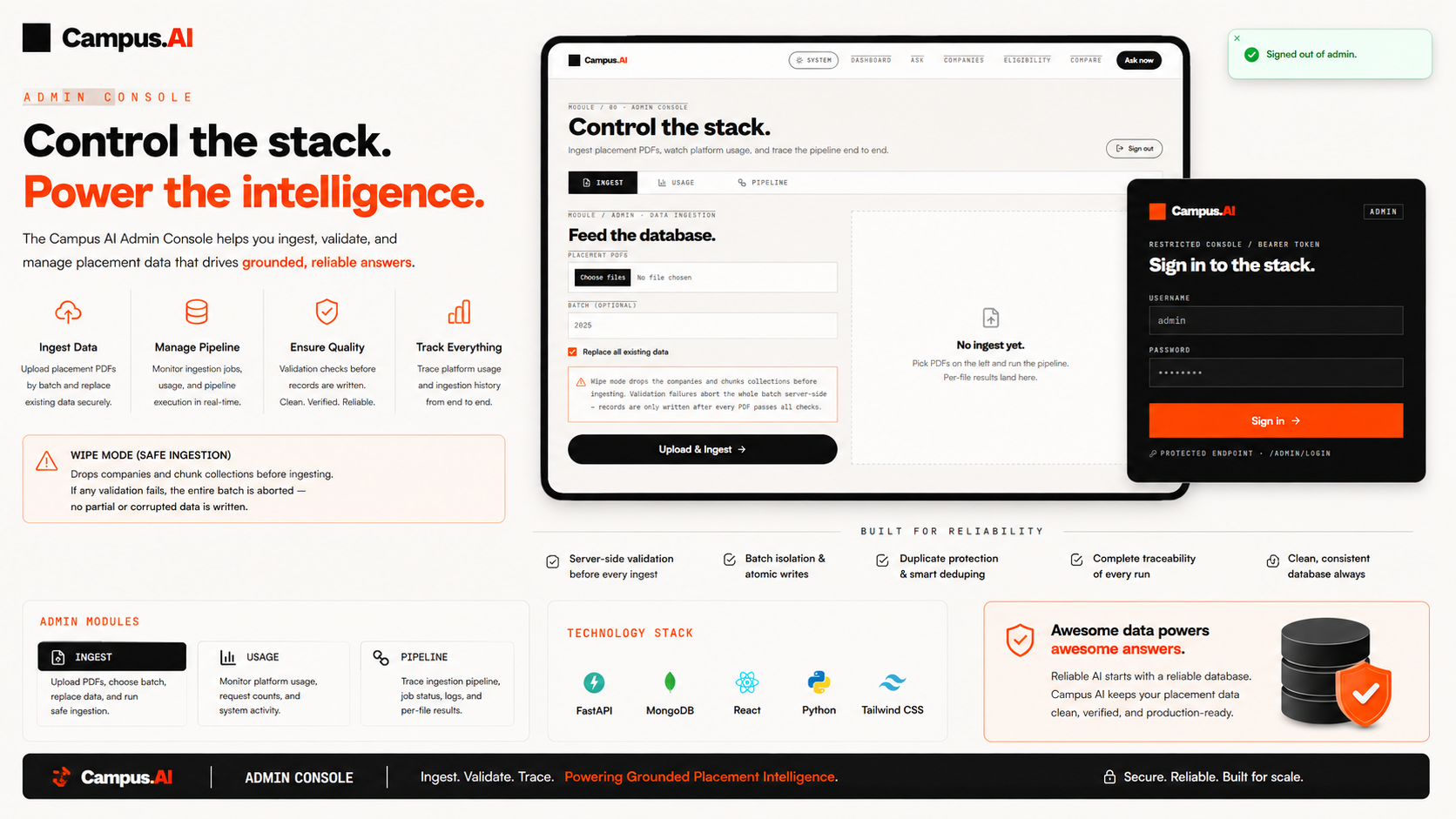
- Document Ingestion Pipeline — Make it easier for institutions to continuously add new placement brochures and verified records.
- Institution-Level Deployment — Adapt Campus AI for colleges and universities with their own placement datasets.
The long-term vision is simple:
Turn placement data from something students search through into intelligence that helps them decide.
Campus AI is not here to replace the student's judgment.
It is here to make that judgment better informed, more confident, and grounded in facts.

Log in or sign up for Devpost to join the conversation.