-
Campus SOS
CampusSOS
Inspiration
As university students, we often receive academic information from many different places—WhatsApp groups, class announcements, PDFs, emails, screenshots, syllabi, and messages from instructors. The real problem is not simply forgetting deadlines; it is academic information overload. Important tasks can be scattered across different sources, and several deadlines can suddenly overlap.
We wanted to create a solution that could understand this messy information and answer a simple question: “What should I do right now?” This idea inspired us to build CampusSOS, an AI-powered academic workload assistant that turns scattered academic information into a clear action plan.
What it does
CampusSOS allows students to upload academic screenshots, PDFs, syllabi, announcements, or paste messages. Gemini analyzes the information and automatically extracts assignments, quizzes, exams, deadlines, required topics, and important instructions.
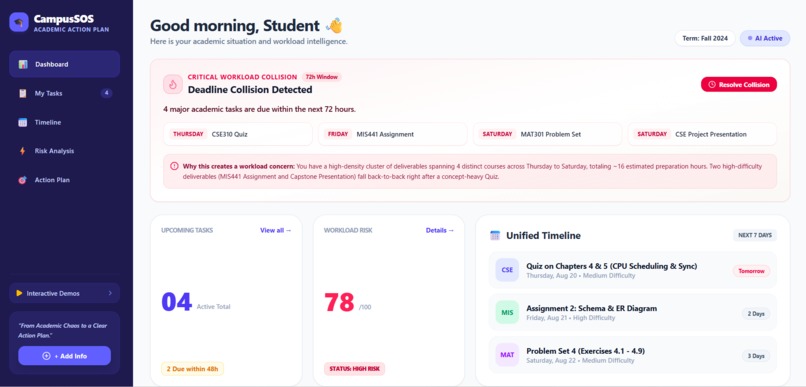
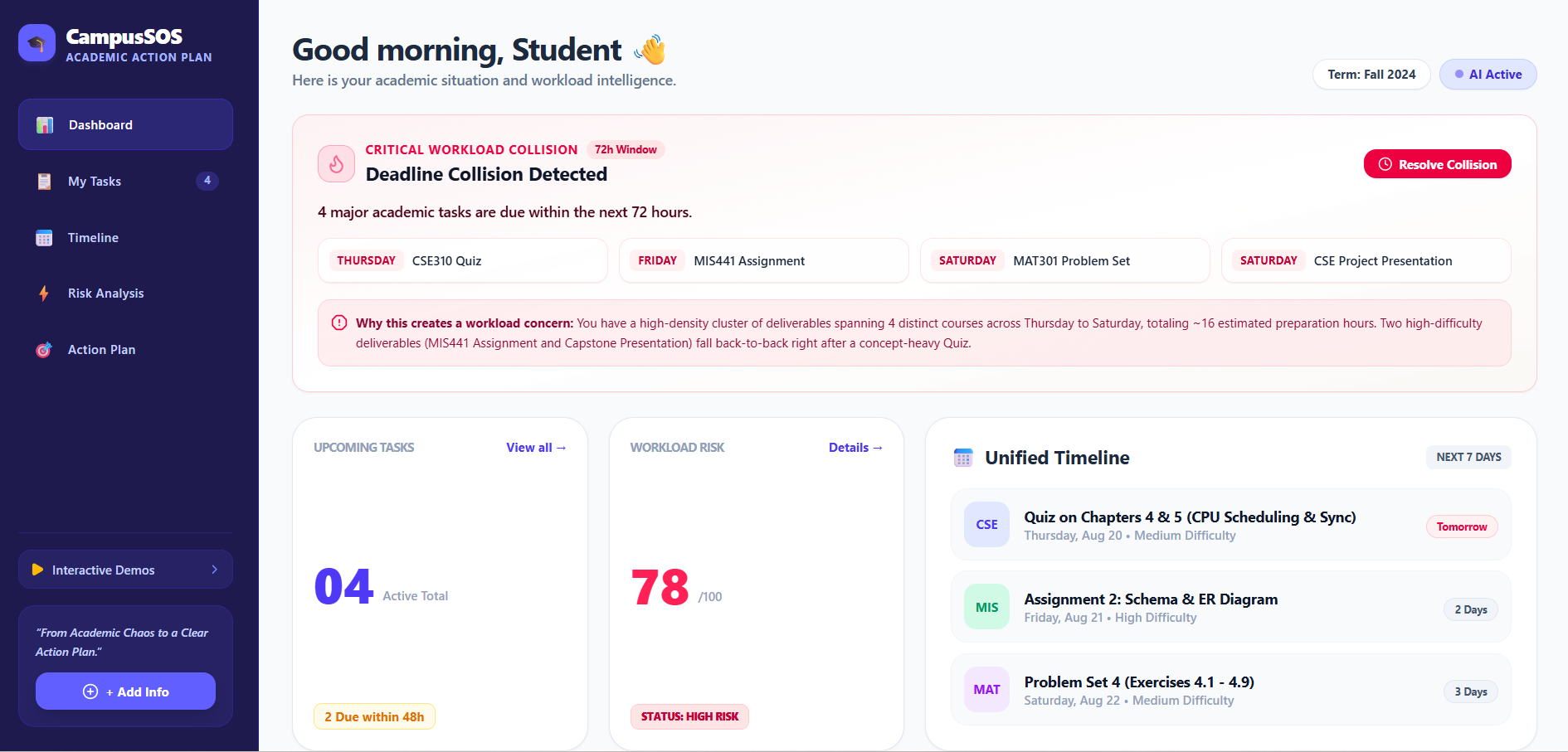
It then creates a Unified Academic Timeline, detects deadline collisions, identifies upcoming workload pressure, and generates a transparent Workload Risk Score.
One of our key features is Deadline Change Detection, which identifies when a previously announced deadline has been changed.
Finally, students can tell CampusSOS how much time they have available, and it generates a personalized action plan showing what they should prioritize and what they should do next.
How we built it
We built CampusSOS as an AI-powered web application using Google AI Studio and Gemini's multimodal capabilities.
Gemini is used to understand text, screenshots, and documents and extract structured academic information from them. We then organize the extracted information into a unified timeline and use workload factors such as deadline urgency, task volume, overlapping deadlines, and available study time to calculate the workload risk.
The application then uses the analyzed information to generate personalized recommendations.
Our core workflow is:
Scattered Information → Gemini Extraction → Unified Timeline → Workload Analysis → Personalized Action Plan
We focused on building a simple and functional MVP suitable for a real student workflow rather than adding unnecessary complexity.
Challenges we ran into
One of our biggest challenges was handling academic information that comes in many different formats. A teacher's announcement, WhatsApp message, PDF, and screenshot may all communicate the same type of information differently.
Another challenge was preventing AI from making assumptions. If a document does not clearly mention a deadline or course, the system should not simply guess. We had to design our prompts and logic to handle incomplete information carefully.
We also had to make the workload analysis understandable and explainable rather than simply giving students an unexplained “high” or “low” result.
Accomplishments that we're proud of
We are proud that we were able to turn a very common student problem into a functional AI-powered solution within the hackathon timeframe.
Our biggest accomplishment is that students do not need to manually enter every academic task. They can simply provide the information they already receive, and CampusSOS can turn it into an organized academic timeline.
We are especially proud of the Deadline Collision Detection, Deadline Change Detection, and “What Should I Do Now?” features because they move CampusSOS beyond being a basic reminder or study-planning application.
What we learned
We learned that building a good AI solution is not just about adding AI to an existing application. The most important part is identifying where AI actually provides value.
We also learned that AI is particularly useful for converting unstructured information—such as screenshots, messages, and PDFs—into structured and actionable information.
Another important lesson was that AI and rule-based logic can work together. Gemini is useful for understanding academic content, while transparent calculations and rules can make workload analysis more consistent and explainable.
What's next for CampusSOS
Our next step is to make CampusSOS more automated by integrating it with university learning management systems, academic calendars, email, and communication platforms.
We also want to introduce:
- Automatic academic calendar synchronization
- Smarter workload estimation
- Course-specific workload tracking
- Personalized study-time recommendations
- Recurring deadline monitoring
- Notifications when important academic information changes
Our long-term vision is for CampusSOS to become a personal academic command center that continuously understands a student's academic workload and helps them stay ahead instead of reacting when deadlines are already close.
Built With
- ai
- api
- artificial
- document
- edtech
- gemini
- generative
- intelligence
- javascript
- learning
- machine
- multimodal
- react
- studio
