Inspiration
Campus safety reporting systems are often fragmented, noisy, and slow to process incoming hazard notifications. When students submit reports about broken lighting, infrastructure issues, or campus hazards, dispatchers have to manually triage details, identify urgent risks, and redact sensitive personal information (PII). We created Campus Sentinel to automate this initial triage layer, delivering immediate, anonymized, and structured incident digests to safety teams in real time.
What it does
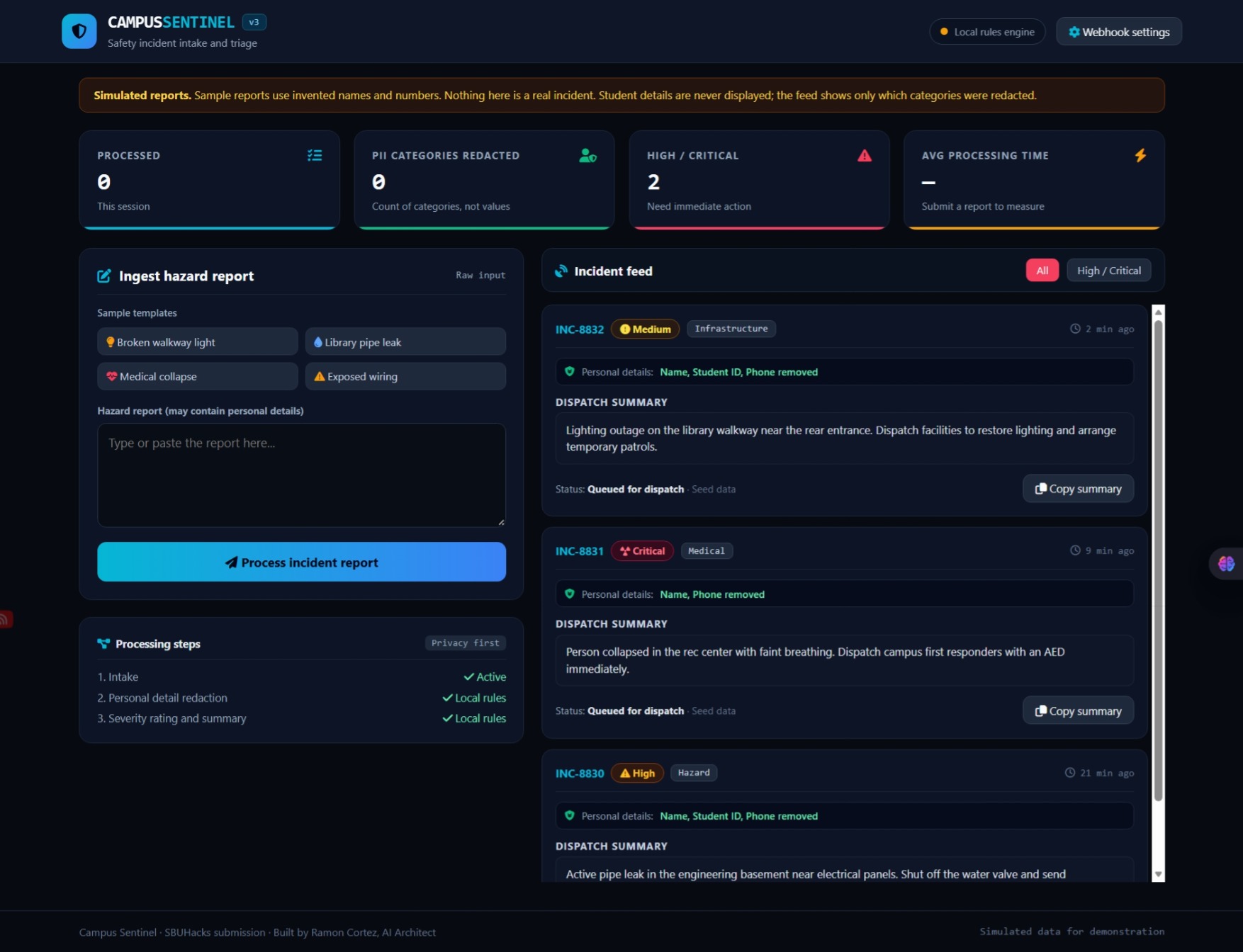
Campus Sentinel is an autonomous incident processing engine. It ingests raw student hazard reports, strips out PII (names, student IDs, phone numbers), evaluates event urgency, categorizes the hazard, and generates a structured, two-sentence executive summary with recommended immediate dispatch steps. The output is delivered in valid JSON format directly to a live monitoring dashboard.
How we built it
- AI Core: Integrated the Google Gemini API (
gemini-1.5-flash) via structured REST API calls to perform strict JSON classification, PII stripping, and executive summary generation. - Workflow Orchestration: Built inside Relevance AI to manage multi-node execution, state handling, and payload normalization.
- Frontend & Deployment: Hosted a clean, responsive incident monitoring dashboard live on Netlify.
Challenges we ran into
Ensuring absolute adherence to the JSON response schema without receiving conversational wrapper text or markdown blocks from the model. We refined the system instructions to enforce strict output boundaries and verified PII stripping across various unstructured report formats.
Accomplishments that we're proud of
- Achieving reliable, sub-second PII redaction and report categorization.
- Successfully enforcing clean, deterministic JSON output formatting directly from natural language student reports.
- Building a seamless pipeline connecting raw webhook inputs to an actionable safety dispatch summary.
What we learned
- How to optimize system prompts for zero-shot JSON schema enforcement using Google Gemini.
- Best practices for combining low-code agent orchestration (Relevance AI) with production edge hosting (Netlify) for fast, reliable deployment.
What's next for Campus Sentinel
- Integrating real-time GIS mapping to plot verified incident coordinates directly on a campus heat map.
- Adding automated multi-channel dispatch alerts (SMS/Email webhooks) for critical-level emergencies.# Inspiration
Built With
- ai-agents
- css3
- google-gemini
- html5
- javascript
- json
- netlify
- relevance-ai
- rest-api
- webhooks

Log in or sign up for Devpost to join the conversation.