Inspiration
Campus Legends began with nostalgia. Nearly twenty years ago, I spent countless hours playing social simulation games on Facebook, especially Sorority Life. I loved how friendships, rivalries, reputation, and social status created unique stories and made every player feel connected to their virtual campus community. I was also inspired by games like The Oregon Trail, where every decision carried consequences and each playthrough unfolded differently. Those experiences showed me how meaningful choices can create memorable stories and give players ownership over their journey.
Campus Legends brings those ideas together in a modern college life simulator. It combines the relationship-building and social dynamics that made social simulation games memorable with the choice-driven storytelling and replayability that made decision-based games so engaging. The result is a world where players build friendships, join organizations, shape their reputation, and create a legacy that reflects the choices they make throughout their college experience.
What it does
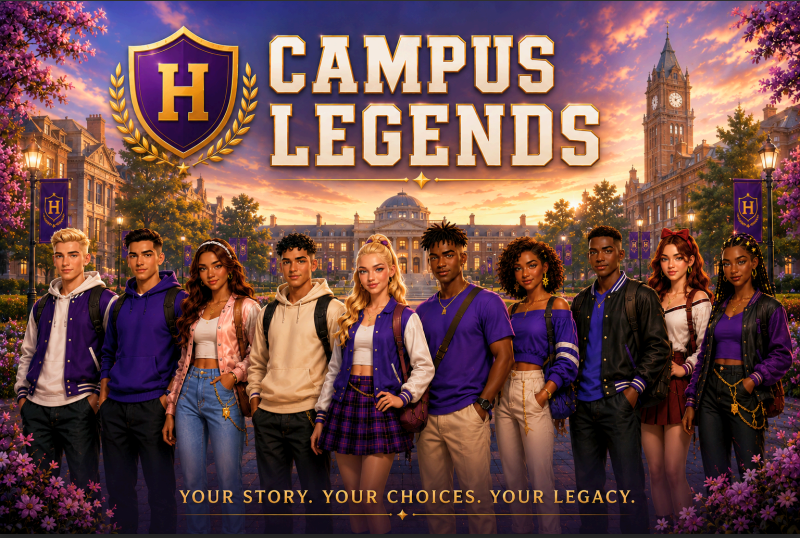
Campus Legends is a mobile, choice-driven college life simulation and management game set at Horizon University. Players create a student, choose a major, join an organization, build relationships, and make decisions that shape their reputation and legacy. Every choice affects opportunities, character reactions, and long-term outcomes. Players must strategically manage their reputation, relationships, organization involvement, and academic progress to achieve their desired legacy outcome. The game is designed to be emotional and replayable, with five reputation tracks, positive and negative relationship paths, five unique organizations, and nine legacy endings. The world responds to the player's identity, decisions, and the way they navigate campus life.
How we built it
I built Campus Legends using Canva, Copilot, Claude, Meta AI, and Adobe Acrobat. Each tool supported a different part of the design process. The core game concept, gameplay systems, player progression, branching choice structure, and supporting documentation were developed through iterative design and refinement. Copilot, Canva, and Adobe Acrobat were used to create, edit, and polish the final artifacts, ensuring that the visual presentation, branding, layouts, and overall aesthetic aligned with the intended vision for Campus Legends. Copilot and Claude supported the organization, refinement, and documentation of ideas within the Game Design Document and Production Plan, while Meta AI assisted with brainstorming, concept exploration, and iteration. The four required artifacts were developed as a cohesive package that communicates the game's systems, visual identity, player experience, and development approach, while all creative direction, design decisions, and final content remained under my leadership.
Challenges we ran into
One challenge was defining a focused MVP that demonstrated the core gameplay loop while remaining achievable within a realistic development scope. Another challenge was maintaining consistency across all four artifacts so that the gameplay systems, visual identity, player experience, and production strategy supported the same vision. Working with AI tools also required significant iteration, as generated content did not always align with the intended design direction. Achieving the desired results often required multiple rounds of prompting, editing, refinement, and creative judgment to ensure that the final artifacts accurately reflected the vision for Campus Legends.
Accomplishments that we're proud of
One of the strongest accomplishments was successfully creating a complete and cohesive concept package as an individual creator. The four required artifacts work together to communicate a clear vision for Campus Legends, from gameplay systems and player progression to visual identity and user experience. Despite the challenges of balancing scope, maintaining consistency, and refining AI-assisted content, the final submission presents a polished, professional, and well-defined game concept centered on player choice, replayability, and legacy-driven storytelling.
What we learned
Developing Campus Legends reinforced the importance of iteration, consistency, and clear creative direction. One key lesson was that AI tools are most effective when paired with human judgment, as achieving the desired results often required multiple rounds of prompting, editing, and refinement. The project also highlighted the value of maintaining alignment across design, visuals, player experience, and production planning so that every artifact supports the same vision. Most importantly, the process demonstrated how a strong concept becomes more compelling when gameplay systems, presentation, and player experience are developed together rather than in isolation.
What's next
Campus Legends is ready to move from concept to prototype. The next phase focuses on implementing the core systems including reputation tracks, relationship paths, organization events, and legacy evaluation, while expanding the narrative with new scenarios, majors, and character arcs. UI development will follow the visual identity established in the Visual Concept Package, and the core gameplay loop will be validated through playtesting against the behavioral signals defined in the Production Plan. Every next step builds directly on the foundation the four documents created together.
Built With
- adobeacrobat
- canva
- claude
- copilot
- metaai


Log in or sign up for Devpost to join the conversation.