-
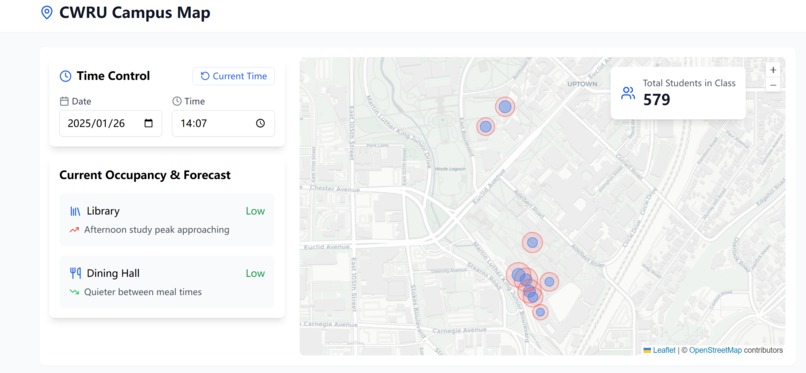
main web
-
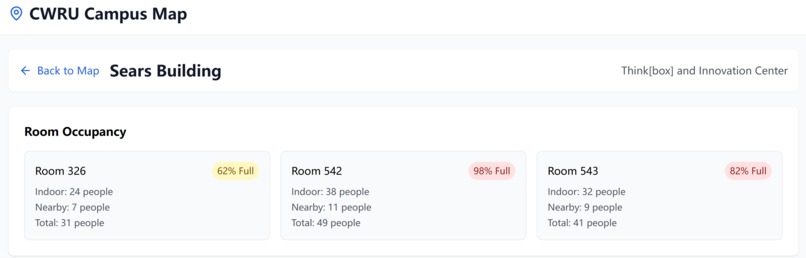
details
Inspiration
Our project was born from the frustrations of daily academic life and a crazy idea. As a student of Computer Science and Data Science, I often struggle to find a quiet place to study, whether or not I have classes that day. However, when I ventured a bit further, I realized the problem wasn’t the lack of facilities but rather the tendency of most students to congregate near the classrooms they had attended. Given how predictable human routines can be, why not create a model that simulates and predicts this behavior without tracking individual user data or compromising privacy? This model could help me and others find the best places to study or relax at any given moment.
What it does
1. Frontend Interface
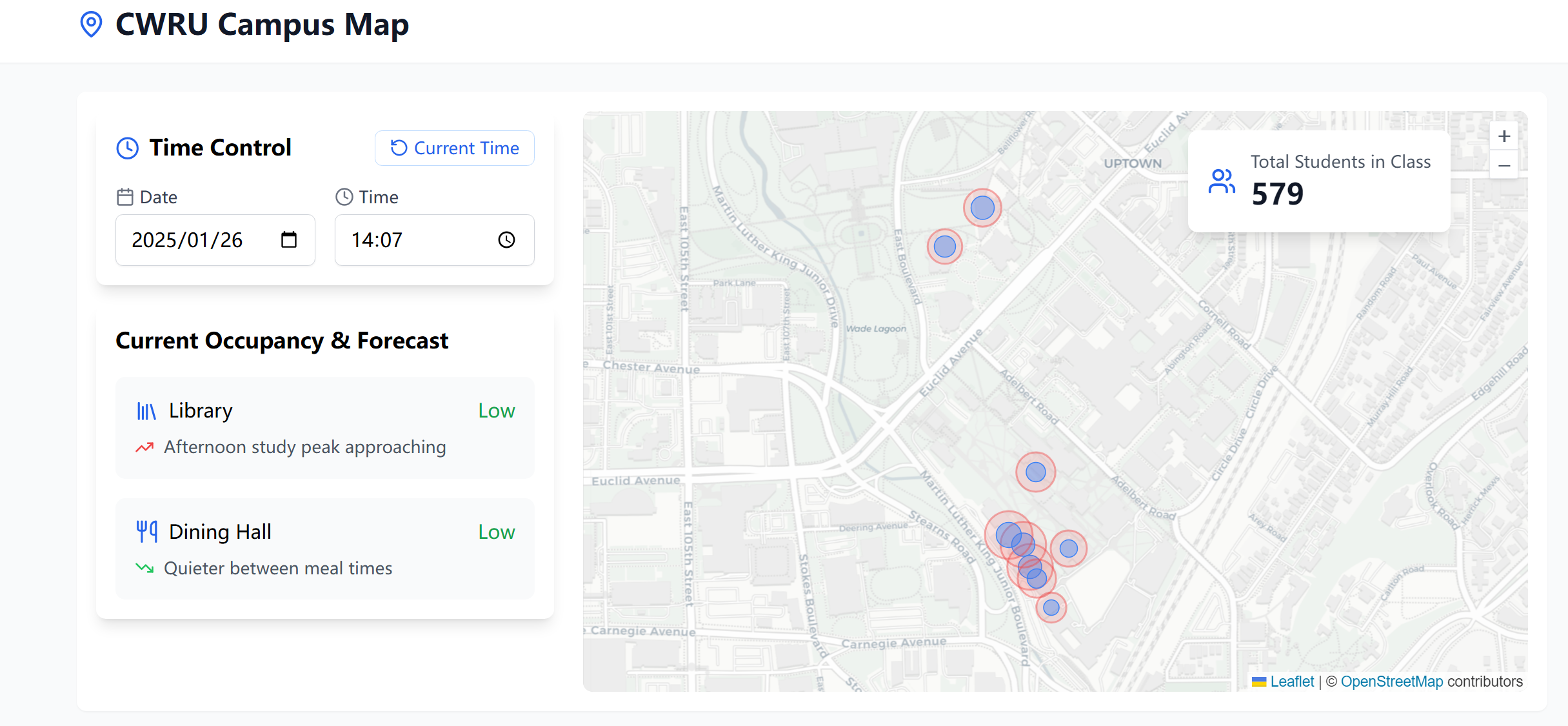
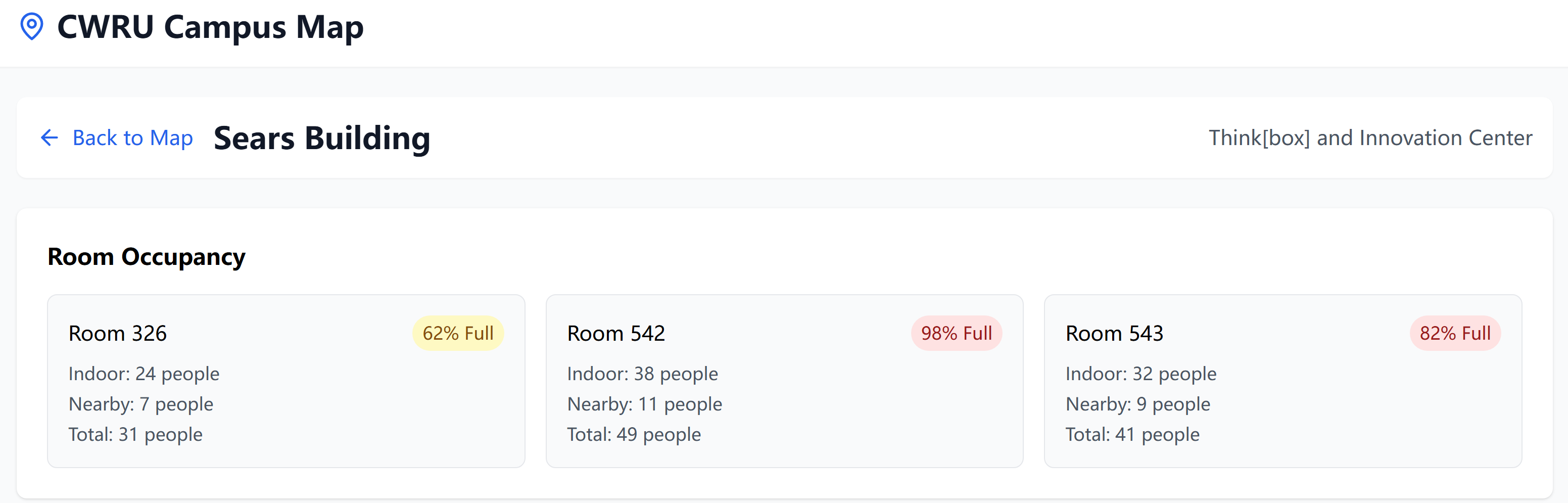
We developed a web-based interface to ensure accessibility for all users without requiring registration. Through a clean, intuitive design, users can view real-time campus heatmaps that represent the density of people in various locations. For those interested in specific buildings, we created a layered structure that allows users to click and explore detailed, 3D representations of classroom and nearby rest area heatmaps. Additionally, we implemented an AI-powered interaction system to deliver personalized analyses and real-time recommendations.
2. Backend Database
Foundational Data
To minimize privacy concerns, our project only requires course enrollment data, without needing actual student IDs. Due to time and access constraints, we simulated student enrollment data by designing a complex algorithm to generate “virtual students” based on publicly available course information.
Hyperparameters
To make our simulation smarter, we incorporated several hyperparameters that influence student movement patterns. These include factors such as course schedules, building proximity, and time-of-day habits. We designed a dynamic backend system to store this data, complete with interfaces to ensure real-time updates and seamless interaction.
3. Algorithms
Enrollment Data Generation
Our first algorithm uses publicly available course schedules and the university’s course requirement policies to generate realistic enrollment data for “virtual students.” By simulating factors like minimum credit requirements, mandatory and elective courses, and schedule conflicts, we created a plausible dataset of student course schedules.
Movement Simulation
The second algorithm focuses on simulating the daily activity trajectories of each student using hyperparameters and a dynamic system simulation. For example:
- A student with more than two classes in a day might be less inclined to visit the library and more likely to rest or return home.
- If a student has a significant gap between classes that overlaps with meal times but is too short to go home, they are more likely to visit the dining hall before heading to a rest area near their next class.
We utilized a time-series-based Markov model to simulate individual movements, combining these results to generate the overall dynamic distribution of the campus population.
How we built it
Frontend Development
Our frontend is built using a robust website architecture, designed with dynamic interfaces to connect with real-time data updates. The system incorporates user-provided inputs, weather conditions, and other relevant parameters to enhance the accuracy of movement simulations. An AI interface provides users with intelligent, personalized services, making the platform both practical and engaging.
Backend Development
The backend features a dynamic, modifiable database to store course enrollment data. It supports real-time computations, ensuring the system remains up-to-date and effective. This real-time capability ensures that our website truly serves its purpose: helping users find optimal study or relaxation spaces.
Algorithm Design
Data Generation:
Lacking access to real course enrollment data, we researched the university’s course policies (e.g., minimum credit requirements, mandatory courses, and scheduling constraints). Based on this, we developed algorithms to generate realistic “virtual students” with plausible schedules.Movement Simulation:
To ensure the simulation’s realism, we incorporated behavioral rules, for example:- Students with packed schedules are less likely to engage in extra activities.
- Gaps between classes influence whether students stay near their last class, visit the library, or go to the dining hall.
Using a time-series Markov model, we simulated individual behaviors and combined them to visualize the campus’s overall dynamic heat distribution.
Challenges we ran into
Time Constraints
The short timeframe was one of the biggest hurdles. Designing a dynamic system and simulating the trajectories of all particles (i.e., every student) is inherently complex. Each individual is unique, and accurately modeling their potential movements with a simple approach proved extremely challenging. Poor simulations would lead to significant deviations in predictions over an entire day’s time series.
Workload
With only two team members and just a few dozen hours, implementing the entire system — including the frontend, user interactions, backend, database, and interfaces — was a daunting task.
Lack of Real Data
We lacked access to real enrollment data, and time constraints prevented us from investigating every department’s course policies or the full geographical layout of the campus. More realistic simulations would require real data and trained models, but we simply didn’t have the time for that.
Our Solution
To overcome these challenges, we focused on designing a comprehensive and scalable architecture that could seamlessly integrate real data in the future without requiring structural changes. Meanwhile, we generated simulated data to substitute for real data and treated this as an interesting problem of its own.
What We Learned
As students, this was our first exposure to dynamic systems, and we had to build and simulate the entire system from scratch. While modeling, we were astonished by the sheer number of parameters required to simulate human movement realistically and the complexity this added to the model. Now, we’ve gained valuable insights and skills in this area.
Additionally, we learned how to design and architect a complete, real-time updating website and service. This project also reinforced the importance of data and its role in building effective solutions.
Accomplishments that we're proud of
We successfully built a complete, interactive system and an intuitive website. Additionally, we generated highly realistic simulated data and developed a dynamic system simulation that is both sophisticated and believable!
What's next for CampusHeat
Our model is ready to integrate real data, enabling us to create an application that can genuinely enhance the daily experiences of students. The thought of making this idea a reality is truly exciting!
Built With
- css
- dynamicsystem
- eslint
- javascript
- python
- router
- vite


Log in or sign up for Devpost to join the conversation.