-
-
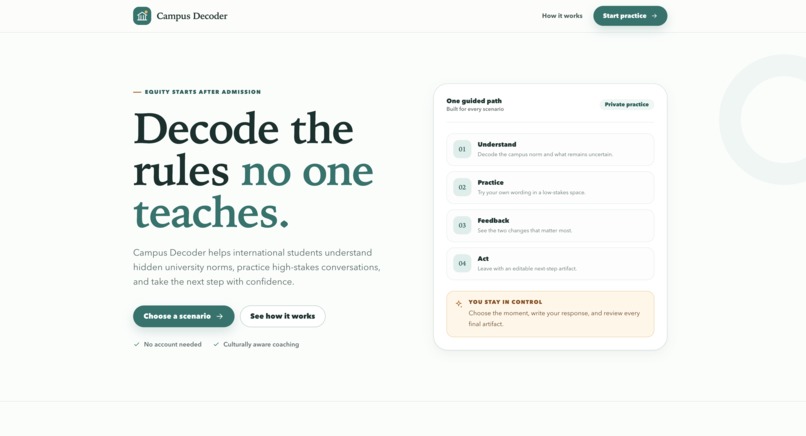
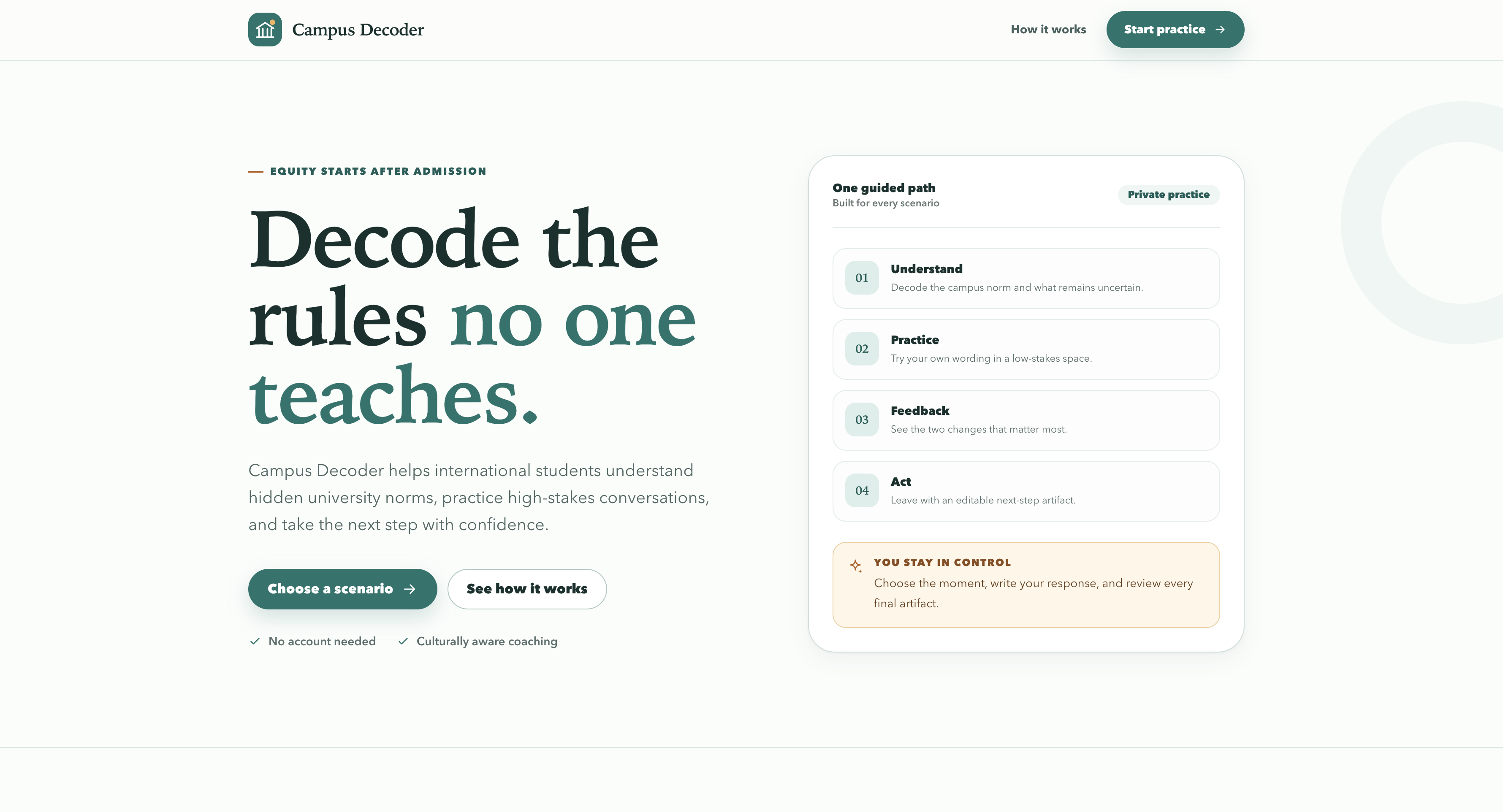
Landing hero: Campus Decoder - decode the unwritten rules of university life
-
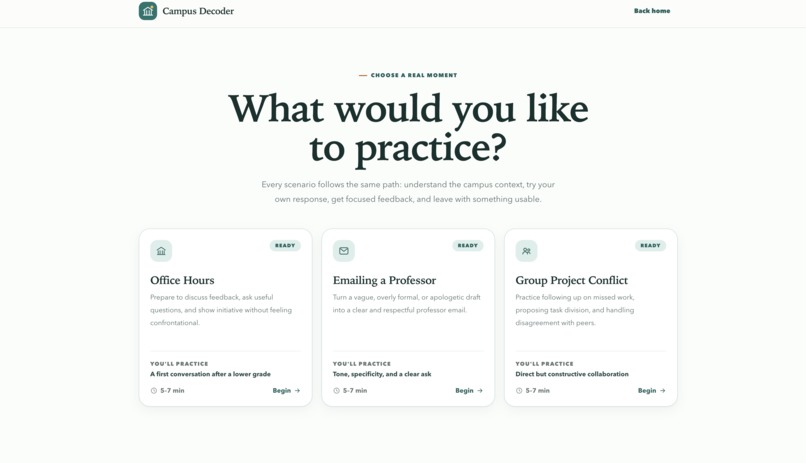
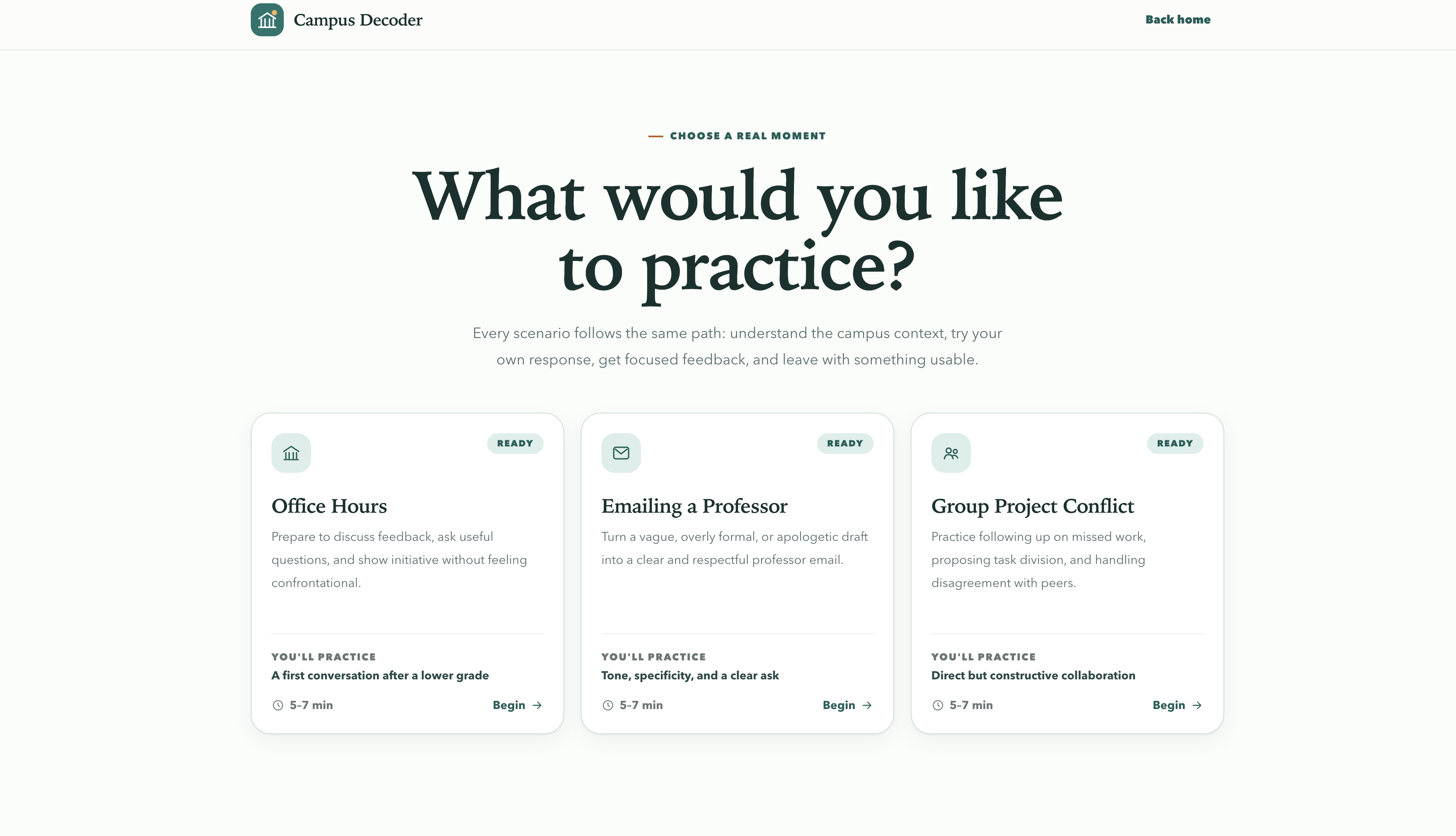
Three scenarios: Office Hour, Emailing a prof, group project
-
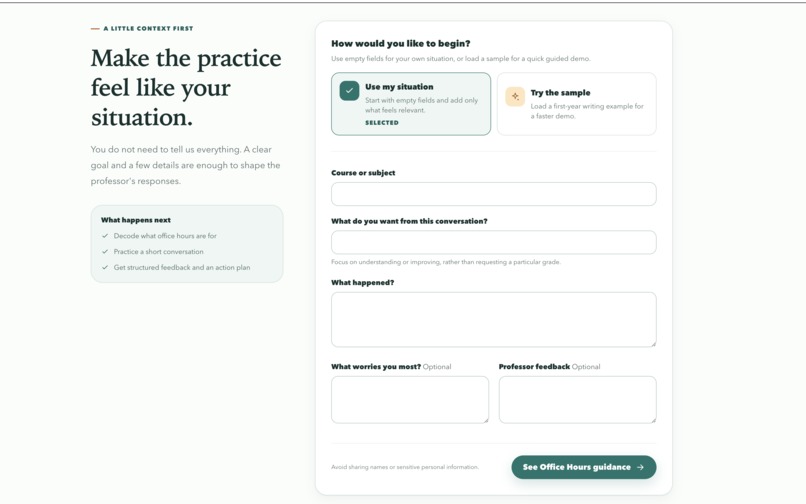
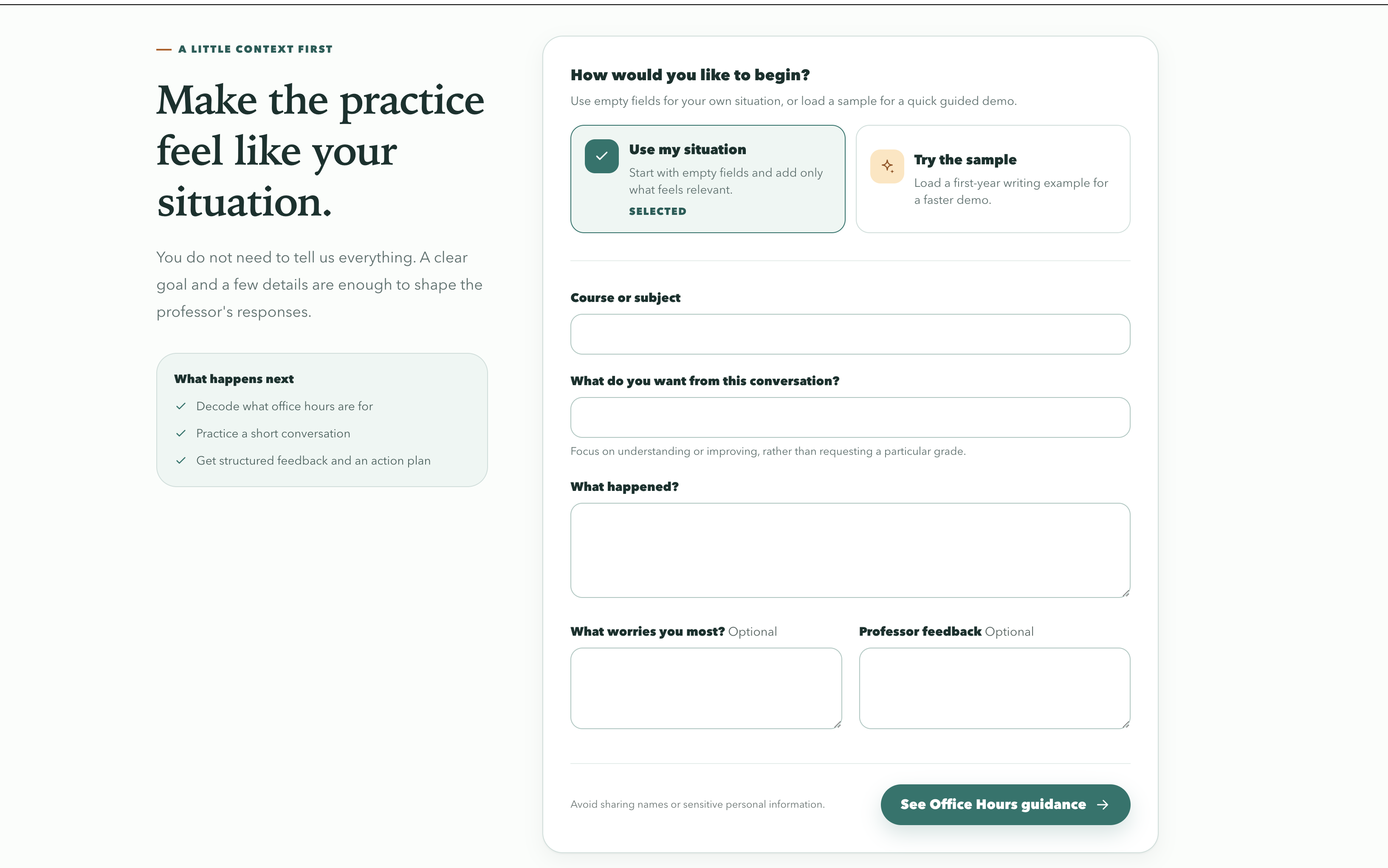
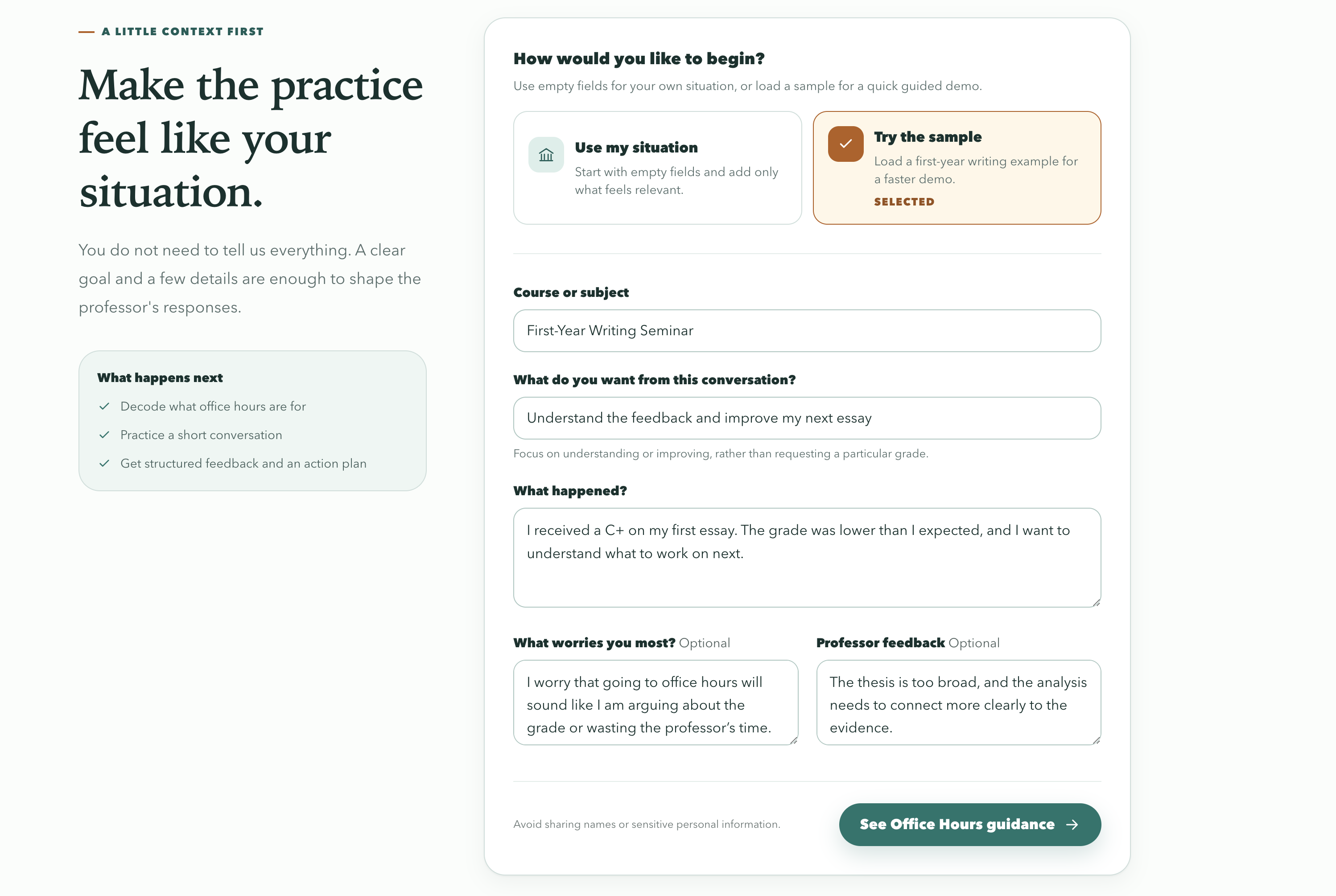
Setup collects only what matters: course, goal, what happened, and the student's real worry.
-
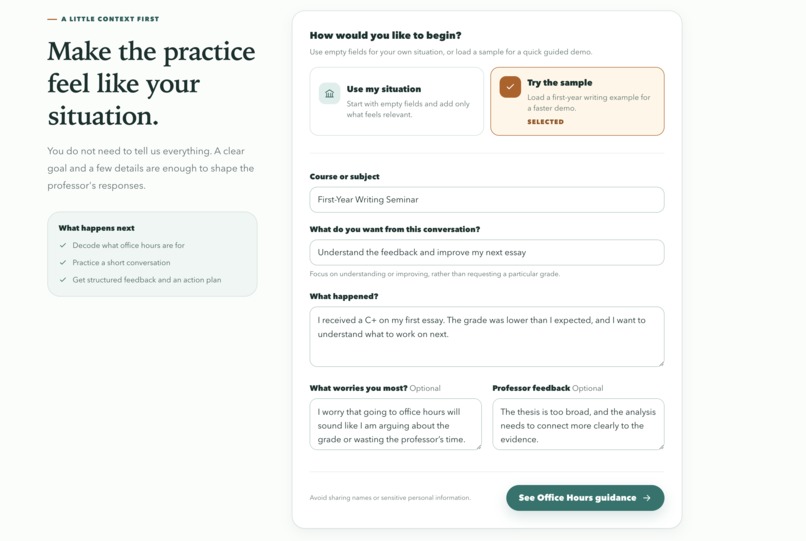
example of the setup
-
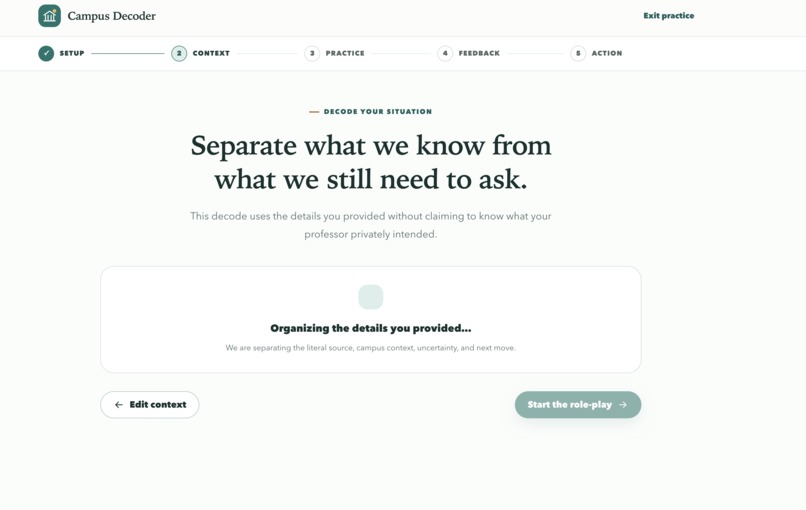
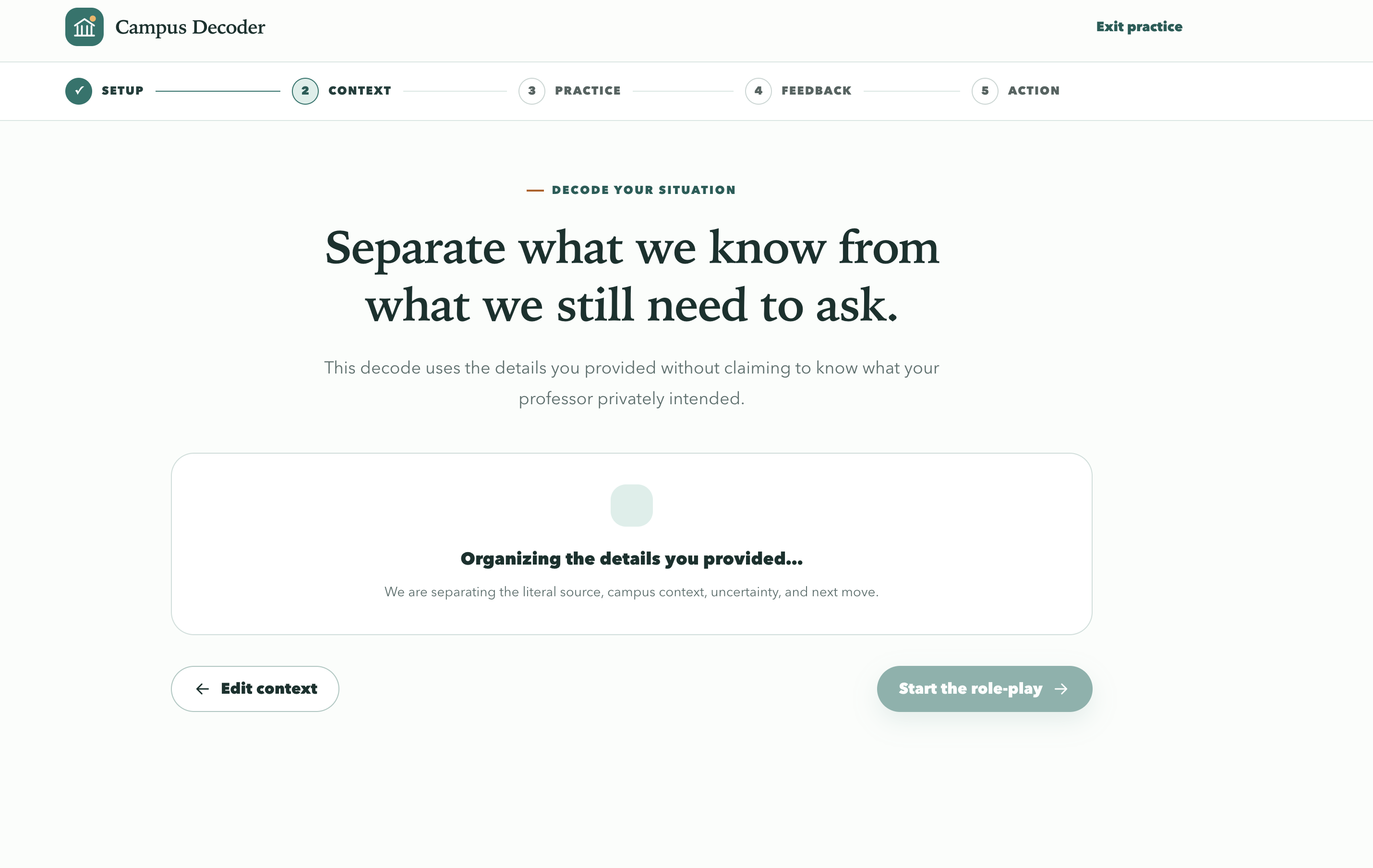
AI thinking & generating valid response
-
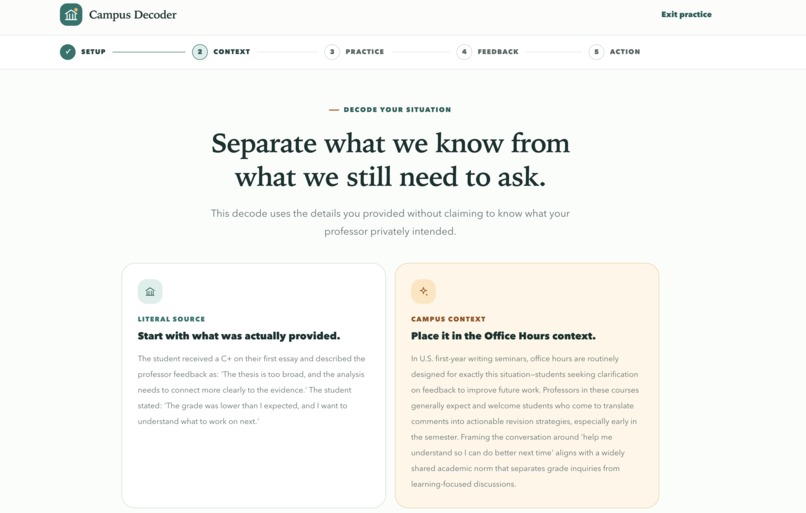
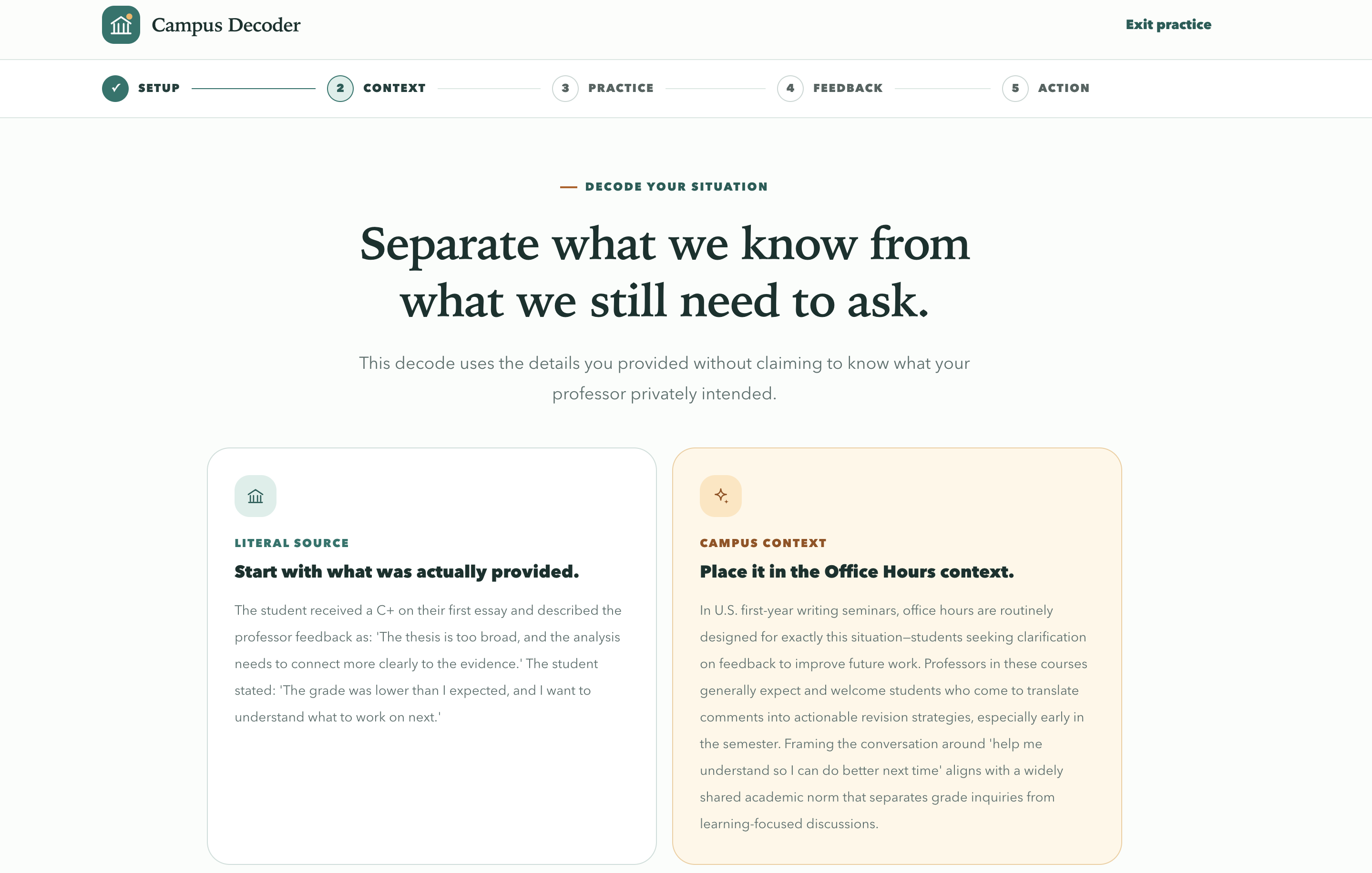
Separates what the feedback literally says, what it may mean on campus, what stays uncertain, and one next move.
-
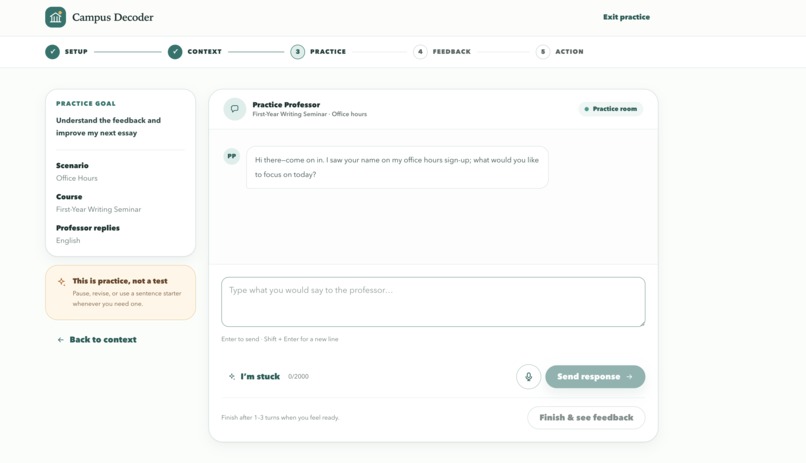
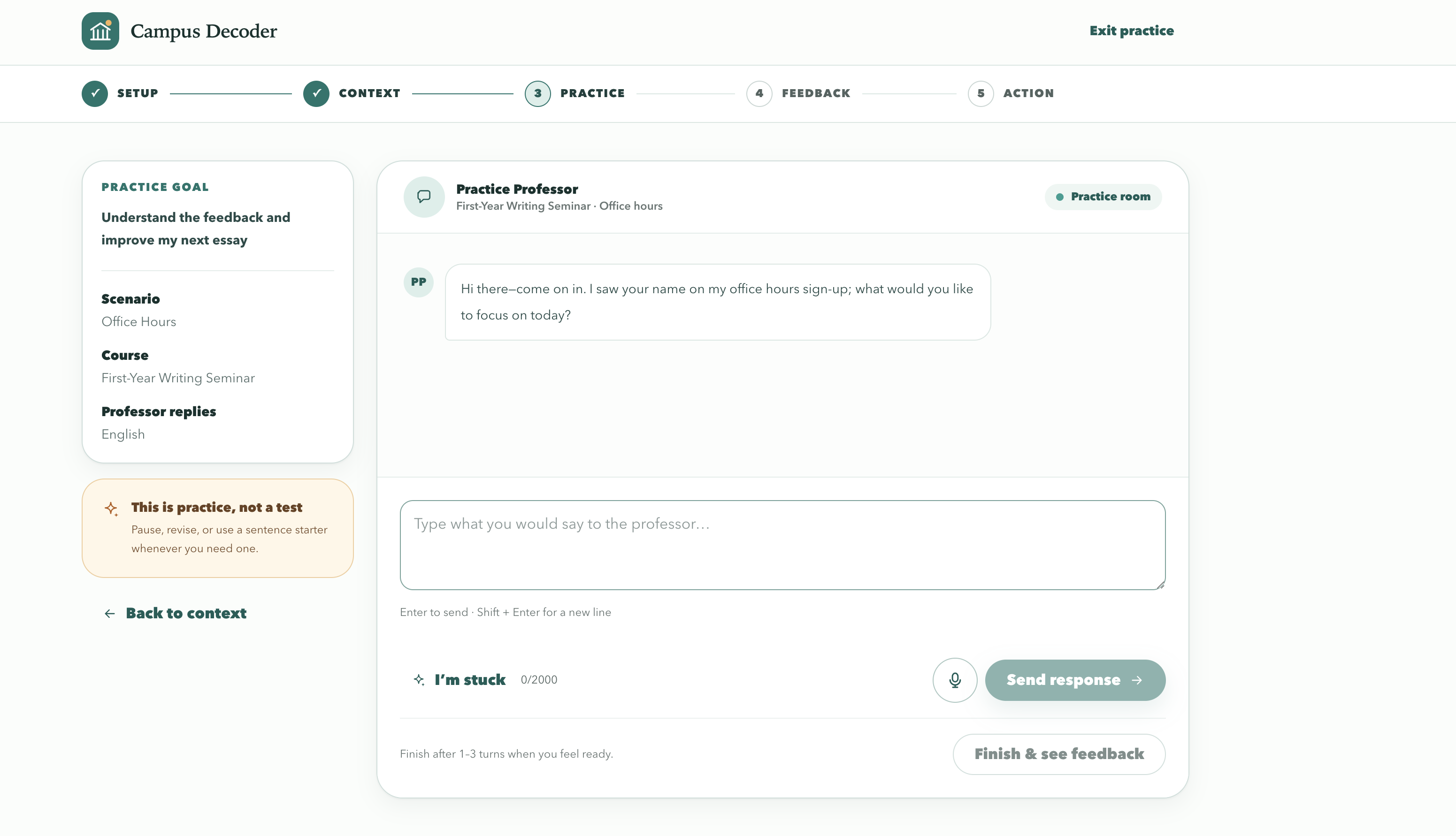
The student writes their own replies. Hints and sentence starters help — the app never answers for them.
-
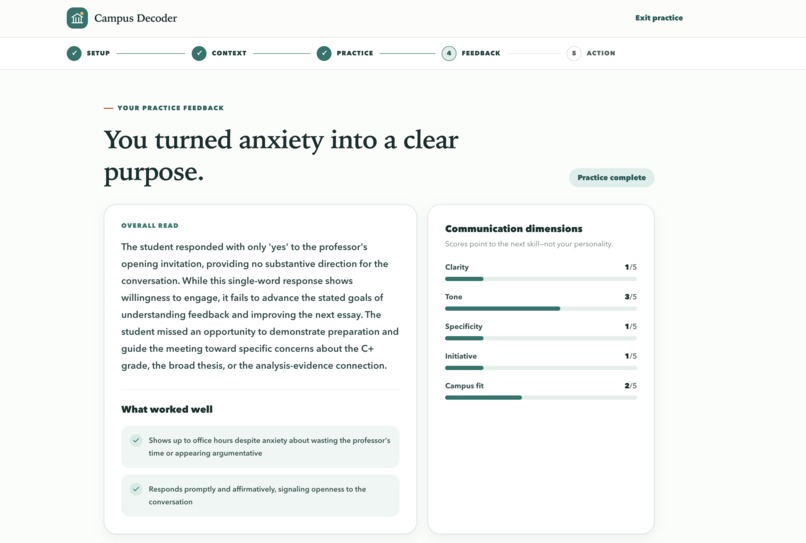
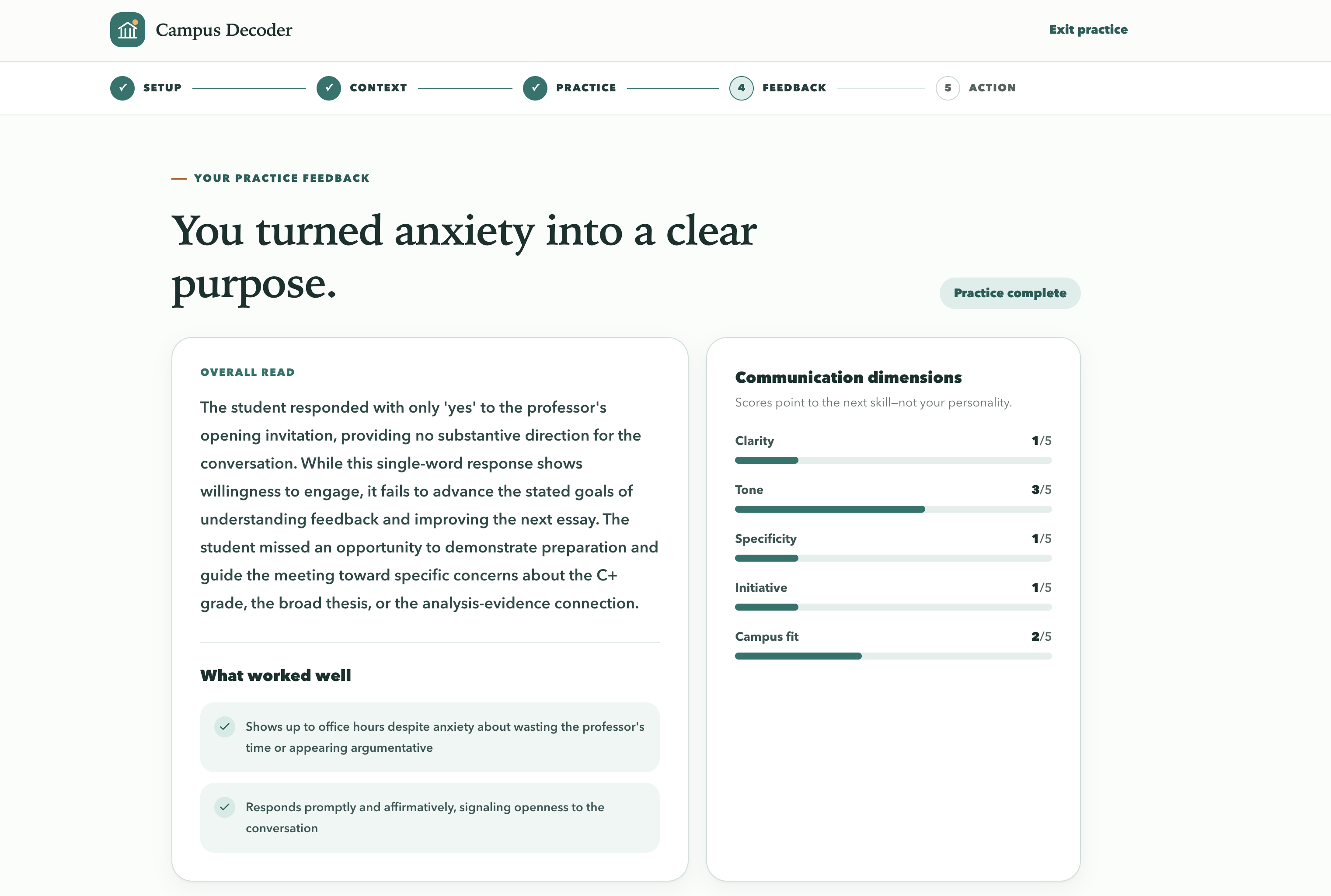
Transcript-grounded feedback on clarity, tone, specificity, initiative, and campus fit.
-
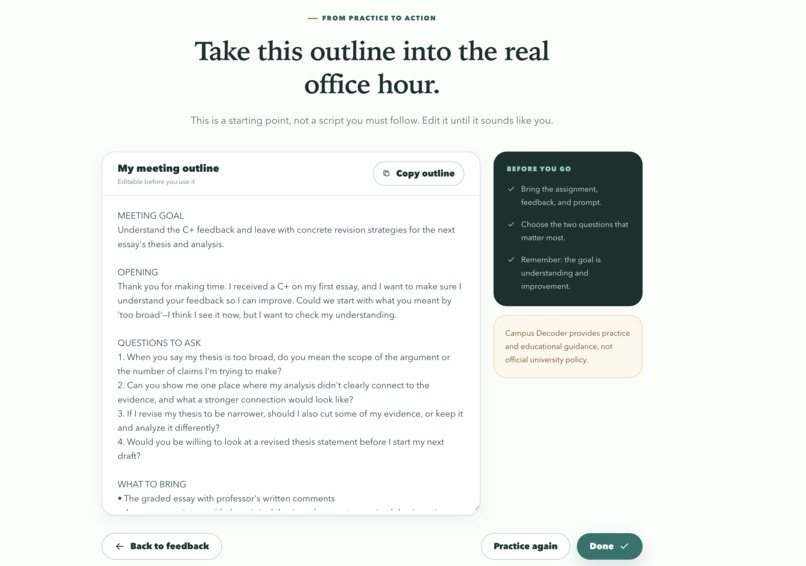
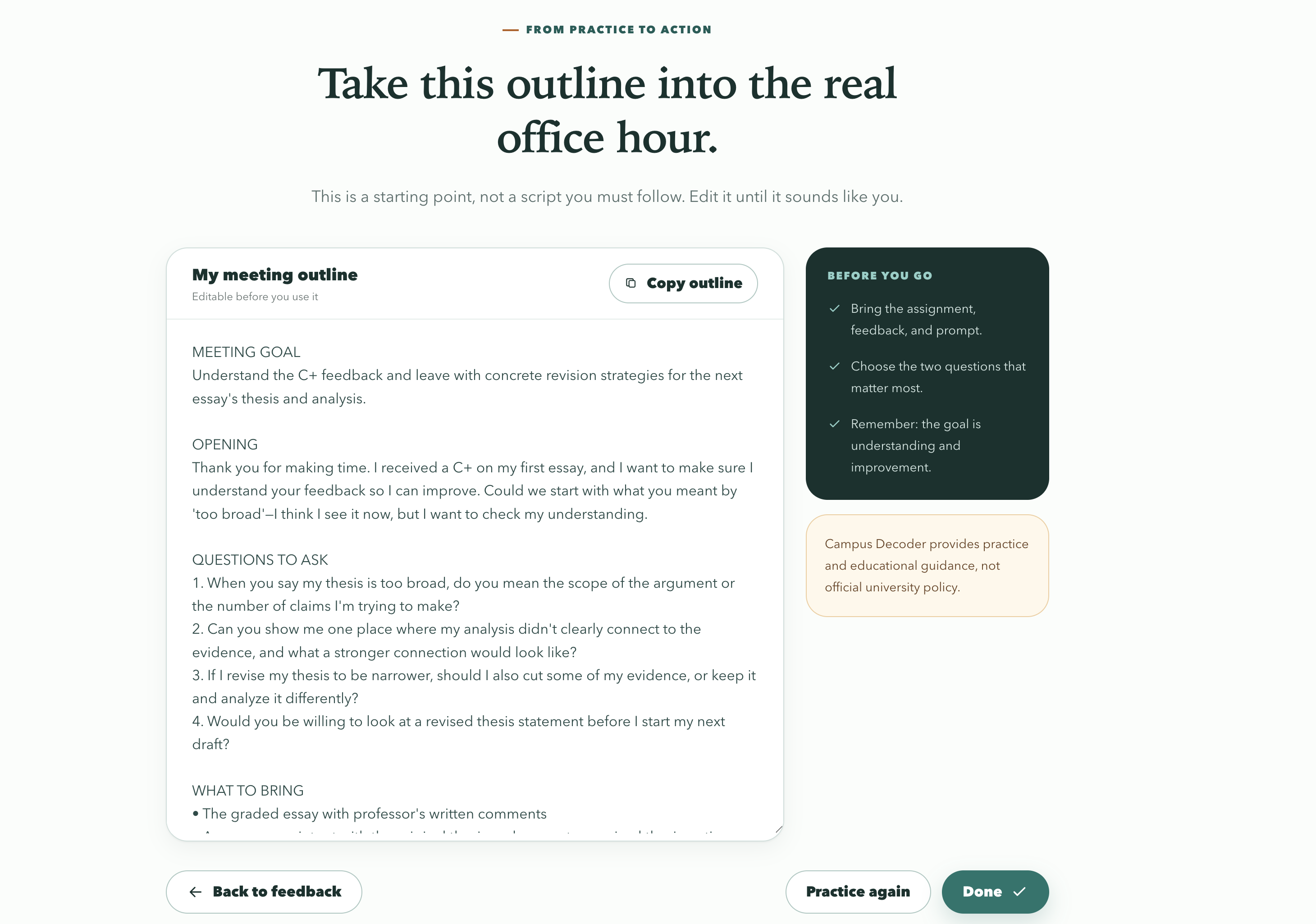
Ends with a usable artifact: an editable office-hours outline the student can bring to the meeting.
Inspiration
As an international student, I constantly run into situations where I understand the English words, but not necessarily what they actually mean in a U.S. college context. From office hours and emailing professors to group project conflicts and unfamiliar campus norms, there are many small moments where cultural context matters just as much as language.
Campus Decoder came directly from that personal experience. I wanted to build something that could help me navigate these situations more confidently and make my daily life easier. With the capabilities AI tools give individual builders today, I was able to turn that real-life problem into a product I could actually build and ship.
If these situations are confusing for me, I know there are many other international students in the same boat. Campus Decoder is built for us.
What it does
Campus Decoder is an AI-powered tool that helps international students understand and navigate everyday situations in U.S. college life.
Instead of simply translating English, it helps decode the context behind a situation: what something actually means, what social or cultural expectations may be involved, and what a student can realistically do or say next.
Students can describe a confusing campus situation in their own words and receive a clear, practical explanation and suggested next steps. The goal is simple: reduce the uncertainty that international students often experience when adapting to a new academic and social environment.
How we built it
Campus Decoder was built as a web application with an AI model at the core of the experience.
The product takes a student's description of a campus situation, structures that context into a prompt, and uses Kimi K2.6 to generate a practical, student-friendly response. I focused heavily on making the experience simple: describe what happened, send it, and quickly get an explanation that is actually useful.
AI tools also played a major role in the development process itself. I used AI-assisted development throughout coding, debugging, iteration, and product refinement, allowing me to move from an idea based on my own experience to a deployed product within the hackathon timeframe.
Challenges we ran into
One of the biggest challenges was defining what Campus Decoder should actually do.
It would have been easy to build another generic AI chatbot or translation tool. The harder problem was making the product specifically useful for international students navigating U.S. college life. That meant thinking carefully about the difference between translating language and decoding context.
Another challenge was turning an open-ended student situation into an AI response that feels practical rather than generic. I had to think about prompt structure, user experience, and how much context the model needs in order to provide useful guidance without overwhelming the user.
Finally, as my first hackathon project, I also had to learn how to balance building, debugging, product decisions, deployment, and submission under a limited amount of time.
Accomplishments that we're proud of
The accomplishment I am most proud of is simple: I shipped it.
Campus Decoder started from a problem I personally experienced as an international student, and I was able to turn that experience into a real, working product during my first hackathon.
I am also proud that the project has a clearly defined user and problem. Rather than building something around AI just because AI is exciting, I used AI as a tool to solve a problem that I genuinely encounter in my own life.
Most importantly, Campus Decoder is something I would actually use myself. That makes shipping it especially meaningful to me.
What we learned
This project taught me that building a useful AI product is about much more than simply connecting an interface to an AI model.
The quality of the experience depends on understanding the user's problem, providing the right context to the model, designing a simple interaction, and turning AI output into something actionable.
I also learned how powerful AI-assisted development can be for an individual builder. Even as a first-time hackathon participant, I was able to move quickly across ideation, coding, debugging, product design, and deployment.
Most importantly, I learned that personal problems can be great starting points for products. Sometimes the best way to find something worth building is to notice the friction in your own life.
What's next for Campus decoder
The current version is only the beginning.
Next, I want to make Campus Decoder more personalized and more deeply connected to real student life. That could include support for different types of campus situations, university-specific context, better follow-up conversations, and more structured guidance for common scenarios such as communicating with professors, understanding classroom expectations, handling group projects, and navigating social situations.
I also want to test the product with more international students and learn which situations create the most confusion for them. Their feedback can help determine what Campus Decoder should become next.
Long term, I see Campus Decoder evolving from a simple AI decoder into a practical companion for international students adapting to college life in the United States.
Built With
- axe-core
- cloudflare
- cloudflare-workers
- github-action
- kimi
- moonshot-ai
- next.js
- node.js
- openai
- opennext
- playwright
- react
- tailwind
- typescript
- web-speech-api
- zod

Log in or sign up for Devpost to join the conversation.