-
Home
Inspiration
Every human dreams Every human dreams about 3 to 6 times per night. With 8.2 billion people on Earth, that’s an astonishing 24 to 49 billion dreams happening every single night — an immense, untapped source of insight about the human mind. Dreams often reveal the core issues our unconscious is grappling with — topics we may struggle to express in waking life. The question is: how can we harness this rich information to help people?
Therapy dropouts are at an all-time high. While more people than ever are starting therapy — often with the help of new technologies — dropout rates are rising too. In fact, 52% of patients in the USA leave therapy before their third session, often because they don’t see value quickly enough. The high cost of therapy, combined with the time it takes to learn how to engage, identify the right topics, and build a connection with a therapist, makes the process challenging for many.
**Key Question" How can we use the rich, hidden information in dreams to help reduce therapy dropouts and make therapy more effective from the start? Dreams often reveal the core issues our unconscious is grappling with — topics that can take years to surface in traditional talk therapy. By helping people identify these key themes early, we can guide them to have more focused, meaningful therapy sessions, build a stronger connection with their therapist, and ultimately stay more engaged in the process.
Background Camila Figueroa MA Psychology, one of our team members, practitioner over 10 years of experience in Public and Mental Health, has spent years developing a structured dream interpretation process that has helped hundreds of patients uncover deep insights that traditional talk therapy often misses. In her practice, she observed that patients frequently reveal unconscious material through dreams — information they were unable to articulate in therapy, even after 2 to 7 years of treatment. This is often due to self-censorship or simply not knowing how to express what’s truly going on beneath the surface. Yet the insights hidden in dreams — the stories our unconscious tells — are often at the very core of the problems people are struggling with and the topics they need to explore in therapy.
Core idea This realization inspired us to ask: How can we democratize this powerful process and make it accessible to millions? By combining Camila’s method with AI, we can help millions of people save 2 to 7 years in therapy, reduce therapy dropout rates, and even help insurance companies lower costs — all while making the rich, meaningful information contained in dreams available to everyone. Looking ahead, how can we best prepare for the Neuralink era — developing technologies to process dreams captured through brain-computer interfaces, and using this vast amount of data to help humanity build healthier minds and better mental health experiences.
What it does
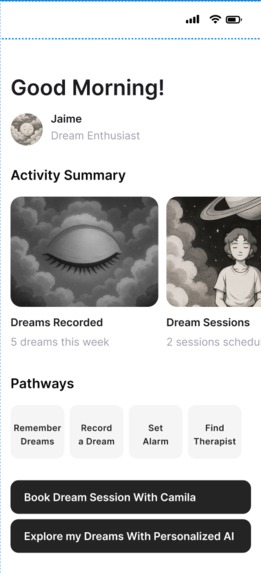
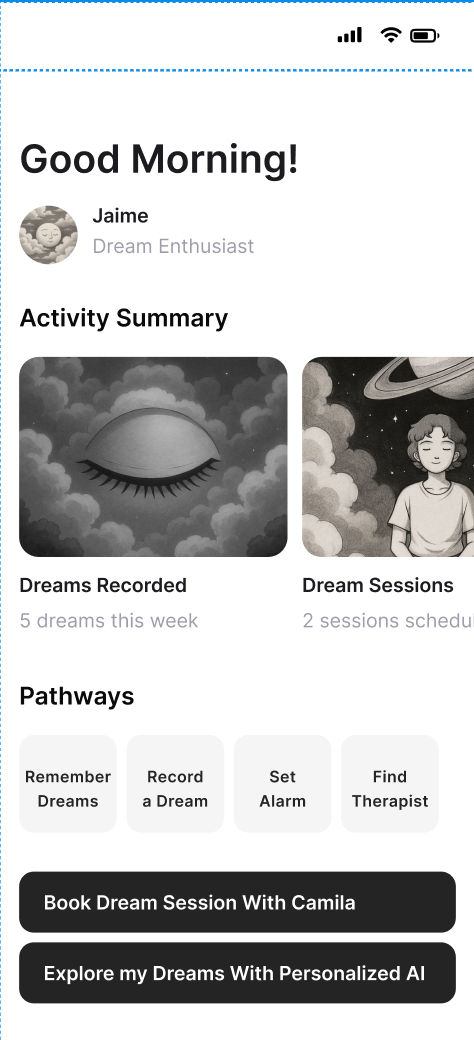
Good Morning uses AI to interpret dreams, helping users uncover key therapy topics — reducing therapy dropout rates and potentially saving 2 to 7 years of therapy by surfacing unconscious issues often missed in talk therapy.
To achieve this, Good Morning offers three main flows: 1. Dream recall guide — Helps users remember and record their dreams. 2. Live interpretation sessions — Schedule, prepare, and experience a guided dream interpretation session with Camila. **3. AI-guided sessions — An AI agent replicates Camila’s process, guiding users before, during, and after sessions. It continuously learns from sessions and new dreams, deepens insights, and suggests actionable topics for therapy — but most importantly, it democratizes access by allowing millions of users to experience these powerful sessions through AI.
Good Morning uses a step-by-step process developed by therapist Camila Figueroa to interpret dreams — a method typically delivered through a 1.5-hour session between Camila and her patients. Now, Good Morning brings this proven workflow to life through an AI agent that guides users step-by-step, providing clear, actionable insights they can take directly into their therapy sessions.
In addition, Good Morning teaches users how to remember and record their dreams — an essential part of the process, since no dream recall means no interpretation. Helping users build this habit makes the experience actionable and sustainable.
Finally, Good Morning ensures that insights from each session are actionable and connected to the user’s ongoing therapy. It helps users bring these insights into conversations with their therapist, encourages them to keep journaling new dreams, and shows how new dream content connects to earlier sessions. When new patterns or important topics emerge, the AI also prompts users to schedule follow-up sessions to deepen their self-exploration.
How we built it
Good Morning is based on amplifying the power of Camila’s therapy process to millions of people, starting from two fundamental facts: 1. Everybody dreams 2. Camila can only have a finite number of sessions a week
Therefore, the main objective of the app is for people to develop the proper habits of dream tracking, record their dreams on a daily basis, and have our AI model help them navigate those dreams and turn them into actionable insights to boost their therapy sessions.
Good Morning has 3 main features 1. Register a Dream a. As a new user, I would like to learn what I have to do in order to consistently remember my dreams in the morning, so I can start developing the habit. i. "Register a dream" is the main call to action on the app. It takes the user through a useful guide on how to properly set their sleep hygiene habits to be able to remember dreams in the morning. ii. This is a wizard that, step by step, takes the user through their night routine. iii. This is a mandatory workflow for every new user and an optional tool for existing users, something they can rely on when they’re struggling to remember their dreams. iv. As a new user, I would like to set up nice and balanced alarms inside the app that align with my sleep cycle and help me wake up at the right moment to maximize the chances of remembering my dream. v. Sleep cycle pattern recognition will be done through sound detection (like the Sleep Cycle app). vi. As a new user, when the alarm rings in the morning, I would like to have a voice note record button as the main call to action on the alarm screen. vii. This helps the user download all the dream info into the app as quickly as possible, preserving detail. viii. The app will use an AI model for speech-to-text, trained to recognize the voice patterns of recently-awake users. ix. As a new user, I would like to read the log of my dream session in both text and audio formats, so I can edit, add, or delete any details.
2. Dream Journal Interpreter a. As a user, I would like to have a feature in the app where I can go through the dream interpretation therapy process — where the app takes me on a guided meditation, asks me to write a poem, and helps me reflect on the key takeaways.Includes a set of pre-recorded guided meditations. b. The app will open a text editor for the user to write the poem. c. The text editor will include a feature to highlight and save key takeaways from the poem. d. A reasoning model LLM will start a conversation with the user to help them bounce around ideas in a structured way — guiding them toward insights they can take to therapy. i. Why a reasoning LLM over an inference model: A. It can make logical deductions, draw structured conclusions, and follow cause-effect relationships — instead of just predicting the next word like an inference model. B. It’s better at multi-turn conversations, where context builds over time and larger history matters. It brings past inputs and user behavior into the conversation to synthesize meaningful responses. C. It can use external knowledge, like quoting studies or referencing scientific data to enrich and support the discussion. D. It guides users to uncover the key themes hidden in their dreams by asking the right questions and prompting thoughtful answers. Dream interpretation isn’t just about generating text — it’s about building an AI experience that acts as a guide, helping users explore and discover their own insights.
3. Book a Dream Interpretation Session with Camila a. A feature to schedule, prepare for, and experience an individual dream interpretation session with Camila. b. For users who want to experience a 1:1 session with a therapist and truly see the power of dream work by going through Camila’s process of unlocking the meaningful insights hidden in dreams. c. A scheduling tool will allow users to book 1:1 appointments with Camila directly.
Challenges we ran into
1. Translating the dream interpretation session into a step-by-step AI process Most dream interpretation apps rely on the AI model making loose associations between dream content and common archetypes — resulting in generic, surface-level insights. For Good Morning, we wanted to go much deeper. Our goal was to faithfully translate Camila’s in-person process into an AI-driven workflow, so the experience retains the depth, nuance, and impact of a real-life session. 2. Finding the right approach to this translation As a team, we needed to align on how to tackle this challenge. It was tempting to jump straight into building — but we realized it was critical to first mock up the process step-by-step. This saved us coding time and helped us fine-tune the user flow. By mapping out each step, we gained a clearer understanding of the user journey, identified ways to make it more intuitive and accessible, and ensured that the core session process could be effectively translated into a digital product. 3. Leveraging AI to move fast To deliver on time, we made full use of all AI tools available to us — accelerating both our prototyping and iteration process.
Accomplishments that we're proud of
1. Developing under tight time constraints We couldn’t work on this project during Saturdays, so we focused all our energy on Sunday morning. In just 6 hours, we built the AI workflow and prototype — moving the project forward more than we ever had before. 2. Clarifying what we really want to build This process helped us finally bring to life ideas we had been discussing for weeks! We asked ourselves, “Can this actually be done?” — and the answer is a resounding yes. The hackathon helped us define clear goals and timelines, and showed us just how much can be accomplished when a team is aligned around a shared mission. 3. Using the right tools to make it work We leveraged every AI tool at our disposal to push this project forward. The right tools truly make a difference when building something ambitious. 4.Unlocking the power of dream interpretation through AI scalability This process showed us that our method can absolutely be turned into a product — and that it has huge potential to democratize access to dream interpretation. We had been stuck in “what ifs” and excuses about why it might not work. The AI hackathon helped us push past those doubts, break through roadblocks, and prove that our approach is highly translatable to AI — and incredibly impactful.
What we learned
Take Action We’ve been thinking about this idea for a long time — and for just as long, we kept telling ourselves we couldn’t do it. But this Sunday morning, we finally took action. We built it, tested it, and now we have clear insights on how to keep moving forward. The biggest lesson: you learn the most by doing.
AI Tools There are so many incredible AI tools available today that can help us prototype and visualize exactly what we imagine. One of the best parts of the hackathon was simply using these tools — going through the creative process of imagining the experience, and then actually building it. The gap between idea and execution is smaller than ever.
Development What we thought was a one-of-a-kind, live-only session experience has proven to be something much bigger. We now see that the process can absolutely become an AI-powered, scalable tool — one that could help millions of people. And we were able to prove that in just one morning of focused work.
# What's next for Good Morning, Dream Interpretation to accelerate therapy process
Overview First, we will generate scientific proof that Good Morning accelerates therapy outcomes. This will create business proof by demonstrating clear value for users, therapists, and partners — enabling us to build a scalable product. With this foundation, we can drive strategic partnerships, secure funding, and position Good Morning for long-term market leadership in mental health innovation. We want to make dream interpretation a necessary step into the mental health mainstream ideal process. In the long term, we aim to establish Good Morning as the leading technology for dream analysis, preparing for the Neuralink era, where we will be positioned as the go-to platform to process dreams captured through brain-computer interfaces — unlocking new possibilities for large-scale health insights and marketing solutions.
Summary (Business & Scientific Timeline View) Month 0–3: Finalize the product, design the controlled study, recruit therapists and patients. Month 4–9: Run the study, capture and analyze data, publish the first white paper. Month 6–9: Refine the product (V2), prepare partnership strategy, launch PR and marketing efforts. Month 9–12: Start partnerships, pilot with therapy platforms, initiate fundraising. Month 12–18: Scale user acquisition, secure partnerships with insurance companies and employers, deepen scientific validation with larger studies. Month 18–24: Establish market leadership, expand both B2C and B2B revenue streams. Month 24- 15 years: Establish Good Morning as the leading technology for dream analysis, preparing for the Neuralink era, where we will be positioned as the go-to platform to process dreams captured through brain-computer interfaces — unlocking new possibilities for large-scale health insights and marketing solutions.
Detailed plan 1. Scientific / Product Define what “saving years” means Finalize AI process Build therapist + patient recruitment plan Design 3–6 month controlled study
NEXT 3–6 MONTHS (Proof Generation Phase) 2. Scientific / Product Run controlled study with N = 50–100 Track and log key metrics Analyze data Publish first proof
NEXT BUSINESS STEPS → TURN PROOF INTO BUSINESS GROWTH (Month 6+) 3. Business → Monetization Prep Package the validated product Build partnerships pipeline PR & marketing
4. Business → Fundraising & Scaling Leverage proof to raise next funding round Build scalable acquisition channels
5. Long-Term → Establish Good Morning as a category leader Continue running additional validation studies Publish in top psychology / digital health journals Build out personalized dream AI Integrate with therapy platforms Work with employers + insurance to subsidize access Prepare for the Neuralink Era. Positioned our technology as the go to technology to process dreams captured through brain-computer interfaces to unlock new possibilities for large-scale health insights and marketing solutions.
Built With
- amazon-web-services
- flutter
- java
- sql(relational)

Log in or sign up for Devpost to join the conversation.