-
-
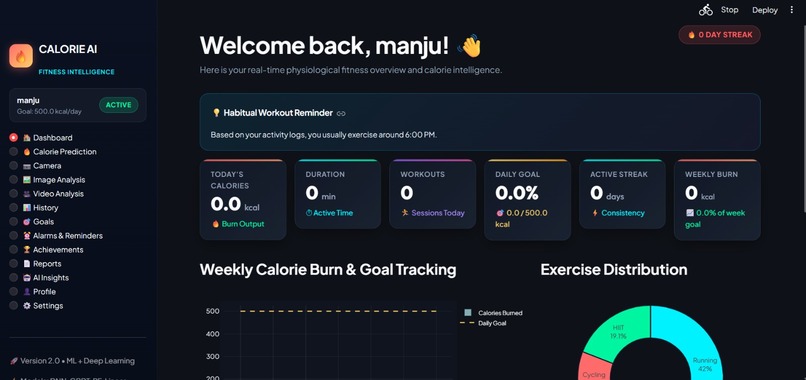
calories burnt prediction

Inspiration :-
The inspiration behind Calories Burnt Prediction AI came from the growing importance of health, fitness, and maintaining an active lifestyle. Many people exercise regularly but may not know how many calories they burn during their workouts. We wanted to develop an intelligent system that uses Machine Learning and Deep Learning to estimate calorie expenditure based on personal and workout-related data. Our aim is to combine technology and fitness to make workout analysis more accessible, interactive, and data-driven while encouraging people to make informed decisions about their fitness goals.
What it does
People exercise every day, but they may not know how many calories they burn during a workout. So, you got the idea to develop an AI-based application that predicts calories burned using personal details and workout information. Example: If someone exercises for 30 minutes, your application can estimate how many calories they burned based on their age, weight, heart rate, and other inputs.
How we built it
- Data Collection We collected a dataset containing information such as age, gender, height, weight, exercise duration, heart rate, body temperature, and calories burned. The dataset provided examples for training our prediction models.
- Data Preprocessing We used Python libraries such as Pandas and NumPy to clean and prepare the data. We handled missing or inconsistent values where necessary and prepared the input features for model training.
- Machine Learning and Deep Learning We trained predictive models using workout data. Machine Learning algorithms learned patterns between the input features and calories burned, while a deep learning neural network could learn more complex relationships.
- Model Evaluation We compared model performance using RMSE, MAE, and (R^2). These metrics helped us understand prediction errors and determine which model performed best on the test dataset.
- Web Application Development We used Streamlit to build a user-friendly web interface where users can enter their workout details and view the predicted calories burned. Python connects the user inputs to the trained prediction model.
Challenges we ran into
While developing our Calories Burnt Prediction AI project, we faced several challenges. One of the main challenges was preparing the dataset and ensuring the quality of the data used for training. We also had to understand how different personal and workout parameters influenced calorie-burn predictions. Comparing Machine Learning and Deep Learning models and evaluating their performance using RMSE, MAE, and R² required careful experimentation. Another challenge was integrating the trained model with Streamlit and ensuring that the application worked smoothly during deployment. Through teamwork, debugging, testing, and continuous improvements, we worked to overcome these challenges and develop an interactive AI-based fitness prediction system.
Accomplishments that we're proud of
One of our proudest accomplishments was successfully developing Calories Burnt Prediction AI, an interactive fitness prediction system that combines Machine Learning, Deep Learning, and Streamlit. We transformed our idea into a working web application that estimates calories burned based on personal and workout-related parameters. We are proud of applying theoretical AI concepts to a practical real-world problem, exploring model evaluation techniques, and making our project accessible through an online deployment. Being selected for our college expo was another important milestone that motivated us to continue improving our project. This experience strengthened our technical knowledge, teamwork, problem-solving skills, and confidence in developing AI-powered solutions.
What we learned
Through our Calories Burnt Prediction AI project, we learned how to apply Machine Learning and Deep Learning concepts to solve a real-world problem. We gained practical experience in data collection, data preprocessing, model training, and performance evaluation using RMSE, MAE, and R². We also learned how to integrate a trained model into a Streamlit web application and deploy it online. Along with technical skills, we improved our teamwork, communication, debugging, and problem-solving abilities. Most importantly, we understood that developing an AI project requires continuous learning, testing, and improvement to create a useful and user-friendly solution.
What's next for calories burnt prediction
Our next goal is to make Calories Burnt Prediction AI smarter, more accurate, and more personalized. We plan to improve prediction performance by experimenting with advanced Machine Learning and Deep Learning models. We also aim to introduce personalized fitness recommendations, workout history tracking, goal setting, and interactive progress dashboards. In future versions, we hope to explore integration with wearable fitness devices for real-time activity data, along with reminders and notifications to encourage consistent exercise habits. We also plan to enhance the user interface and accessibility to make the application more useful for fitness enthusiasts. Our vision is to evolve this project into a comprehensive AI-powered fitness analytics platform that helps users better understand and monitor their workout performance.
Built With
- deep-learning
- machine-learning
- python
- streamlit
- tensorflow

Log in or sign up for Devpost to join the conversation.