Inspiration
Millions of students around the world lack access to high-quality mentorship. In many communities, especially in developing regions, private tutoring is expensive or simply unavailable.
At the same time, most AI tools used in education today behave like answer engines. They provide instant solutions but rarely help students develop real reasoning skills.
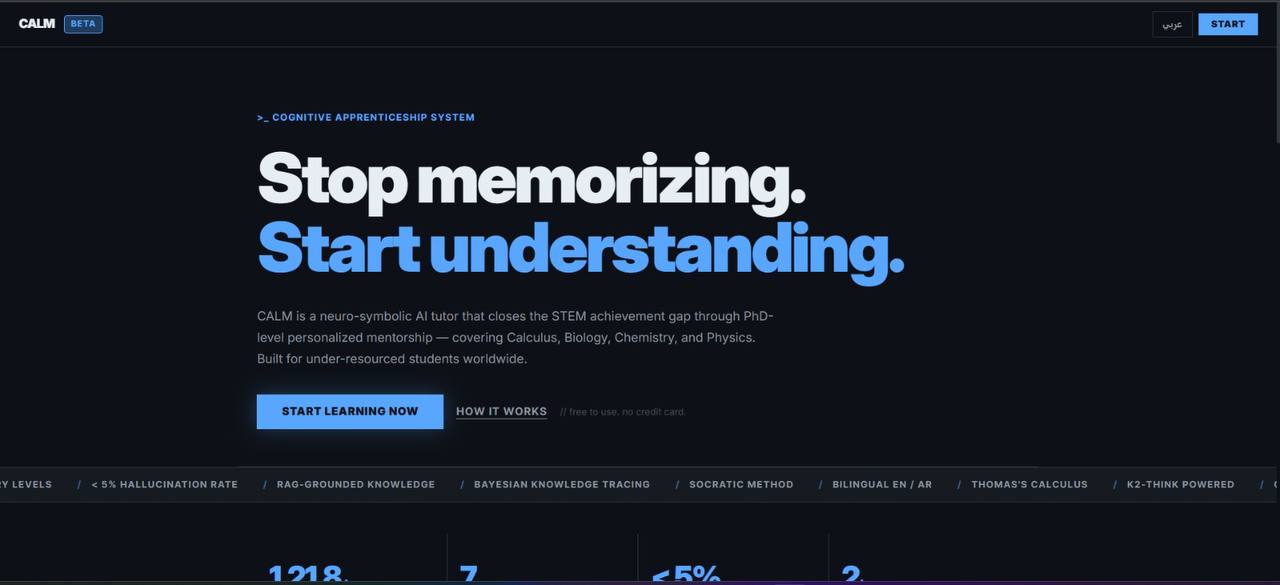
CALM was created to address this gap. Our goal is to provide a PhD-level AI mentor that guides students through reasoning rather than replacing their thinking. By combining modern AI models with structured learning principles, we aim to make world-class STEM education accessible anywhere, at zero cost.
What it does
CALM is an AI tutor designed for guided reasoning and conceptual learning.
Instead of immediately giving answers, CALM asks structured questions that help students think through problems step-by-step. The system adapts explanations based on the student's current mastery level and encourages active engagement with the material.
Students can explore mathematical ideas through built-in visualization tools such as a graph calculator, interact with the system using text or voice input, and receive AI-generated summaries of their learning sessions.
The goal is not just to solve problems, but to help students truly understand them.
How we built it
CALM is built on a structured Retrieval-Augmented Generation (RAG) architecture combined with reasoning models.
To improve retrieval accuracy, knowledge sources are segmented into smaller conceptual units such as chapters or topics instead of embedding entire books as a single document. These segments are embedded using OpenAI embedding models and stored in a vector database.
When a student asks a question, the system retrieves the most relevant knowledge segment and combines it with reasoning from the K2-Think-v2 model. The model performs internal reasoning before generating a Socratic response that guides the learner.
The system also includes a learner interface with progress tracking, graph visualization tools, and support for voice input, creating an interactive learning environment rather than a simple chatbot.
Challenges we ran into
One of the main challenges was preventing the AI from behaving like a typical answer-generation chatbot. Most language models are optimized to produce answers quickly, which can discourage learning.
To address this, we designed constraints in the architecture that encourage the system to guide reasoning rather than reveal final answers immediately.
Another challenge was improving retrieval quality in the RAG system. Early experiments using large documents often produced irrelevant context. Segmenting the knowledge sources into structured conceptual units significantly improved retrieval accuracy and response quality.
Accomplishments that we're proud of
We successfully built a working prototype of CALM that integrates reasoning models, structured knowledge retrieval, and an interactive learning interface.
The system demonstrates how AI can act as a learning mentor rather than an answer machine. Our architecture reduces hallucination risks by grounding explanations in trusted academic sources and improves retrieval precision through segmented knowledge indexing.
We are especially proud of building a platform that can deliver advanced educational support to students who might otherwise never have access to expert tutoring.
What we learned
Building CALM taught us that the design of AI learning systems is just as important as the underlying models.
Large language models are powerful, but without structured reasoning frameworks they often encourage passive learning. By combining reasoning models with pedagogical constraints and structured knowledge retrieval, we can transform AI from a simple tool into an active learning mentor.
We also learned that improving retrieval structure and knowledge organization has a huge impact on the reliability and usefulness of AI responses.
What's next for CALM - Cognitive Apprenticeship via Large Language Models
Language Models
Our next goal is to expand CALM beyond calculus into additional STEM subjects such as physics, biology, and chemistry. We also plan to enhance multimodal capabilities, allowing students to interact with the system using handwritten solutions, images, and richer visual learning tools. Ultimately, our vision is to create a globally accessible AI mentor capable of delivering PhD-level educational guidance to students anywhere in the world, helping reduce the global education gap through technology.


Log in or sign up for Devpost to join the conversation.