

Inspiration
Marketing teams spend heavily on ads and content, yet many still cannot answer a basic question: which campaign actually made the phone ring?
Long-established platforms such as CallRail and WhatConverts offer extensive feature sets, but they can feel overly complicated and expensive for teams that simply want clear attribution. We saw an opportunity to build a more focused alternative without the complexity associated with legacy platforms.
We created CallRadar to provide a clearer, more approachable way to connect real leads with the marketing that generated them.
What it does
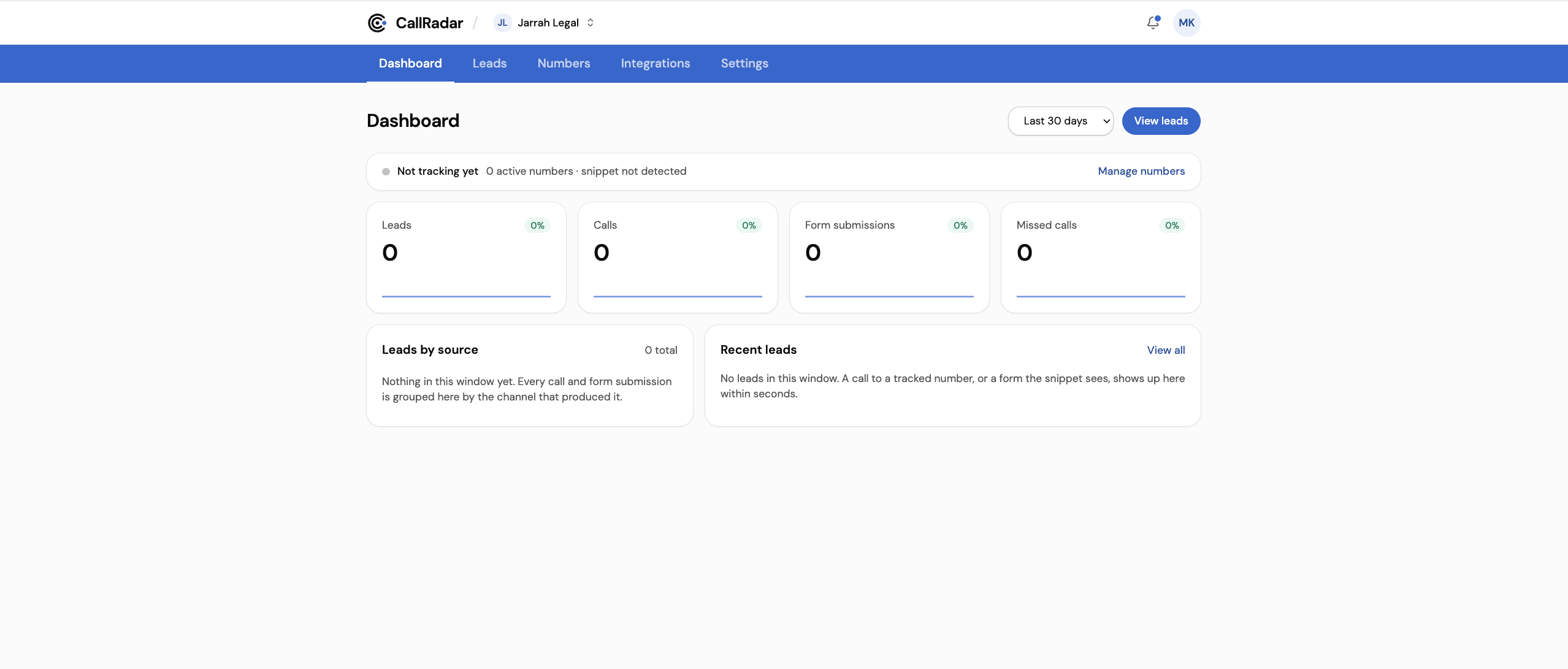
CallRadar is a call tracking and marketing attribution platform for businesses and agencies. It connects phone calls and form submissions to the campaigns, keywords, ads, and landing pages that produced them.
The platform uses dynamic number insertion to display the appropriate tracking number to each website visitor. When someone calls or submits a form, CallRadar records the lead’s marketing source and presents it in a unified report.
CallRadar also supports call recording, missed-call alerts, scheduled reports, CSV exports, conversion tracking, and integrations with tools such as Google Ads, Google Analytics 4, Meta Ads, Salesforce, Slack, and Zapier. Webhooks and a REST API make it possible to build custom workflows.
How we built it
CallRadar is built on Laravel, which provides the foundation for the application, attribution workflows, reporting, integrations, and API.
We built the platform around one core principle: setup and reporting should be as straightforward as possible. A single script handles dynamic number insertion and form tracking on a customer’s website. Behind the scenes, the Laravel application connects visitor attribution data with incoming calls and submissions, processes call events, and organizes everything into readable reports.
CallRadar also communicates with advertising, analytics, CRM, and messaging services so that lead data can move automatically between the tools customers already use. We designed each part of the product to reduce configuration work while still supporting the flexibility required by agencies managing multiple websites.
Challenges we ran into
Accurately connecting an offline phone call to an earlier online visit was one of the central challenges. Attribution data must remain consistent as visitors move between pages, interact with forms, and call a dynamically displayed number.
Telephony introduced another layer of complexity. Number provisioning, routing, recording, porting, and carrier requirements can differ across countries and number types.
Integrations created their own edge cases because every external platform handles authentication, conversion data, and failures differently. Making these systems reliable while keeping the experience simple for customers required careful error handling and reporting.
The final challenge was deciding what not to build. Call tracking platforms can quickly become overloaded with settings and dashboards, so every feature had to justify the complexity it added.
Accomplishments that we're proud of
We are particularly proud that CallRadar brings calls and form submissions together instead of forcing users to analyze them in separate products.
We are also proud of the simple installation process, the clean reports, and the ability to support agencies working across multiple client websites. The platform turns complicated attribution and telephony infrastructure into something customers can begin using without a lengthy implementation project.
Another important milestone was acquiring CallTrackingFox.com, a call-tracking SaaS company previously backed by Dreamit Ventures, as part of CallRadar’s launch.
What we learned
Building CallRadar taught us that attribution is rarely as simple as matching one click to one conversion. Browsers, advertising platforms, phone carriers, consent requirements, and real customer behavior all introduce edge cases.
We also learned that clarity is a product feature. Customers do not necessarily need another complicated dashboard; they need reliable answers they can understand, share, and act on.
Most importantly, we learned that technical support, documentation, and product development are closely connected. Every customer question reveals an opportunity to make the product or its explanation better.
What's next for CallRadar
The next stage is focused on expanding integrations, improving attribution and reporting, and making setup even faster for businesses and agencies.
We also plan to develop more automation options, strengthen tools for agencies managing multiple clients, and continue improving the platform based on real customer feedback.

Log in or sign up for Devpost to join the conversation.