-
-
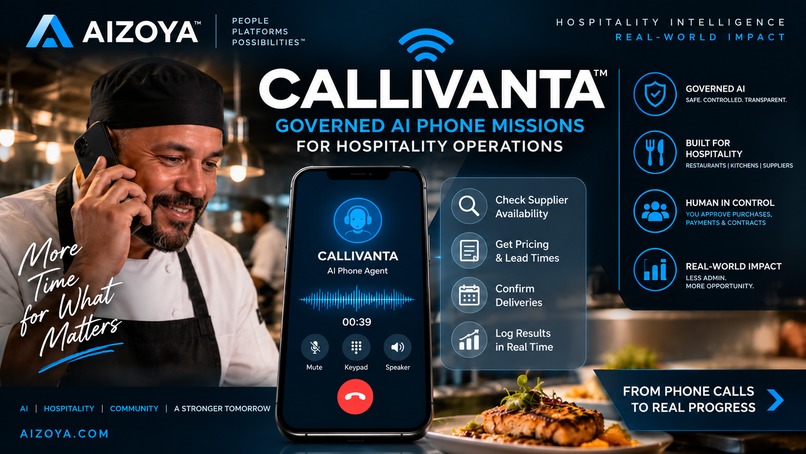
CALLIVANTA Mission Control — governed CALL-E restaurant operations workflow
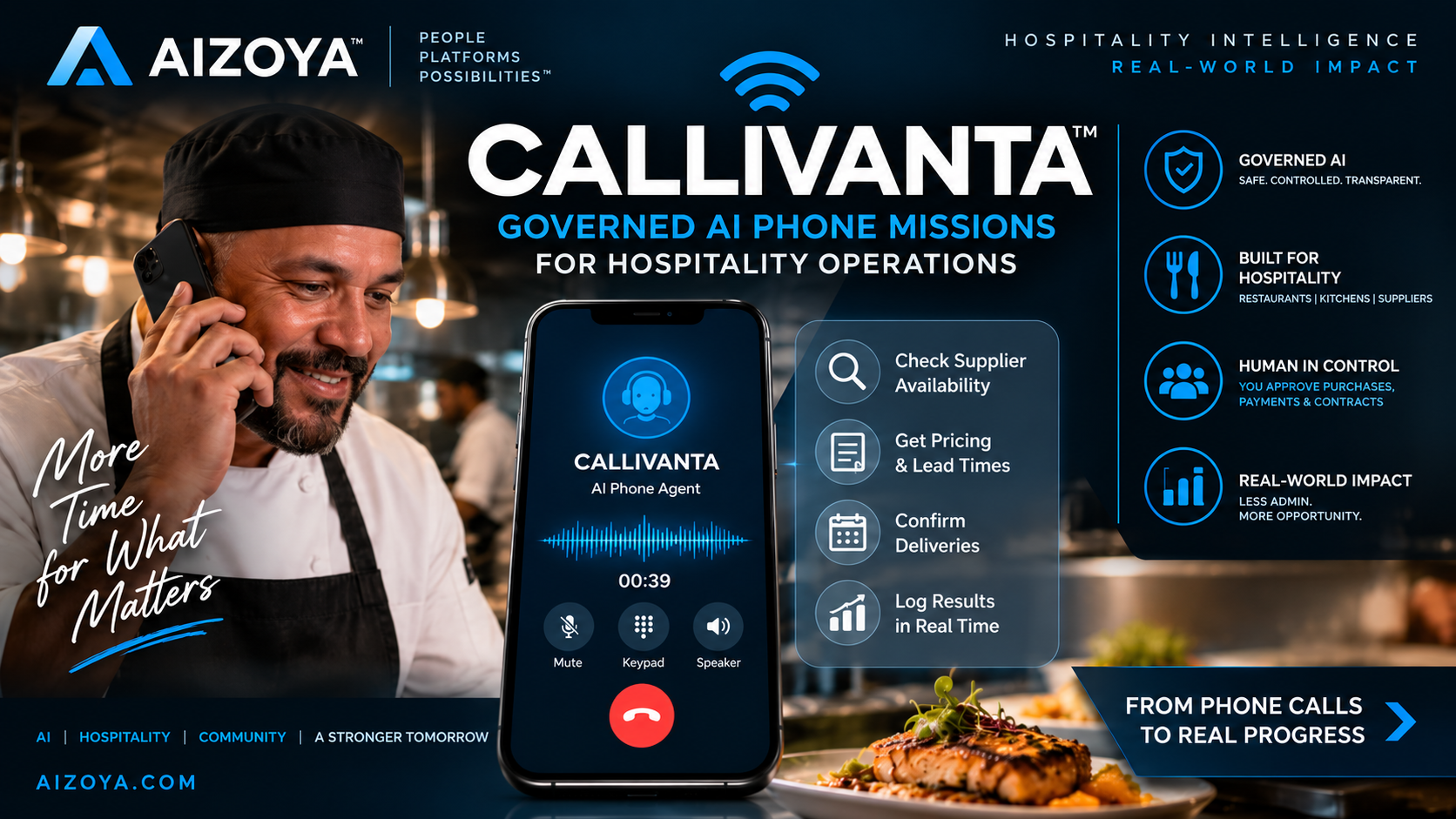
Inspiration
Hospitality operators often lose valuable time calling suppliers to confirm availability, quantities, delivery timing, or other urgent operational details. These calls matter, but they are repetitive, difficult to track, and often disconnected from the systems operators use to make decisions.
CALLIVANTA Mission Control was built to turn that manual communication problem into a structured, governed agentic workflow.
What it does
CALLIVANTA is an agentic voice mission-control system that uses CALL-E to execute bounded outbound phone missions, capture structured evidence, and turn real-world operating exceptions into clear next actions.
The workflow is:
An operator identifies an operational information gap. CALLIVANTA creates a bounded mission defining what may be asked and what actions are prohibited. CALL-E executes the outbound phone interaction. The result is captured and normalized as structured mission evidence. CALLIVANTA surfaces that evidence for an authorized human to make the consequential business decision.
For this challenge, the implementation focuses on a restaurant supplier-information use case involving product availability, quantity, and earliest fulfillment timing.
CALLIVANTA gathers information. It does not autonomously place orders, authorize payments, accept contracts, or make other consequential commitments.
How we built it
We built CALLIVANTA as a focused CALL-E integration rather than a generic voice platform.
The challenge implementation includes:
a Node.js ESM CALLIVANTA Mission Control reference app a bounded supplier-information mission workflow CALL-E Developer API integration exact-destination authorization for controlled live execution idempotency protection asynchronous call-status polling structured-result handling deep output sanitization deterministic dry-run/no-call behavior automated tests using fake provider responses a judge-facing Mission Control interface a sanitized public contribution to the CALL-E awesome-phone-call-agents repository
During development, we also completed a verified live CALL-E call, confirming the end-to-end phone integration.
Challenges we ran into
The biggest challenge was proving a real phone workflow while keeping the public contribution safe, reproducible, and free of sensitive information.
We needed to clearly separate:
verified live-call evidence deterministic demonstration data sanitized public repository examples private product architecture judge-facing product presentation
We also strengthened the integration around exact-destination authorization, output sanitization, idempotency, and human decision boundaries.
That separation allowed us to preserve credible technical proof without exposing private phone numbers, credentials, recordings, or production data.
Accomplishments that we're proud of Completed a verified live CALL-E integration Built a reusable supplier-information mission pattern Converted phone interactions into structured operational evidence Implemented dry-run-first execution and deterministic automated tests Preserved human authority over purchases, payments, contracts, and other consequential actions Published a sanitized public CALL-E reference implementation Submitted upstream PR #396, which was reviewed and merged into CALLE-AI/awesome-phone-call-agents Demonstrated that CALL-E can serve as an execution channel inside a larger operational intelligence system
What we learned
Voice agents become significantly more useful when the phone call is treated as one step inside an operational workflow, rather than the final product.
The key design lesson was that success is not simply:
“The agent made a phone call.”
The more valuable outcome is:
“The system obtained trustworthy evidence, preserved the appropriate decision boundary, and gave the operator what they needed to act.”
We also learned that real-world agent systems need strong separation between execution, evidence, and authority.
What's next for CALLIVANTA
The same mission-control architecture can expand beyond supplier availability into:
delivery exceptions vendor coordination catering and event confirmations reservation and hospitality operations service recovery operational follow-up customer and partner coordination other business workflows that still depend heavily on phone calls
Food and hospitality are the first proving ground, but the underlying architecture is designed to support additional verticals through governed capability packs.
The long-term goal is to make voice communication a governed, observable, evidence-producing execution layer inside operational software.
Built With
- agentic
- ai
- api
- call-e
- github
- json
- node.js
- rest
- schema
- typescript
- vercel
- voice


Log in or sign up for Devpost to join the conversation.