Inspiration
What it does# Project Story
Inspiration
I built CallFlow AI around a simple question:
What if businesses could have AI employees that don't just chat on a screen, but can actually communicate with people through phone calls?
Phone-based work is still a major part of many businesses. Sales teams make calls, support teams answer questions, recruiters contact candidates, and businesses spend countless hours scheduling appointments and following up with customers.
I wanted to explore how AI could turn those repetitive conversations into something more intelligent and automated.
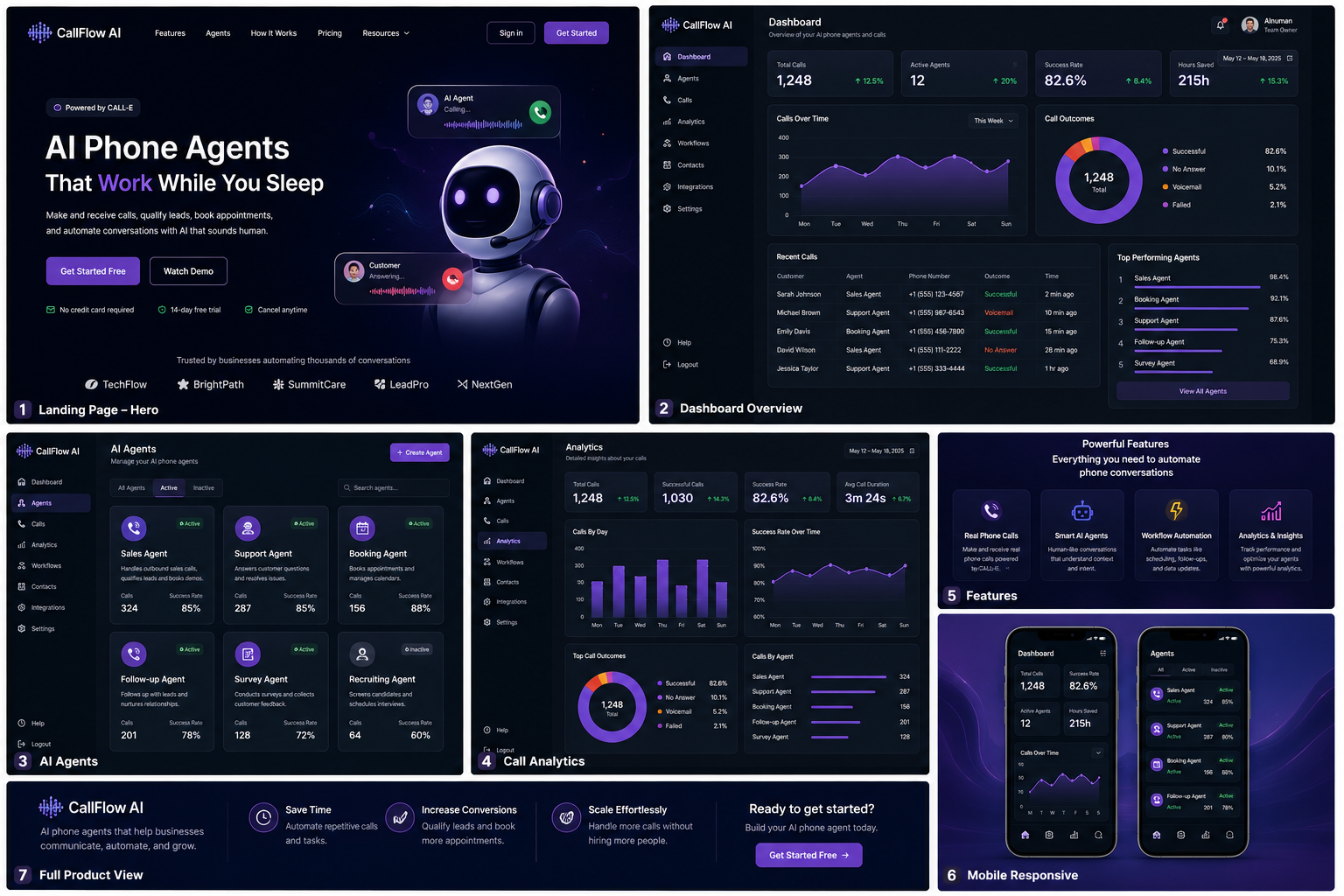
That idea became CallFlow AI — a platform concept for building AI phone agents that can make and receive real phone calls, qualify leads, schedule appointments, automate workflows, and handle real-world tasks. The landing page is built around the vision of AI phone agents powered by CALL-E.
What I Learned
Building CallFlow AI helped me understand that creating an AI product is not only about the AI model itself. The surrounding product experience is just as important.
I learned how to:
- Build a modern application using Next.js 16, React 19, and TypeScript.
- Structure a project using reusable components instead of putting the entire interface into one page.
- Create a responsive SaaS-style landing page and dashboard.
- Design interfaces for AI agents, analytics, and business automation.
- Use component libraries and utilities such as Lucide React, Radix UI, Tailwind CSS, and shadcn.
- Work with forms and validation using React Hook Form and Zod.
- Think about how an AI phone platform could eventually connect conversations, agents, workflows, and analytics.
The project also taught me an important product lesson: a powerful technology needs a simple interface. Users should understand what the product does within seconds.
How I Built It
I built CallFlow AI as a modern Next.js application with a component-based architecture.
The main landing page is composed of reusable sections such as the navigation bar, hero section, and feature section. The dashboard is separated into its own route and uses reusable statistic cards to present important information about AI phone agents.
The core product concept is:
$$ \text{Business Task} \rightarrow \text{AI Phone Agent} \rightarrow \text{Real Conversation} \rightarrow \text{Task Completion} \rightarrow \text{Analytics} $$
The interface focuses on three main capabilities:
Real Phone Calls
AI agents are designed around the idea of making and receiving real phone calls through CALL-E.
Smart AI Agents
The platform concept allows businesses to create specialized agents for different purposes, including sales, customer support, recruiting, and other workflows.
Analytics
The dashboard is designed to give businesses a quick overview of their automated phone operations, including total calls, active agents, success rate, and estimated hours saved.
Technology
The current project uses:
- Next.js 16
- React 19
- TypeScript
- Tailwind CSS
- Framer Motion
- Lucide React
- Recharts
- React Hook Form
- Zod
- Radix UI
- shadcn
- Axios
These dependencies gave me a strong foundation for building a polished SaaS interface while keeping the project modular and extensible.
Challenges I Faced
One of the biggest challenges was turning a broad idea — "AI that makes phone calls" — into a product experience that people could immediately understand.
There are many pieces involved in an AI phone platform: agents, conversations, tasks, workflows, analytics, and eventually real-time voice infrastructure. I had to think about how these pieces could fit together without making the interface overwhelming.
Another challenge was building the dashboard in a way that feels like a real business operations platform rather than simply a collection of UI cards.
I also had to make architectural decisions about reusable components, routing, styling, responsive layouts, and how the application could grow beyond the initial prototype.
These challenges taught me that good product development is often about reducing complexity for the user, even when the technology behind the product is complex.
How AI Helped Me
AI played an important role in the development process.
I used AI as a development co-pilot to help explore ideas, structure components, debug problems, improve code, and think through the product experience.
But one of my biggest lessons was that AI does not remove the need for engineering decisions.
I still had to decide:
- What the product should actually do.
- Which features matter most.
- How users should navigate the application.
- How the dashboard should communicate information.
- Which technologies and components fit the project.
- How the idea could evolve into a real production platform.
AI accelerated the process, but the product vision and final decisions remained mine.
What's Next
CallFlow AI is only the beginning of the idea.
The next stage would be moving from a polished product concept and interface toward a fully operational AI phone platform.
Future improvements could include:
- Real phone-number integration
- Live voice AI conversations
- Agent creation and configuration
- Call scheduling and automation
- Conversation transcripts
- Lead qualification
- Appointment booking
- CRM integrations
- Real-time call monitoring
- Advanced analytics
- Call recordings and summaries
- Multi-agent workflows
- Authentication and team management
- Persistent cloud data
The long-term vision is to make CallFlow AI a platform where a business can describe a task, create an AI phone agent, deploy it, and then monitor the results from one place.
Final Takeaway
Building CallFlow AI taught me that the future of AI is not only about answering questions.
It is about taking action.
Instead of an AI that simply tells you what to do, I imagine AI systems that can communicate, coordinate, follow workflows, and complete useful tasks on behalf of people.
That is the idea behind CallFlow AI:
Let AI handle the conversations, so people can focus on the work that matters.
How we built it
Challenges we ran into
Accomplishments that we're proud of
What we learned
What's next for CallFlow AI
Built With
- agents
- ai
- application
- axios
- conversational
- css
- dashboard
- form
- framer
- hook
- lucide
- motion
- next.js
- radix
- react
- recharts
- saas
- shadcn/ui
- tailwind
- typescript
- ui
- voice
- web
- zod

Log in or sign up for Devpost to join the conversation.