Inspiration
Most AI outreach tools jump straight from a website to a generated email.
That approach often produces generic outreach because the AI has very little understanding of the business it is contacting.
I wanted to build something different.
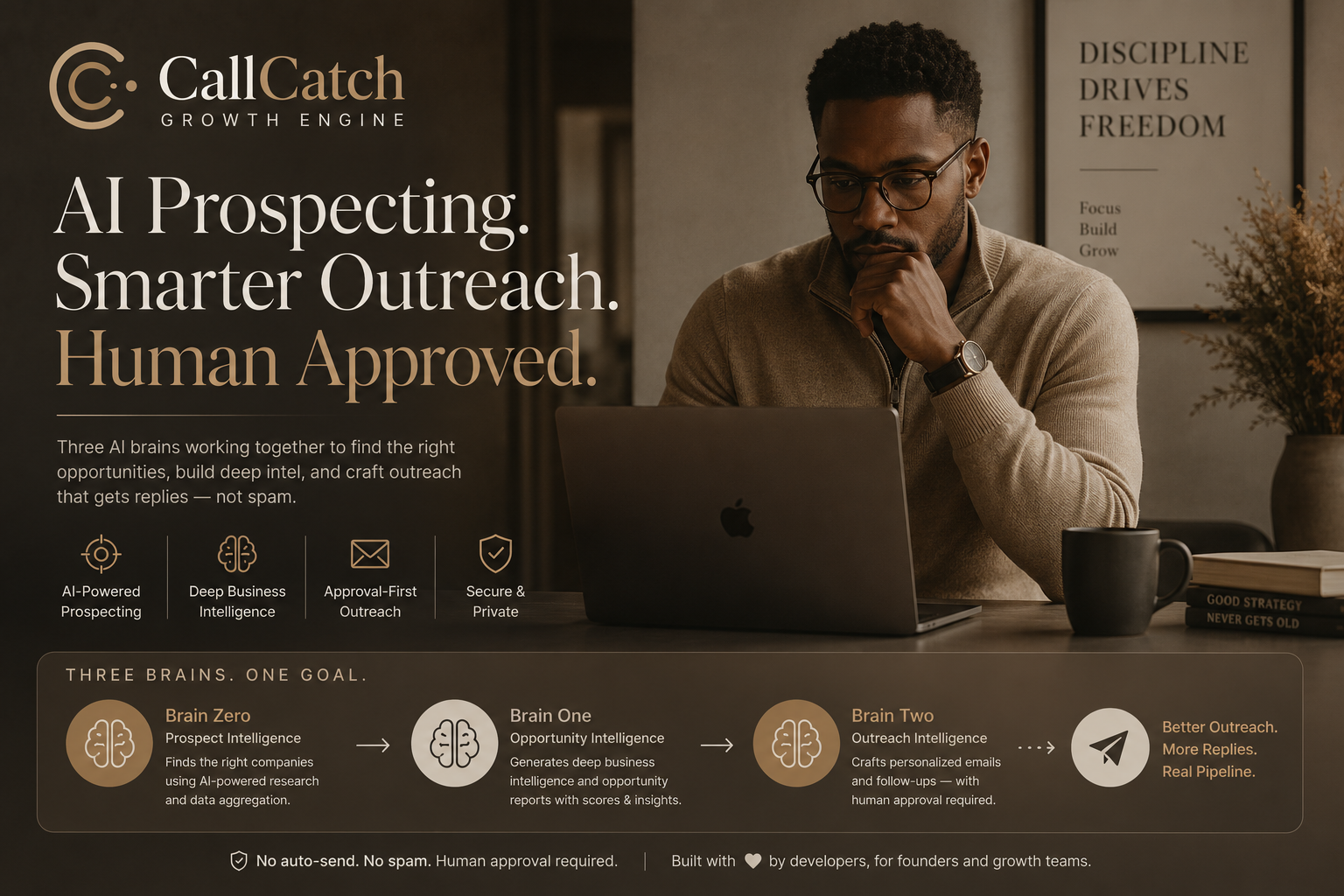
Instead of one AI doing everything, I designed CallCatch as a collection of specialized AI brains, where each brain has one clear responsibility. This makes the reasoning more explainable, easier to test, and much easier to improve over time.
What it does
CallCatch researches businesses before any outreach is created.
The platform first gathers evidence from public sources, evaluates the business, identifies growth opportunities, and only then prepares personalized outreach for human review. The current architecture consists of:
- Brain Zero – Evidence Collection
- Brain One – Opportunity Intelligence
- Brain Two – Outreach Intelligence
Brain Zero gathers structured evidence.
Brain One analyzes the business and produces scores such as Business DNA, Digital Health, AI Discoverability, Opportunity Radar, Hidden Opportunities and Trust signals.
Brain Two consumes only the approved Brain One output and prepares personalized outreach including contact persona, outreach strategy, subject lines, email drafts, follow-up emails and confidence scoring.
Importantly, Brain Two never sends emails automatically. Human approval is always required.
How we built it
I built CallCatch using JavaScript running on Node.js with a modular service architecture.
GPT-5.6 and Codex were used throughout development to design the architecture, implement production services, improve modularity, generate tests, fix production bugs and accelerate development.
The application is deployed on Render and currently operates as a production-ready web application.
Challenges we ran into
The biggest challenge was ensuring that each AI brain had a deterministic responsibility instead of overlapping logic.
During testing I also encountered several edge cases in the evidence pipeline, including missing evidence references that caused Brain One validation failures. Those bugs were fixed with additional regression tests while keeping the intelligence logic unchanged.
Designing independent AI services instead of one large prompt required more engineering work, but resulted in a cleaner and more maintainable system.
Accomplishments that we're proud of
I am proud that CallCatch evolved from a simple outreach idea into a working multi-brain AI system with clear boundaries between research, analysis and outreach.
Key accomplishments include:
- Building Brain Zero as an evidence collection layer that gathers and structures public business information.
- Building Brain One as an independent opportunity intelligence service that evaluates Business Foundation, Business DNA, Trust, Digital Health, AI Discoverability, Future Readiness and growth opportunities.
- Building Brain Two as a separate outreach intelligence service that consumes only approved Brain One output.
- Separating business quality from contactability, so a strong company is not incorrectly scored as a weak business simply because no verified contact path exists.
- Adding manual company analysis so the system can test any business by name and website.
- Creating human approval controls before any outreach intelligence progresses further.
- Adding modular validation, regression testing, failure-stage tracking and safe background processing.
- Deploying the working application to Render and testing it against companies including Microsoft, Stripe, HubSpot and Shopify.
- Using Codex and GPT-5.6 throughout the real development process to architect, debug, test and improve the system.
The accomplishment I value most is that CallCatch is no longer one large prompt. It is now a repeatable intelligence pipeline where each AI service performs one clearly defined job.
What we learned
This project reinforced that reliable AI systems are built through architecture, testing and clear separation of responsibility not larger prompts. By splitting intelligence into independent AI brains, I was able to build a system that is easier to understand, safer to operate and easier to extend in future versions.
What's next for CallCatch:
The next stage is to complete and connect the remaining intelligence and execution layers.
Planned improvements include:
- Strengthening Brain Two’s contact-persona selection, outreach angles, subject lines, first email and follow-up sequence.
- Building Brain Three as an approval and campaign execution layer.
- Adding verified decision-maker discovery while preserving evidence and confidence scoring.
- Creating a voice approval assistant that can tell the user when a draft is ready and accept spoken approval or rejection.
- Adding reply intelligence so the system can classify responses, recommend the next action and update the CRM.
- Expanding analytics to measure reply rates, meetings booked, opportunities created and revenue influenced.
- Supporting more industries and countries beyond the current service-business discovery flow.
- Improving the user interface so the full multi-brain process is easier to understand at a glance.
- Making the system suitable for teams, agencies and businesses that need a repeatable outbound growth engine.
The long-term vision is for CallCatch to operate as an intelligent growth team: researching companies, understanding their needs, preparing responsible outreach, requesting approval and learning from every result while keeping a human in control.
Built With
- codex
- github
- gpt
- html
- javascript
- node.js

Log in or sign up for Devpost to join the conversation.