Inspiration
A support form captures a question, but it does not always uncover why someone is stuck. For an independent creator using a SaaS tool, a short conversation can clarify a project blocker or product question and identify when a human should help.
CallBridge Connect explores that missing step: an explicitly requested AI phone check-in, with a human operator controlling whether a call happens. Aura Manager, an existing AI workspace for creative projects, is our first integration pilot. An AI callback is clearly labelled as AI and is separate from a request to speak with a human.
What it does
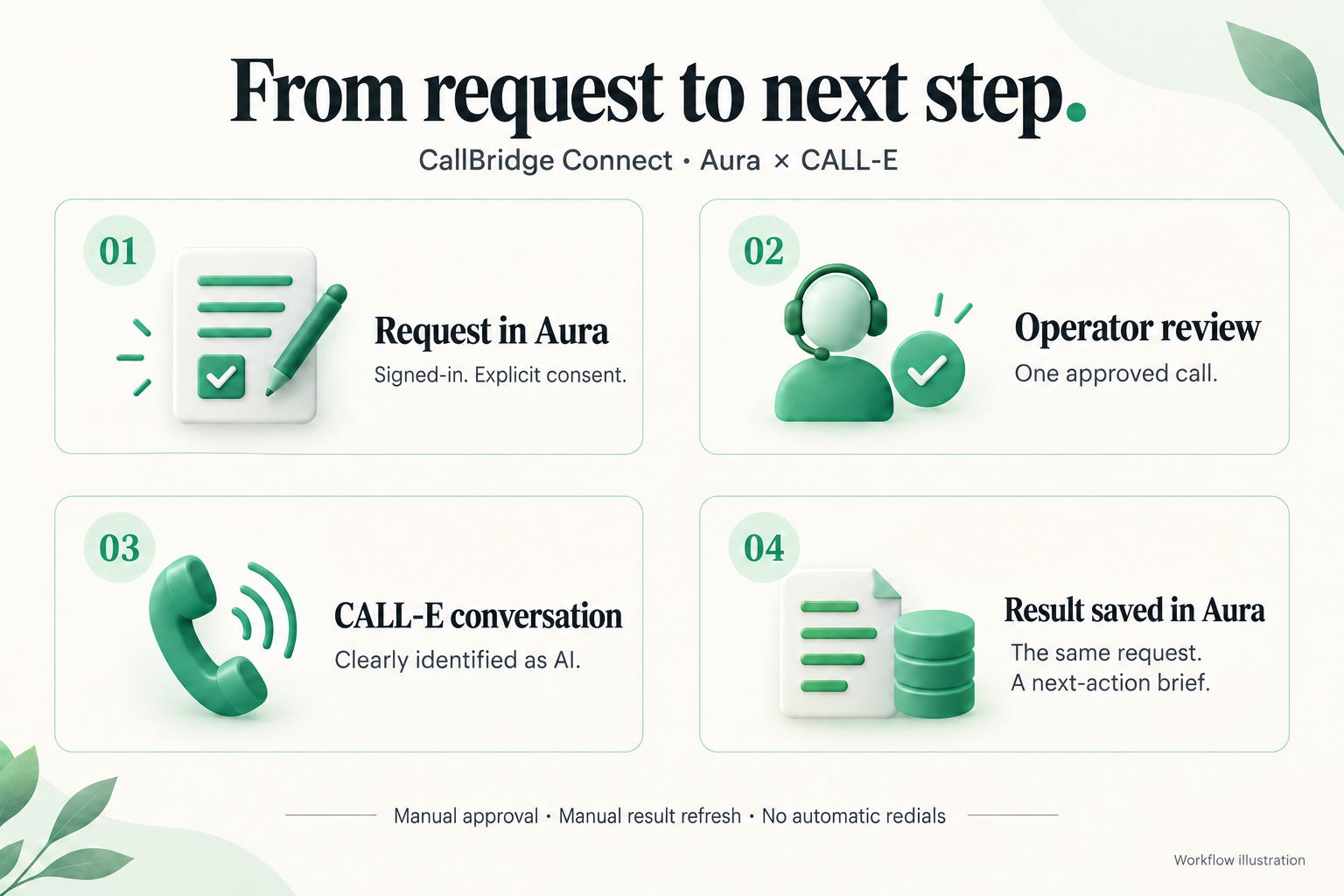
A signed-in Aura user can request one AI callback, provide minimal context, and give explicit consent. The request is stored privately, and the user can view its status or cancel before a call starts. A private CallBridge operator console reads the queue and enforces a separate approval step.
The CALL-E SDK adapter turns an approved request into a conversation and a structured brief: the blocker or question, urgency, a next action, and any requested human follow-up. The human remains responsible for custom pricing, account changes, and follow-up decisions. Creating a request never automatically dials, and the app does not promise live human transfer.
The public Render demo is a separate, fictional no-call experience. Visitors can explore sample creation, preview, and operator review without exposing real customer data or using telephony credits.
How we built it
The React and TypeScript interface began in Lovable and was integrated with a Python backend using Codex. TanStack Start, Router, and Query power the web interface. The backend uses the official CALL-E Python SDK with a result schema, a stable request idempotency key, and an atomic dispatch claim to guard against duplicate calls.
For the Aura pilot, the existing Aura sign-in and Supabase database hold owner-scoped callback requests. CallBridge accesses that queue through a narrow authenticated server API; it does not need Aura's database credentials. Docker packages the public demo for Render. CALL-E credentials remain on the backend, never in frontend code.
Codex helped implement the consent flow, storage adapter, operator controls, failure handling, deployment configuration, documentation, and tests. On September 14, 2026, 29 Python tests and 11 Aura tests passed locally. These automated tests use fake providers and do not prove a successful live conversation.
Challenges and verified pilot
The hardest part was keeping the application honest about real-world side effects. A sample preview must not become a real call, a repeated click must not create a duplicate, and an uncertain provider response must not trigger an automatic retry.
On September 14, 2026, one complete operator-approved Aura callback was verified: a signed-in user saved a consented request, CallBridge dispatched it through the CALL-E SDK exactly once, the user and AI had a two-way conversation, and the returned structured result was saved and independently re-read on the same Aura request. Aura then displayed "Call task completed." The demo video shows the request, the real conversation, and the completed outcome.
The call clarified a request for more daily image generation for short-film storyboards and captured a request for human follow-up. No account allowance was changed and no human appointment was booked. The verified path used an operator-triggered result refresh, not unattended automation.
Earlier direct CLI tests reached a Sonetel announcement rather than the recipient. Those failed receiving-end tests are separate from this successful, app-driven Aura callback.
An earlier app-driven SDK submission returned no confirmed provider call ID and remains locked for review. We have not retried that uncertain request or attached an unrelated CLI result to it. The successful pilot used a separate fresh, consented request and its own matching provider result. The public sample output is not presented as real call evidence.
Accomplishments and what we learned
We built a reusable, guarded callback workflow with explicit consent, private durable request storage, masked phone displays, operator approval, and clearly separated sample and live paths. We learned that phone-agent reliability depends on the receiving endpoint, supported destinations, and trustworthy outcome handling as much as the prompt itself.
What's next
Reconcile the older uncertain SDK submission without blind retries, improve receiving-end guidance and operator recovery, and evaluate a small opt-in pilot with supported, approved numbers. Broader CRM integrations, automated outreach, and multi-business accounts are future work. We do not claim revenue, customer conversion gains, or a completed production calling service.
Try it
Public fictional demo: https://callbridge-connect.onrender.com/
Source: https://github.com/Senseiglobal/callbridge-connect
Contest contribution PR: https://github.com/CALLE-AI/awesome-phone-call-agents/pull/511
Built With
- call-e
- docker
- python
- react
- render
- supabase
- typescript

Log in or sign up for Devpost to join the conversation.