-
-
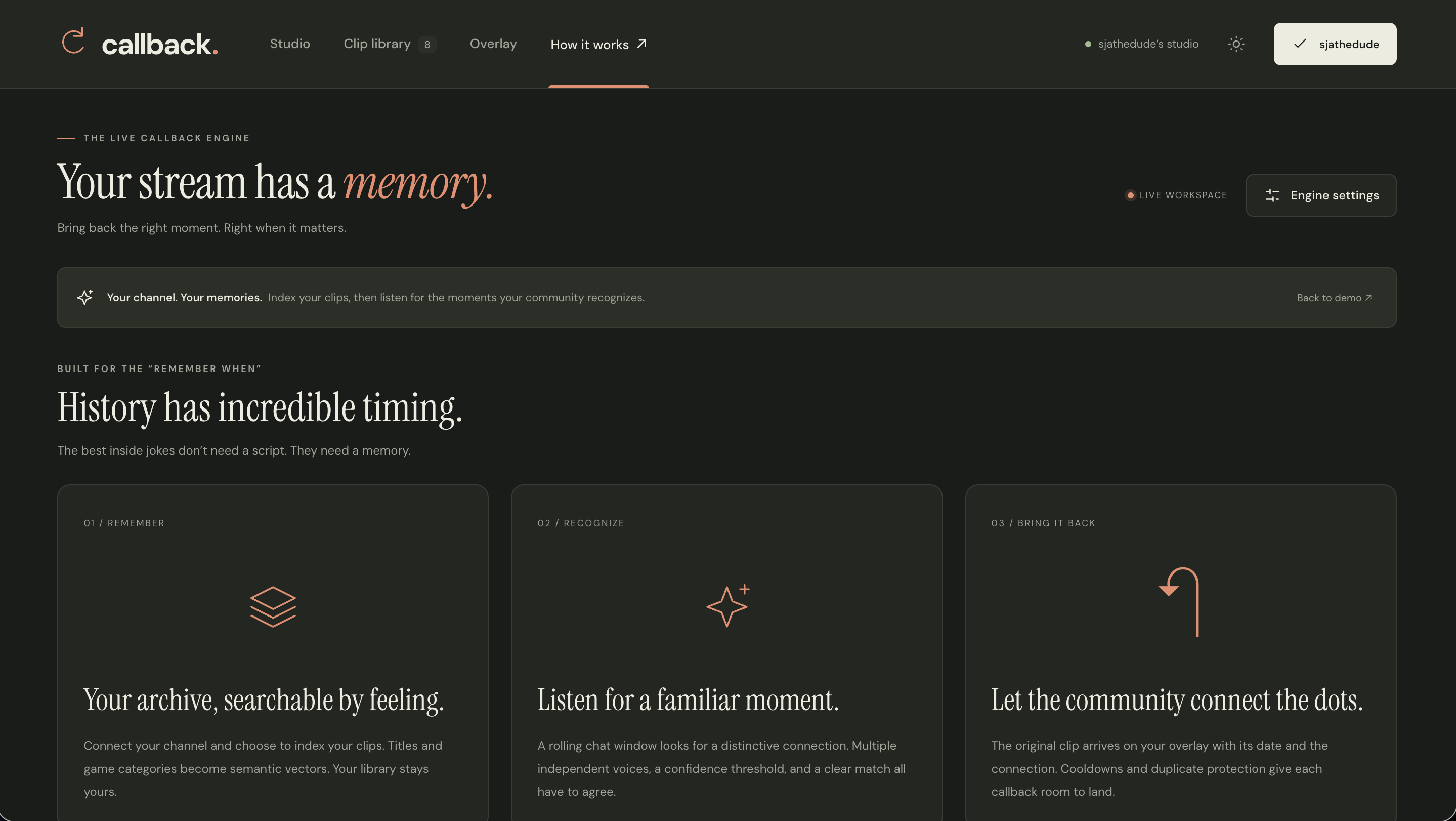
How it works
-
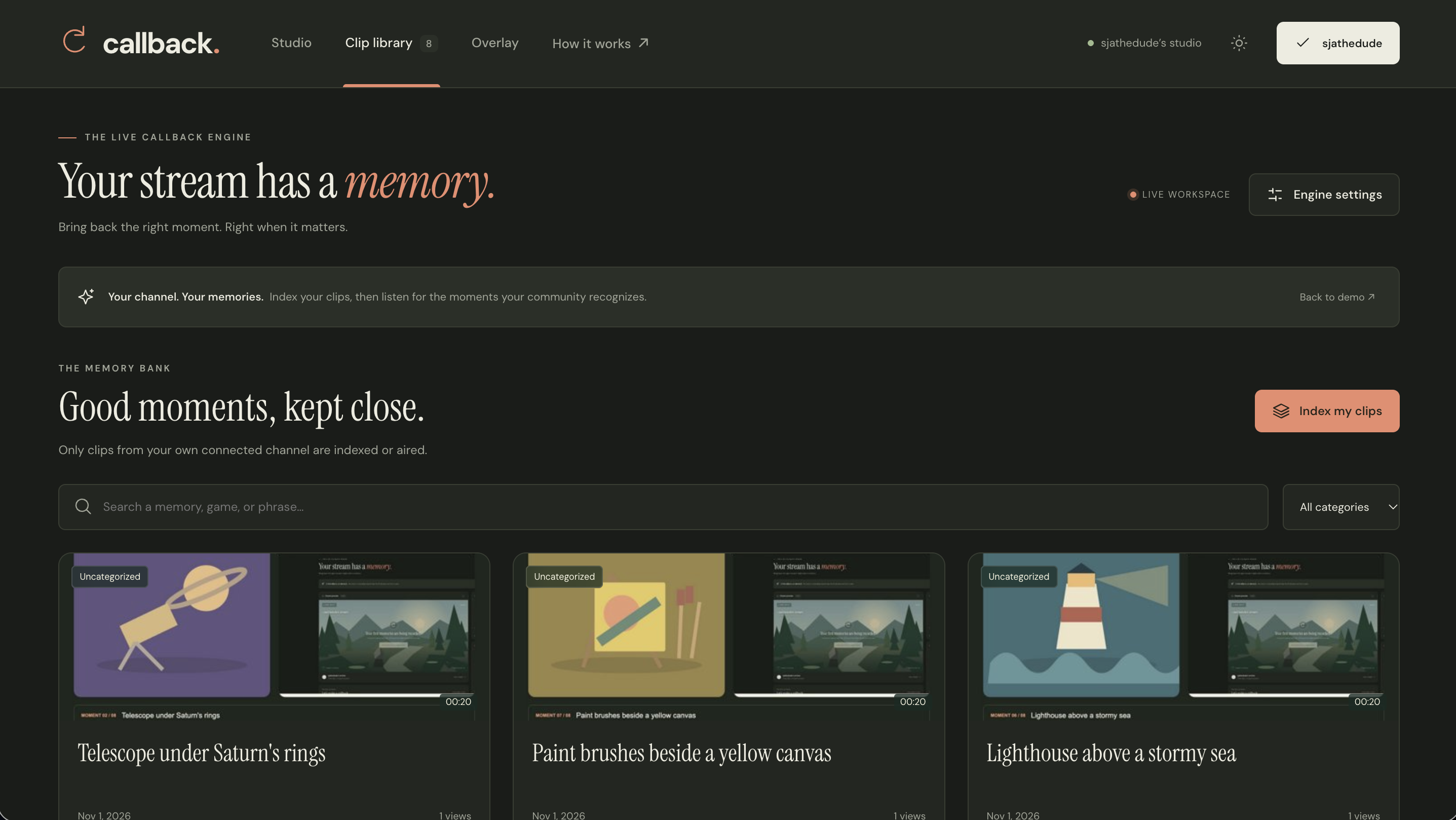
Clip Library
-
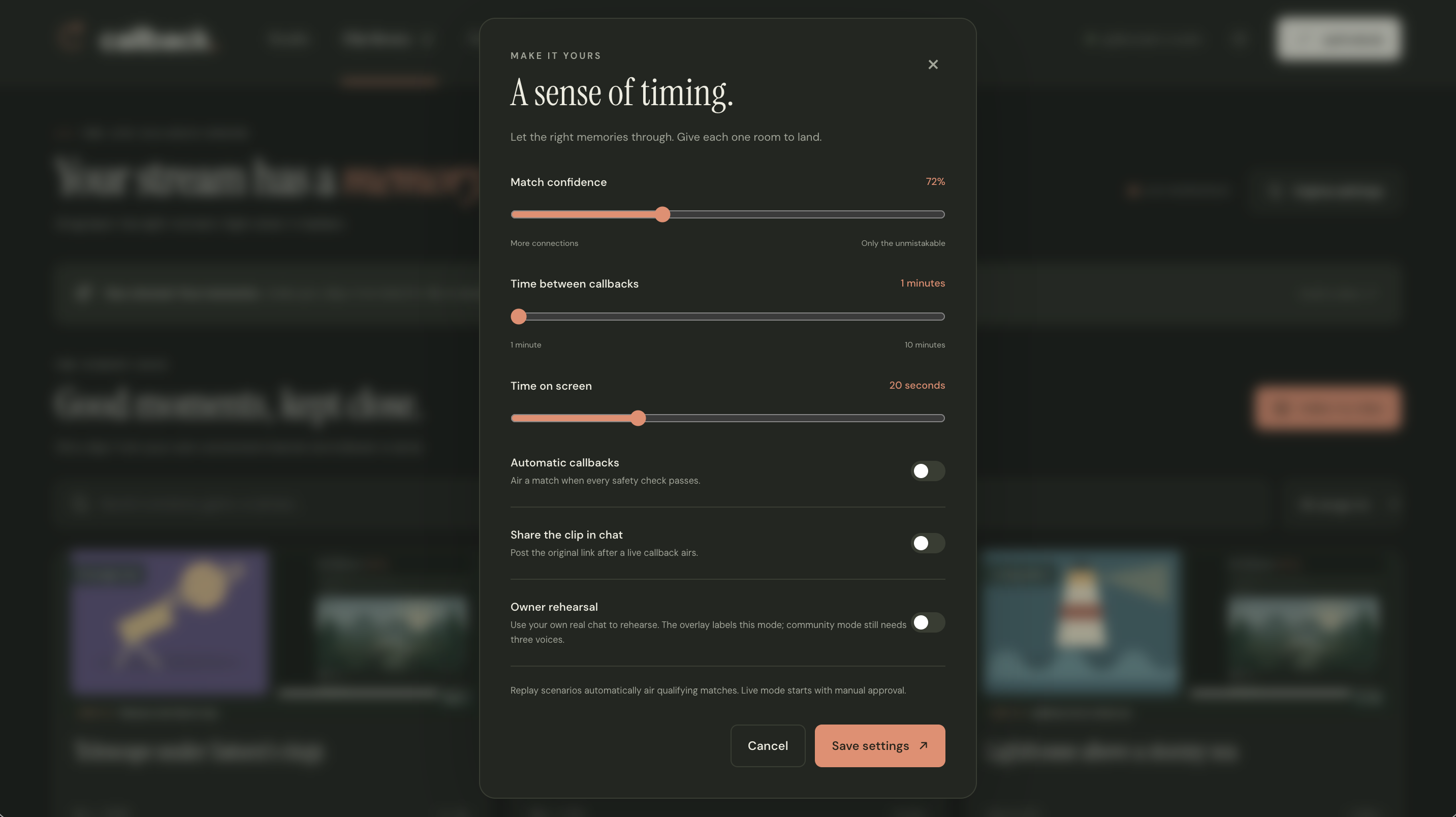
Engine Settings
-
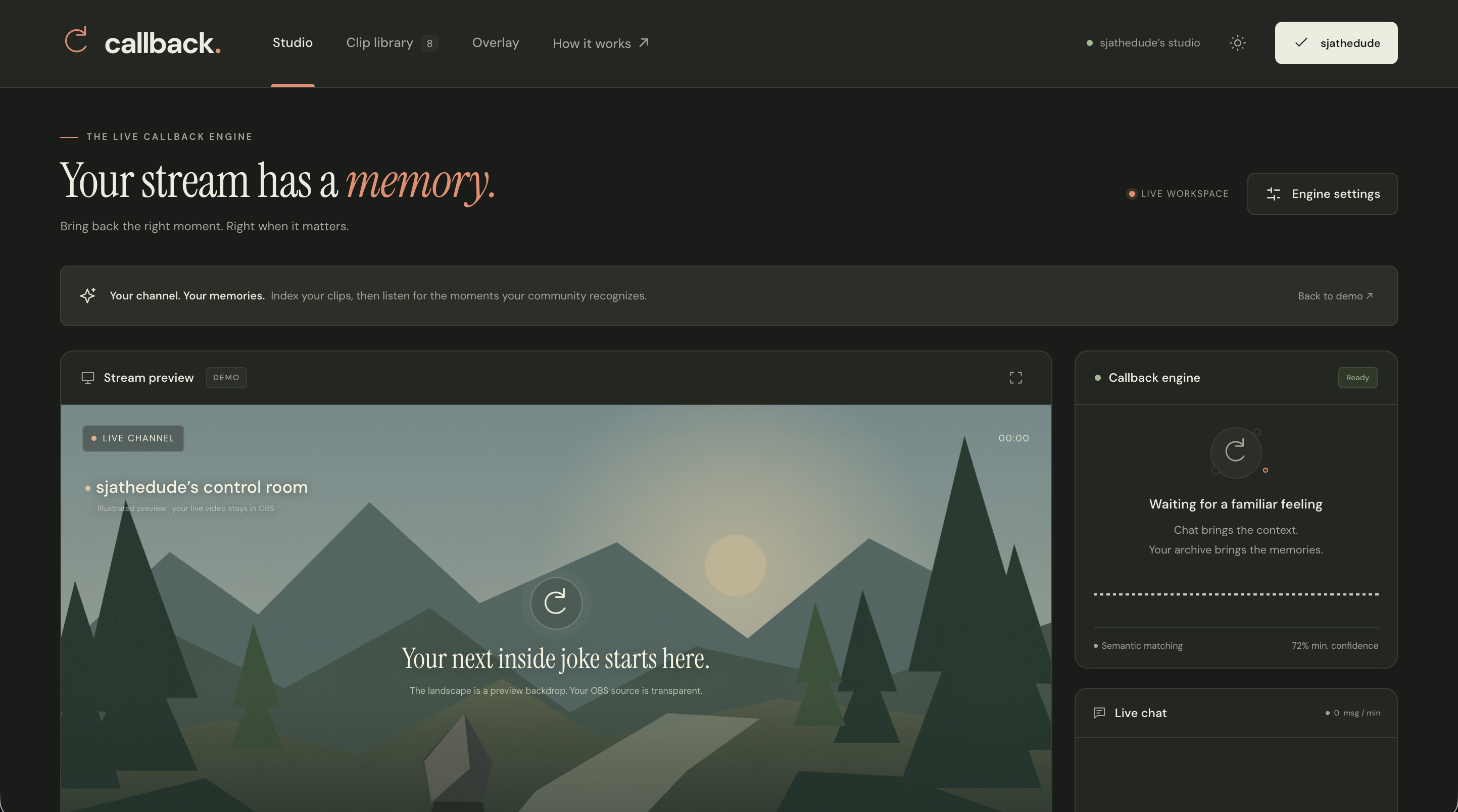
Studio
Inspiration
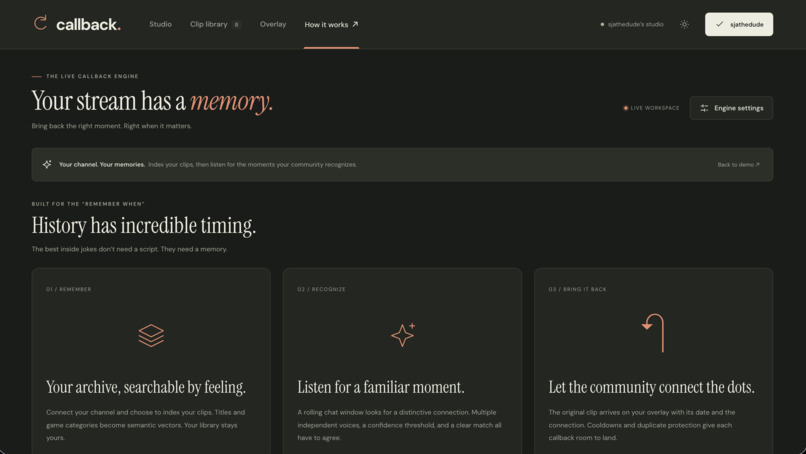
Stream communities run on shared history. The joke that keeps coming back. The corner you always die in. The thing chat still brings up two years later.
That history exists. It's sitting in a clip archive nobody can search while they're producing a live show. The moment a callback would land, it's gone, because remembering it takes longer than the moment lasts.
I wanted to give a stream its own memory.
What it does
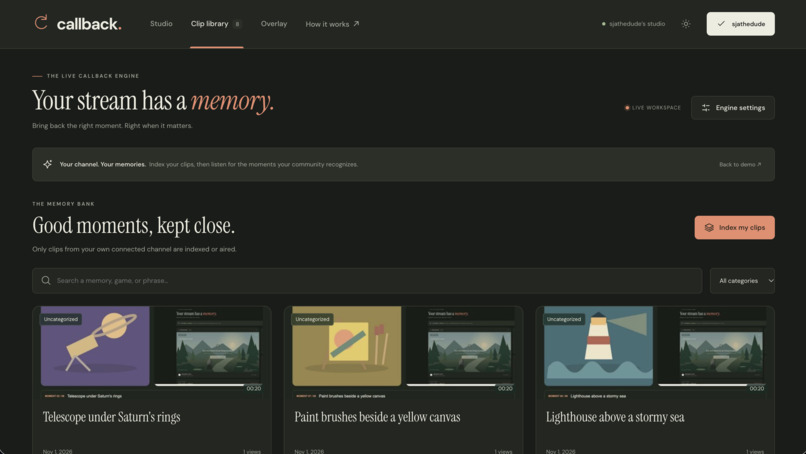
A streamer connects their channel and indexes their own clips. Callback then sits invisible until it's needed.
It listens to live chat. When several chatters land on something that matches a moment from the archive, an overlay brings the old clip back on screen with its date and a line explaining the connection, and, when chat posting is enabled, the bot posts the original link in chat.
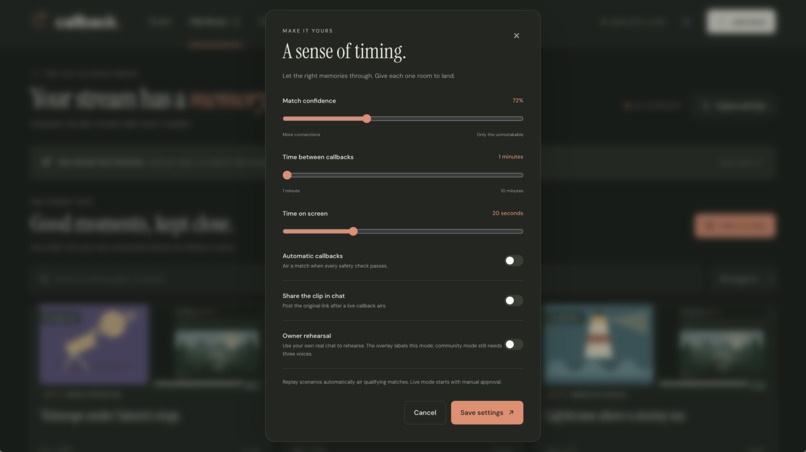
The restraint is as much the product as the retrieval. An uncertain match is held, not forced. A callback has to clear confidence, ambiguity, cooldown, duplicate, freshness and ownership checks before it airs, and the streamer gets a seven-second veto window for automatic callbacks. Eligible candidates can also be approved manually.
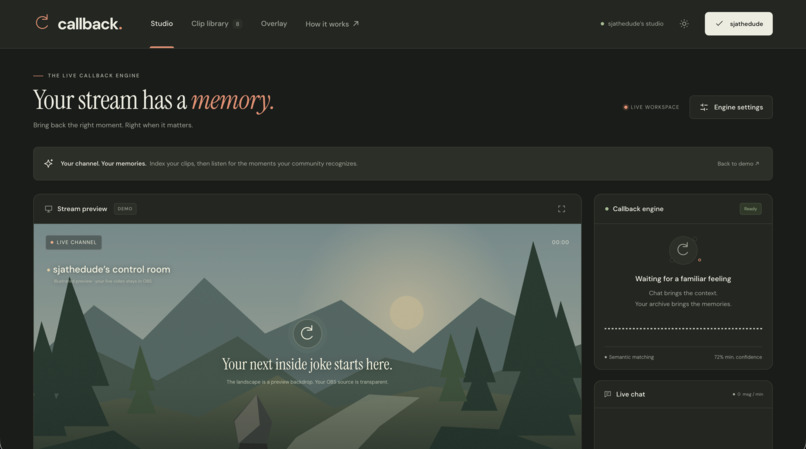
The control panel shows the whole decision: indexing progress, chat activity, up to three ranked matches, their separation, and why it aired or didn't.
There's an account-free replay so anyone can try it without waiting for a stream to go live.
How I built it
A Cloudflare Worker handles Twitch OAuth, token refresh and Helix calls. Indexing pulls a channel's clips, verifies ownership, resolves game categories, and embeds titles and categories with BGE Small English v1.5. Vectors live in a Durable Object per studio.
EventSub WebSockets deliver live chat. A rolling 30-second window is embedded and ranked against the clip vectors by cosine similarity. Community mode needs three distinct chatters, a score above threshold, and at least a 0.08 lead over the next-best clip. Both the threshold and the runner-up margin must pass; similarity is not treated as a calibrated probability.
The overlay is a transparent page added to OBS as a browser source, driven over a separate read-only WebSocket. Twitch application credentials and OAuth tokens are kept out of browser code and API responses.
How I used Codex
I described the experience I wanted and the production constraints, and built the project with OpenAI Codex. It scaffolded the frontend and the Worker, implemented Twitch OAuth and Helix clip indexing, wrote the EventSub subscription and chat ingestion, and wired semantic retrieval to the overlay.
It also built the parts that make it safe to put on a live broadcast: the confidence and ambiguity gates, cooldown and duplicate checks, account-switch isolation, the persistent veto queue, and delivery confirmation that only reports success when Twitch confirms it. It wrote tests for weak matches, foreign clips, stale candidates, veto cancellation and Twitch backoff, then drove the deployed app through browser checks at phone and desktop widths in both themes, configured the real OBS browser source, and measured its transparency.
Challenges I ran into
Score alone is not enough. The engine checks both similarity and the gap between the best and second-best clips. Automated tests verify that weak and ambiguous candidates are held; there is no measured comparison of the margin against threshold tuning.
A wrong callback on a live stream is worse than none. That reframed the whole project. Most of the engineering went into reasons not to fire.
Delivery had to be confirmed, not assumed. A successful HTTP
response does not by itself prove a chat message was sent. The
bot checks Twitch’s is_sent field, with tests for rejected
messages and real EventSub receipt of the live callback links.
Twitch rate limits. The index fetches up to 500 clips per operation. Helix 429 handling and reset-window backoff have automated coverage; the real demo archive contains eight clips.
What I learned
Retrieval quality is mostly about what you refuse to return. The engine uses both an absolute threshold and a relative margin. The eight demo scenarios pass both checks; broader retrieval quality has not been measured.
Building for live broadcast is a different discipline from building for a page. There's no undo in front of an audience, so automatic airing needs a human-cancellable window.
Accomplishments
Eight original clips created, indexed and retrieved correctly, with all eight replay scenarios selecting the intended clip above threshold and clear of the ambiguity margin. Real live verification covering sign-in, indexing, EventSub, a held near miss, veto cancellation, two live callbacks and confirmed bot delivery. OBS Studio 33.0.1 displaying a live callback with verified transparency. 34 passing tests.
About the demo content
Every clip is original content from my own Twitch channel, sjathedude: original rendered scenes broadcast and clipped through automation I authorized. Scripted replay chat is based on real clip titles and is not historical chat. There is no third-party archive and no fictional clip library. The live takes used a clearly labelled owner-rehearsal mode rather than simulated community participation.
Honest limits
Raid, subscription and category triggers aren't implemented. Retrieval works from clip metadata, so vague titles limit recall. Similarity scores are retrieval signals, not calibrated probabilities. The three-chatter community requirement is covered by automated tests; the live takes demonstrate owner mode. Engagement and retention gains are unmeasured.
What's next
VOD transcription, so retrieval works on what was said rather than what the clip was titled. Raid and category triggers. Calibrating the thresholds against real multi-streamer usage.
The demo video’s build segment presents the original request, a recorded coding action, fresh test output, and verification results from the actual Codex session export. It is clearly labeled as an export presentation rather than native chat-application footage.
Built With
- cloudflare-workers
- css
- embeddings
- eventsub
- ffmpeg
- javascript
- kokoro-tts
- obs
- openai-codex
- puppeteer
- react
- svg
- twitch
- twitch-irc
- typescript

Log in or sign up for Devpost to join the conversation.