-
-
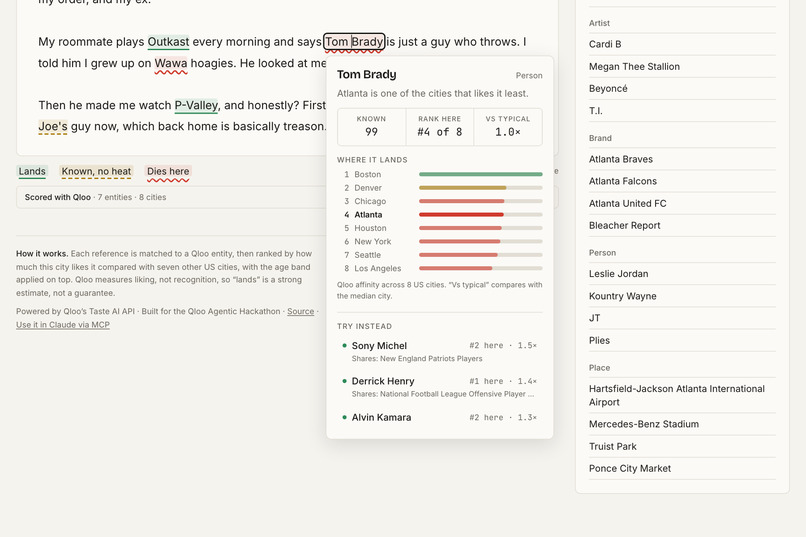
The "why" popover with city bars and swaps
-
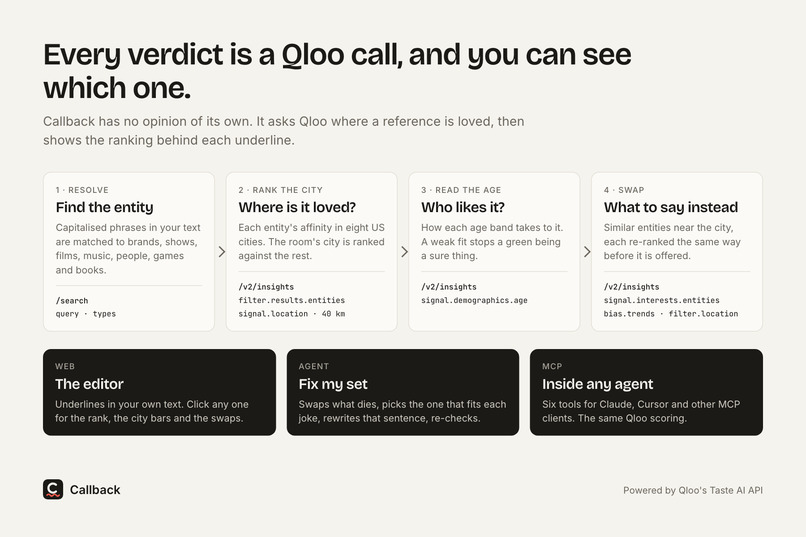
The four Qloo calls behind every verdict
-
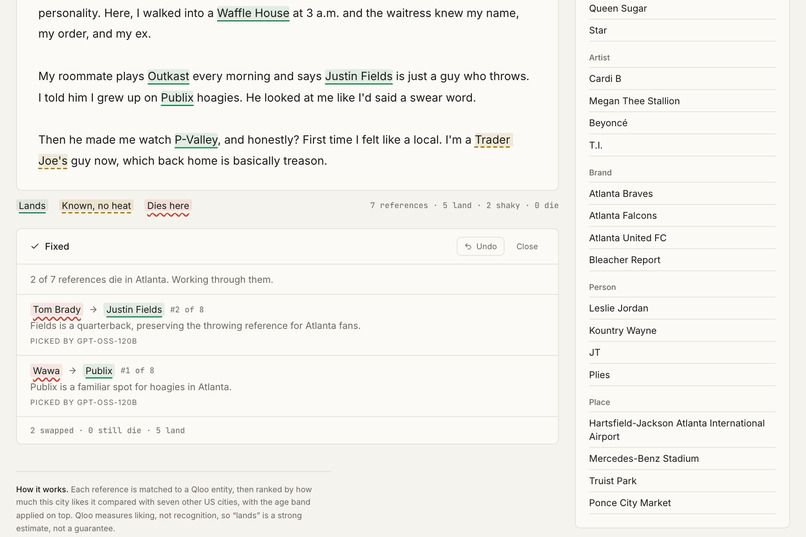
Fix my set
-
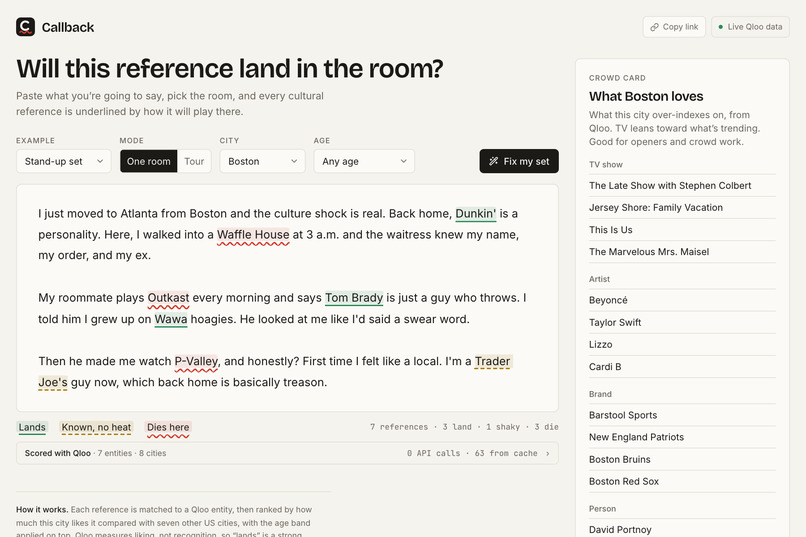
The same set in Boston
-
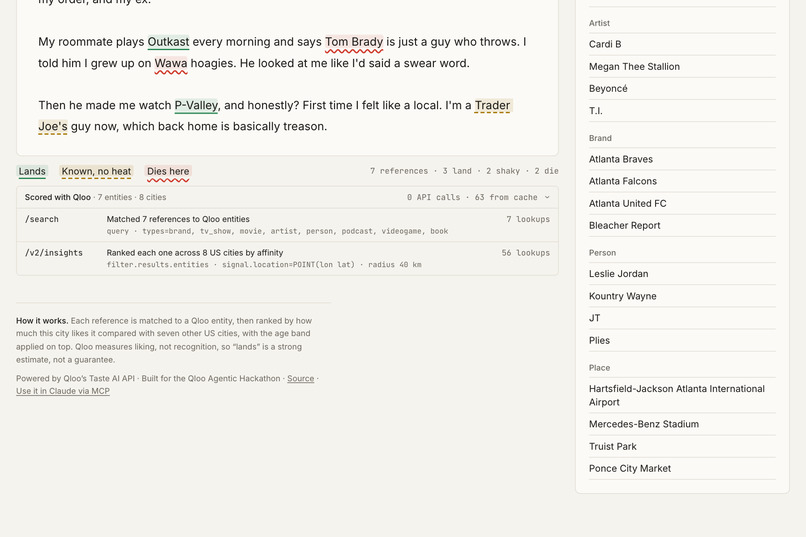
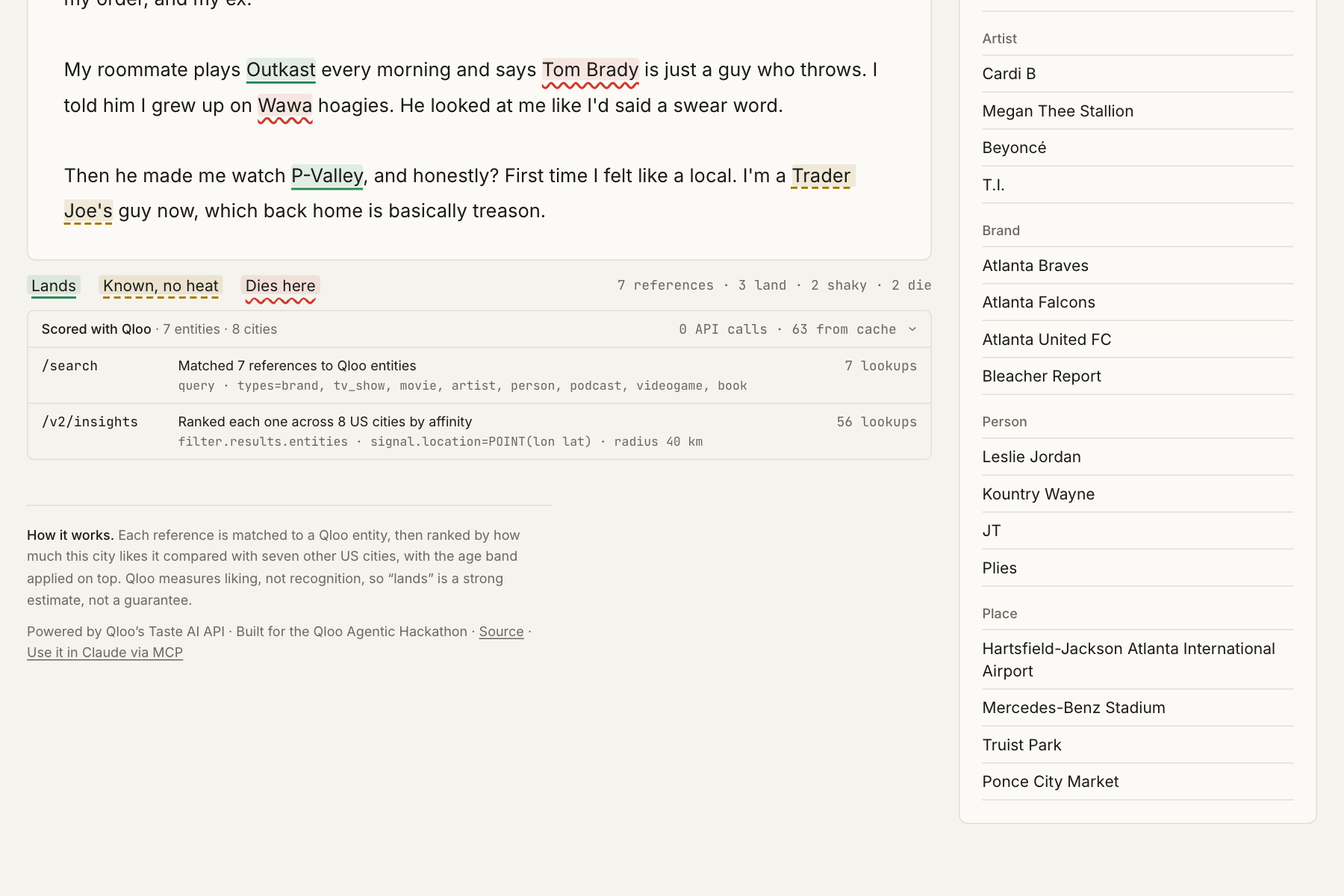
The Qloo receipt
-
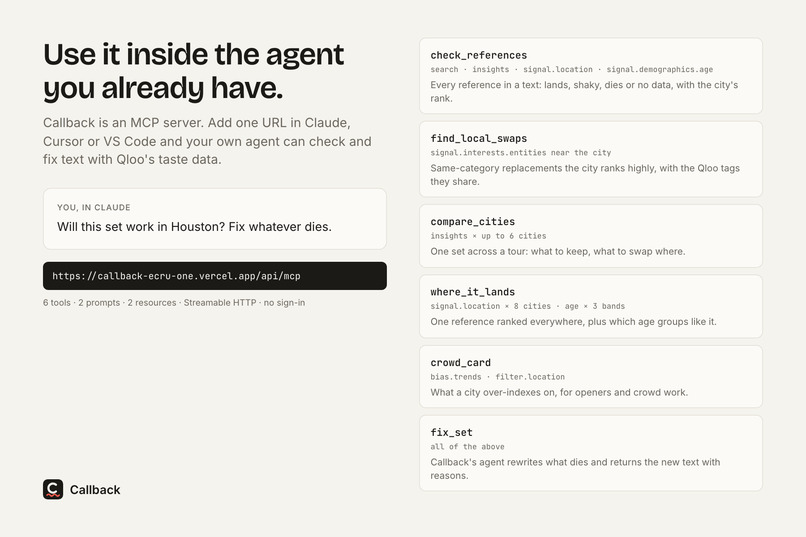
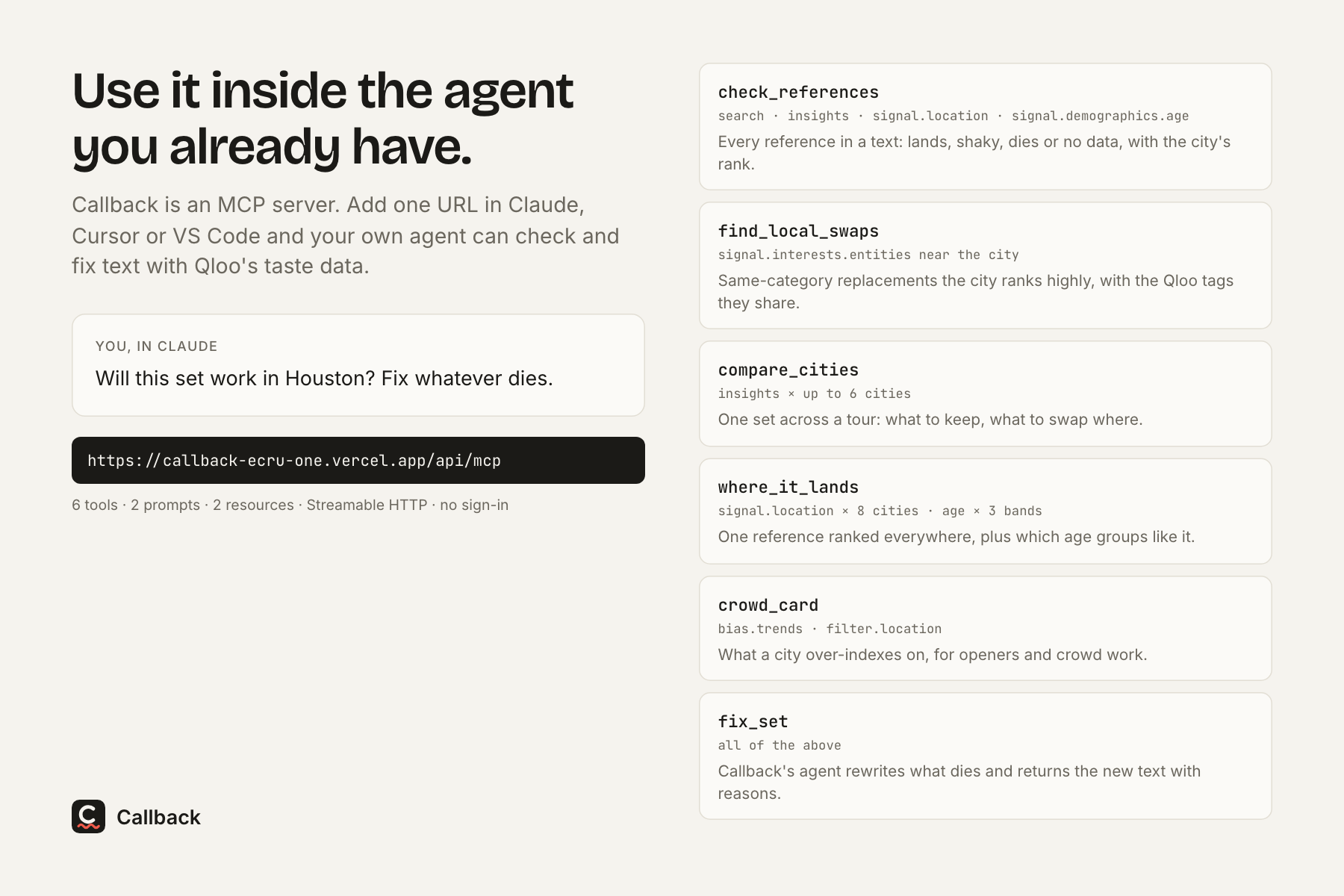
The MCP card
-
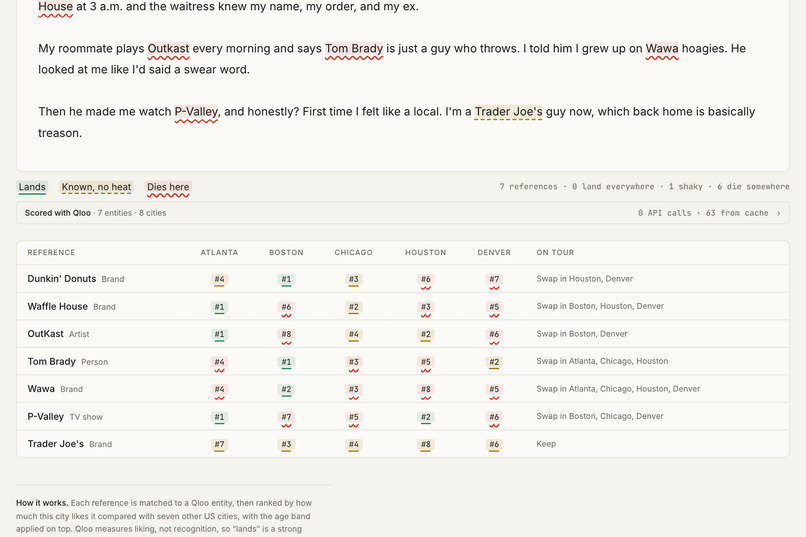
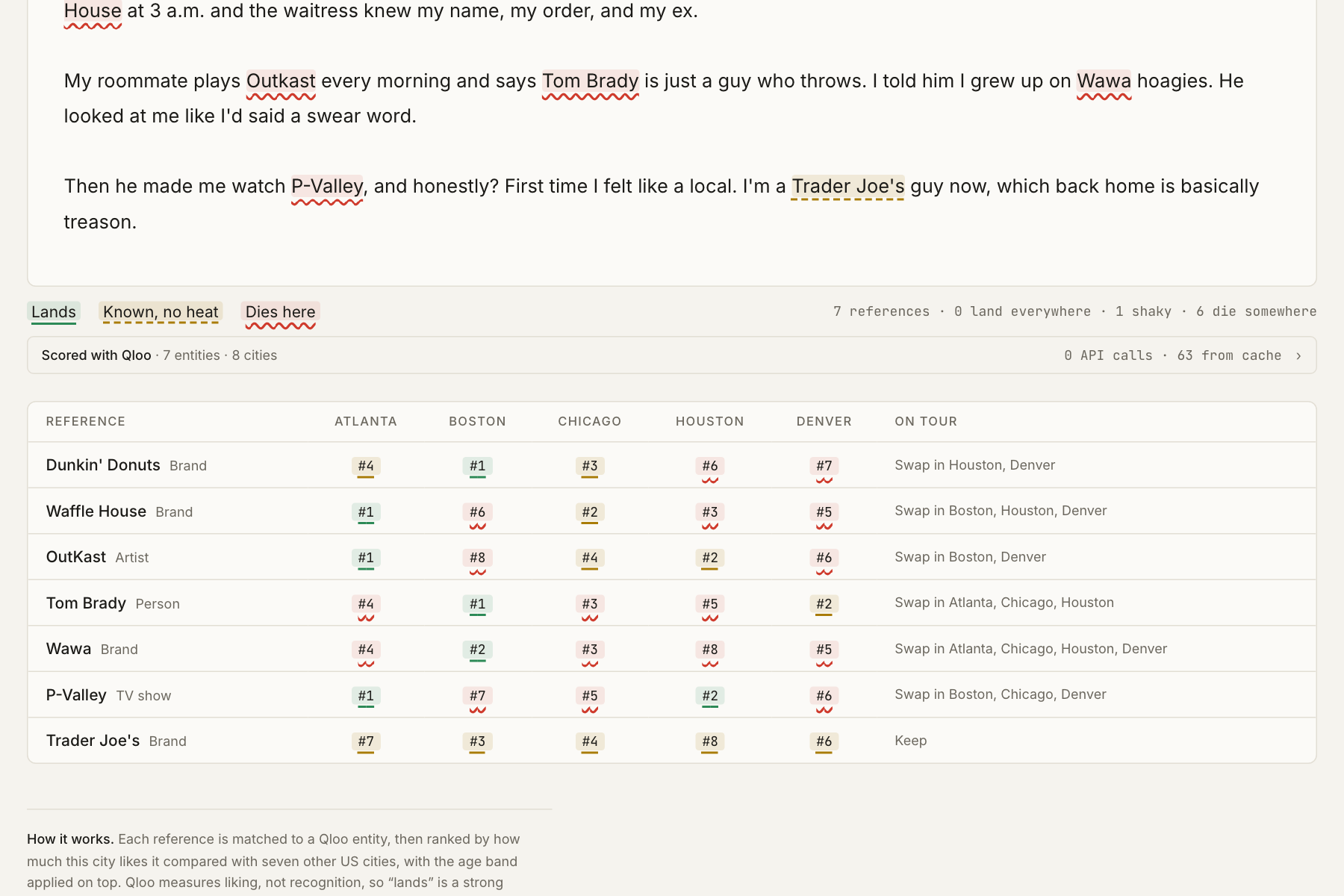
Tour mode
-
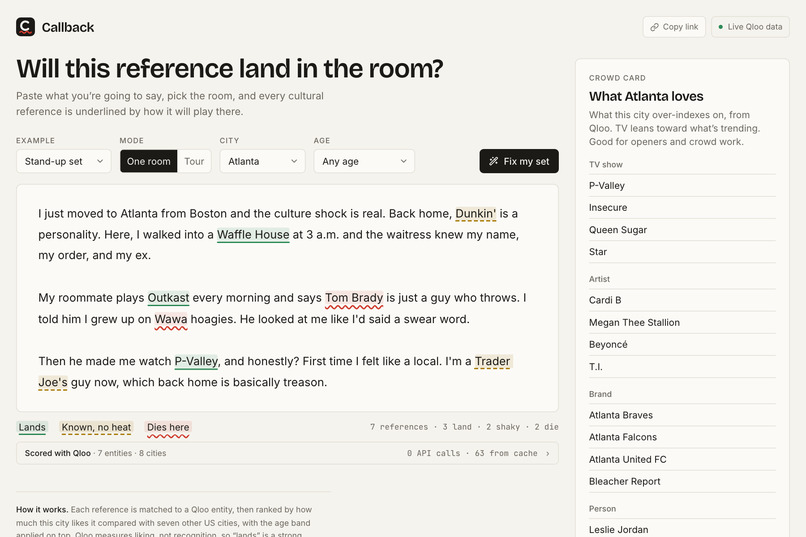
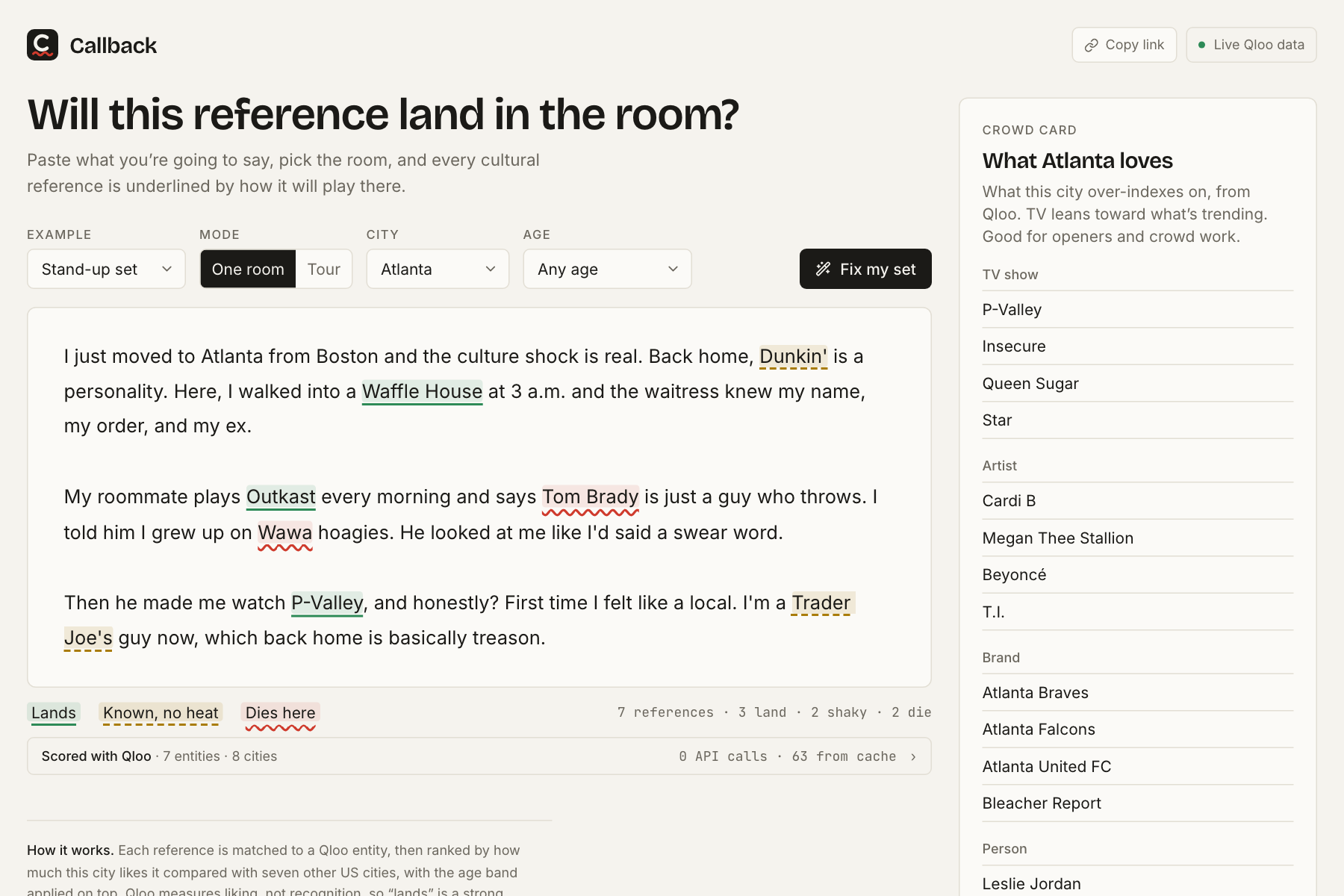
The editor with the underlines
Inspiration
Every comic, best man, keynote speaker and sales rep has made a reference that went silent. The reference was fine. The room was wrong. A Dunkin' joke works in Boston and dies in Houston, and nobody can tell you that in advance. An LLM can only guess clichés ("deep dish for Chicago"). Qloo can actually answer it, because it measures what a specific place and age group over-indexes on.
What it does
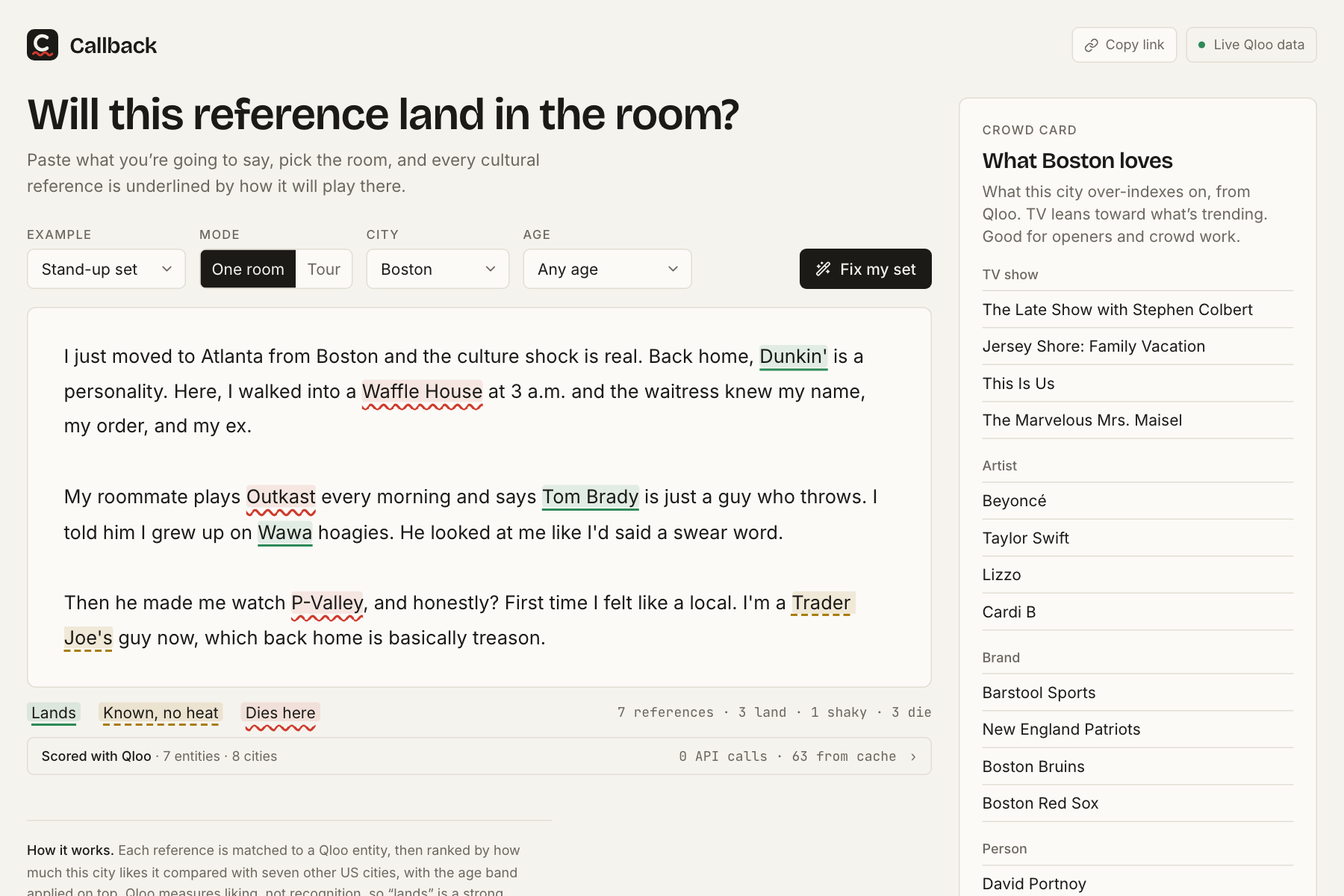
Callback is a spell-checker for cultural references. You paste anything written for an audience (a stand-up set, a toast, a pitch), pick a city and an age band, and every reference is underlined:
- Green, solid: this city is one of the ones that likes it most.
- Yellow, dashed: everyone knows it, and it plays about the same everywhere.
- Red, wavy: this city is one of the ones that likes it least.
- Grey, dotted: Qloo has no city data for it, so we say so instead of guessing.
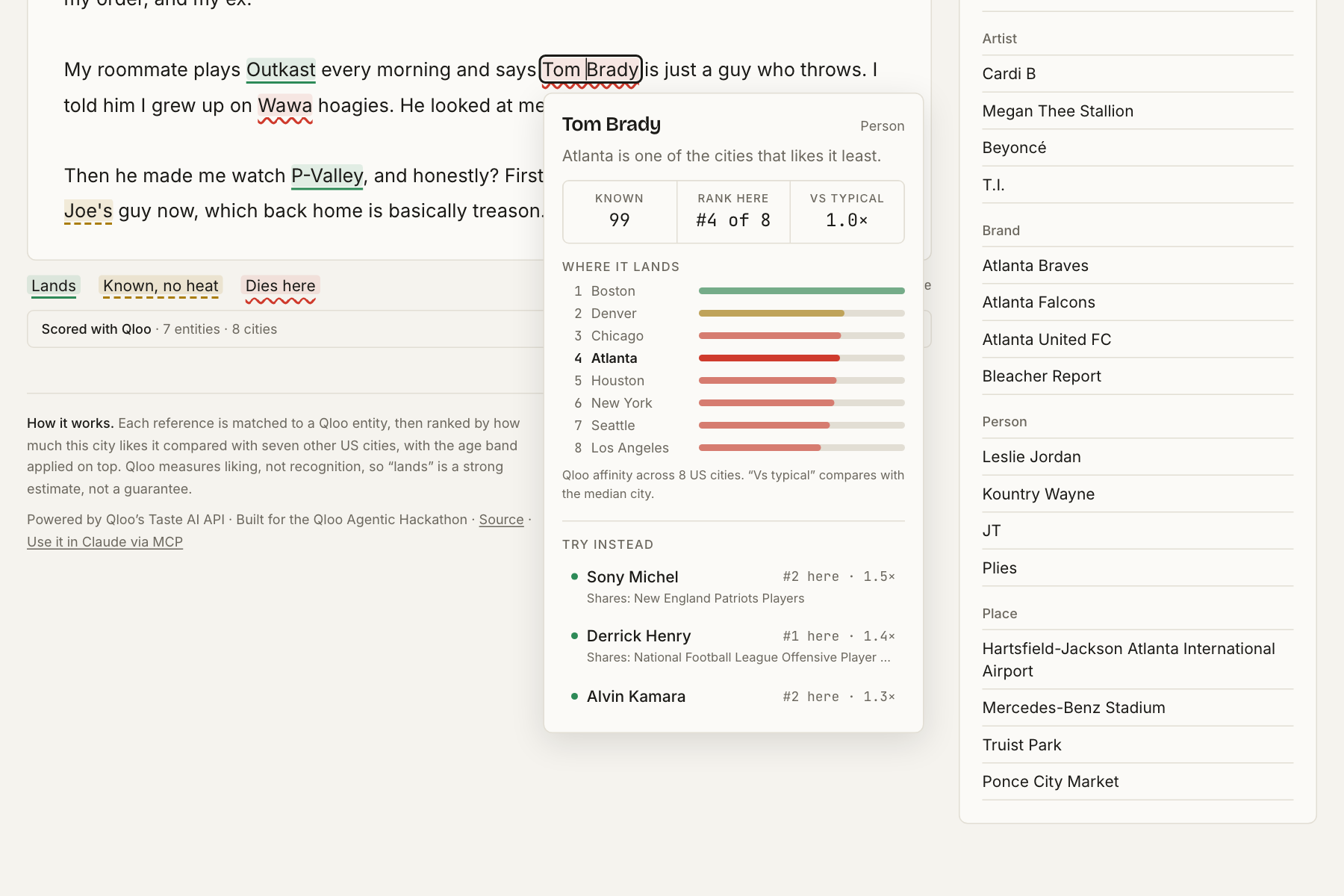
Click any underline to see why: its rank among 8 US cities, a chart of where it lands, how each age band takes to it, and (for the weak ones) same-category swaps this city loves, with the Qloo tags they share. One click swaps it in and re-checks.
Beyond that:
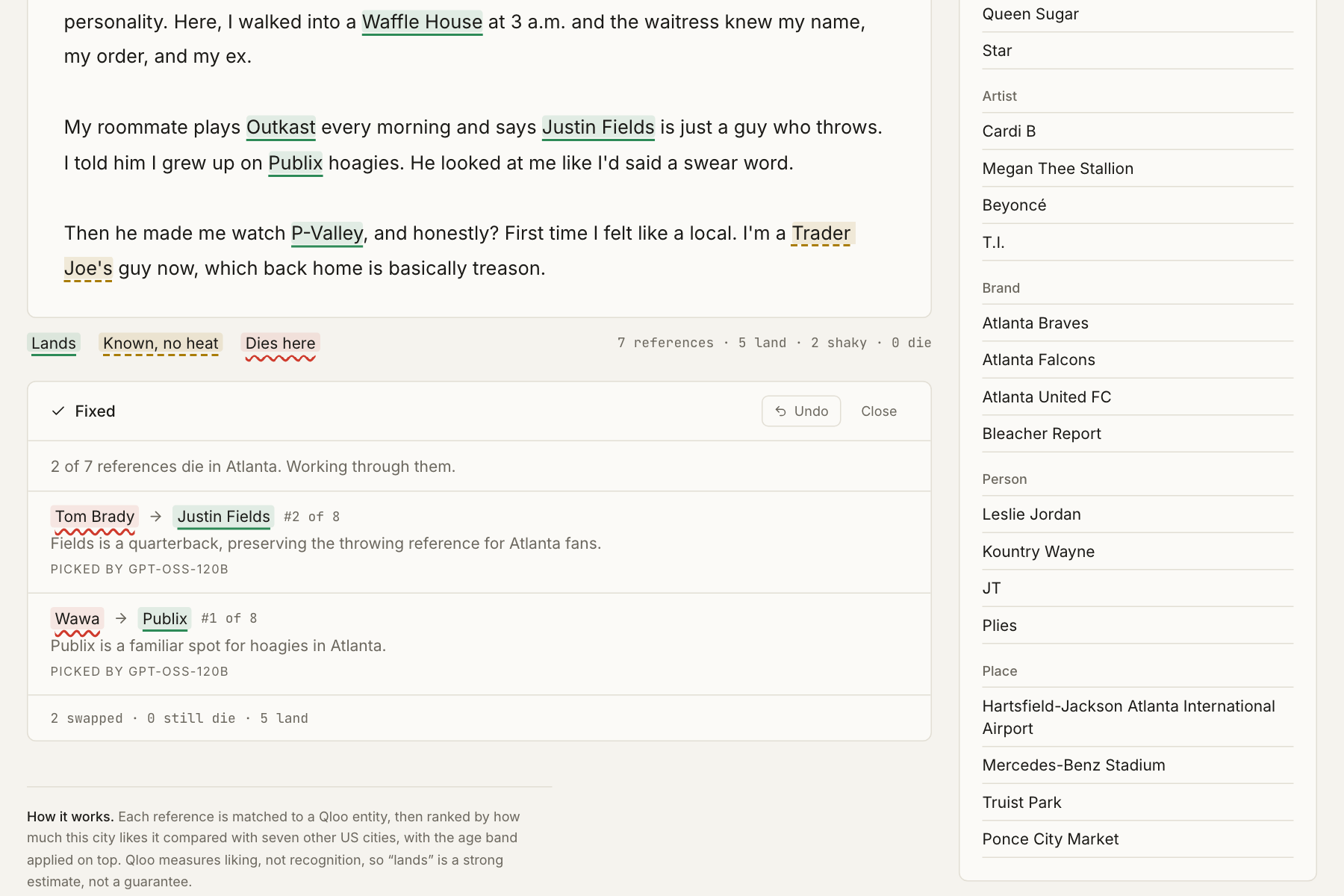
- Fix my set is an agent that works through everything that dies in the room, picks the swap that fits each joke (a quarterback for a line about throwing, not a running back), rewrites only that sentence, re-checks, and shows every step. It warns when a swap sits in a paragraph about another city.
- Tour mode checks one set against up to 6 cities as a reference-by-city grid, with "keep" or "swap in Atlanta, Boston" for each row.
- Crowd Card shows what the city over-indexes on right now (TV biased toward trending), for openers and crowd work.
- An MCP server with six tools, two prompts and two resources lets Claude Desktop, Cursor or any MCP client check and fix text with the same Qloo-backed scoring.
- A Qloo receipt under every check shows exactly which endpoints and signals were used, and how many were live calls versus cache.
How we built it
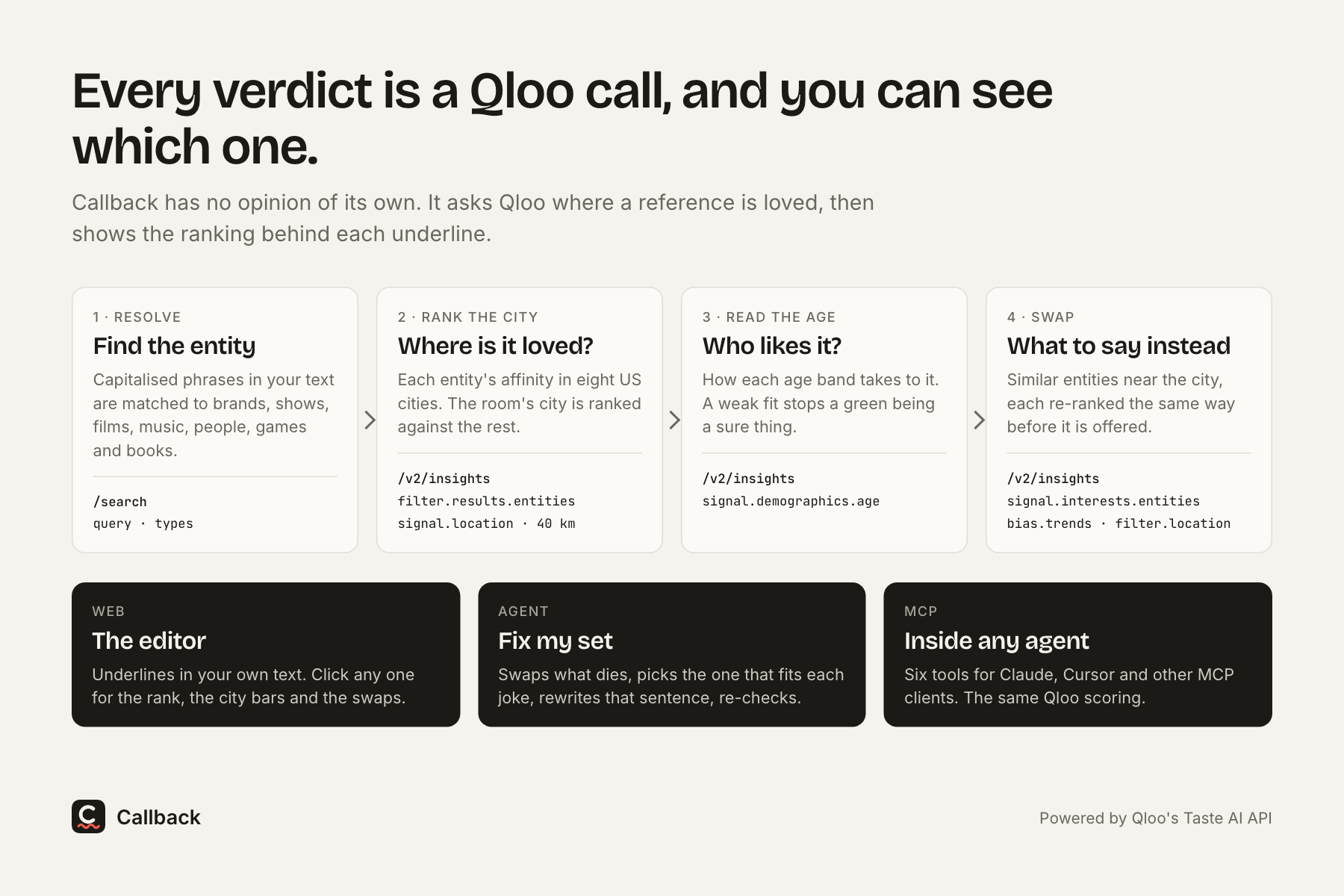
The scoring is Qloo end to end, with no LLM involved.
- Find references. Capitalised phrases are extracted and resolved with Qloo
/searchacross brand, TV, film, music, people, podcast, game and book entities. No LLM is needed, which makes it fast and free to run. - Rank the city.
/v2/insightswithfilter.results.entitiesandsignal.location(a map point, 40 km radius) returns each entity's affinity in 8 cities. Qloo affinities bunch near 1 (0.96 vs 0.9998), so we stretch them with -log10(1 - a) and rank the room's city against the pool. A reference lands when it's widely known and the city ranks near the top. - Apply age.
signal.demographics.ageis scored on its own, because combined with location it drowns out the city. - Swaps.
signal.interests.entitiesseeded with the original, near the city. Every candidate is then re-ranked the same way before it's offered, so a swap is never worse than what it replaces. - Crowd Card.
signal.location,bias.trendsfor TV, andfilter.locationfor places.
The agent loop is plain code. A free OpenAI-compatible model (Groq's gpt-oss-120b) makes the judgement calls Qloo can't: does this swap fit the line, and what's the rewritten sentence. Rewrites that drift from the writer's words are rejected, and if the model fails or runs out of quota, simple rules take over, so the demo never breaks.
Stack: Next.js 15, TypeScript, CodeMirror 6, Tailwind, the MCP SDK v2 with mcp-handler, deployed on Vercel. Scoring thresholds are pinned by tests on real Qloo numbers.
Challenges we ran into
- Qloo has no national baseline. An insights call with no signal returns no affinity at all, so we can't say "Atlanta is 2.6x the national average". We rank a city against a pool of cities instead.
- Location queries silently drop entities. Querying by city name returned nothing for Starbucks; a map point with a radius doesn't.
- Age swamps location when both signals are sent together, so we score them separately and let age only knock a green down to yellow.
- A 10,000-call monthly quota shared by development and judging. Every entity-and-city pair is cached once, a snapshot of live responses ships with the app so the examples cost nothing, and a guard stops making new calls before the quota runs out.
- Some famous entities have no city data (The Office, Drake). We mark them grey.
Accomplishments that we're proud of
- It's an editor, not a report page: you see the verdict in your own text.
- Every number on screen traces to a Qloo call, and the receipt proves it.
- The same engine works three ways: the web app, an agent that fixes your set, and an MCP server other agents can call. We tested the last one end to end from Claude through a custom connector.
- It runs on a free model with no paid APIs.
What we learned
Liking isn't recognition. Qloo measures what a place loves, and "will it land" is a proxy for that: popularity says people probably know it, and the city rank says this room likes it more than most. We say that plainly in the app, and we show the numbers behind every underline.
What's next for Callback
More cities and a venue-level signal, a Google Docs add-on, per-city "house style" for recurring shows, and letting a comic save a set and watch it re-rank as the Qloo data moves.
Built With
- codemirror
- groq
- model-context-protocol
- next.js
- qloo
- qloo-taste-ai-api
- react
- tailwindcss
- typescript
- vercel

Log in or sign up for Devpost to join the conversation.