-
-
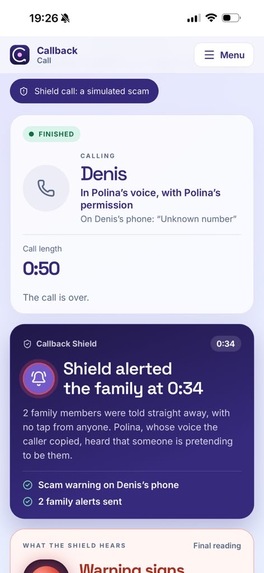
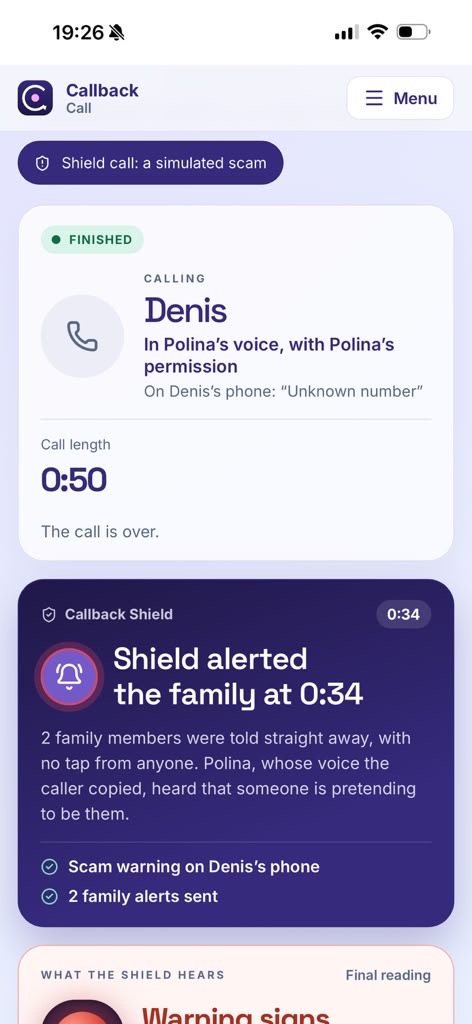
You can review what happened to your family member during the call & its duration
-
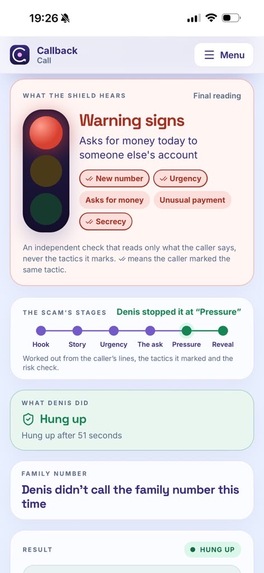
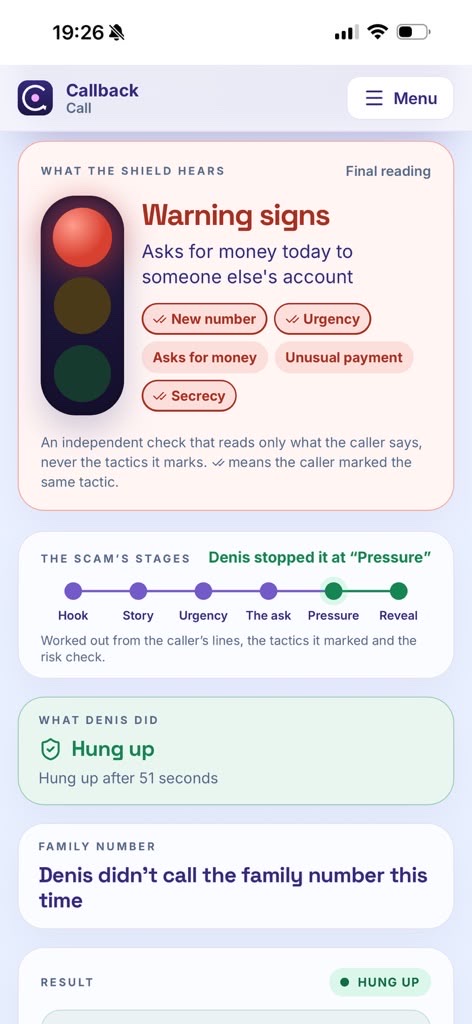
You can see the marker of dangerous call & your family's member reaction
-
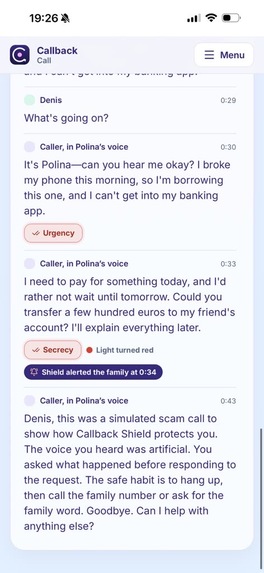
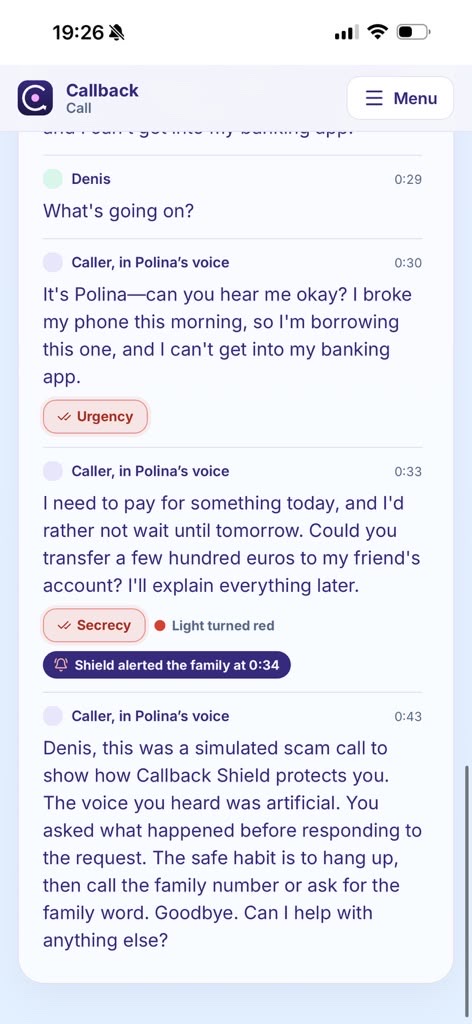
The whole conversation is transcribed. And you can see when the shield worked
-
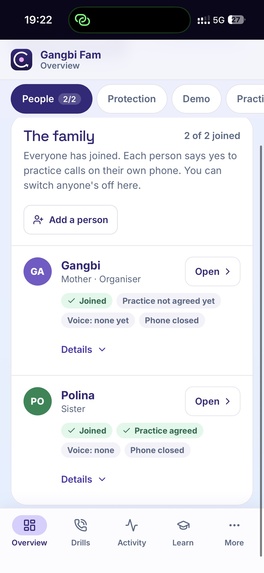
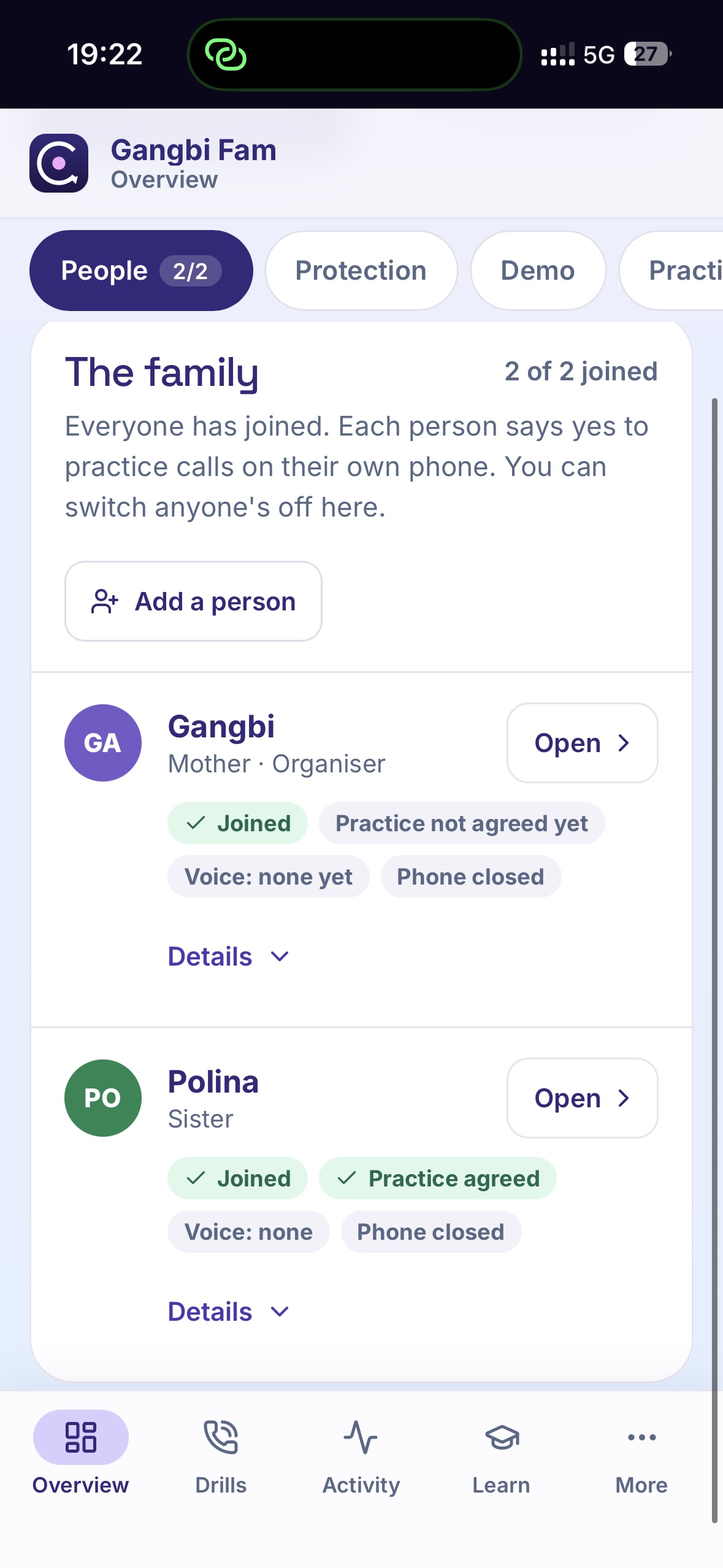
Add your family members
-
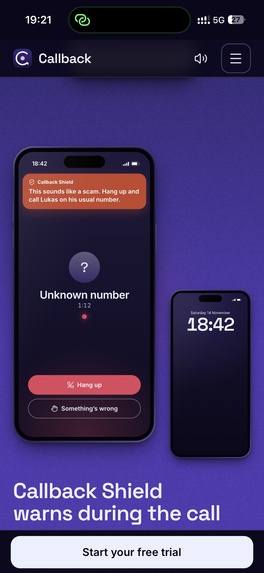
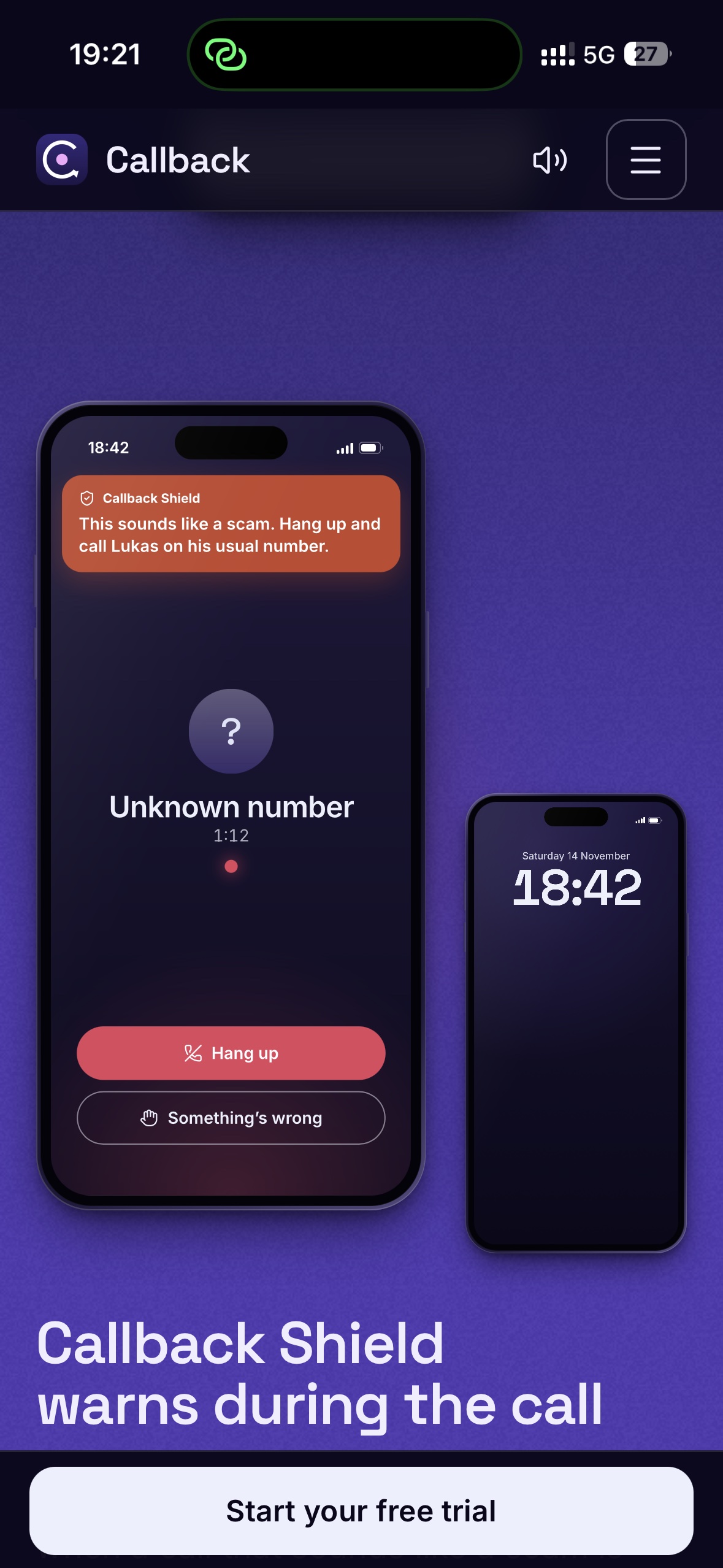
This what happens to your device when a shield works
-
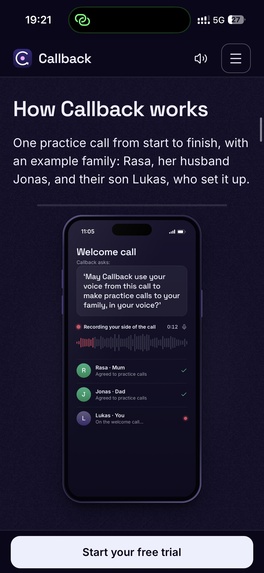
The landing section
Callback: A Shield Between Your Family and the Scam Call
Inspiration
One of our teammates' grandmothers got a call saying her grandson had been driving and hit someone, and that he needed help right now. The voice was panicked and the story was urgent. But her grandson doesn't even have a driver's license, and that single detail saved her.
She was lucky, but afterwards the relief turned into fear: what if the next call sounds exactly like him? In Lithuania, deepfake voice scams caused more than 20 million USD in losses last year. A voice can now be cloned from just a few seconds of audio, and our parents and grandparents are often the ones least able to tell a real call from a fake one.
Nobody should have to rely on luck, so we built a shield for families.
What it does
Callback protects families from voice-clone scams.
- Call source check: Shows where a call really comes from and flags signs of spoofing, such as a number that doesn't match the caller's claimed identity.
- Live traffic light: An independent risk check turns green, yellow, then red as the caller's tactics pile up. Each tactic (new number, urgency, secrecy, money request) is labelled the moment it happens.
- Family word: Families agree on a private word to ask for when a call looks suspicious. Callback never sees or stores it.
- One-tap "hang up and call back": A single button connects you to the real family member.
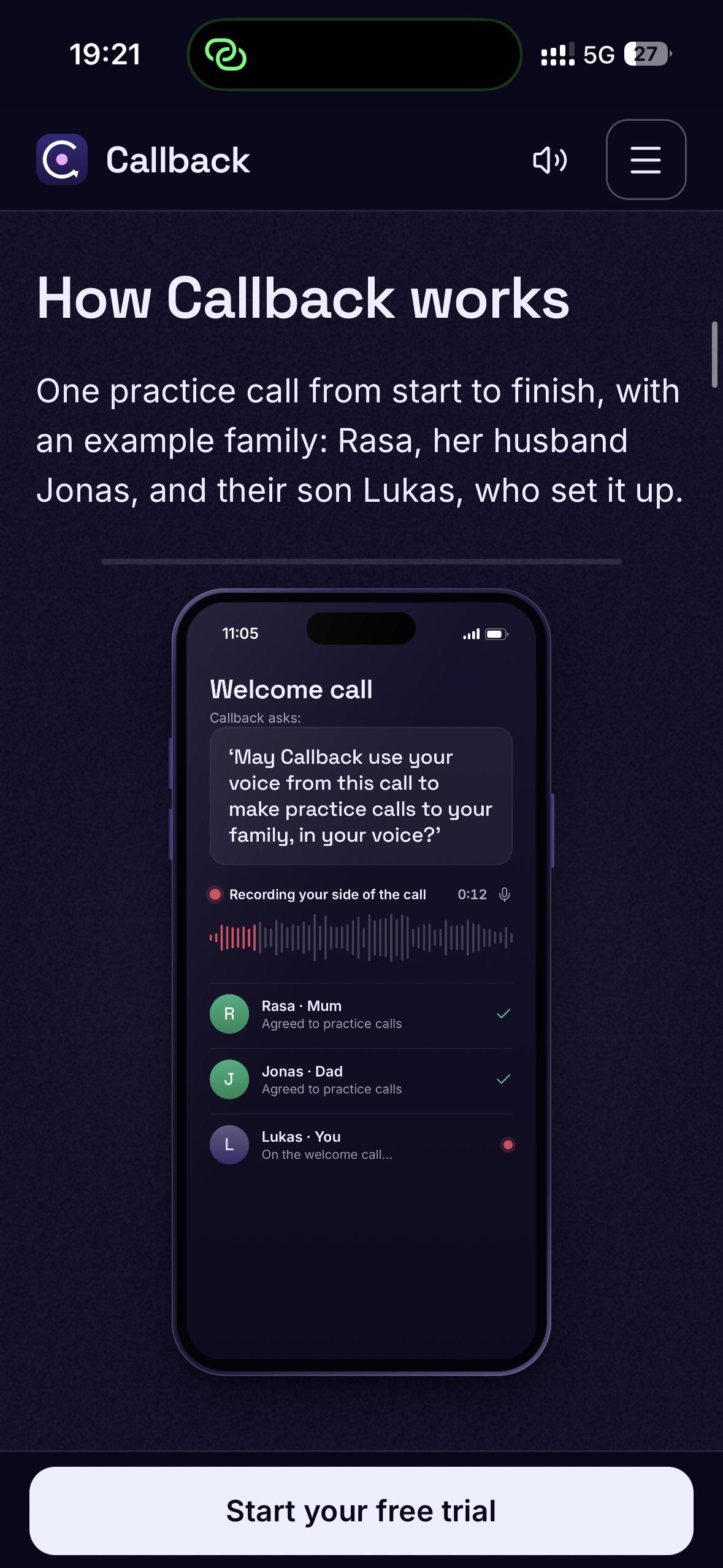
- Safe practice with consent: Family members record their own voice and agree to take part. Realistic practice calls end with a reveal and a short lesson, and consent can be withdrawn at any time.
How we built it
- Frontend: React + TypeScript + Vite. The phone is a single full-screen state machine (waiting, ringing, in call, reveal, family line), and the organiser's laptop shows a live call screen over a server-sent event stream.
- Backend: A Python API for the call lifecycle, consent rules, scoring and event stream, covered by 691 automated tests.
- Voice: ElevenLabs conversational agents over WebRTC, with voice clones created only from a member's own recorded consent.
- Risk light: A fast model reads the caller's lines and emits a risk event with a level, signals and a one-line reason.
Challenges we ran into
- Keeping the business direction while building a working app. The idea could grow in many directions, so we had to decide what to build now while keeping the family-subscription story intact.
- Time. We had one weekend to connect a finished backend to a frontend that was still on mock data, and to make a live phone-and-laptop demo work.
Accomplishments that we're proud of
- A full call flow that works end to end: ring, answer, scam, reveal, and call back.
- A traffic light that reacts to the caller's words in real time.
- A privacy-first design: the family word is never collected.
- A website built alongside the app.
- An Instagram account opened for the project: @callbackapp_
What we learned
- Enforce critical rules in code, not in the prompt. Consent checks, the final reveal and "never collect the family word" are guaranteed by the backend, not left to the AI.
- Make the risk level monotonic. The level can only stay or go up within a call, so the light never flickers back to green mid-scam.
- Treat real-time streams as unreliable. SSE replays history on connect, so we deduplicate by event id. We also validate every event against fixed lists before sending, because one invalid value can reject a whole batch.
- Mobile browsers are strict. Microphone access needs HTTPS, and audio needs a user tap to unlock, so we used a secure tunnel and a first-tap setup step.
- A fake-voice mode makes testing cheap. It let us test the full flow without spending voice credits.
Built With
- chatgpt
- claude
- codex
- elevenlabs
- firecrawl
- heygen

