-
-
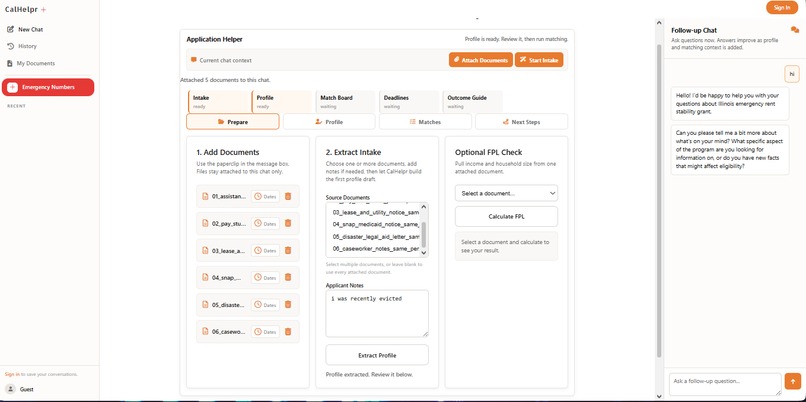
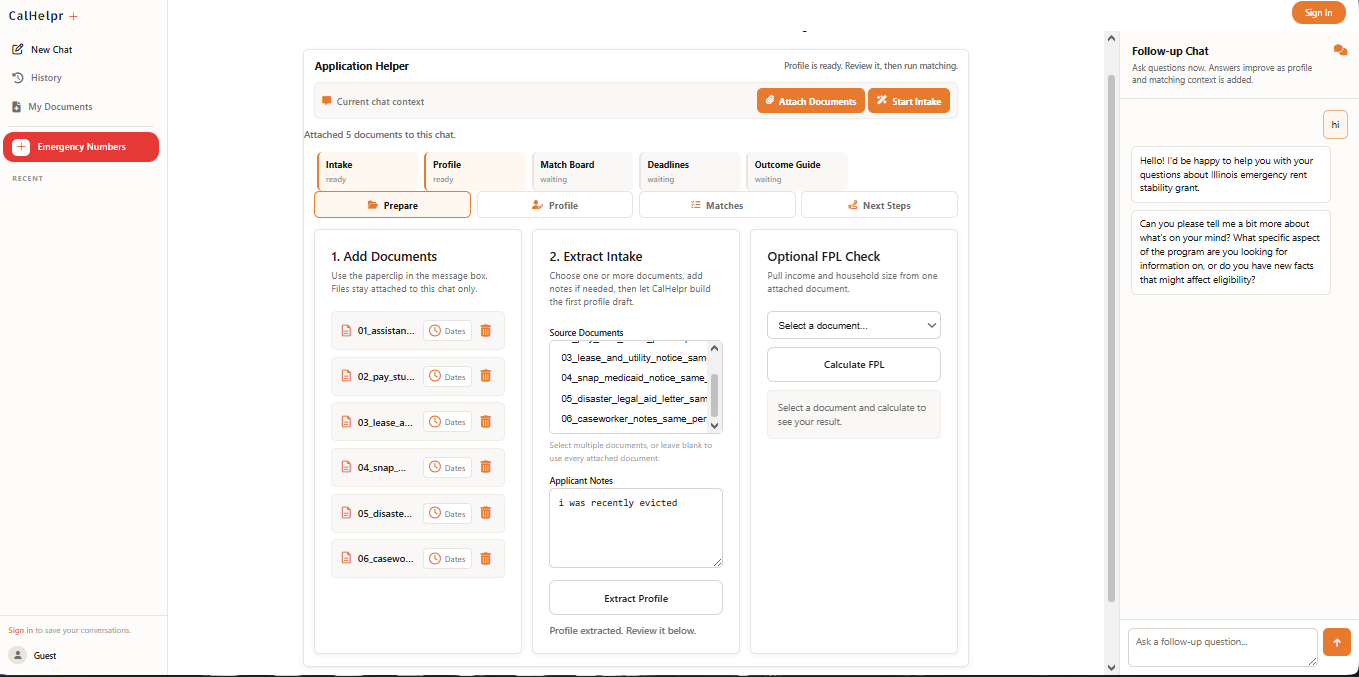
Applicant build their profile details via doc parsing and user messaging in order to be matched with best programs and receive best guides
-
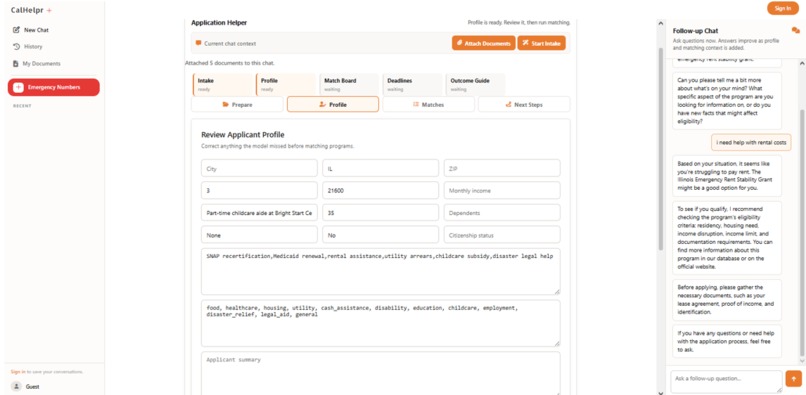
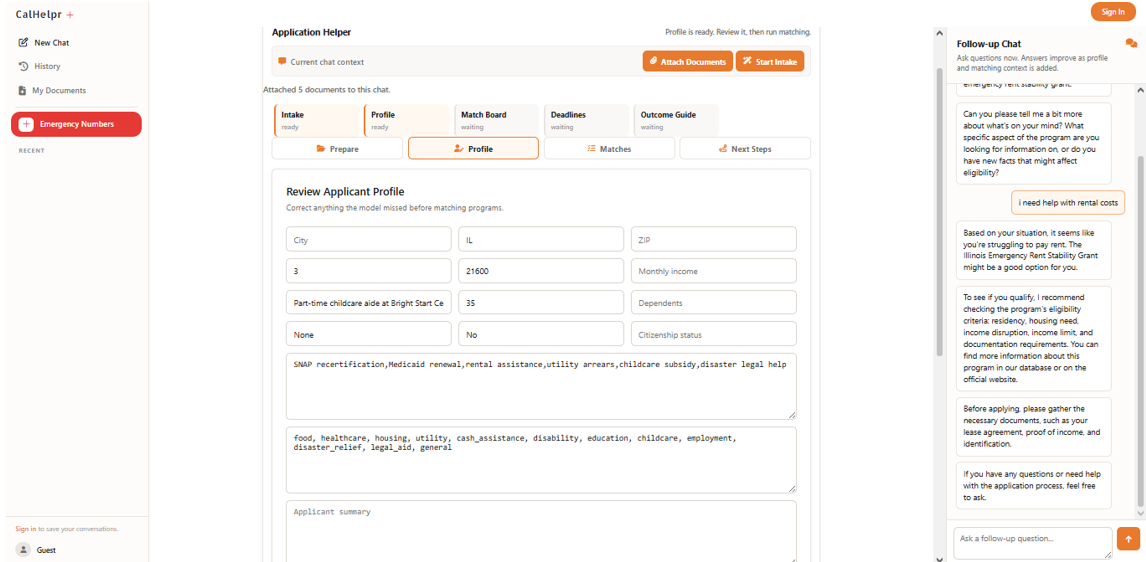
Human Verification of parsed and detected information about applicant user to prevent incorrect analysis(Humanin loop)
-
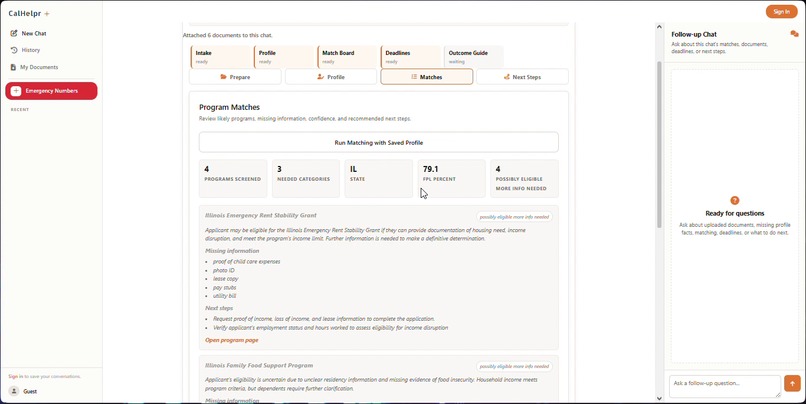
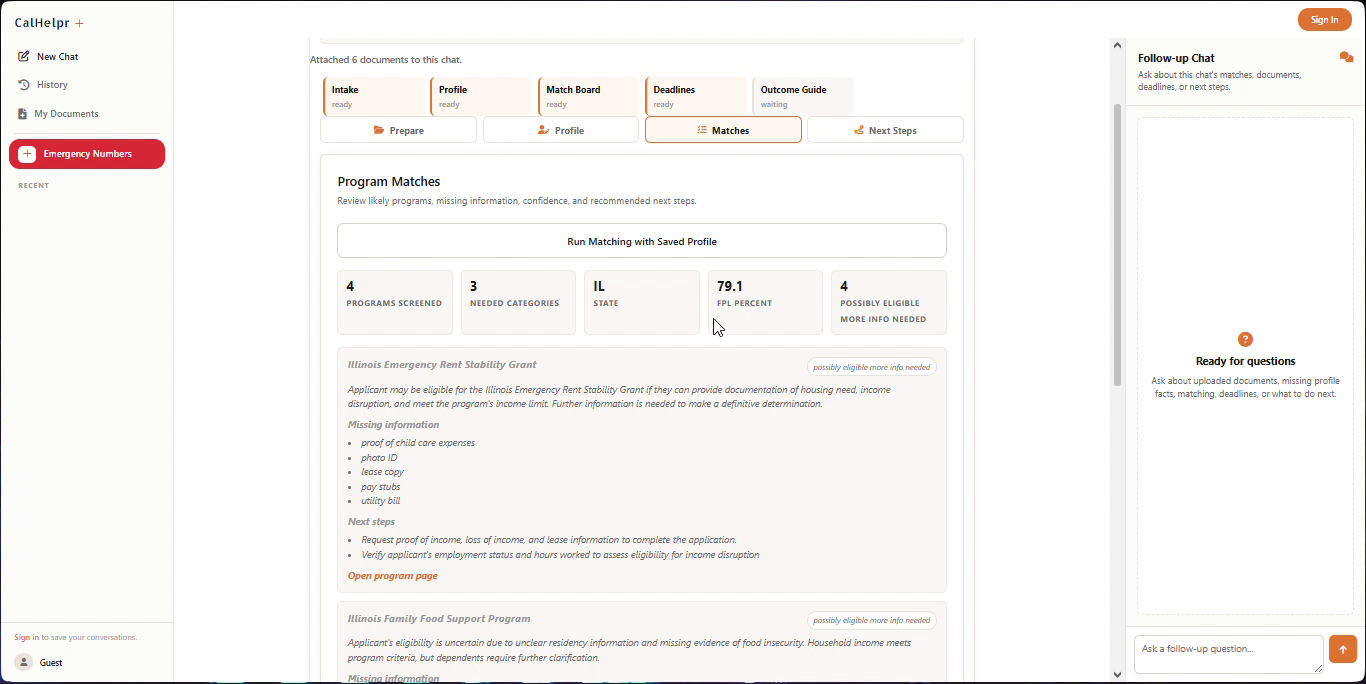
Matched programs with the acceptance probability confidence score and possible next steps and guides to improve application approval chance
-
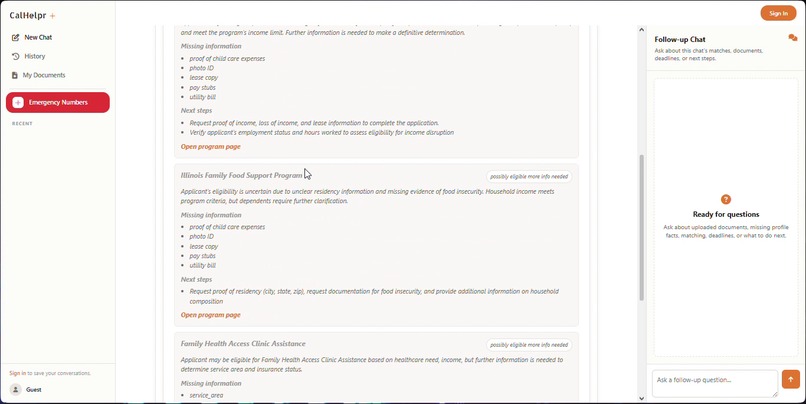
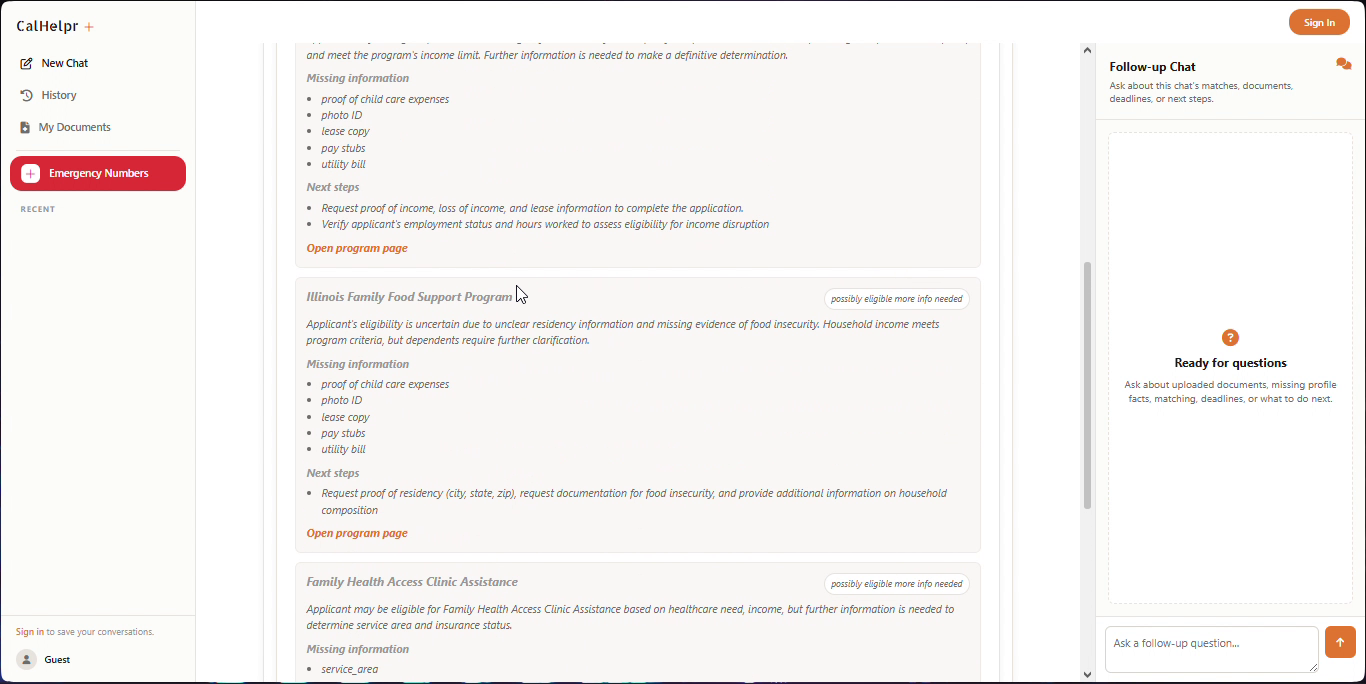
More Matched programs and guides
-
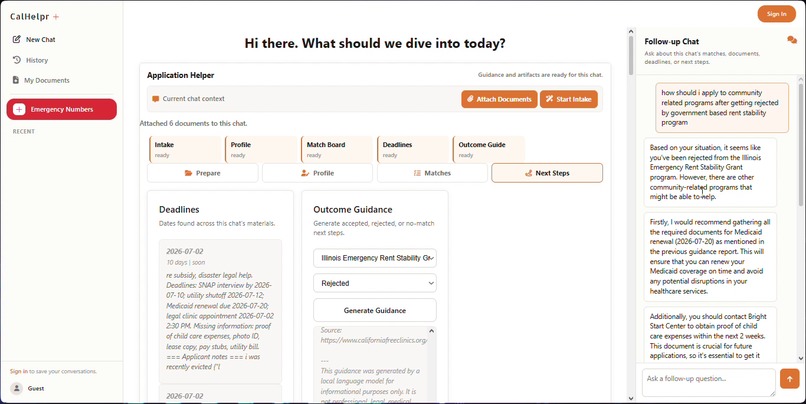
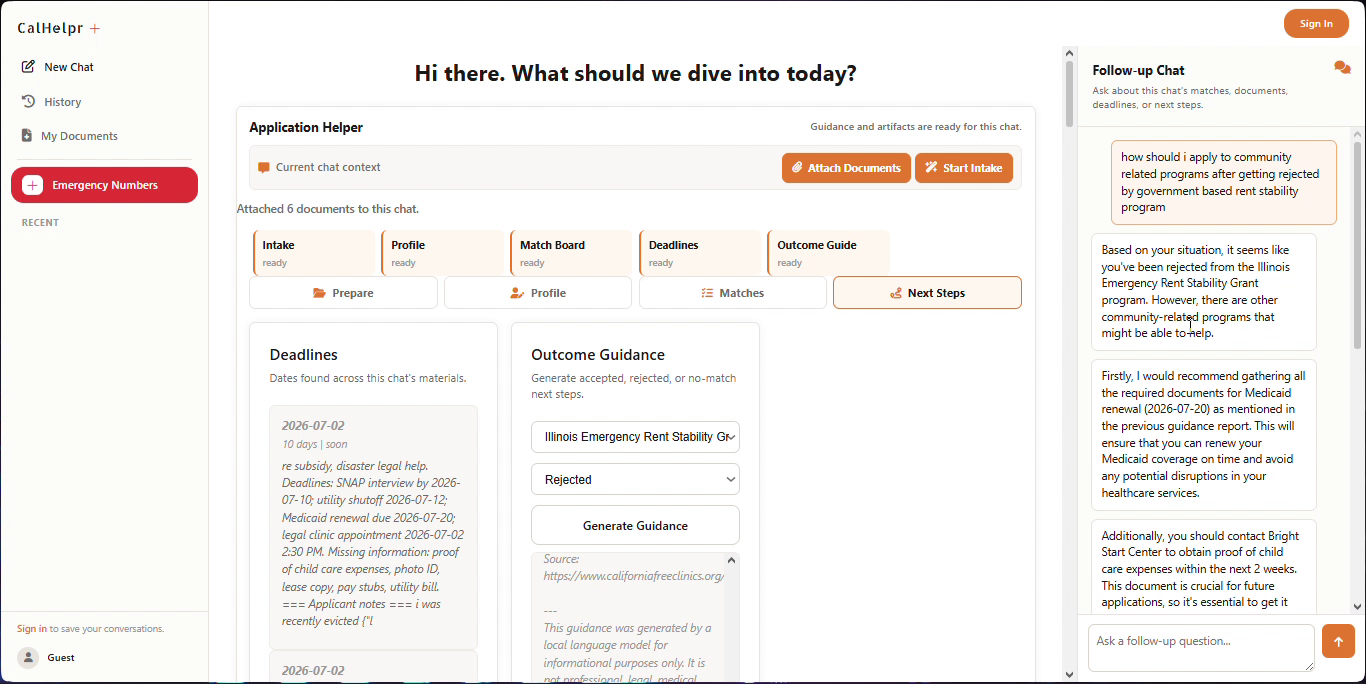
After application tracking and guide for program acceptance/rejection/ no match for improving conditions using community help or other steps
-
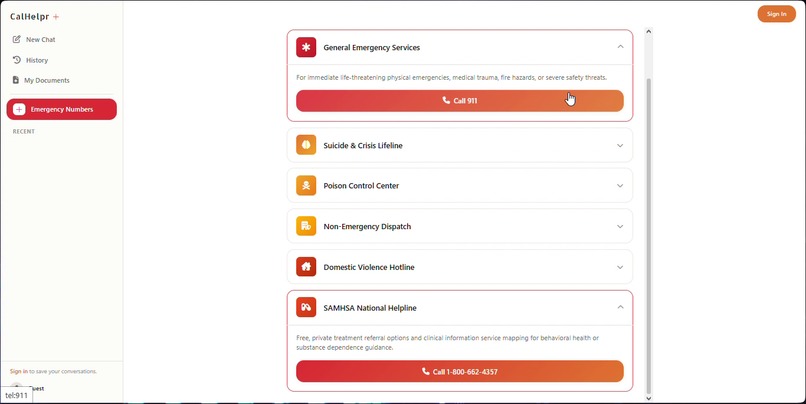
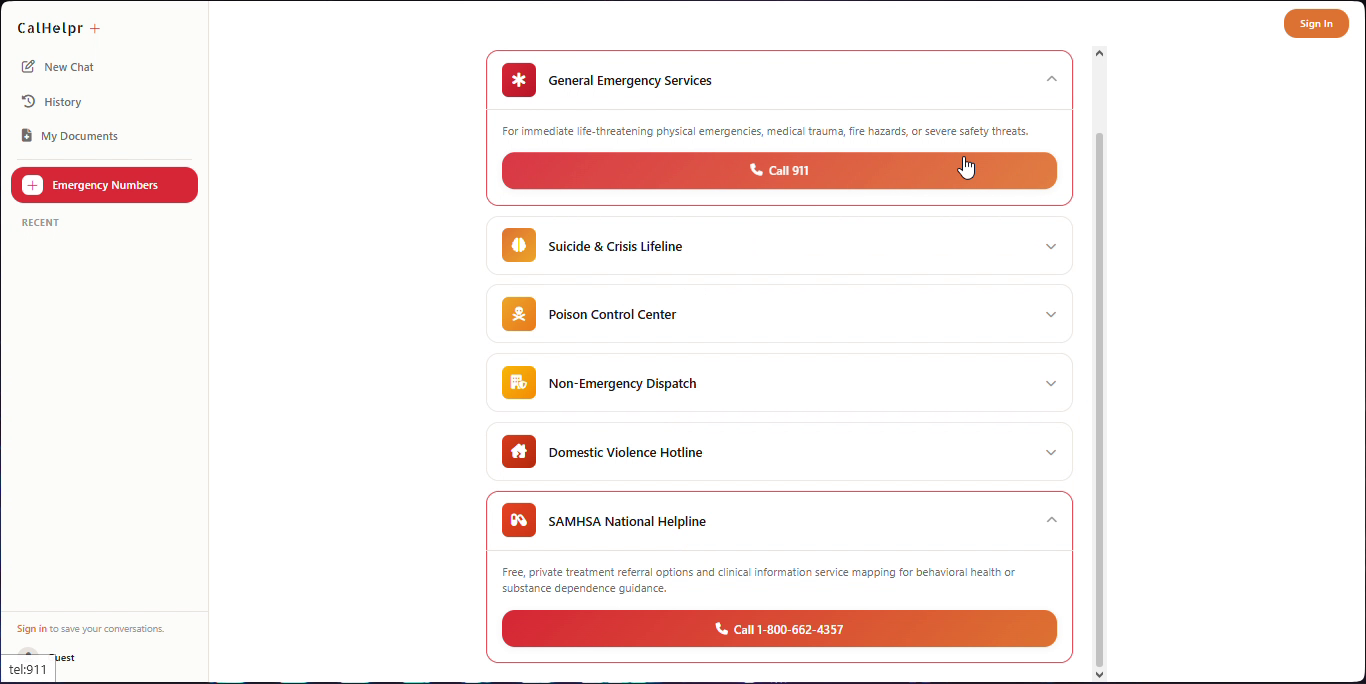
Emergency numbers to bypass the AI system and have emergency helpline access
Inspiration
Applying for assistance should not feel harder than the crisis that made someone ask for help. We were inspired by people who qualify for benefits, emergency aid, legal support, food assistance, housing help, or healthcare programs but still miss out because the process is confusing, fragmented, and deadline-heavy.
CalHelpr was built around a simple idea: people should be able to bring their documents, notes, or questions and quickly understand what help may be available, what information is missing, and what to do next. We wanted to support not only applicants, but also caseworkers, NGOs, nonprofits, and community volunteers who help families navigate these systems every day.
What it does
CalHelpr turns confusing assistance paperwork into clear, trackable guidance.
It helps users:
- Understand possible eligibility for public benefits and emergency assistance
- Extract important details from documents, notices, or intake notes
- Identify missing information before an application gets delayed
- Track deadlines, recertification dates, appeal windows, and follow-ups
- Generate practical next steps after acceptance, denial, or missing-document requests
- Create caseworker-friendly summaries
- Connect users with government programs as well as NGO, nonprofit, and community-based support
CalHelpr is designed to help beyond the first application. If someone receives a decision letter, needs to appeal, must submit extra documents, or still needs support after being denied, the tool can continue guiding them through the next step.
Privacy is central to the project. Assistance documents can include income, housing, health, family, and legal information, so CalHelpr is designed with local-first processing and careful handling of sensitive details in mind.
How we built it
We built CalHelpr as a guided pipeline from messy input to useful action.
The flow is:
- A user uploads or enters documents, notes, or applicant information.
- The system extracts key facts such as income, household size, location, stated needs, and deadlines.
- The profile is matched against assistance programs.
- Eligibility-related calculations are handled in a structured way.
- The results are turned into plain-language explanations, missing-information lists, deadline tracking, and caseworker notes.
- Users can continue with follow-up guidance after an application decision or change in circumstances.
We focused on making the system practical rather than flashy. AI helps interpret messy language and explain results clearly, while structured logic supports more consistent screening and calculations.
Challenges we ran into
The biggest challenge was responsibility. Benefits guidance can affect real decisions, so CalHelpr cannot pretend to be an official determination. We had to design it to show uncertainty, identify missing information, and encourage users to verify final decisions with official agencies or trusted advocates.
Another challenge was messy input. Real assistance documents are not always clean or complete. Important facts may be missing, phrased indirectly, or spread across multiple documents.
We also had to think carefully about privacy. The project handles sensitive situations, so we wanted to reduce unnecessary exposure of personal information and make privacy part of the core design.
Finally, we wanted CalHelpr to support the full journey, not just the first eligibility check. That meant thinking about tracking, follow-up, appeals, deadlines, and community support after the initial application.
Accomplishments that we're proud of
We are proud that CalHelpr is not just another chatbot. It is a practical navigator that turns confusion into a clear path forward.
We are especially proud of:
- Making assistance guidance easier to understand
- Including deadline and follow-up tracking
- Supporting users after application decisions
- Designing with privacy and trust in mind
- Helping caseworkers and community organizations work faster
- Considering NGO, nonprofit, and local community support alongside government programs
- Separating structured checks from plain-language explanation
Most importantly, we are proud that the project focuses on real decision value: helping people know what to do next.
What we learned
We learned that the hardest part of getting help is often not whether support exists, but whether someone can find it, understand it, and complete the next step in time.
We also learned that responsible AI should support people and advocates, not replace them. The best use of AI here is to reduce confusion, organize information, surface deadlines, and explain options clearly.
A key lesson was that trust matters as much as accuracy. Users need to know what the tool found, what is uncertain, what information is missing, and where human verification is still needed.
What's next for CalHelpr
Next, we want to make CalHelpr more useful for real community settings.
Future improvements include:
- Expanding the program database across more states and local areas
- Improving support for denial letters, appeals, renewals, and recertifications
- Building better reminders for deadlines and follow-ups
- Adding multilingual support
- Creating dashboards for caseworkers and community organizations
- Adding clearer confidence indicators and source citations
Our long-term goal is for CalHelpr to become a trusted support layer between people in need and the many programs, nonprofits, and community organizations that can help them.
Built With
- css
- css3
- fastapi
- html
- html5
- javascript
- javascript-frameworks/databases:-fast-api
- ngo-database-ai-orchestration/architecture:-slm-via-llama3.2:3b
- rag
- semantic-retrieval-augmented-generation-(rag)
- slm
- slqalchemy
- sqlalchemy
- sqlite


Log in or sign up for Devpost to join the conversation.