-
-
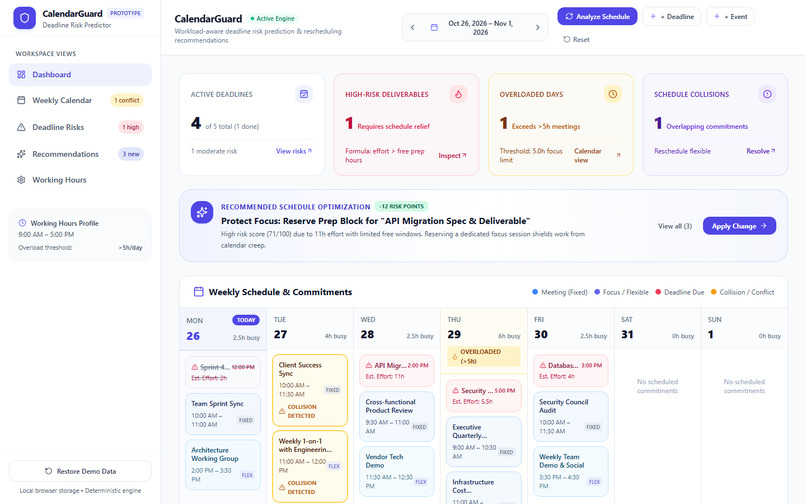
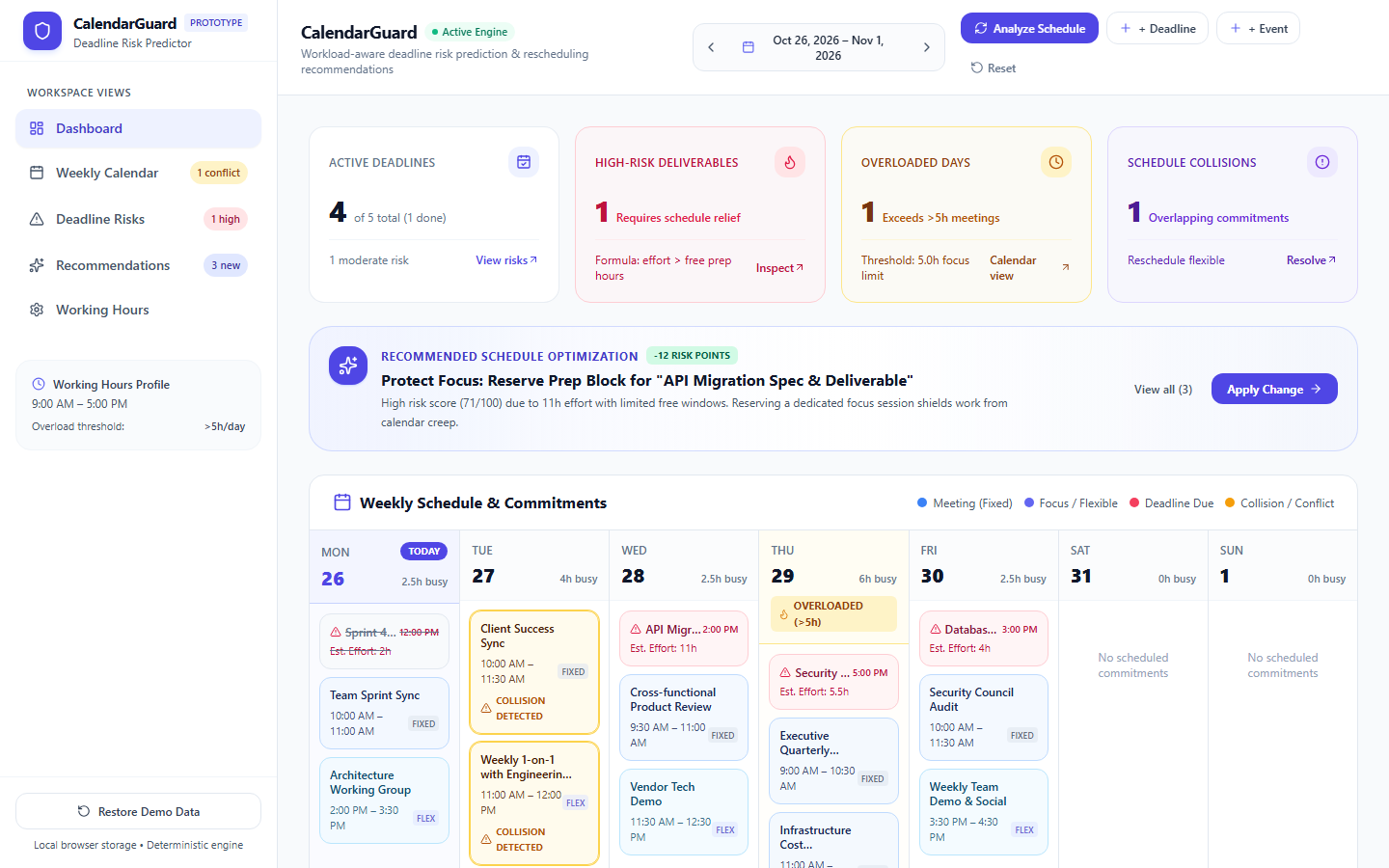
Dashboard Overview
-
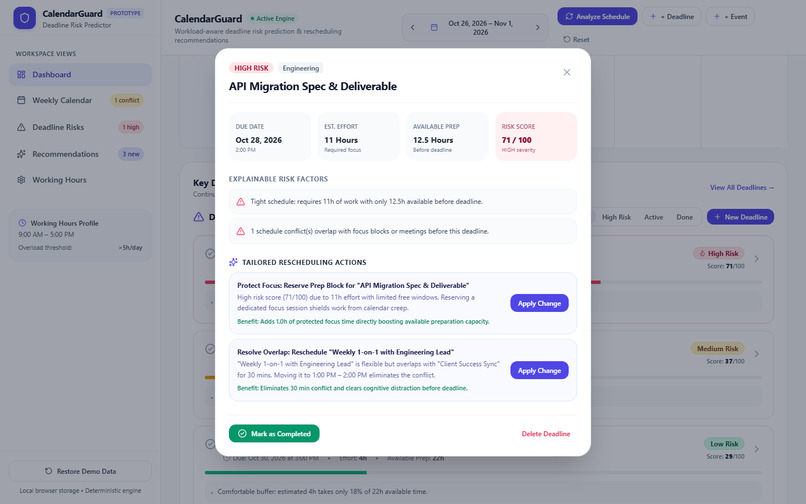
Deadline Risk Analysis Model
-
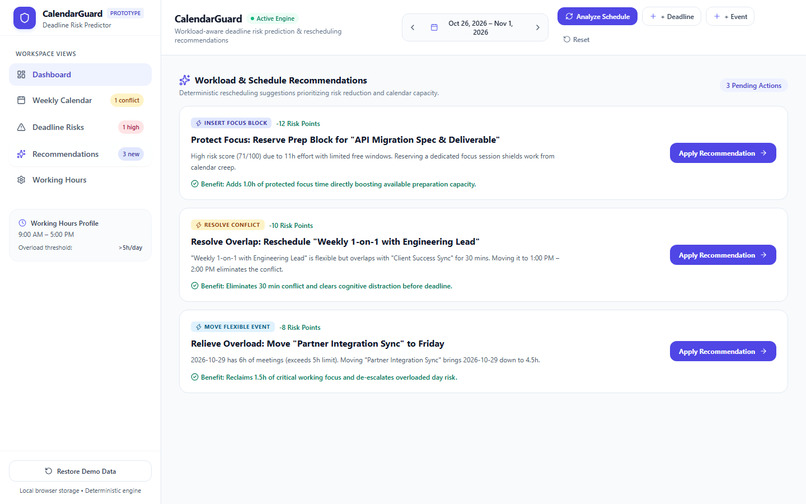
Rescheduling Recommendations Center
Inspiration
Calendars help people organize events, but a packed schedule does not always reveal whether a deadline is realistically achievable. Students and busy professionals can underestimate the time required for assignments, projects, and other commitments until it is too late.
We wanted to explore how a calendar could move beyond displaying events and become a proactive tool that helps people identify deadline risks before they fall behind.
What it does
CalendarGuard — Deadline Risk Predictor is a proposed upgrade to Google Calendar that analyzes schedules and highlights deadlines that may be difficult to complete on time.
Key features include:
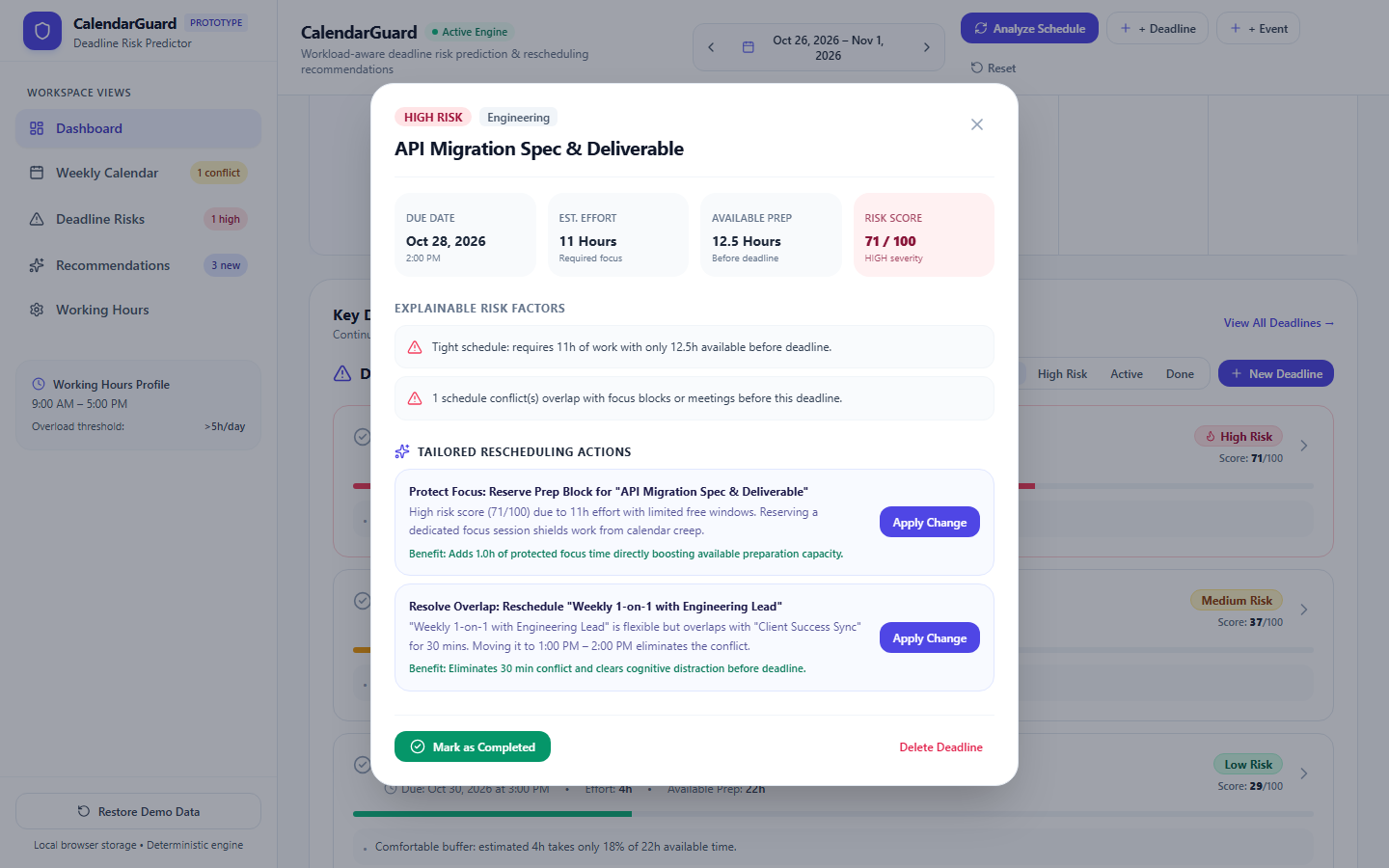
- Deadline risk scoring: Classifies deadlines as Low, Medium, or High risk using estimated effort, remaining time, and available capacity.
- Workload analysis: Highlights overloaded days and periods with limited preparation time.
- Conflict detection: Identifies overlapping scheduled events.
- Explainable insights: Shows why a deadline is considered risky instead of presenting an unexplained score.
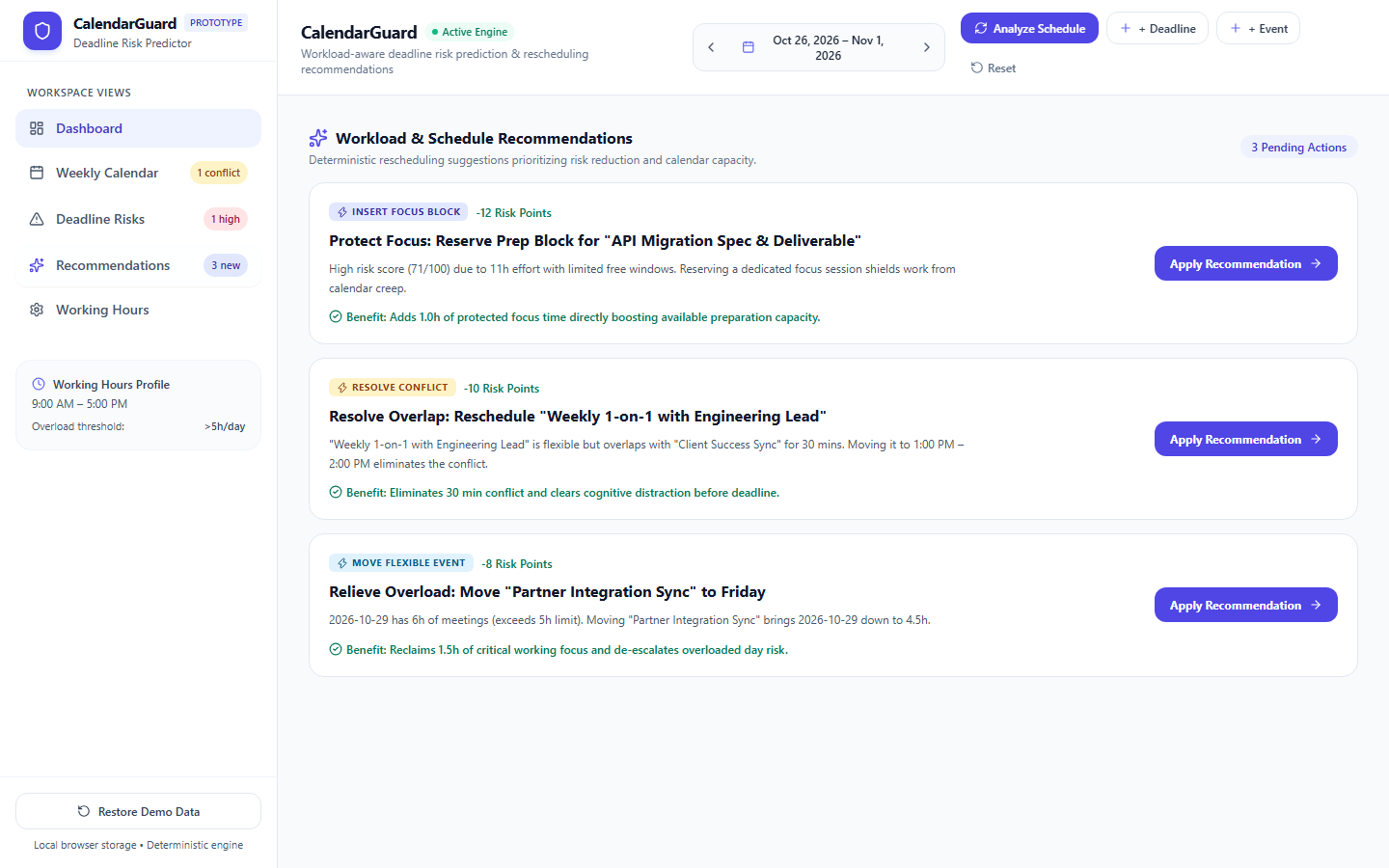
- Rescheduling recommendations: Suggests moving flexible commitments and reserving focused work time.
- Local persistence: Preserves schedule changes in the browser so the prototype can work without external services.
The goal is to help users make better scheduling decisions before a deadline becomes a crisis.
How we built it
We built CalendarGuard as a lightweight web application using React, TypeScript, and Vite.
The risk analysis uses deterministic rules rather than requiring an external AI service. It considers estimated effort, time remaining, calendar workload, and scheduling conflicts to produce an explainable risk score.
The application uses synthetic sample events and browser localStorage, avoiding the need for Google account access, API credentials, or a remote database.
We designed the interface around a weekly calendar, overview metrics, deadline risk details, and actionable recommendations. We also use Playwright to verify important browser interactions and regression scenarios.
Challenges we ran into
One challenge was making deadline risk useful without pretending that a simple heuristic can predict the future with certainty. We addressed this by making risk factors visible and keeping the scoring logic deterministic.
Another challenge was balancing functionality and scope under a short hackathon deadline. Rather than depending on external APIs or a complex AI pipeline, we prioritized a local-first implementation that remains usable when network connectivity is unreliable.
We also needed to ensure that schedule changes, risk classifications, and dashboard metrics remain consistent when a recommendation is applied.
Accomplishments that we're proud of
We focused on turning a familiar calendar workflow into a more proactive planning experience.
The core design combines deadline risk classification, workload analysis, conflict detection, and rescheduling guidance in one interface. The local-first architecture also reduces setup complexity and removes mandatory third-party dependencies.
Our emphasis is on understandable recommendations and a demonstrable workflow rather than adding AI features that do not improve the result.
What we learned
We learned that useful predictive assistance does not always require a large AI model. Clear rules, reliable data handling, and transparent explanations can provide meaningful decision support.
We also learned to prioritize the core user journey, account for edge cases, and treat automated browser testing as part of implementation rather than a final optional step.
What's next for CalendarGuard
Future improvements could include an official Google Calendar integration, user-configurable working hours, more sophisticated workload estimation, and personalized planning preferences.
With appropriate permissions, a future version could analyze a user's real calendar and suggest schedule adjustments while leaving final decisions under the user's control.
CalendarGuard is an independent prototype concept and is not affiliated with or endorsed by Google.
Built With
- css
- javascript
- playwright
- react
- typescript
- vite
- vitest


Log in or sign up for Devpost to join the conversation.