-
-
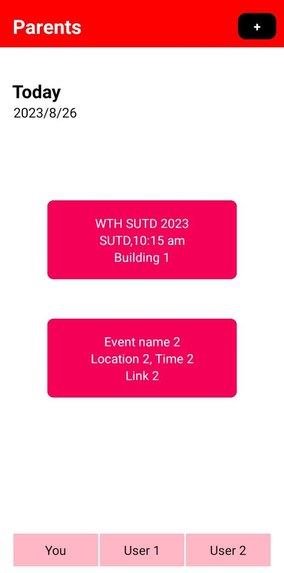
Home Page
-
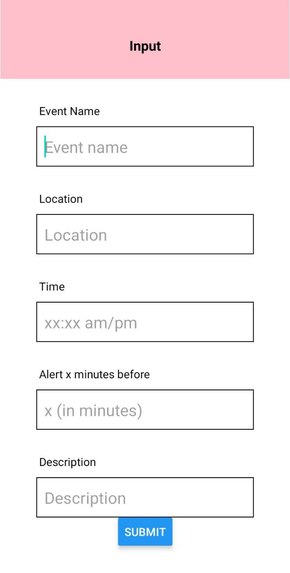
Input event page
About our solution
The topic that our team decided to focus on was Inclusivity and Accessibility Technology. After pondering on ideas for awhile, we decided to create a solution that would help a demographic that is dear to all of us - the elderly, or more specifically, those with memory issues or dementia. All of us have grandparents, and we all witnessed firsthand of the problems that memory issues created for our grandparents in their everyday lives. For example, one of our members has a grandmother who constantly forgets events that she has already committed to, and ends up double-booking appointments without realising until the other party contacts her. With this demographic and issue in mind, we brainstormed ideas from there to find a solution that could help.
We ended up deciding on a calendar app. First and foremost, though our initial target demographic was the elderly with memory issues, we decided to expand the demographic of our app to anyone that need support for their day-to-day activities, specifically on remembering them, such as the aforementioned elderly, young children, individuals with special needs (such as those with ADHD or autism), etc. What separates our calendar app from other calendar apps is its main feature: the ability for a third party to add events for the user.
What this feature addresses is the person’s inability to remember events by themselves whether due to memory issues, an inability to sufficiently organise their day or time by themselves, or any other reason.. Our app would have additionally a feature to push alerts/notifications to remind the user of upcoming events on their phone. By having a related third party be able to input new events, this allows the user to be reminded of their activities through the notifications. For example, if a person has a child who needs support with their daily activities, whenever their child has an appointment, the person can remotely input it into their child’s schedule so the child can be reminded of it themselves. All sorts of events such as meeting friends, taking medicine, doing exercise etc. can be input into the user’s calendar.
Through this feature and thus easy third party support, those needing support for their daily activities can ensure they reach their commitments as well as organise their time better. We feel that this support is relevant to many people especially in Singapore, as even when focusing specifically on the elderly amongst our target demographic, 10% of elderly over 60 in Singapore suffer from dementia and hence need outside support to live their daily lives.
When fully finished, our app can be distributed on the app store for anyone to download and use. We would also implement features such as using voice control for those who have hard time using their hands or fingers, integration with other apps to automatically add events from other calendars such as Google Calendar, etc.
Features and technologies of the app
- A third party can add events to another user’s schedule
- Can link multiple accounts (the third party can support multiple users)
- Push alerts to remind users of events (alert time customisable)
- Easy to see and understand UI (for those that might have trouble reading words or need more visual representations of time)
- Key features in adding events include Event Name, Location, Time, custom notifications, Description that includes links to maps, contact information, etc.
Technologies
We used React Native to code the prototype in MSVC Code. For one page, we created the home layout with an overview of the day’s events for users, coding the interface and buttons, and for the other page, we created an “Add Event” page for users remotely add events. For our demo, the latter page has working input, with any user being fully able to add any events. Snack Expo was utilised to view the functions of our code before exporting it to the app.
Key Challenges
We faced a lot of setbacks and challenges throughout the event. Our first, biggest problem was finding an idea. While our team had a vague idea of the topic we wanted to choose going into the event, namely Inclusivity and Accessibility Technology, we were stumped and overwhelmed on what we should focus on and create. After going to the fireside talk, we followed the advice of the speakers and decided to choose a specific group to focus on, then brainstorm with that as our focus. We had already been vaguely focusing on the elderly, so we expanded from there. Eventually we got the anecdote from our aforementioned team member about their grandmother of which resonated with our team, which finally kickstarted our project. This however was a lengthy process, and in the end we only properly started working on our project at around 4:30PM in the afternoon.
Another very big challenge we experienced, however, was the coding itself. Two out of four of our members had very little experience with coding apps, which posed a very big challenge for us. And so, this hackathon was a very good challenge and experience for us as well, forcing us to push our limits to do a crash-course style learning of the coding language React JS, and simultaneously introduce us to the world of creating apps. However, we managed to get a hang of it within those hours, thus simultaneously making this challenge a big achievement for us as well.

Log in or sign up for Devpost to join the conversation.