Inspiration
Calculus 2 is one of the hardest courses for college students. Concepts like volumes of revolution and surface area are extremely difficult to visualize from textbook equations alone. I wanted to build a tool that makes these abstract concepts instantly visual and intuitive.
What it does
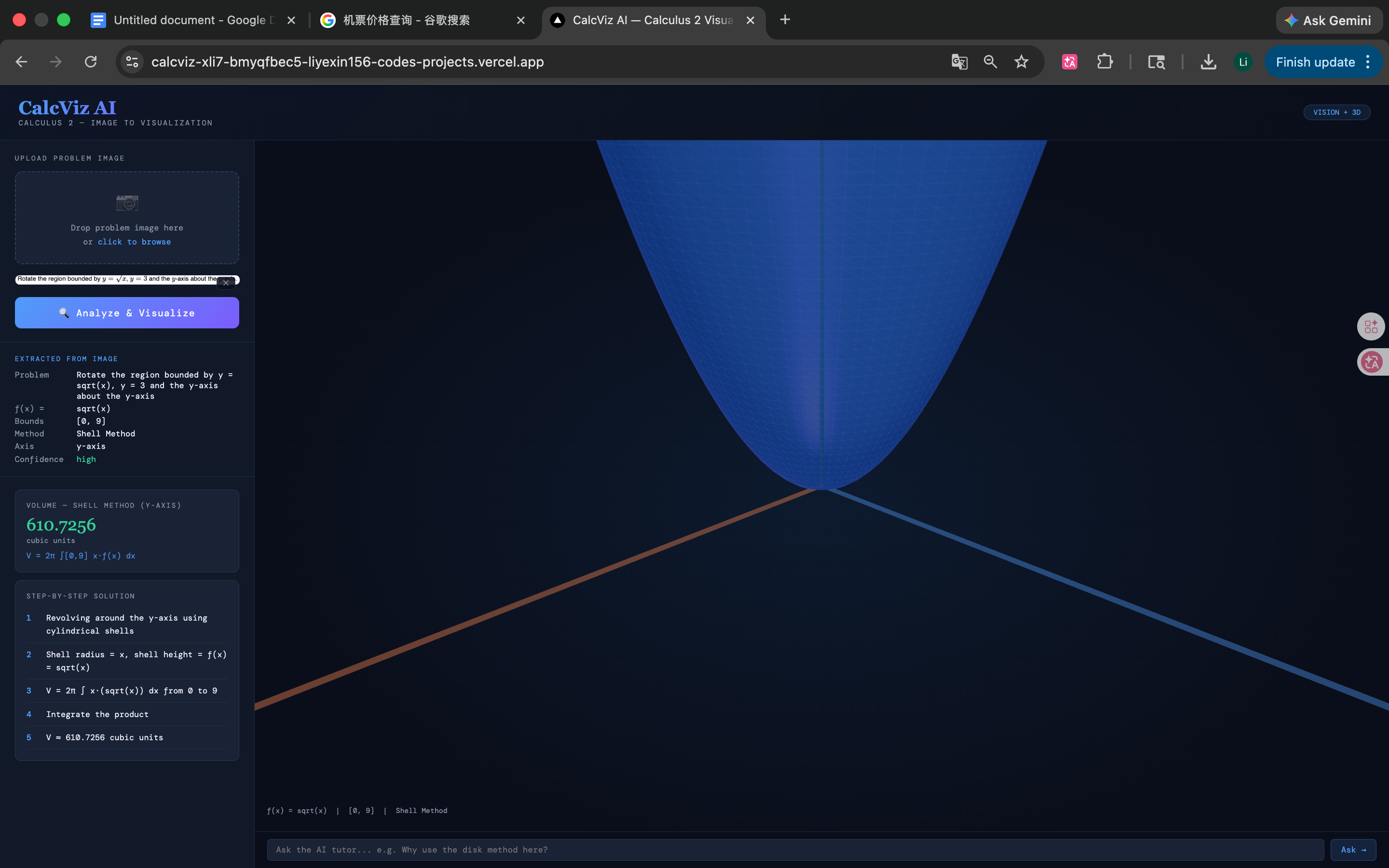
CalcViz AI lets students upload a photo of any Calculus 2 problem and instantly get:
- A 3D interactive visualization of the solid of revolution (drag to rotate, scroll to zoom)
- Step-by-step solution with the correct formula
- Numerical answer using numerical integration
- An AI tutor chat to ask follow-up questions
Supported problem types: Disk Method, Washer Method, Shell Method, Surface Area of Revolution, Arc Length, and Area Under a Curve.
How I built it
- Next.js for the full-stack web application
- Claude AI Vision API to read and parse math problems from uploaded images
- Three.js for real-time 3D WebGL rendering
- mathjs for numerical integration (Simpson's rule)
- Vercel for deployment
Challenges I ran into
- Getting the AI to correctly identify the integration method and axis of rotation from a handwritten or printed problem image
- Rendering accurate 3D solids of revolution using Three.js LatheGeometry
- Handling both x-axis and y-axis rotation with the correct integration variable
What I learned
- How to use Claude's vision API to extract structured data from images
- How to build and deploy a full-stack AI-powered web app from scratch
- How Three.js LatheGeometry works to render solids of revolution
What's next
- Support for more problem types (parametric curves, polar coordinates)
- Improve accuracy for complex multi-region problems
- Add step-by-step animation showing how the solid is built up slice by slice

Log in or sign up for Devpost to join the conversation.