-
-
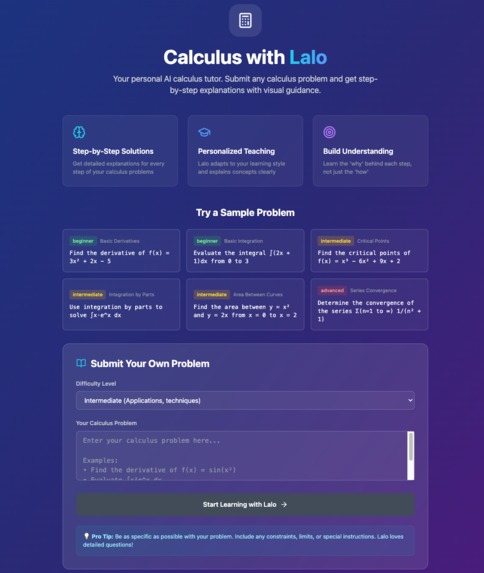
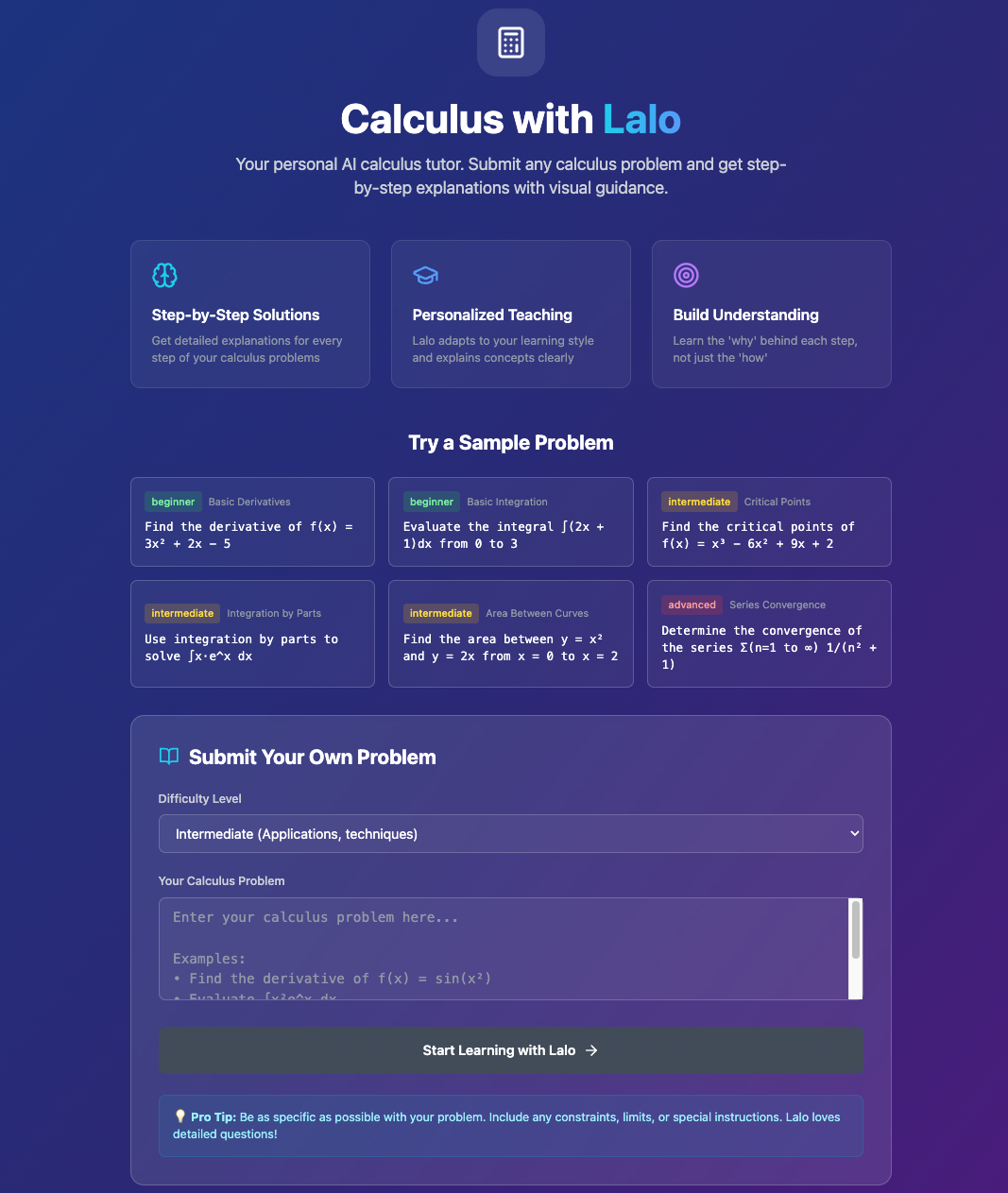
landing page
-
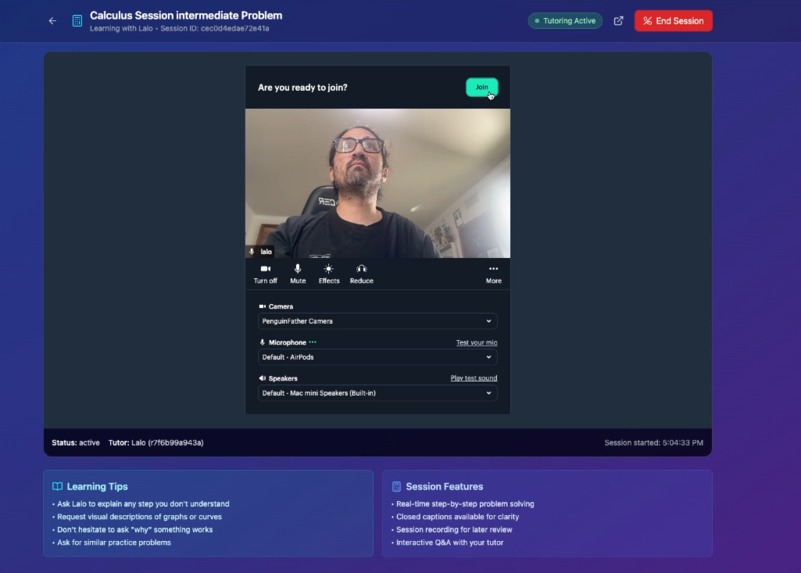
connecting to your AI tutor
-
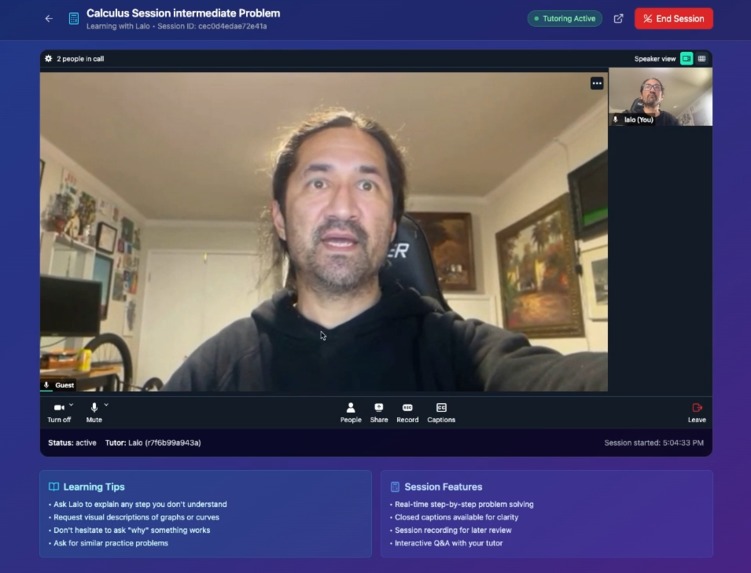
talking with lalo!
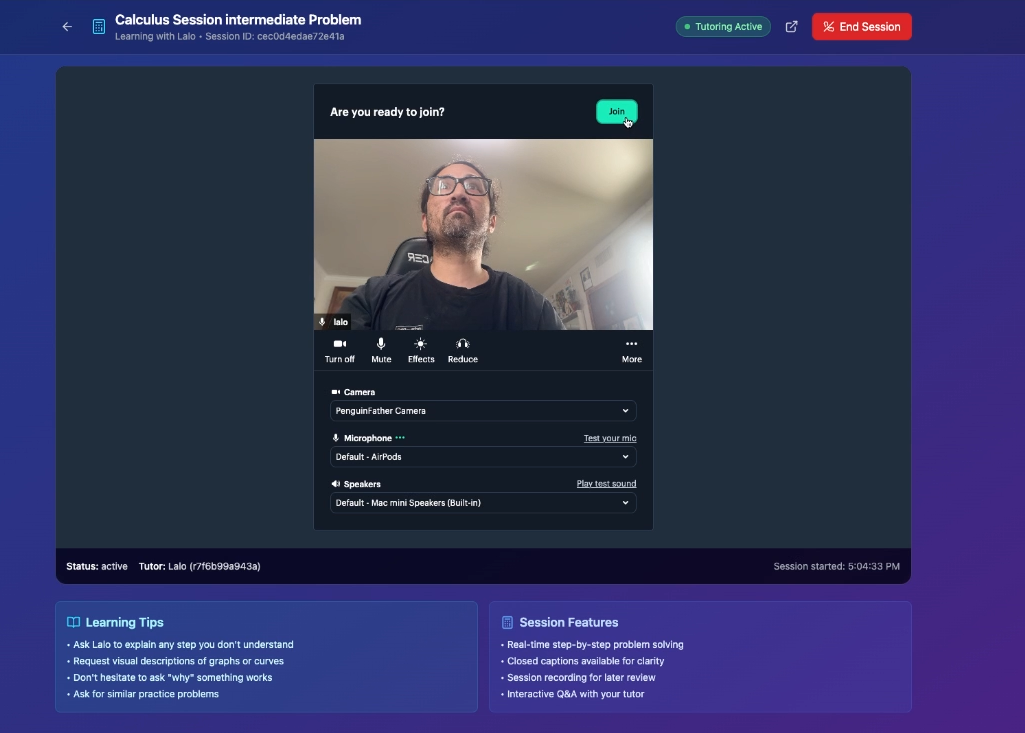
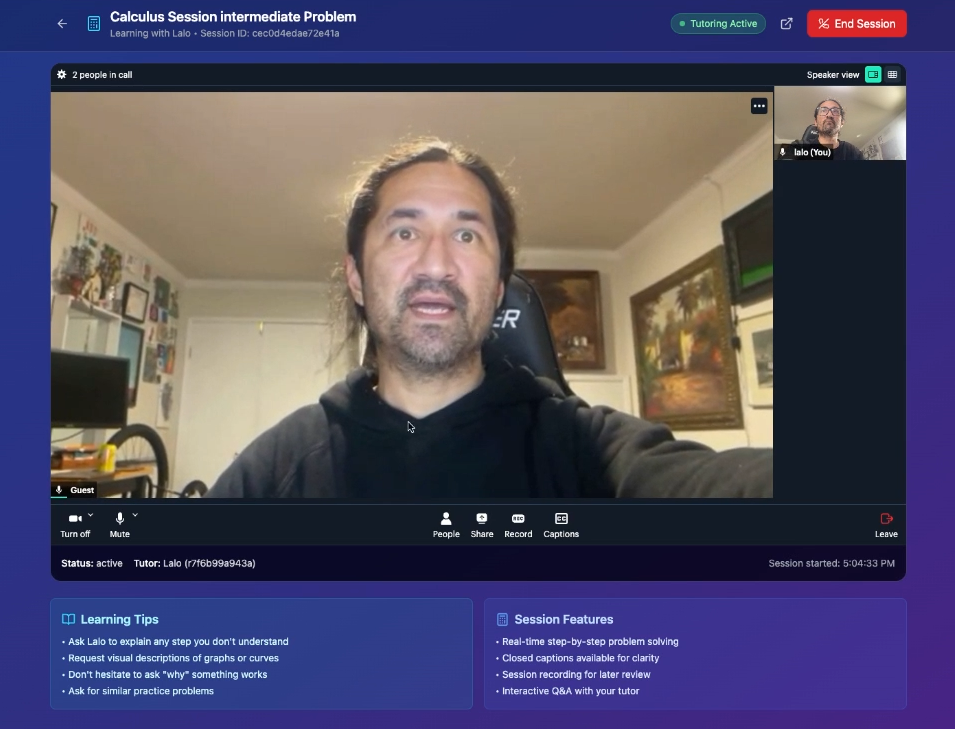
Alright, here’s that hackathon submission in markdown format, written in your voice.
Inspiration
Honestly, the inspiration came directly from my own grind. I'm taking Calculus for Engineers at ASU this summer, and I hit that classic wall where you see a solution, but you don't actually get why it works. Just staring at static problems and text-based answers is rough. As a developer, my first instinct when something is inefficient is to build a better tool. So I thought, what if I could build the tutor I actually need? Something interactive that talks back to you. That's how "Calculus with Lalo" started. It’s basically me building a solution for my own headache, combining my passion for coding with what I'm learning right now.
What it does
It's a straightforward web app that acts as your personal AI calculus tutor. You drop in a problem you're stuck on, anything from a basic derivative to something more advanced like series convergence. Instead of just spitting out a wall of text, a digital AI avatar of me pops up, powered by Tavus AI. It then verbally walks you through the entire problem, step-by-step. The key is that you can have a conversation with it, so it can actually teach you the 'why' behind the steps, not just the 'how'. It’s all about building that real understanding.
How we built it
I built this with my go-to stack to get it up and running quickly. The frontend is all React and JavaScript, with some clean CSS to keep it simple. The backend is a Node.js server that wrangles the APIs. The real magic comes from hooking into Large Language Models to handle the calculus logic and then piping that through Tavus AI to generate the talking avatar of me. The whole thing is set up with my typical workflow: code in VS Code, push to a GitHub repo, and let Railway handle the deployment automatically.
Challenges we ran into
The biggest headache was getting the different APIs to talk to each other without a ton of lag. You want the conversation with the AI to feel natural, not like you're waiting five seconds for every response. Syncing the LLM's step-by-step math solution with the avatar's speech from Tavus was a challenge. Also, you have to really nail down the prompt engineering. LLMs can get creative with math, so I had to put in work to make sure the solutions were consistently accurate and explained things in a way that actually makes sense for someone learning.
Accomplishments that we're proud of
I'm most proud of the fact that it actually works and feels like a new way to learn. It's one thing to have an idea, but it's another to see a lifelike avatar on the screen teaching calculus in a conversational way. This project proves that you can humanize AI education and make it interactive instead of just passive. Shipping a full-stack app with these kinds of complex AI integrations in a short timeframe feels like a solid win and shows the power of a streamlined development process.
What we learned
This was a crash course in applied AI. The main lesson was that you get the best results by combining specialized APIs. Using a powerful LLM for the 'brains' and a dedicated service like Tavus for the avatar creates a much better product than trying to force one tool to do everything. It also hammered home that prompt engineering is everything. The quality of the AI's explanation is a direct result of the quality of your prompt. It’s a skill I’m definitely leveling up.
What's next for Calculus with Lalo
This hackathon is just the start. The plan is to build this out into a real, monetizable platform. I want to add more subjects like Physics and Algebra, since the framework is already there. The next big step is to add user accounts for tracking progress and then implement that $10 a month pay button I've been planning for my projects. The ultimate goal is to create a go-to tool for students that also generates real income.
Built With
- bolt
- tavus
- vite

Log in or sign up for Devpost to join the conversation.