Pitch
Cakery explained 3 different ways:
For Developers:
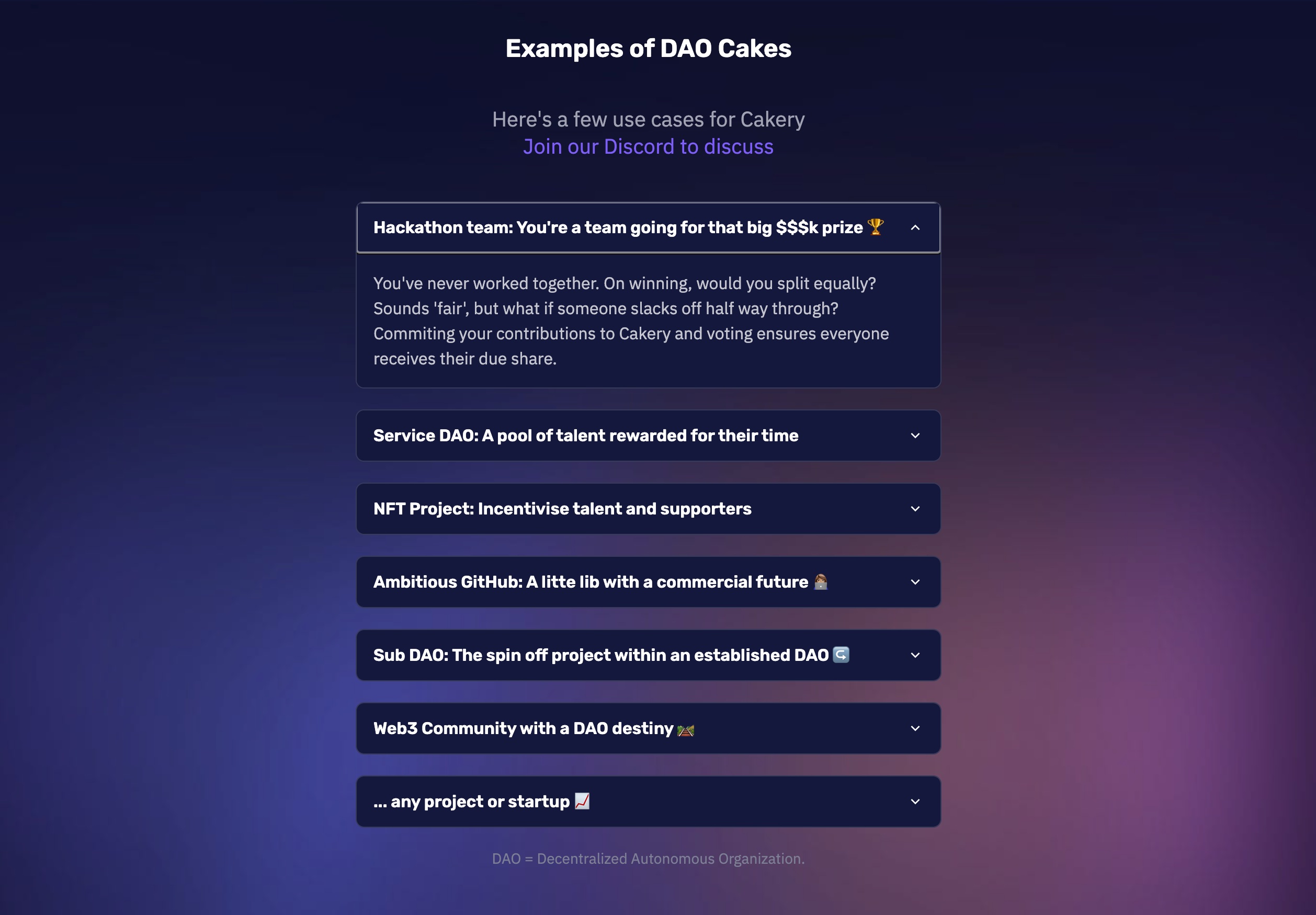
Cakery is like GitHub but instead of committing code, you submit your contribution in time, knowledge, expertise to earn a stake in the project.
For Founders:
Cakery is like the ‘Slicing Pie’ method bootstrap co-founders use to track their slice of a company but on the blockchain and with added governance and smart contracts to save the legal costs of founding a company.
For DAOs / Web3 Communities:
Cakery is a tool to spin up a ‘DAO’ in minutes without code and without tokenizing. Begin immediately tracking community contributions. Allowing you to reward and issue tokens later.
Cakery is all these things to all these types of people because of its atomic simplicity. It is an open, transparent decentralised protocol for managing new projects and organisations on-chain. You get the benefits of DAO proposals, voting, governance and contribution value without the complexity.
Cakery brings DAO tooling tech to anyone including web2 and those in the physical world.
For example: 3 friends restoring an old car. One buys the car, another fixes the engine and other does the panel work and paint. Each put in different amounts of capital, physical labor related to their individual expertise. The total input costs were $50k. A buyer offers $150k. Do you sell or hold for a higher offer? Who gets what from the proceeds?
Hint: $50k each would break up the friendship! The only fair way to answer these questions is with Cakery.
Inspiration
Personally, and when talking to others who touted to be ‘DAO founders’ on Twitter and IRL I discovered less than 1 in 10+ I spoke to had actually Tokenized. For the rest of us Tokenization was only in our roadmaps so for now we were essentially web3 communities. When asked "Why?" I found that as DAO founders we experienced the same hesitations about tokenization:
- We're still refining our tokenomics and incentives to build into the token
- Concerns of legal implications or needed funding to structure correctly
- Still proving up the idea and onboarding valuable contributors
- Concerns generating a Token can ‘Price’ the project prematurely
- Tokens are volatile right now.
Yet, we had the same urgent needs:
- To incentivise and measure contributions from founders / members
- Provide transparent governance (proposals, voting, contributions)
- Accurately track equity ownership for a later pricing event (token or otherwise)
What Cakery does
Cakery allows a group of individuals to operate as a DAO without tokenizing.
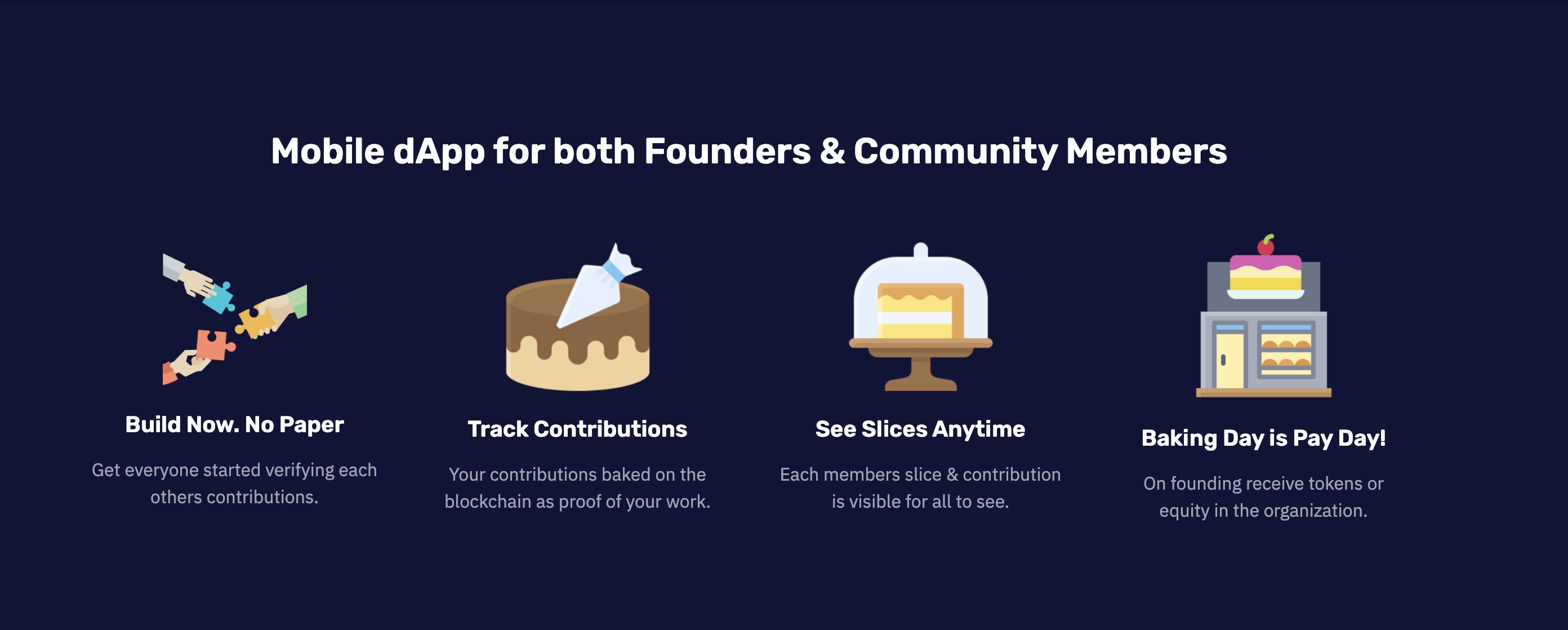
Cakery tracks contributions in ‘DOU’ (the DAO Ows yoU). Members vote on proposals and claims to approve. The sum of the approved DOU your claims is your ‘Slice’ of the Cake.
Cakery allows organizations and projects large and small to function as a DAO formalizing what is necessary: accountability, governance and the pending equity (DOU) without the barriers of legal, monetary, strategic and technical so they can get started right away; then, tokenize later.
Where does Cakery fit in the NEAR Ecosystem?
It's true! with AstroDAO you can create a DAO. This is still a different market than Cakery.
Cakery is the tool of choice to onboard and manage contributors before creating a formal DAO. The DAO can choose to ‘Bake’ later to reward the contributors. This may include tokenising with a native token on Astro DAO or customised contracts and tokenomics on NEAR.
A tokenised DAO on NEAR may wish to create a sub-DAO with a group of members to explore a project within the DAO. Cakery is perfect for a sub-DAO as activities won’t affect the DAO’s native token value. When the sub-DAO is successful, its’ Cake can be ‘Baked’ in Native Tokens of the parent DAO.
By making DAO creation, joining and contribution as simple as a few taps in an app there will be more DAOs in the world. With Cakery on NEAR that means more DAOs from new markets ultimately tokenizing, issuing NFTs and building their projects on NEAR.
How we built it
NEAR for performance. Aurora for end-user Smart Contract readability.
Decentralised file storage served over IPFS. Ethers for communication. NextJS front-end walkthrough and JS-Docs for the platform API.
Cakery App front end developed in Flutter for cross platform wide availability.
Project components:
- Solidity Contracts deployed to Aurora Testnet 0x1175B8Fb85e5B545E3364055B5EfB5b239cf9FA6
- API documentation https://beta.cakery.io/playground
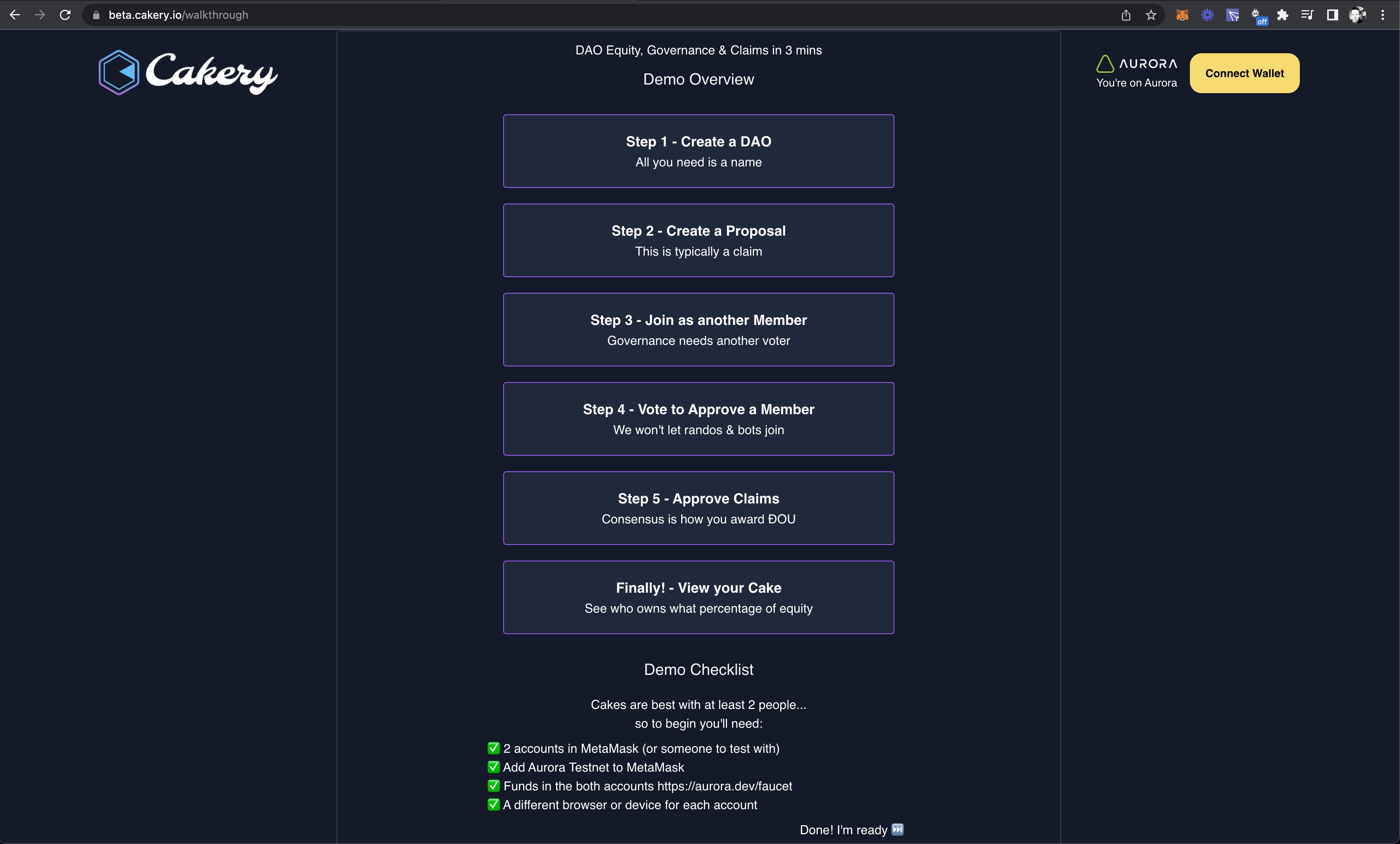
- Front-end Walkthrough https://beta.cakery.io/walkthrough
- dApp links https://beta.cakery.io
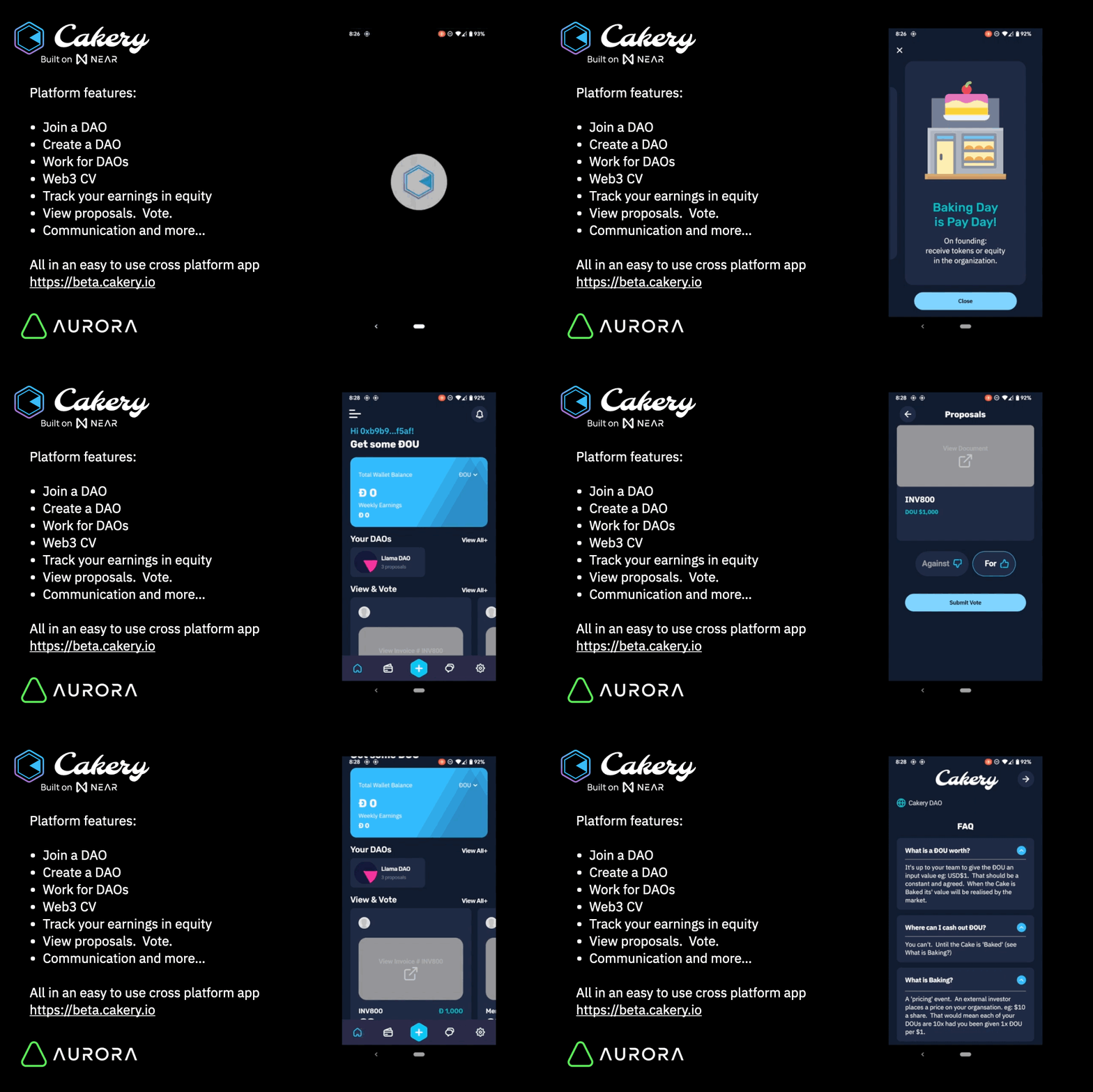
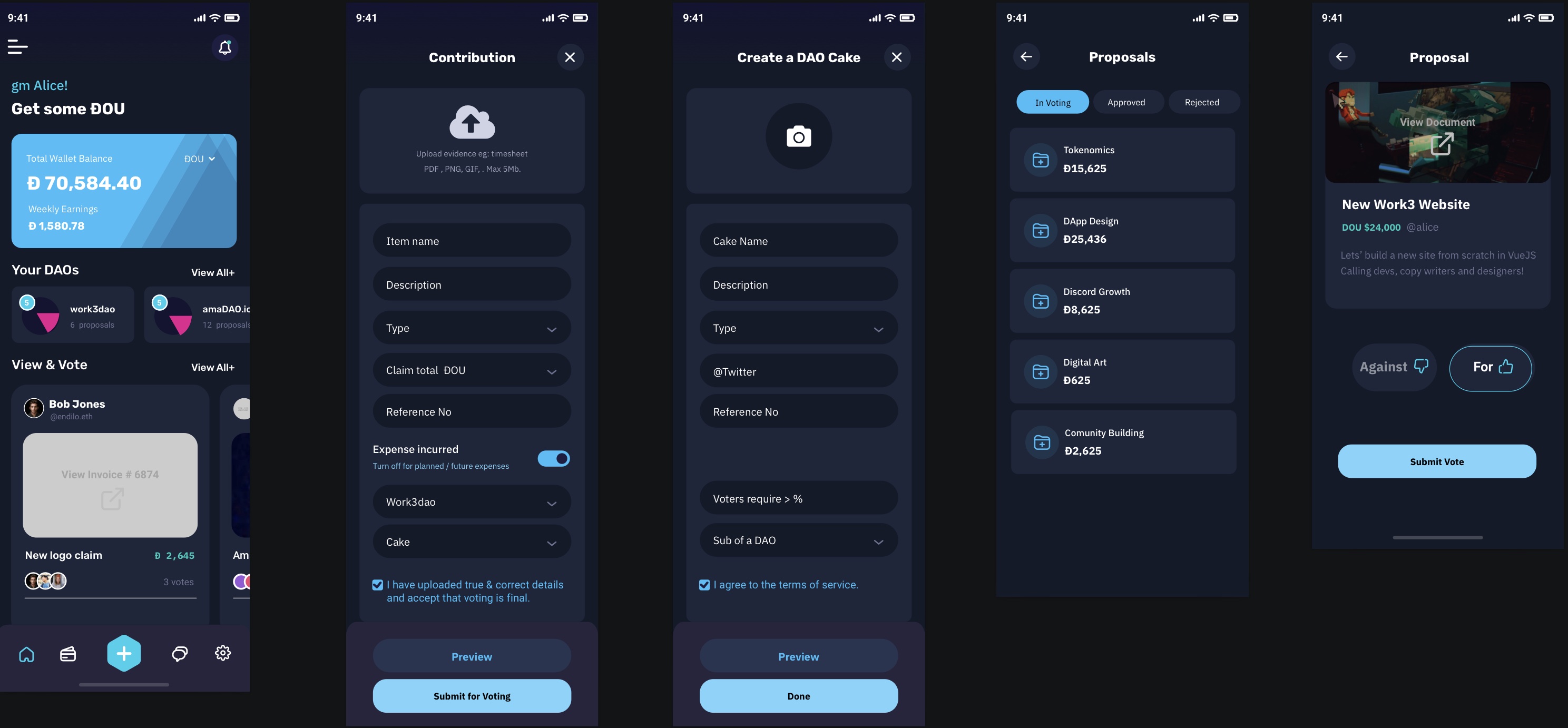 Tap to View an animated GIF scroll through
Challenges we ran into
3 mins is too short to demonstrate the dApp :) Instead we’ve created a purpose built walkthrough. Try it for yourself here https://beta.cakery.io and follow the YouTube video to be guided. This walkthrough calls all the same smart contracts and APIs as our Cakery dApp. You can use the APIs too if you want to build your own dApp: https://beta.cakery.io/playground
If you want a peek at the dApp without having to install it. Here is an animated GIF scroll through
Business model
SaaS Subscription - For larger DAOs. Fee includes full dashboard and additional features for querying, talent acquisition etc.
Ad Hoc PAYG Services - Provide DAOs the ability to issue NFTs to contributors based on queries and filters. Fee for use. Build in ‘Bake’ events and tokenization & tokenomics services.
Accomplishments that we're proud of
The smart contracts are complex yet easily read. Hitchens CRUD & Open Zeppelin libraries abstract deeper operations; combined with the repository approach with shared entities the high level the contract Cakery.sol provides an easy to read & implement interface.
Wrapping the blockchain interactions with an API and swagger documentation has improved the accessibility to the smart contracts and assisted rapid development of the app.
The API will allow even web2 developers to build on the Cakery system even if new to blockchain development. Of course signing requests must interact directly with the Smart contracts but the use of APIs means all the rest is more versatile.
What's next for Cakery dApp
Make it possible for users to create an account without needing MetaMask. We ran out of time in the hackathon to explore this from Aurora but know it’s possible natively in NEAR. This would open the usage of the app to non-crypto users.
Explore a potential market with Web3/Crypto VCs. I’ve heard from fund managers of battle stories relating to founders who receiving money from a crypto fund then returned to their full-time job 😳. Cakery would solve this as the ongoing contributions by the team would be visible on-chain. Conversely, Cakery could be used by founders to substantiate their commitment for pre-seed or accelerator funding.
Our Vision
DAOs have introduced a large part of the web3 community to the idea of earning tokens. The idea that you can own 'equity' as part of being 'paid'. Blockchain enables this but it does not need to be limited to DAO people and web3.
Just as NEAR Protocol is the blockchain that will transition the world to web3. Our vision is that Cakery can help drive this transition to the blockchain through the DAO way of working for all.
Built With
- aurora
- near
- nextjs
- solidity
- swagger


Log in or sign up for Devpost to join the conversation.