Cairn
Record once. Reuse forever. Repaired when the target changes.
Turn a browser task you already do by hand into a durable, private, typed API — verified end-to-end and owned by you. You and your agents call it forever; Cairn keeps it working when the site moves underneath it.
Inspiration
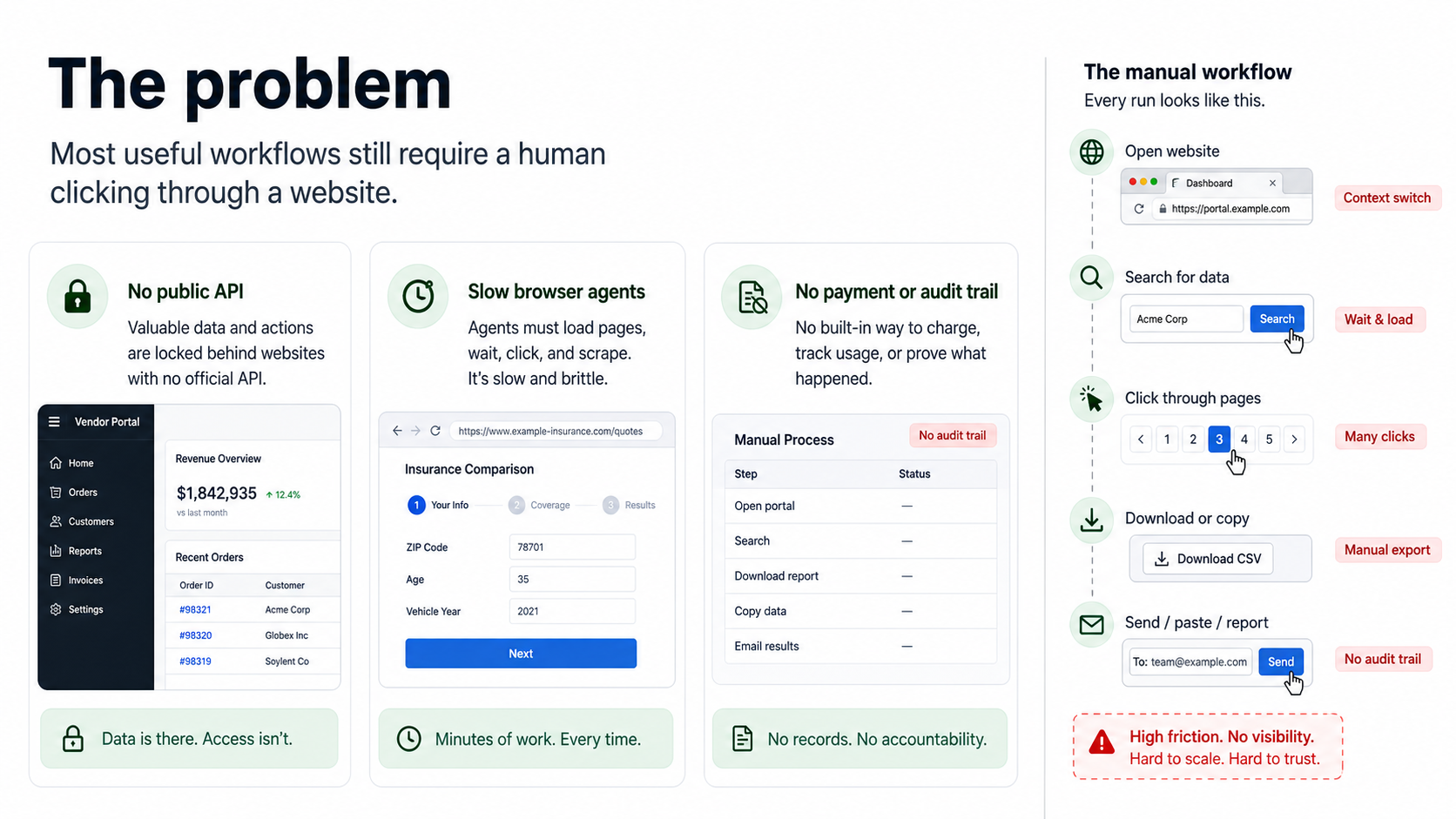
Agents are brilliant at reasoning and miserable at the boring part: reliably driving real websites. Every team we talked to had the same graveyard — a hack for the insurance portal, a scraper for the county records site — brittle scripts that broke the instant a button moved. And it's worse than fragile: every agent re-solves the same multi-step flow from scratch, slowly, on every single run.
One idea kept surfacing: the hard, repeated work of clicking through a site should be done once, captured, and frozen into something you can call like any other API — not a script you babysit, but an endpoint that stays working.
The realization that became the product: the recording isn't the valuable thing. The durable, verified contract that survives the site changing is.
What it does
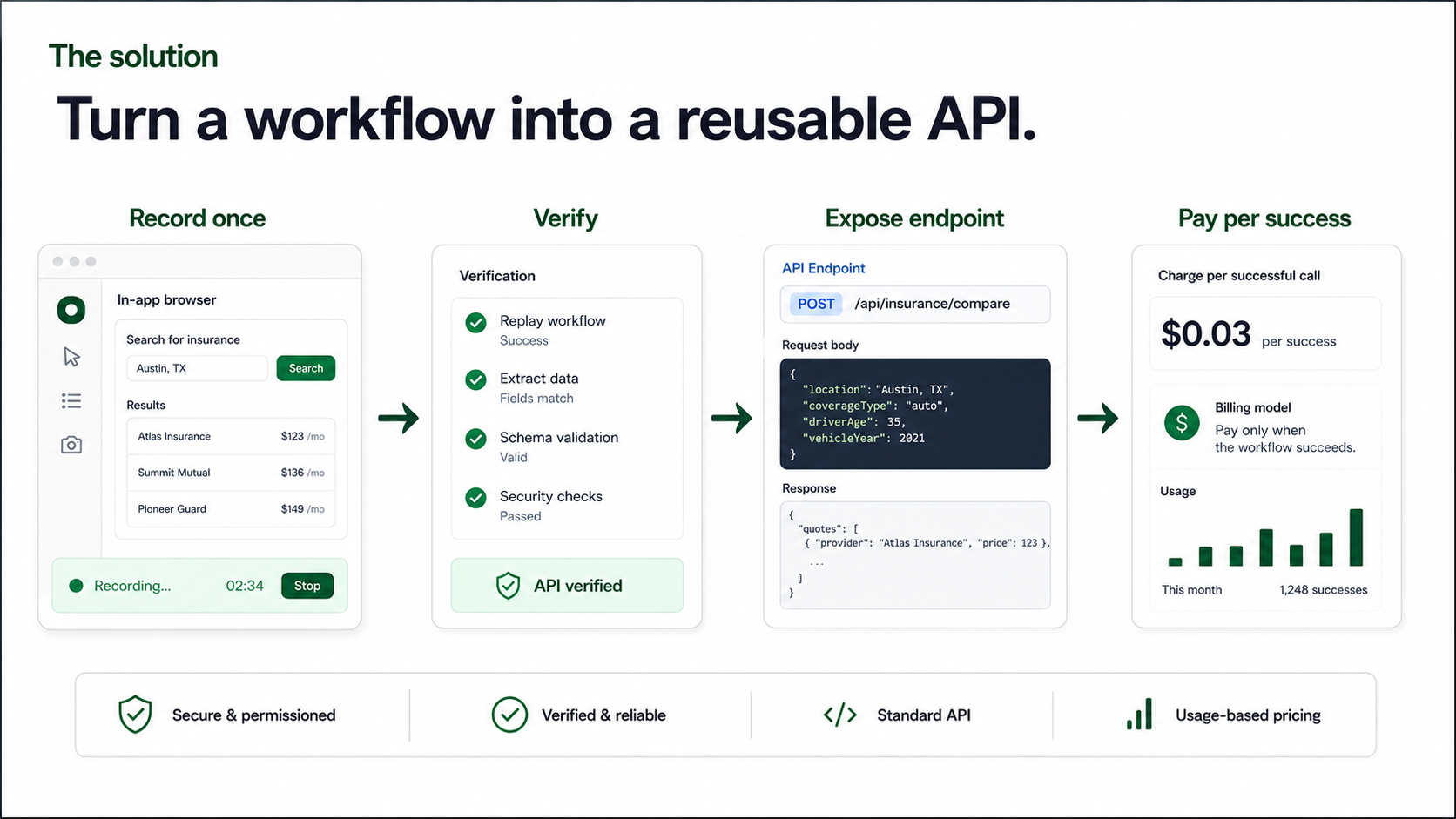
Cairn turns a recorded browser workflow into a durable, private, typed API.
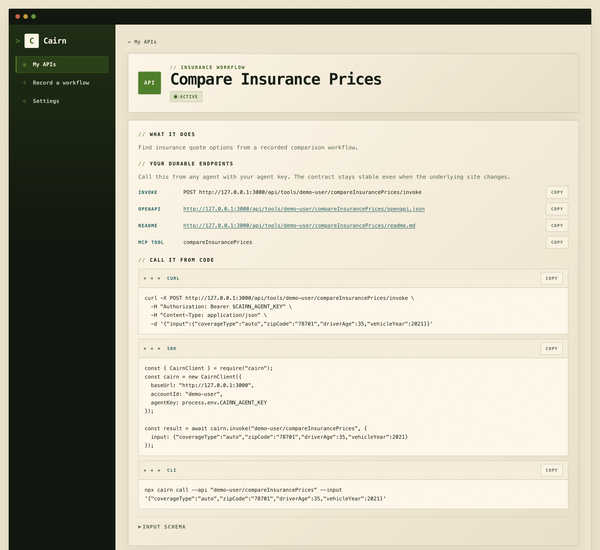
You record a task once — title, target URL, goal. Cairn compiles that recording into an operation: an input schema, an output schema, an execution plan, selectors, allowed domains, and success predicates. Then it verifies the operation end-to-end by replaying it against known input and asserting the expected output. Only once it passes do you get:
- an HTTP invoke endpoint
- a generated OpenAPI spec
- a native MCP tool (so Claude, Cursor, or any MCP agent calls it directly)
- an SDK + CLI
…all four generated from one operation definition — a single source of truth.
Every API is private and account-scoped: gated by a hashed bearer key, owned by you, never dropped into a public catalog. And it's durable — Cairn re-verifies the operation, classifies why it broke when it breaks, proposes a targeted repair, and republishes only after the repair re-verifies.
Agents call a stable typed contract, not a raw browser session. The contract holds even when the site doesn't.
How we built it
One framework-free Node server. The entire lifecycle — record → compile → verify → invoke →
repair — runs in a single Node HTTP server with hand-rolled routing and exactly one production
dependency (pg). No Express, no framework. It keeps the boundaries explicit and makes the demo
a one-liner: npm start.
Two sandbox targets, chosen to hurt. Meridian is a clean JSON REST CRM — the easy case.
Civic is a deliberately nasty legacy portal: per-request CSRF tokens and ViewState-style
hidden fields minted fresh on every page and rejected (422) if replayed. Civic is what forced
the real design — a recording can't be replayed verbatim, so the operation lifts fresh tokens per
run and re-derives hidden fields from the live, server-rendered form. That single requirement is
why "operation definition" and "raw replay" are two different things in Cairn.
One contract, four clients. OpenAPI is generated from the operation. The same operation drives
the MCP tool (a real JSON-RPC 2.0 tools/list + tools/call), the SDK, and the CLI. Change the
operation and every surface updates — there is no second source to keep in sync.
Durability is the engine, not a feature. When verification fails, Cairn classifies the failure
into a typed cause — changed_route, stale_token, selector_failure, changed_response_schema,
auth_expired, extractor_failure — and only attempts a repair it's confident in. A confident
repair (e.g. a route that moved within an allowed domain) is re-verified against the original
input/output and auto-published as a new version; anything risky is held for human approval
rather than shipped blind.
Auth & privacy by construction. Accounts issue bearer keys that are SHA-256 hashed before
storage and shown by prefix only. Every read and invoke is account-scoped, and cross-account
lookups return an identical 404 for "doesn't exist" and "not yours" — so one tenant can't
even probe another's API names.
Persistence — and a production topology it's built to grow into. The whole thing runs with
zero external services: state lives in memory, or in Postgres (via pg) the moment you set
DATABASE_URL — the source of truth for accounts, operations, skill manifests, verification
records, and invocation logs. Every internal boundary is drawn to map cleanly onto a real AWS
topology — RDS for data, S3 for immutable recordings/traces/artifacts, SQS + EventBridge + Step
Functions + Fargate for a worker plane, Secrets Manager + KMS for secrets — and the env and infra
scaffolding is already in place for that next phase.
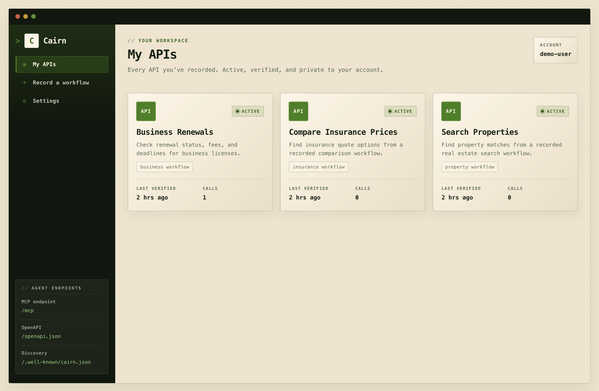
Frontend. A clean monospace/terminal dashboard for schemas, data, and forms, plus a Next.js landing deployed on Vercel.
Challenges we ran into
- Legacy sites fight back. Civic's CSRF + hidden ViewState made verbatim replay impossible — we had to lift fresh tokens per run and re-derive hidden fields from each server-rendered page. This one constraint shaped the entire "operation vs. raw replay" split.
- Drift is the actual product. Recording a flow once is easy; keeping it alive is the whole game. Classifying why a workflow broke — route vs. selector vs. token vs. schema — precisely enough that a repair could be both targeted and safe to auto-publish took the most iteration of anything we built.
- Keeping secrets out of the contract. Session cookies, CSRF tokens, and credentials can never leak into agent-visible schemas or traces. Drawing that line cleanly — hashed keys, prefix-only display, secrets never in the operation — took real care.
- Repositioning mid-build. We started as a paid marketplace. Partway through we realized the
durable private API was the product and the storefront was noise. We ripped out payments,
credits, and the public catalog entirely — a migration that drops every wallet/ledger/payment
table and turns
marketplace_listingsinto account-ownedapis— and re-scoped every route to its owner. A genuine kill-your-darlings pass that made everything sharper.
Accomplishments that we're proud of
- A complete record → compile → verify → invoke → repair loop that works against both a modern API and a hostile legacy portal.
- One operation definition, four clients — HTTP, OpenAPI, MCP, SDK/CLI — with no second source of truth.
- Tenant isolation done right, down to the
404-not-403detail that defeats cross-tenant name probing. - A genuinely self-healing API: typed drift classification, targeted repair, and re-verification before anything republishes.
- Runs end-to-end with zero external services, yet every seam is drawn to lift straight onto a real AWS production topology.
What we learned
- The valuable artifact isn't the recording — it's the contract that survives change. Verification and repair are the product, not a feature bolted on top.
- Less surface, sharper story. Cutting payments and the marketplace made the code, the pitch, and the demo all better.
- Designing for agents as first-class callers — MCP, bearer keys, typed I/O,
404-not-403— is a genuinely different discipline than designing for humans clicking buttons.
What's next for Cairn
- Team/tenant ownership and roles on top of account scoping.
- Scheduled re-verification with health scores and alerting on repeated drift.
- LLM-assisted repair (computer-use / Browser Use) running behind deterministic replay, with human approval for risky diffs.
- The worker plane wired onto the AWS topology it's already designed for.
- A published SDK with typed clients generated per API from its OpenAPI, plus hosted MCP config for Claude, Cursor, ChatGPT, n8n, and Zapier.
Built With
node.js · javascript · postgresql · mcp · openapi · json-rpc · next.js · react ·
typescript · vercel · aws (target topology: rds · s3 · sqs · eventbridge · step-functions ·
ecs-fargate · secrets-manager · kms)
Built With
- amazon-ecs
- amazon-eventbridge
- amazon-rds-relational-database-service
- amazon-sqs
- amazon-web-services
- aws-kms
- aws-secrets-manager
- aws-step-functions
- css3
- html5
- javascript
- json-rpc
- mcp
- next.js
- node.js
- openapi
- pnpm
- postgresql
- react
- rest
- sql
- typescript
- vercel
- webgl

Log in or sign up for Devpost to join the conversation.