Inspiration
China, being the world's largest exporter of e-commerce goods, indeed sends tens of millions of different types of products to consumers globally every year through air transport. Among these products, there are many items that are sensitive for air transportation, such as batteries, pressurized cans, magnetic materials, and other substances with special attributes that may not always be properly declared. This has led to accidents in the past, and in the last five years, it has even resulted in the write-off of three aircraft. Due to these safety concerns, the Civil Aviation Administration of China (CAAC) imposes strict requirements for air cargo security checks. Companies like Cainiao, Alibaba's logistics arm, have experienced periods where the return rate of goods due to security inspection issues has exceeded 10%, which poses significant challenges to transport efficiency and load rates.
As a logistics company born out of e-commerce, Cainiao Network has set its sights on how to leverage the capabilities of the ONE Record (1R) to reduce the safety risks associated with the transportation of e-commerce goods. The overall idea is to use the capabilities of ONE Record to enhance the reliability and reduce safety risks through more extensive data sharing of security information among different participating entities, all while maintaining the data as the single source of truth. This approach not only improves safety but also provides more accurate information feedback for freight forwarders and shippers
What it does
By implementing 1R, Cainiao aims to streamline the flow of information, ensuring that each stakeholder in the supply chain has access to comprehensive, accurate, and real-time data about the cargo. This will facilitate better risk assessment and management, allowing for more effective identification and handling of potentially sensitive or hazardous goods before they are shipped. Enhanced data sharing and transparency can lead to improved safety protocols, fewer incidents, and a more trustworthy and efficient logistics process for e-commerce shipments.
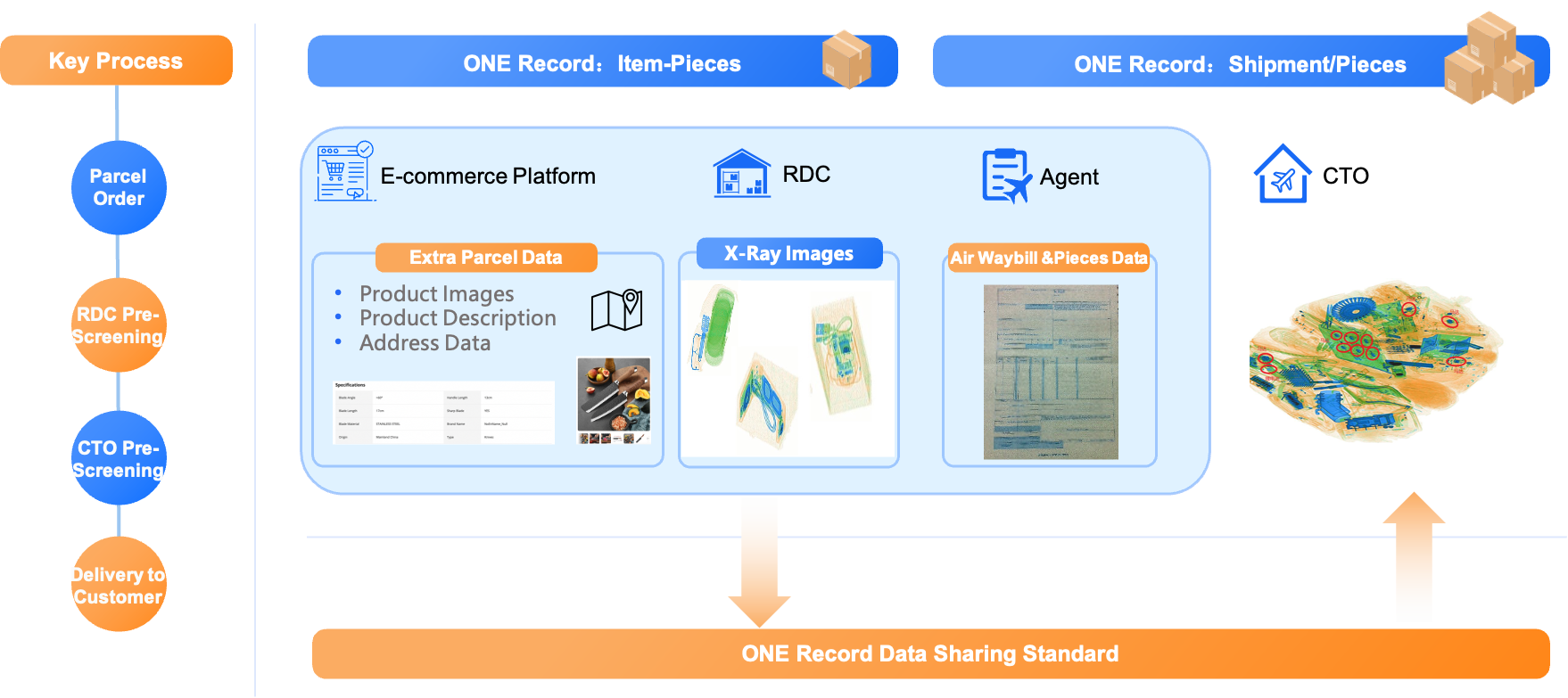
Our solution is closely integrated with ecommerce goods information and can be further expanded and made more efficient by incorporating AI capabilities. After a user places an order on an ecommerce platform and completes the consolidation of large packages, some information about small parcels, such as product images, descriptions, destination countries, and screening images, is recorded on the server in a ONE Record format. When the goods arrive at the freight forwarder, the forwarder will provide the association between the air waybill and each small parcel, which is usually in the format of waybill - piece - inner small parcels, and this data has also been defined by the ONE Record standard. When goods are delivered to the cargo terminal for collection and security inspection, the waybill - piece – small parcel relationship allows for the verification of each ecommerce parcel's product images, names, and screening images as auxiliary identification information, which assists security inspector in relocating and making more accurate judgments about suspected contraband. Of course, if combined with AI capabilities in semantic and image recognition, a multimodal calculation can be performed prior by above data and images, providing preliminary prompts to inspectors.
How we built it
In our proposal, we have utilized three types of stakeholders - Shipper, Agent, and CTO (as the security inspection entity) - as the providers and consumers of information. The data they require, such as Waybill, Piece, and Parcel, are stored in five types of Logistic Objects under the ONE Record standard: shipment, waybill, pieces, product, and items. For image information, we have also added some fields dedicated to storing and recording this data separately.
Challenges we ran into
It should be noted that the Shipper and Agent information are obtained according to ONE Record subscription agreement: extra e-commerce parcel data comes from users making orders on the platform, parcel screening images come from distribution center, and air waybill related data provided by agent. In the demo, we will use the centralized server solution of ONE Record to realize the login and permissions of three different enterprise entities: shipper, agent, and Cargo Terminal Operator, and then simulate the collection of relevant data. In essence, parcel, package, and air waybill data provided by the shipper and freight forwarder are Production data of respective systems.
Simulate the process of providing parcel, package, waybill, and screening image data, and then update relevant fields to Shipment, Waybill, Pieces, Product, and Item. Simulate security inspector performing piece-level screening operation on e-commerce goods at the cargo terminal. Getting data of Item, Product, Pieces, Waybill, and Shipment through ONE Record, the security inspector can query the product pictures, names, and screening images of all pacels associated with package when detecting. If suspecting the package, click parcel image, and record security check failure information, then update 1R relevant fields. At this time, you can see on the screening data page that the security data of parcel, package, and waybill has been updated to fail.
Accomplishments that we're proud of
For shippers, we are willing to provide assurance of transport timeliness and quality through data sharing. For freight forwarders, this increases the efficiency of cargo handover and reduces the risk of returned shipments or even penalties. For the entire civil aviation transport industry, enhancing safety means the protection of life and property, and our solution focuses on ensuring a balance between safety and efficiency through the sharing of reliable, precise, and detailed e-commerce safety data.
What's next for Cainiao Solution-Screening with ONE Record
Cainiao is well-prepared to share data to accelerate the logistics experience and has accumulated several years of experience in AI applications such as goods nomenclature and security image recognition. We are very much looking forward to leveraging the IATA hackathon events to work with our highly innovative industry partners, and turn this exciting idea into a normalized practice.

Log in or sign up for Devpost to join the conversation.