-
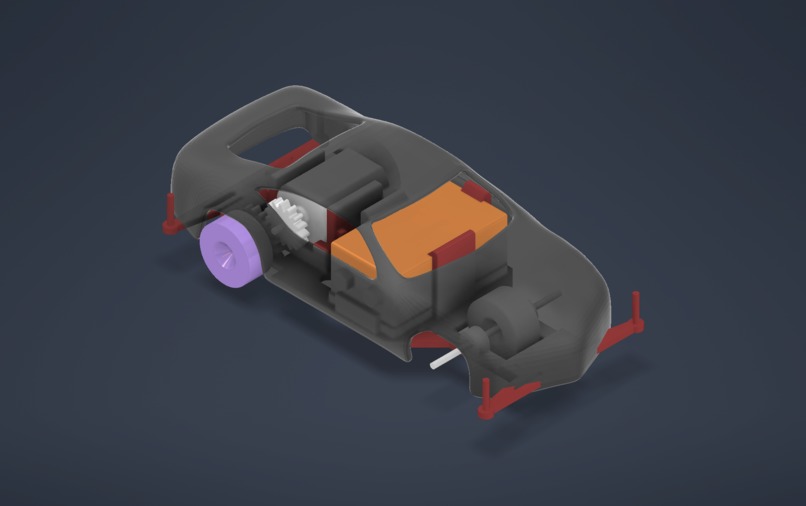
Trickshaw with shell
-
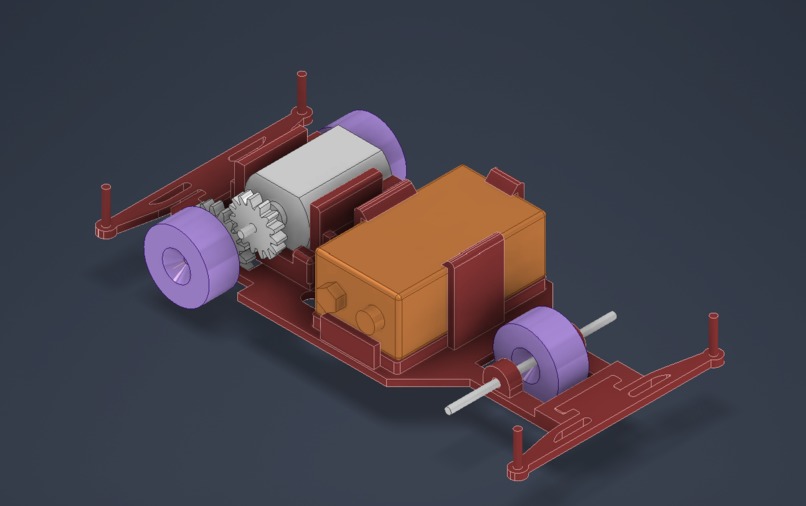
Trickshaw frame
Inspiration
When trying to find ways to go around the track with minimal friction, we had to find out how to reduce points of surface contact. Ultimately, we realized that four wheels might not be needed for an oval track, and perhaps the job could be done with three. The Trickshaw was inspired by real 3 wheeled vehicles, like tricycles and rickshaws. However, such 3 wheeled vehicles cannot go at high speeds due to the possibility of tipping over. However, as our design has a low centre of mass, we need not worry about that.
What it does
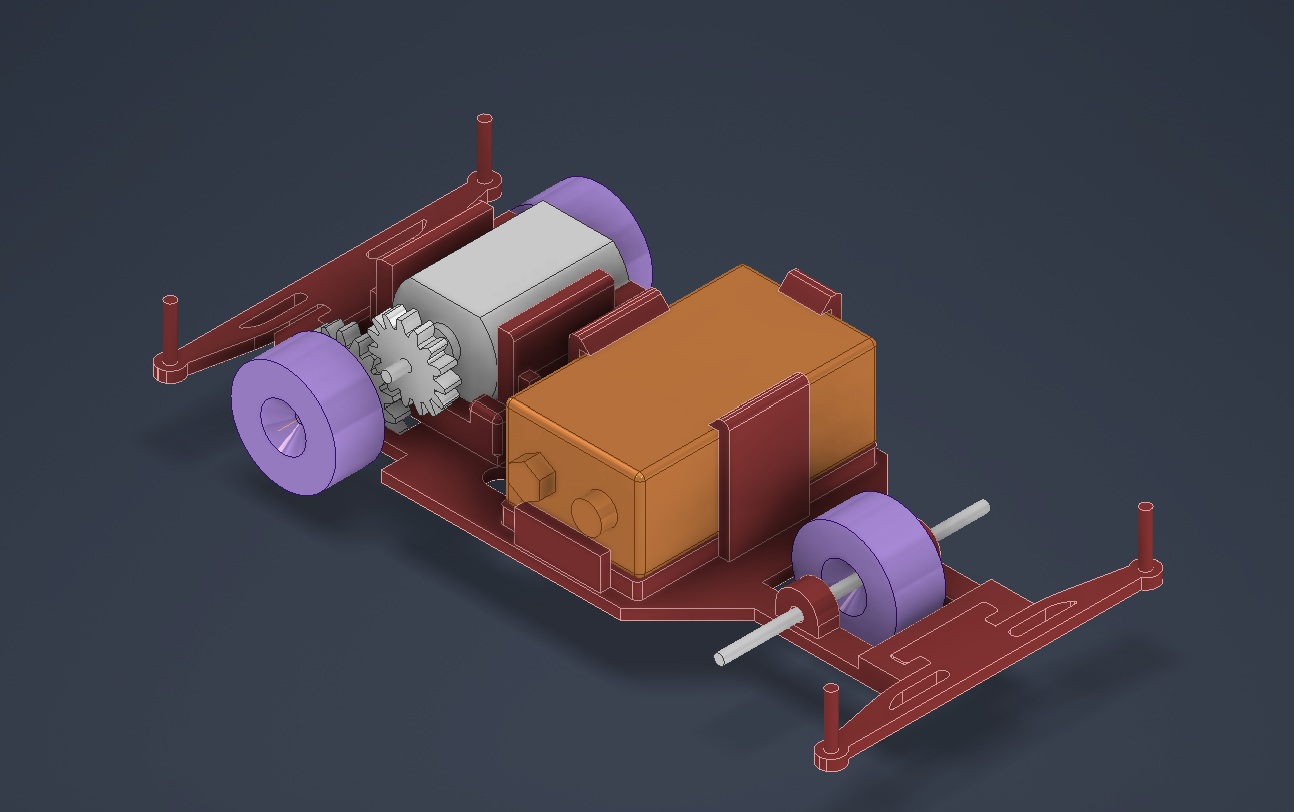
The Trickshaw encases a single central battery and DC motor, strategically placed to minimize mass distribution and localize the centre of gravity. Using spur gears of a 5:4 ratio, we sacrifice some of the car's speed, but gain torque. This will allow the vehicle to power through the turns without getting stuck, an issue we observed with the example vehicle.
The most unique aspect here is that the Trickshaw uses a single front wheel, with two rear wheels powered by rear-wheel drive. This was done to reduce the friction of multiple front wheels when slipping on turns.
To allow for the smoothest turns possible, bumpers with wheels were placed at the front and rear. This ensured that as the Trickshaw faces a turn, it can smoothly roll against the track walls and guide the rest of the car along the track.
How we built it
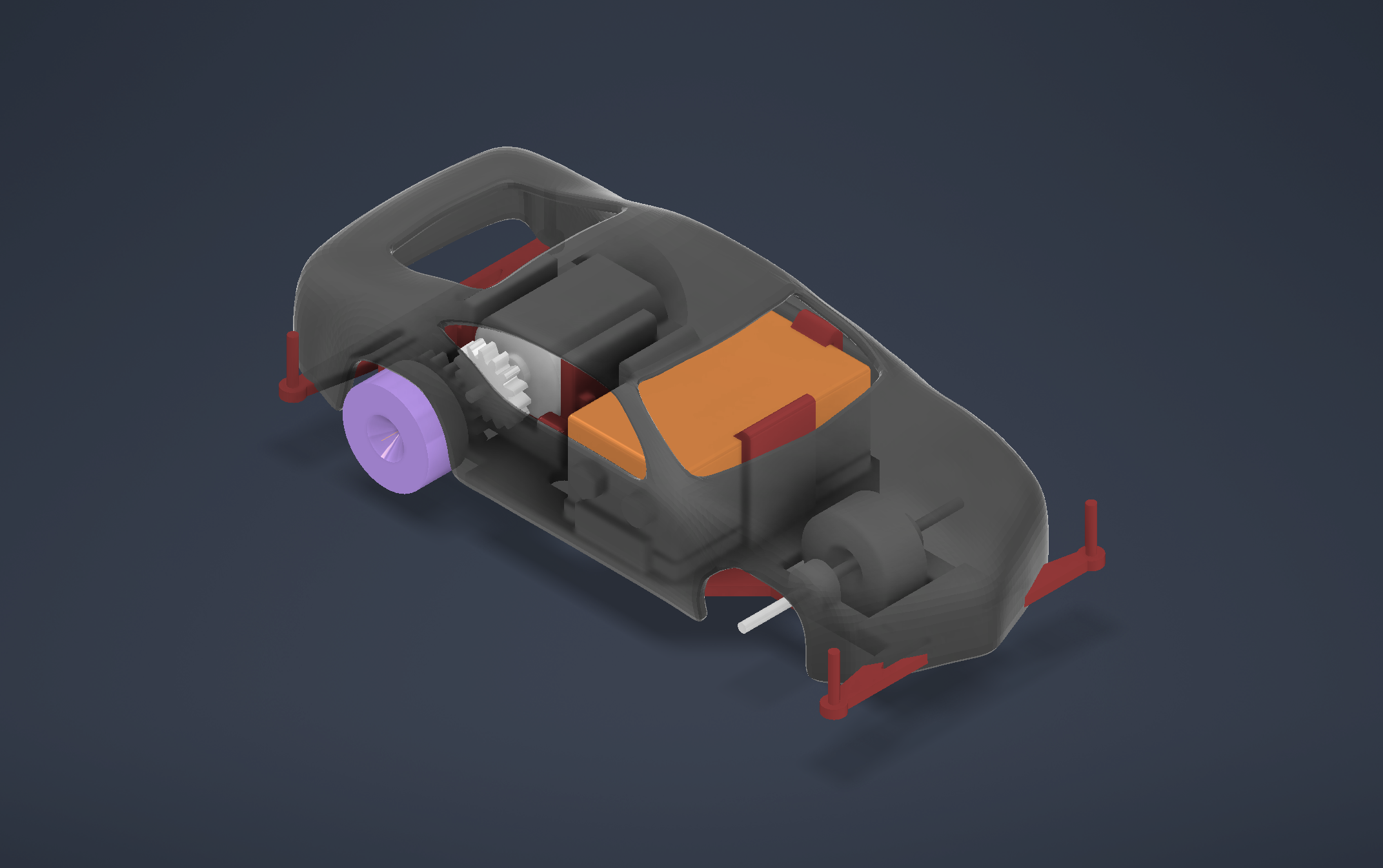
For our first version, we built the base, the motor holder, the battery holder, and the bumpers as separate components. All components were built in Autodesk Inventor Pro. All components were assembled via friction fitting, and electrical tape was used to secure the wired components. For our second version, we combined the base, motor holder, and the battery holder in one single component. This meant that assembly was a lot simpler, as the components were pre-joined. Additionally, we used Blender to model the car body that would conceal the frame.
Challenges we ran into
Aesthetics was a challenge, as the frame on its own is not very appealing. To overcome this, we used Blender to design a cover that could be placed on top of the vehicle. It is modelled off of an existing sports car to provide a fashionable look.
What we learned
We learned about gear systems in a miniature vehicle, as well as how to use Blender for modelling.
What's next for Trickshaw
Next steps would be to implement a steering system for cleaner corner turning. Additionally, we would want to implement an electric switch so that the battery doesn’t have to be removed to turn it off.
Built With
- autodesk-inventor-pro
- blender


Log in or sign up for Devpost to join the conversation.