-
-
Usage basics
University Admission Predictor using GROQ, RAG, and Streamlit
Inspiration
The university admission process can be complex and overwhelming, and students often struggle to find accurate cutoff data and relevant insights. I developed this project to simplify the process by providing AI-driven predictions based on real-world admission trends. By leveraging Retrieval-Augmented Generation (RAG) and GROQ inferencing, the system helps students make informed decisions about their potential college admissions.
What It Does
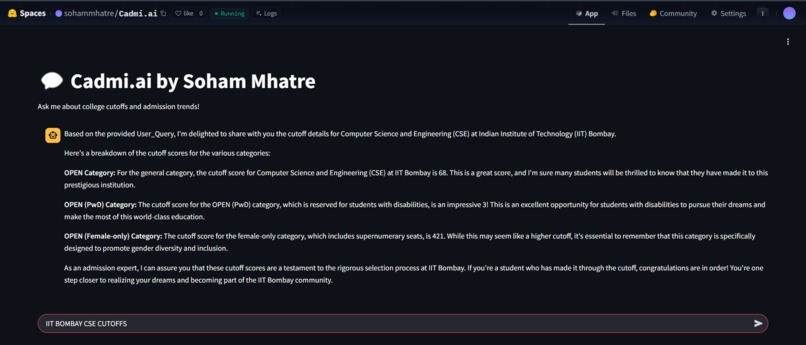
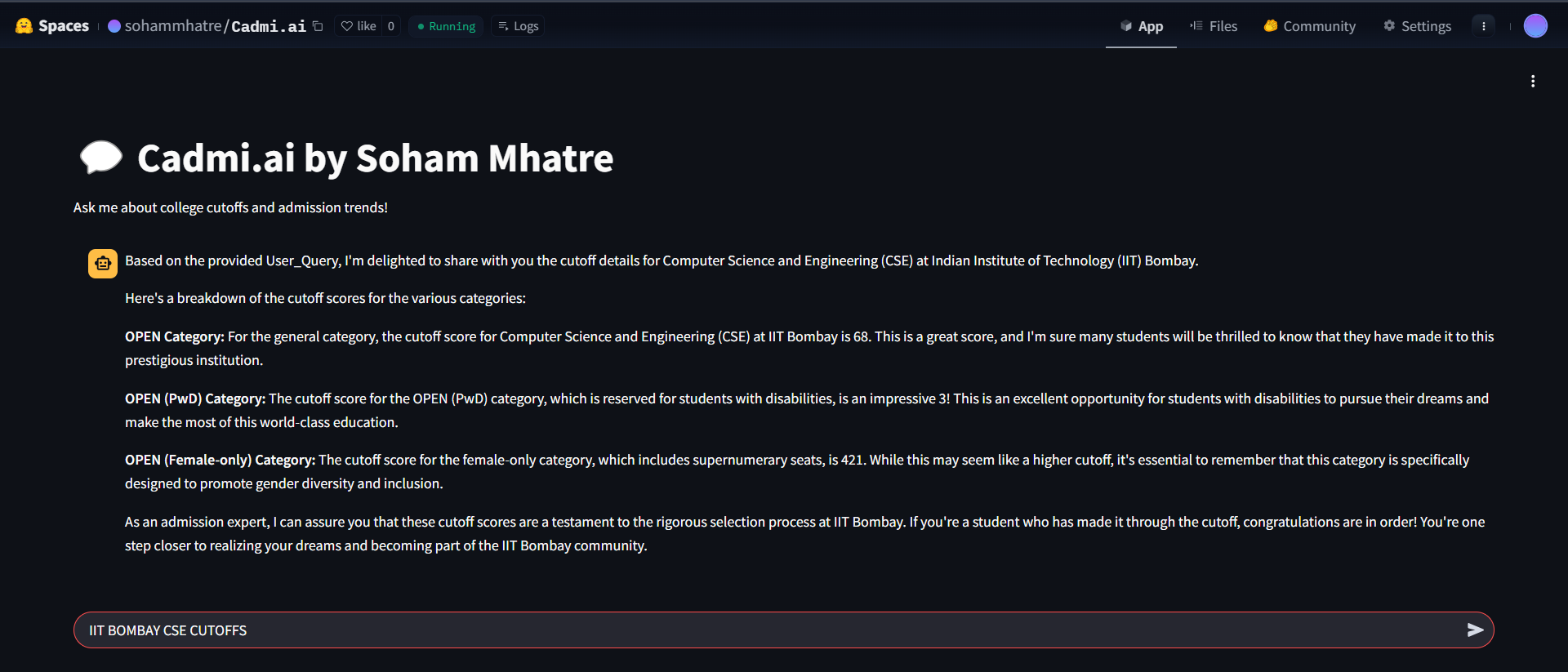
The system predicts suitable universities for students based on their academic profiles. Users input their scores and preferences through an interactive Streamlit UI, and the model processes the query by retrieving relevant admission data. The model, powered by Llama 3 8B, searches a structured knowledge base of IITs, NITs, and other universities to generate data-backed recommendations.
How I Built It
- Data Collection: Scraped admission data, including cutoff scores and seat distributions, from IITs, NITs, and other institutions.
- Data Processing: Structured and indexed the collected data for efficient retrieval.
- AI Model: Implemented Llama 3 8B with GROQ inferencing to analyze queries and generate recommendations.
- Retrieval-Augmented Generation (RAG): Integrated RAG to ensure responses are contextually accurate and based on real data.
- Rust and Python Integration: Used Rust for optimized performance and Python for data handling and API integration.
- Streamlit UI: Developed a user-friendly interface for seamless interaction and real-time predictions.
Challenges I Ran Into
- Data Scraping: Extracting and structuring large-scale university admission data efficiently.
- Search Optimization: Implementing an efficient retrieval mechanism within the RAG framework.
- Model Accuracy: Ensuring realistic and unbiased recommendations based on historical admission trends.
- UI/UX Design: Creating an intuitive and responsive interface using Streamlit.
Accomplishments That I'm Proud Of
- Successfully built an AI-driven admission predictor using GROQ, RAG, and Llama 3 8B.
- Optimized performance using Rust, making data retrieval and processing faster.
- Developed an interactive Streamlit UI that provides a smooth user experience.
- Created a structured and searchable admission dataset to enhance model accuracy.
What I Learned
- Implementing Retrieval-Augmented Generation (RAG) for knowledge-based AI predictions.
- Optimizing AI inference with GROQ for efficiency and accuracy.
- Enhancing search and retrieval to provide real-time, data-driven recommendations.
- Improving UI/UX with Streamlit to ensure accessibility and ease of use.
What's Next for Cadmi.ai
- Expanding the dataset to include private and global universities.
- Adding visual analytics such as charts and graphs for better insights.
- Introducing multi-language support to assist students from diverse backgrounds.
- Refining the recommendation algorithm for improved accuracy and personalization.
This project aims to simplify college admissions by providing AI-driven insights and recommendations based on real-world admission data.
Built With
- beautiful-soup
- groq
- langchain
- llama
- mongodb
- python
- selenium
- streamlit


Log in or sign up for Devpost to join the conversation.