-
-
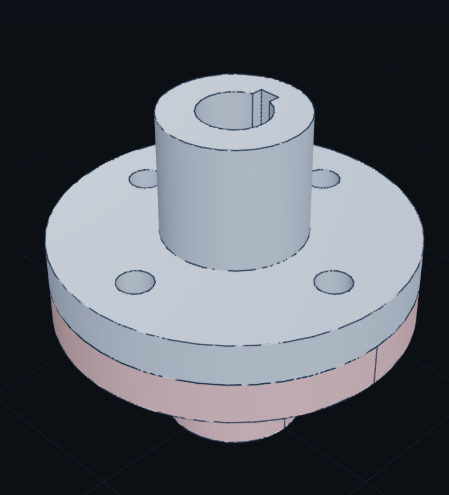
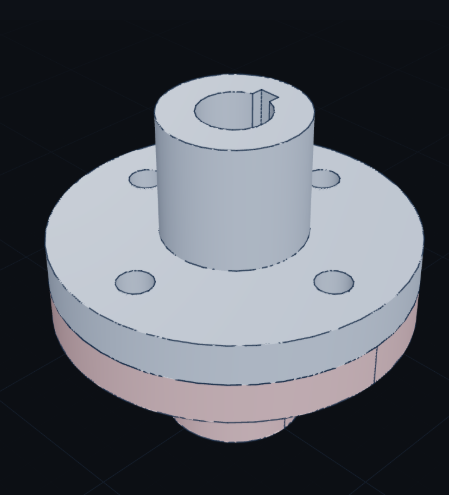
Flange-coupling assembly
-
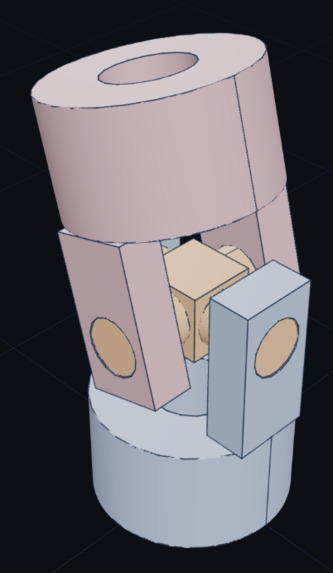
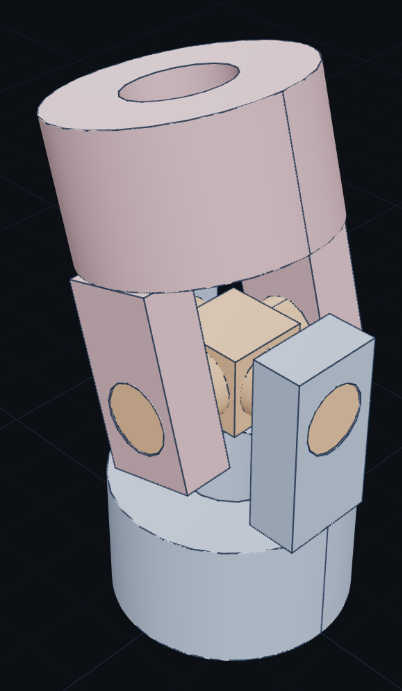
Universal-joint assembly
-
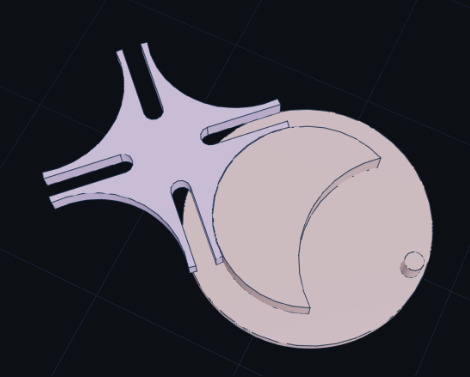
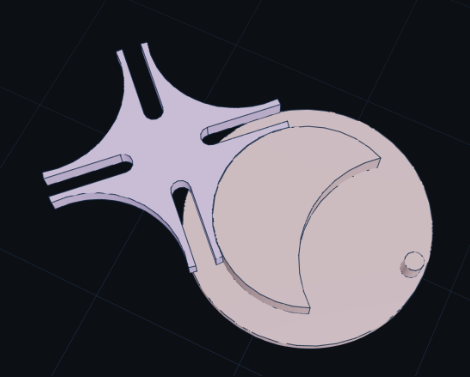
Geneva mechanism
-
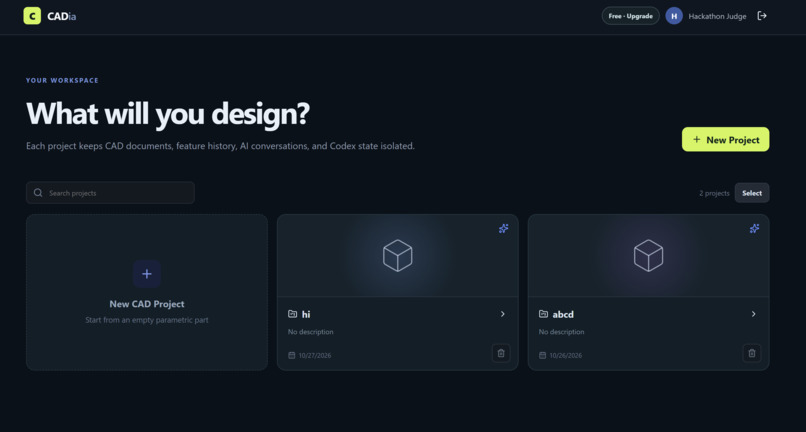
CADia2
-
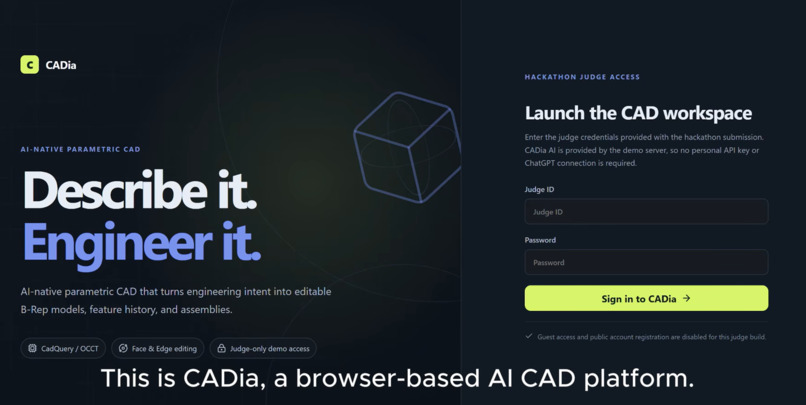
CADia
Inspiration
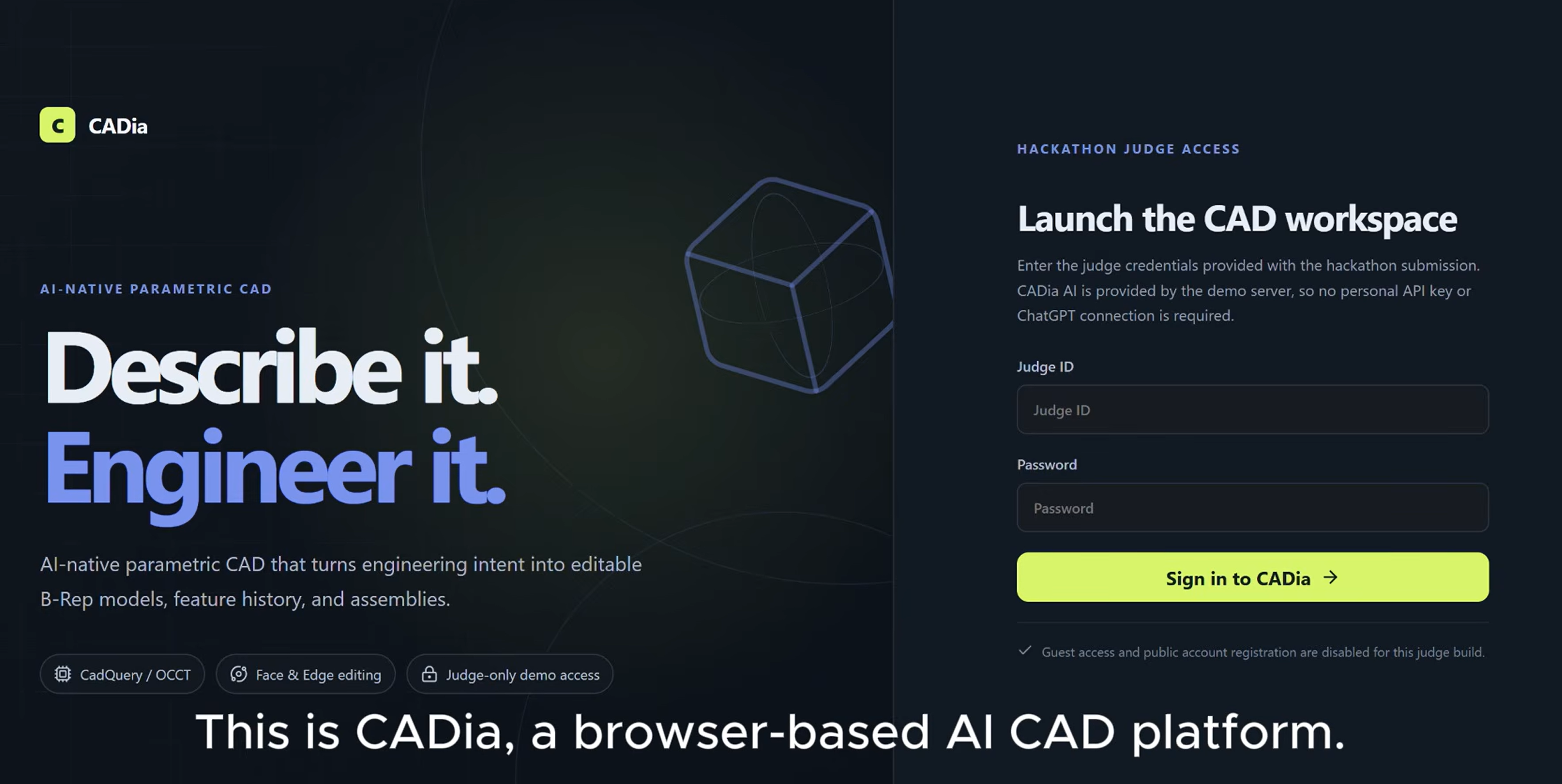
Live Demo: https://app.cadia.co.kr
Judge Login ID: 123456 Judge Password: 123456
What if anyone could turn an engineering idea into a real mechanical design simply by describing it?
Mechanical engineering has always fascinated me because it transforms abstract ideas into physical products. However, the process of turning an idea into a functional mechanical component often requires extensive CAD knowledge, complex modeling operations, and specialized software.
As a mechanical engineering student, I wanted to rethink this process.
Artificial intelligence has already transformed programming, writing, and digital creativity. I believed it could bring a similar transformation to mechanical design.
But engineering presents a unique challenge.
Creating a visually impressive 3D object is not the same as creating a usable mechanical design.
Real engineering requires precise dimensions, editable geometry, mechanical relationships, continuous modifications, geometric verification, and manufacturing-compatible outputs.
An engineer rarely finishes a design after creating the first model. Components must be modified, dimensions adjusted, assemblies refined, and designs prepared for physical production.
I envisioned an environment where these tasks could be performed through natural conversation with an AI engineering assistant.
Instead of learning hundreds of modeling commands, users could describe what they want to create.
Instead of rebuilding a model after every change, they could continue modifying the same design.
Instead of switching between separate applications for modeling and manufacturing, they could continue through the entire engineering workflow in one place.
That vision became CADia — AI Mechanical Engineering Agent.
CADia aims to make mechanical engineering more accessible by combining natural-language interaction, intelligent engineering assistance, and professional CAD geometry in a unified browser-based platform.
Our vision is simple:
Describe it. Edit it. Verify it. Manufacture it.
What it does
CADia is an AI-powered mechanical engineering platform that transforms natural language into editable 3D CAD models and supports continuous design, modification, verification, and manufacturing preparation.
Unlike AI systems that primarily generate visual 3D meshes, CADia creates real Boundary Representation (B-Rep) geometry using Open CASCADE and CadQuery.
This enables users to work with engineering-oriented models that support precise modifications and manufacturing exports.
1. Natural Language to Real Mechanical CAD
Users can generate mechanical components simply by describing their requirements.
For example:
Create a spur gear with module 2, 24 teeth, a 20-degree pressure angle, a 15 mm face width, and a 12 mm center bore.
CADia interprets the engineering request and constructs the corresponding CAD geometry.
The platform supports a broad range of mechanical components, including:
- Spur and helical gears
- Shafts and couplings
- Bearing housings
- Pulleys and sprockets
- Mechanical brackets
- Springs and cams
- Gear mechanisms
- Multi-component mechanical assemblies
The result is an editable engineering model rather than a static 3D visualization.
2. Conversational CAD Editing
One of CADia's most important capabilities is continuous modification of the same model.
Users can create a mechanical component and then refine it through follow-up instructions.
For example:
Increase the base thickness to 16 mm while keeping the mounting-hole positions unchanged.
CADia maintains the existing model context and performs the corresponding engineering modifications.
Users can iteratively refine their designs without restarting the modeling process.
3. Direct Geometric Selection and Editing
CADia combines AI interaction with precise geometric control.
Users can select specific faces, edges, objects, and features directly within the interactive 3D viewport.
They can then perform operations such as:
- Fillets and chamfers
- Face movement and rotation
- Dimension modifications
- Geometric transformations
- Feature modifications
- Multi-object editing
- Assembly positioning
This allows users to combine conversational instructions with direct manipulation of actual CAD geometry.
4. Mechanical Assemblies and Engineering Operations
CADia supports complex mechanical design workflows involving multiple components.
The platform provides 118 project-scoped CAD operations, including modeling, editing, assembly, and geometric verification capabilities.
Its engineering functionality includes component positioning, mechanical relationships, joints, parametric features, and topology-aware editing.
These capabilities enable users to work on complete mechanical systems rather than isolated geometric objects.
5. NVIDIA Nemotron-Powered Engineering Intelligence
CADia integrates NVIDIA Nemotron 3 Ultra through Nebius Token Factory to enhance its AI-assisted engineering workflows.
The platform supports two hybrid AI configurations:
ChatGPT / Codex + NVIDIA Nemotron
Codex handles CAD operation planning, while Nemotron provides engineering supervision through requirement analysis, execution-error diagnosis, and verification of completed results.
When supported by deterministic evidence, the system can also perform a bounded corrective operation.
OpenAI API + NVIDIA Nemotron
An OpenAI API model performs CAD planning, while Nemotron assists with engineering requirement analysis, error recovery guidance, and post-execution verification.
Both configurations connect AI reasoning with CADia's deterministic engineering execution system.
Nemotron acts as an intelligent engineering supervisor, helping CADia evaluate whether the generated design satisfies the user's actual requirements.
6. Engineering Drawings and Visual Inputs
CADia also includes workflows for transforming engineering drawings and reference images into editable CAD geometry.
These capabilities connect visual interpretation with the same geometric modeling environment used for natural-language CAD creation.
7. From CAD to Manufacturing
CADia extends the engineering workflow beyond design creation.
Users can export their models into manufacturing-compatible formats, including:
- STEP / AP242
- STL
- 3MF
The platform also supports design-for-manufacturing checks, slicing, and G-code generation.
Through its integration with Slant 3D, CADia connects engineering models to manufacturing services, including material selection, production quotations, quantities, and shipping calculations.
CADia also includes a Supplier Finder that helps users discover potential manufacturing providers through an interactive map and location-based search.
From the initial engineering idea to editable CAD, manufacturing preparation, supplier discovery, and production quotations, CADia brings the workflow together in one browser-based environment.
How we built it
CADia combines artificial intelligence, geometric modeling, and web technologies to create an integrated mechanical engineering environment.
The central architectural principle is the separation of AI reasoning from deterministic geometric execution.
AI interprets engineering intent and assists with planning and verification. Open CASCADE and CadQuery execute and validate the actual CAD geometry.
NVIDIA Nemotron + Nebius Token Factory
The NVIDIA integration uses Nemotron 3 Ultra through Nebius Token Factory as an engineering reasoning and verification component.
CADia combines Nemotron with two AI planning approaches:
- ChatGPT / Codex
- OpenAI API
The primary AI planner translates user instructions into executable CAD operations.
Nemotron enhances the workflow by extracting engineering requirements, providing recovery guidance when operations fail, and reviewing completed designs against available engineering evidence.
The hybrid architecture follows this workflow:
          User Engineering Request
                     |
                     v
              CADia AI Workspace
                     |
          +----------+----------+
          |                     |
          v                     v
    ChatGPT / Codex        OpenAI API
       CAD Planner         CAD Planner
          |                     |
          +----------+----------+
                     |
                     v
          Structured CAD Operations
                     |
                     v
          CADia Execution Engine
                     |
                     v
         Open CASCADE / CadQuery
                     |
                     v
          Editable B-Rep Geometry
                     |
                     v
          Engineering Verification
                     ^
                     |
        NVIDIA Nemotron 3 Ultra
          via Nebius Token Factory
                     |
          +----------+----------+
          |          |          |
     Requirement   Result     Recovery
      Analysis     Audit      Guidance
                     |
                     v
           Verified CAD State
                     |
                     v
          Continued CAD Editing
                     |
                     v
           Manufacturing Tools
Nemotron's engineering supervision is integrated into the workflow without giving the language model unrestricted control over CAD geometry.
For complex requests, the system can analyze the user's requirements, execute CAD operations, inspect results, and provide feedback for controlled corrections.
Deterministic CAD Execution
The geometric modeling system is built using:
Open CASCADE / OCP
Provides geometric operations, B-Rep modeling, topology management, and geometric validation.
CadQuery
Supports programmable mechanical modeling, parametric geometry, and engineering feature construction.
CADia Engineering Execution Layer
Coordinates CAD operations, persistent model states, geometric references, feature modifications, assemblies, and verification.
The platform exposes 118 project-scoped CAD operations through its engineering architecture.
Persistent Geometry and Parametric Editing
CADia maintains engineering models across successive interactions.
Its modeling architecture includes:
- Persistent model state
- Feature and history-aware operations
- Topology-aware face and edge references
- Parametric modifications
- Direct B-Rep editing
- Mechanical assembly operations
- Geometric validation
- Execution snapshots and rollback
These capabilities allow the AI-assisted workflow to operate on actual engineering geometry.
NVIDIA Engineering Verification
The NVIDIA integration introduces an additional reasoning and verification layer.
Nemotron can extract explicit engineering requirements from the user's instructions and organize them into structured verification information.
After CAD execution, the system can compare engineering requirements with evidence obtained from the resulting model.
For execution failures, Nemotron can analyze actual CAD errors and provide guidance for corrective planning.
In the Codex hybrid workflow, a bounded corrective action can be performed when deterministic verification confirms the need for a repair.
This creates a workflow combining flexible AI reasoning with controlled engineering execution.
Browser-Based Engineering Workspace
The application uses:
- React and TypeScript for the frontend
- Three.js for interactive 3D visualization
- Python and FastAPI for backend services
- PostgreSQL for persistent project data
- WebSockets for real-time communication
- Docker and Nginx for application deployment
The result is an integrated CAD workspace that users can access through a web browser.
Manufacturing and Supplier Integration
CADia connects editable engineering geometry to manufacturing workflows.
The Slant 3D MCP integration enables production-related requests using the active CAD model.
Its manufacturing subsystem supports model export, preflight checks, material selection, quotation requests, and shipping calculations.
The Supplier Finder integrates location search and interactive mapping to help users explore potential manufacturing providers around the world.
Together, these technologies allow CADia to connect conversational engineering, real CAD modeling, intelligent verification, and manufacturing services within a unified platform.
Challenges we ran into
1. Bridging AI Reasoning and Engineering Precision
One of the greatest technical challenges was transforming natural-language engineering instructions into reliable geometric operations.
Language models are effective at interpreting complex requests, but mechanical CAD requires strict geometric consistency.
To solve this, we developed an architecture where AI-generated operations are executed through a deterministic CAD engine.
The geometry kernel remains responsible for the actual modeling and validation.
This allows AI to contribute flexible engineering reasoning while preserving precise CAD execution.
2. Preserving Editable Geometry Across Multiple Modifications
Continuous editing introduces challenges that do not exist in simple one-time 3D generation.
When a mechanical model changes, its faces, edges, and geometric relationships may also change.
CADia addresses this through persistent topology descriptors, reference tracking, and feature/history-aware editing.
These mechanisms support repeated modifications while maintaining the continuity of the engineering model.
3. Integrating NVIDIA Nemotron into a Real CAD Workflow
Connecting NVIDIA Nemotron to CADia required more than adding an AI response interface.
The model needed to contribute meaningful engineering reasoning within an existing CAD execution process.
We integrated Nemotron as an engineering supervisor capable of extracting user requirements, reviewing CAD execution results, and providing recovery guidance based on actual modeling errors.
This creates a hybrid AI architecture in which different models contribute complementary capabilities.
4. Developing Reliable Engineering Verification
Verifying a mechanical model requires more than asking an AI whether the result looks correct.
CADia uses geometric execution evidence to support engineering verification.
The system separates AI-generated assessments from deterministic checks and uses controlled correction mechanisms when supported by actual CAD evidence.
This enables a more reliable relationship between engineering requirements, model execution, and final geometry.
5. Connecting CAD with Manufacturing Services
A complete engineering workflow requires a connection between digital geometry and physical production.
Integrating CAD models with manufacturing services involved handling export formats, geometric preflight checks, model revisions, production quotations, and shipping information.
CADia connects these processes through a unified manufacturing workflow, extending the usefulness of its AI-assisted design environment beyond model generation.
Accomplishments that we're proud of
1. Building an AI Mechanical Engineering Agent
Our proudest achievement is creating an AI-assisted engineering environment where users can generate, modify, and verify actual mechanical CAD geometry through natural-language interaction.
CADia combines conversational AI with a professional geometric modeling engine.
The resulting models are editable engineering representations that can continue through multiple design operations.
2. Implementing 118 CAD Operations
CADia's engineering execution architecture exposes 118 project-scoped CAD operations.
These capabilities support a broad range of modeling, modification, and mechanical assembly workflows.
The operation layer enables AI-assisted access to real engineering functionality through a unified interface.
3. Demonstrating 29 Mechanical CAD Examples
Our GitHub repository contains 29 saved mechanical CAD examples, accompanied by engineering prompts and generated artifacts.
Examples include:
- Spur and helical gears
- Gear assemblies
- Bearing housings
- Mechanical shafts
- Rack-and-pinion mechanisms
- Geneva mechanisms
- Universal joint assemblies
- Piston-cylinder assemblies
- Flange coupling assemblies
- Mechanical crankshafts
- Pipe fittings and other components
The repository includes model previews and engineering exports such as STEP, STL, and 3MF where available.
These examples demonstrate the breadth of mechanical modeling workflows supported by CADia.
4. Integrating NVIDIA Nemotron into Engineering Verification
We implemented hybrid AI workflows combining NVIDIA Nemotron 3 Ultra, Nebius Token Factory, and CADia's engineering execution engine.
Nemotron contributes requirement analysis, engineering verification, and recovery guidance.
The system connects these capabilities with actual CAD execution evidence rather than relying exclusively on language-model responses.
This integration demonstrates how NVIDIA AI can participate in a structured engineering workflow beyond ordinary conversational assistance.
5. Enabling Continuous Conversational CAD Editing
CADia allows users to continue modifying an existing model through follow-up instructions.
This supports an iterative design process in which users can refine geometry without repeatedly generating entirely new models.
Combined with direct geometric selection, this provides a flexible interface for mechanical design.
6. Building a Complete Browser-Based CAD Workspace
CADia brings AI-assisted design and interactive 3D engineering into a unified browser environment.
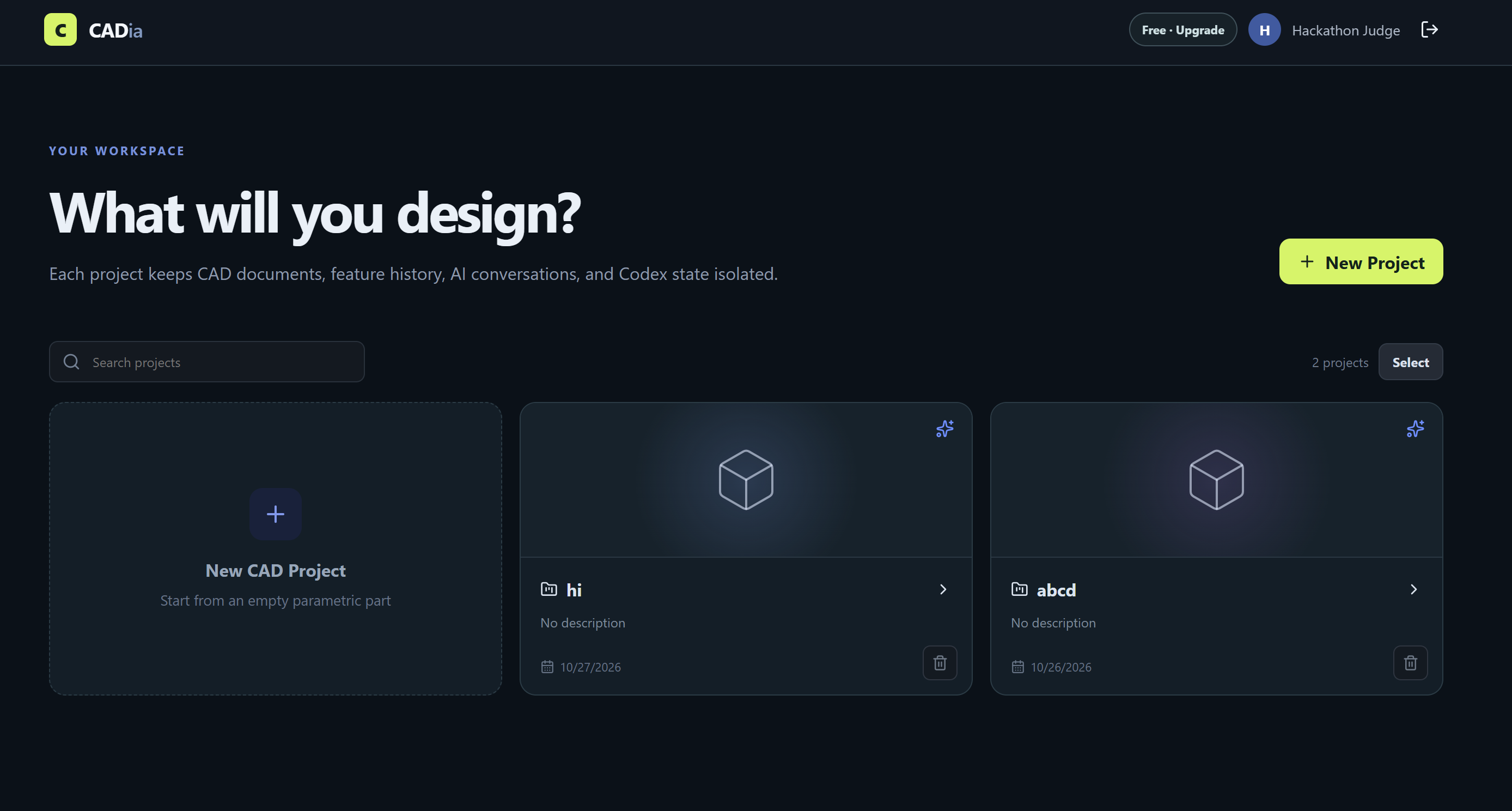
Users can create projects, generate CAD models, modify geometry, assemble components, inspect results, and export engineering files.
7. Connecting Engineering Design to Manufacturing
We integrated manufacturing-related capabilities into the CAD workflow.
CADia supports engineering exports, manufacturing preparation, production quotations, and shipping calculations through external manufacturing integration.
The platform also includes a global Supplier Finder for discovering potential manufacturing partners.
What makes CADia especially meaningful to us is that it connects the entire engineering journey: from an idea, to editable geometry, to an increasingly production-ready design.
What we learned
Building CADia taught us that the greatest potential of AI in mechanical engineering lies in combining intelligent reasoning with established engineering tools.
AI should not merely describe how to create a mechanical component. It should be able to participate in the engineering workflow itself.
AI and Deterministic Geometry Complement Each Other
Language models are powerful tools for understanding engineering intent.
However, the actual geometric model must be constructed and verified by a dedicated CAD engine.
Combining these capabilities allows CADia to benefit from AI reasoning while maintaining geometric precision.
Persistent Models Are Essential
Real engineering is iterative.
A useful AI CAD system must understand the existing model, preserve design context, and support repeated modifications.
We learned that maintaining persistent geometry and reliable feature references is fundamental to meaningful conversational CAD.
AI Verification Benefits from Real Engineering Evidence
NVIDIA Nemotron demonstrated the value of using AI as an engineering reasoning and verification assistant.
By combining user requirements with actual CAD execution evidence, the system can evaluate engineering results more meaningfully.
This reinforced the importance of connecting AI analysis with objective information from the modeling environment.
Autonomous Engineering Requires Controlled Execution
An engineering agent must do more than generate an operation sequence.
It must work with execution results, geometric constraints, validation mechanisms, and recovery procedures.
Structured operations and deterministic verification provide the foundation for these workflows.
Engineering Does Not End with CAD Generation
We learned that the value of an engineering platform extends beyond producing geometry.
Design modification, assembly, validation, manufacturing preparation, and supplier access are all important parts of the product development process.
This insight shaped CADia into a connected engineering environment rather than an isolated AI modeling tool.
Our biggest lesson is that the future of AI-powered engineering is not simply generating better 3D models. It is enabling AI to work with real engineering systems throughout the design process.
What's next for CADia — AI Mechanical Engineering Agent
Our vision is to transform CADia into a comprehensive AI-powered mechanical engineering platform that makes the entire design-to-manufacturing workflow more intelligent, accessible, and efficient.
1. More Advanced Autonomous Engineering
We aim to expand CADia's ability to coordinate complex mechanical design operations.
Future development will focus on longer engineering workflows involving multiple components, geometric constraints, verification, and iterative refinement.
Our goal is to enable AI to assist with increasingly sophisticated engineering tasks through a unified environment.
2. Faster AI-Assisted CAD Modeling
Improving modeling speed and responsiveness is an important priority.
We plan to optimize CAD execution, AI inference strategies, and task routing to deliver a faster engineering experience.
The objective is to make conversational mechanical design practical for everyday use.
3. Advanced Mechanical Assemblies
We plan to expand CADia's capabilities for multi-component mechanical systems.
This includes richer assembly relationships, component interactions, mechanical joints, and automated engineering operations.
4. Enhanced Engineering Drawing Reconstruction
We intend to improve workflows that transform engineering drawings and reference images into editable CAD models.
This will provide additional ways for users to communicate design requirements and reconstruct mechanical components.
5. Deeper Manufacturing Integration
We aim to further connect CADia with manufacturing services, production quotations, supplier discovery, and physical fulfillment workflows.
Our long-term goal is to help users move from an engineering concept toward an actual manufactured product through one connected platform.
6. Intelligent Engineering Verification
We plan to strengthen NVIDIA-powered engineering supervision by expanding requirement analysis, geometric verification, and evidence-based corrective workflows.
Combining advanced AI reasoning with deterministic engineering systems can create increasingly capable and reliable mechanical design assistants.
7. Making Mechanical Engineering Accessible Worldwide
CADia is designed for mechanical engineers, engineering students, inventors, startups, makers, and manufacturing teams.
We believe that engineering creativity should not be limited by the complexity of traditional CAD interfaces.
By making advanced mechanical modeling accessible through natural language and a browser, CADia can help more people transform their ideas into real engineering designs.
We envision a future where anyone can describe an engineering idea, collaborate with an intelligent AI assistant, refine a precise mechanical model, and connect that design to manufacturing.
CADia is more than an AI 3D generator.
It is a step toward a new generation of AI-powered mechanical engineering tools.
CADia — Design Anywhere. Describe It. Edit It. Manufacture It.
Built With
- 3
- 3d
- cadquery
- cascade
- codex
- docker
- factory
- fastapi
- nebius
- nemotron
- nginx
- nvidia
- open
- openai
- opencv
- postgresql
- protocol
- python
- react
- three.js
- token
- typescript
- ultra
- websocket

Log in or sign up for Devpost to join the conversation.