-
-
Cadence
-
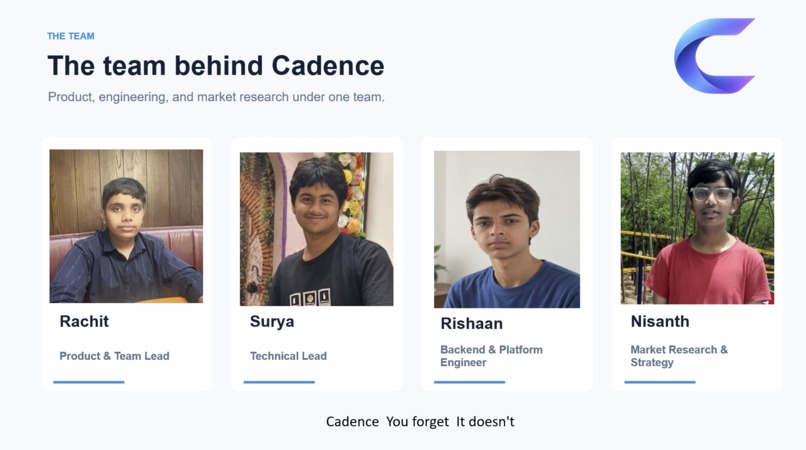
The Team who made Cadence possible
Inspiration
Cadence started with something much closer to home than a hackathon prompt.
My mom runs a micro-agency, and I saw how much time she spent dealing with something that had nothing to do with the work she loved doing: chasing overdue invoices. A delayed payment didn't just mean money arriving late. It meant searching through old contracts, checking payment terms, figuring out when to follow up, writing uncomfortable emails, and spending valuable time simply asking to be paid for work that was already done.
That made us ask a simple question:
Why are small agencies using their time to chase payments when AI could handle the intelligence behind it?
Most invoicing tools help businesses send an invoice. We wanted to build something that helps them understand when, why, and how to act when that invoice isn't paid.
That's how Cadence began.
What it does
Cadence is an AI-powered payment intelligence platform for micro-agencies.
A user can upload their contracts and invoices, and Cadence connects information that would otherwise be scattered across documents. It analyzes contract payment terms, invoice details, and available client history to understand the context behind a payment situation.
Instead of simply saying “this invoice is overdue,” Cadence can surface what's happening, the evidence behind its assessment, the level of risk, and a recommended next action. It can then help draft a contextual follow-up email that the user can review and send.
The idea is simple: You shouldn't have to remember every clause, invoice, deadline, and client interaction. Cadence should.
How we built it
We designed Cadence around one principle: AI should understand context, not just generate text.
Rather than treating an invoice as an isolated document, our system brings together the invoice, relevant contract terms, and client/payment information before generating an analysis. The AI reasons over that context to determine whether action is needed and what that action should look like.
We built a full-stack application connecting the frontend experience, backend processing, document handling, persistent data, AI analysis, and email workflow into one product.
One of our biggest priorities was making the complexity disappear for the user. Behind a simple upload is a chain of extraction, contextual analysis, retrieval, reasoning, and action—but to the agency owner, it should feel like:
Upload. Understand. Act.
Challenges we ran into
Our biggest challenge wasn't coming up with features. It was deciding what not to build.
Cadence could quickly have become an enormous platform: contract analysis, invoicing, CRM, email automation, analytics, client management, and more. We had to continuously bring ourselves back to the core problem—helping small businesses understand and act on payment situations.
We also had to figure out how to make AI recommendations contextual rather than generic. A payment being three days late doesn't tell the whole story. The contract terms matter. Previous payment behavior matters. The invoice matters. Bringing those pieces together into one coherent workflow became one of the most interesting technical challenges of the project.
And, like any hackathon team, we dealt with bugs, changing ideas, integration issues, deadlines, and the challenge of turning diagrams and conversations into something that actually works.
The solution was usually the same: simplify, test, iterate, ship.
Accomplishments that we're proud of
We're proud that Cadence didn't remain a pitch deck. We built it.
We went from a problem we had seen in the real world to designing the product, researching the users, architecting the system, building the frontend and backend, integrating AI, and turning everything into a working end-to-end experience.
We're especially proud of the contextual analysis system. Cadence doesn't just extract a due date—it is designed to connect contract terms, invoices, and payment context to produce an explanation, evidence, risk assessment, and recommended action.
But perhaps what we're proudest of is that four high-school students took an everyday business frustration and turned it into a real product.
We learned technologies along the way. We broke things. We disagreed. We redesigned things. And eventually, it worked.
What we learned
We entered this hackathon thinking the hardest part would be writing the code. It wasn't.
We learned that building a product means constantly balancing what users need, what technology can do, and what you can realistically ship.
We learned that a beautiful interface means little without a reliable backend. Powerful AI means little without the right context. And an impressive feature means little if it doesn't solve a problem someone actually has.
We also learned how much goes into building as a team: dividing ownership, communicating asynchronously, reviewing each other's ideas, handling setbacks, and continuing to move when things don't go according to plan.
Most importantly, we learned that shipping teaches you things planning never can. Cadence started as an idea on a page. Now it's something we can use.
What's next for Cadence - Client Management Agent
The hackathon version of Cadence proved that the idea can become a working product. Our next goal is to evolve it from a reactive payment tool into a proactive Client Management Agent.
First, we want to implement GraphRAG to give Cadence a deeper understanding of the relationships between clients, contracts, invoices, payment history, and communications. Instead of treating these as isolated pieces of information, Cadence could build a connected knowledge graph around each client relationship—allowing its insights to expand from individual invoices to the entire lifecycle of a client.
Next, we plan to explore Stripe integration and direct communication hooks, allowing payment events and client emails to flow directly into the agent rather than relying entirely on manual document uploads.
From there, our focus shifts to optimization and scale: improving retrieval quality, reducing latency, strengthening reliability, refining the AI's autonomous recommendations, and building the infrastructure required for Cadence to manage full client accounts seamlessly.
But our most important next step isn't technical. It's talking to real users.
We want to put Cadence in front of micro-agency owners, watch how they actually interact with the agent, understand where it falls short, and discover which parts genuinely save them time. Their feedback will determine what we build next—not assumptions made behind a screen.
If those conversations confirm the problem we've experienced ourselves, we want to take Cadence beyond this hackathon and explore turning it into a real-world product.
The hackathon gave us the opportunity to build the first version. Now we want to see how far our Client Management Agent can go.
Built With
- api
- deno
- gmail
- nim
- nvidia
- pgvector
- postgresql
- react
- supabase
- typescript
- vite



Log in or sign up for Devpost to join the conversation.