-
-
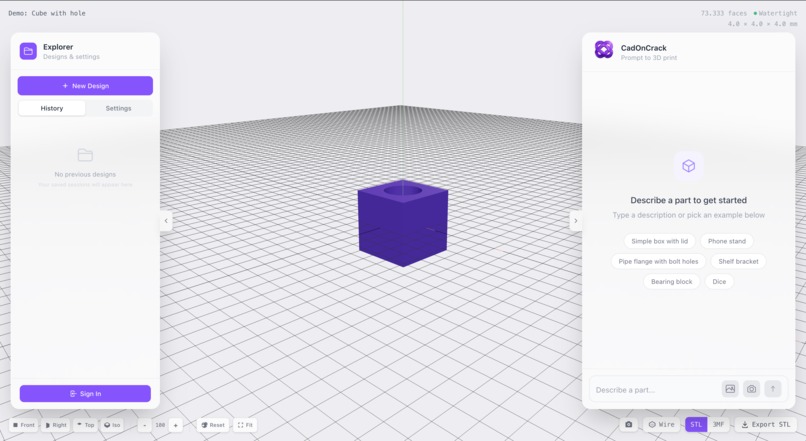
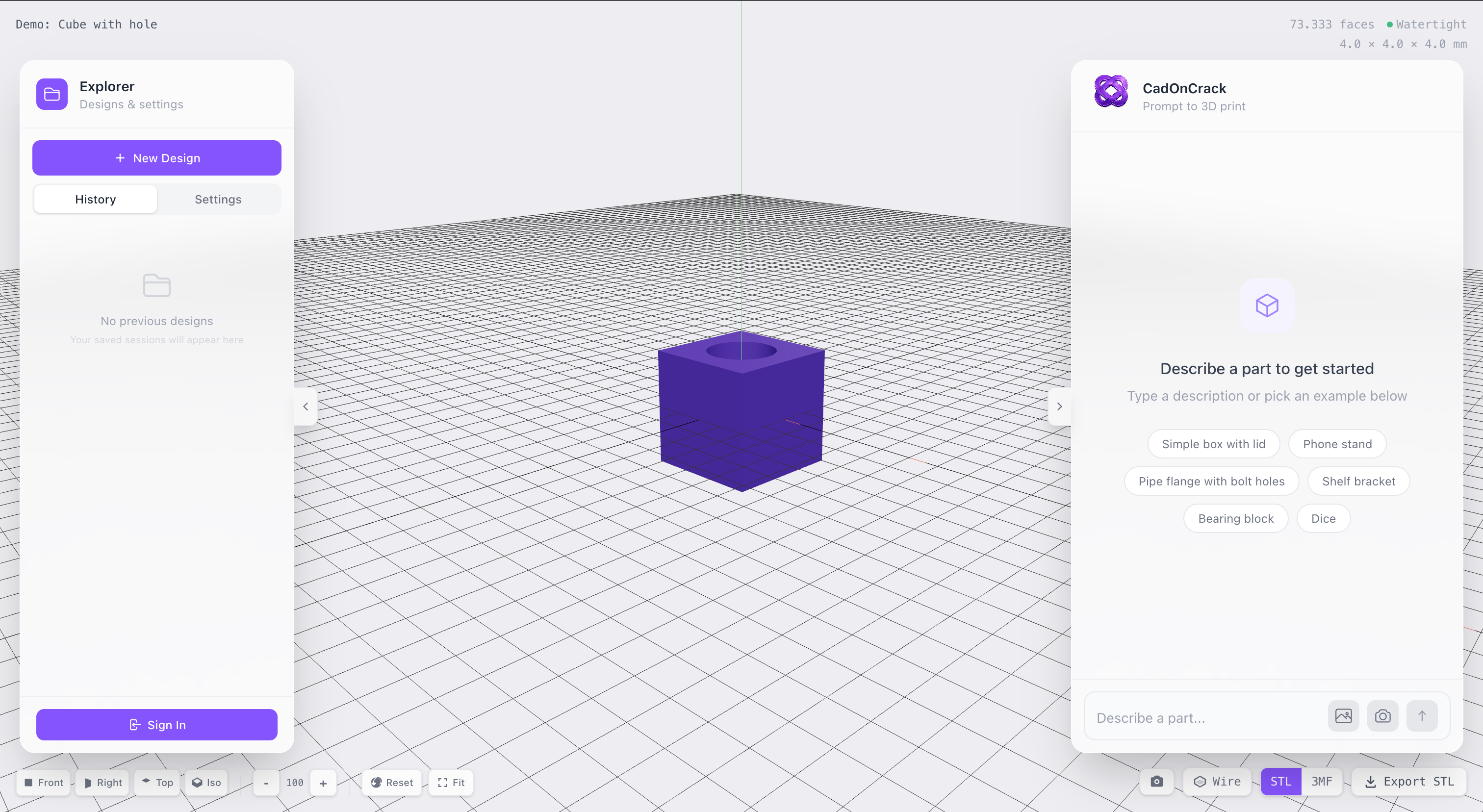
The working webpage version with a demo
Inspiration
In high school, we had many design and tech projects that proved to be extremely tedious meticulously crafting each piece and smoothing out every detail by hand. As we grew older, we watched engineering friends struggle with the same barriers. But the problem runs deeper than classrooms. Public infrastructure across the country runs on aging systems held together by parts that are discontinued, backordered, or prohibitively expensive to replace. Field crews wait weeks for a custom bracket or fitting while a water main leaks or a transit system runs degraded. The hardware revolution gave us cheap 3D printers, but the software barrier kept them out of reach. We built CAD Cursor to destroy that learning curve and to put the power of on-demand part fabrication directly in the hands of the people who maintain our public infrastructure.
What it does
CAD Cursor is an AI-powered CAD tool that lets anyone from a mechanical engineering student to a public works field technician describe a physical part in plain English and receive a fully rendered, 3D-printable file in under 60 seconds. It acts as an autonomous mechanical engineer operating entirely through a simple chat interface. A crew member can type "pipe repair clamp for a 2 inch water main with bolt flanges on each side" and immediately download a print-ready STL file no CAD training, no procurement delay, no waiting on a parts supplier.
How we built it
We architected CAD Cursor as a full-stack web application using Next.js 16 and TypeScript. The backend is powered by the Anthropic Claude API with a carefully engineered system prompt pipeline that forces the model to output valid JSCAD geometry code including mandatory PARAMS objects, boolean overlap margins, and segment minimums for curved surfaces. We built a prompt expansion layer that automatically converts field descriptions into precise millimeter specifications, and a parts dictionary pre-loaded with infrastructure component templates. The geometry executes entirely in the browser inside a sandboxed new Function() environment, serializes to STL or 3MF through JSCAD's serializer pipeline, and renders in real time via React Three Fiber.
Challenges we ran into
The hardest challenge was the geometry engine itself. It is one thing for an AI to write the math describing a 3D shape it is entirely another to actually render that shape in a browser without crashing it, and to guarantee the output is structurally valid for 3D printing. Infrastructure parts are geometrically demanding: pipe clamps require precise boolean subtraction with exact overlap margins, bolt hole patterns must be watertight, and curved surfaces need enough polygonal resolution to look and print correctly. When Claude generated objects with complex boolean operations or overlapping geometry, coincident faces caused z-fighting artifacts and broken mesh topology. We had to build a degenerate triangle filter, implement creased normal computation to preserve hard edges on mechanical parts while keeping curved surfaces smooth, and enforce strict boolean overlap rules through both the system prompt and a regex-based geometry linter that catches errors before the user ever sees them. Getting a language model to think in 3D space like a mechanical engineer not just a programmer required a completely different approach to prompt engineering than anything we had built before.
Accomplishments that we're proud of
We are incredibly proud of successfully bridging the gap between a plain English field description and a production-ready CAD file. A user can type a sentence describing a broken infrastructure component and have a printable replacement file in their hands in under 60 seconds. The pipeline handles real-world infrastructure part types pipe clamps, mounting brackets, cable management clips, junction box housings with dimensionally accurate geometry that comes out of the slicer clean every time. We also built a full context-aware editing system so users can refine parts conversationally, the same way an engineer would iterate with a CAD technician.
What we learned
We learned that integrating AI into something pragmatic and rigidly structured is a fundamentally different challenge than building a conversational assistant. Prompt engineering for executable geometry code requires the model to think spatially, plan boolean operations before writing a single primitive, and respect physical manufacturing constraints that have no tolerance for approximation. We also learned that the real barrier to infrastructure maintenance isn't funding or willpower it's the gap between the person who knows what part is broken and the tools required to replace it. Closing that gap is where technology can have the most immediate real-world impact.
What's next for CAD Cursor
We plan to expand the infrastructure parts dictionary to cover the most common failure components across water, transit, and utility systems, and partner directly with municipal public works departments to pilot on-site fabrication workflows. Longer term we see the text to CAD engine becoming embedded directly into field management software used by infrastructure crews so that the moment a technician logs a broken component in a 311 system, a replacement file is already generating. We also plan to extend to custom hardware companies and mechanical engineering workflows where mass customization and rapid iteration are competitive advantages.
Built With
- claudeapi
- digitalocean
- javascript
- jscad
- mongodb
- next.js
- react
- tailwind
- three.js
- typescript


Log in or sign up for Devpost to join the conversation.