-
HOUSE
Inspiration
You can never be too cautious especially when you're living in an expensive smart home like ours. Our inspiration comes from idea that modern homes should not only be luxurious and convenient, but also proactive in protecting their residents. Taking inspiration from advanced smart cities and automated systems, our goal was to create a home that feels automated, responsive to their owner's needs, and safe, even when the homeowners are away.
What it does
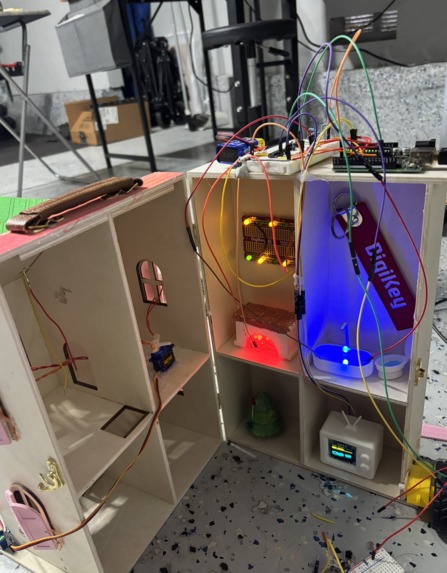
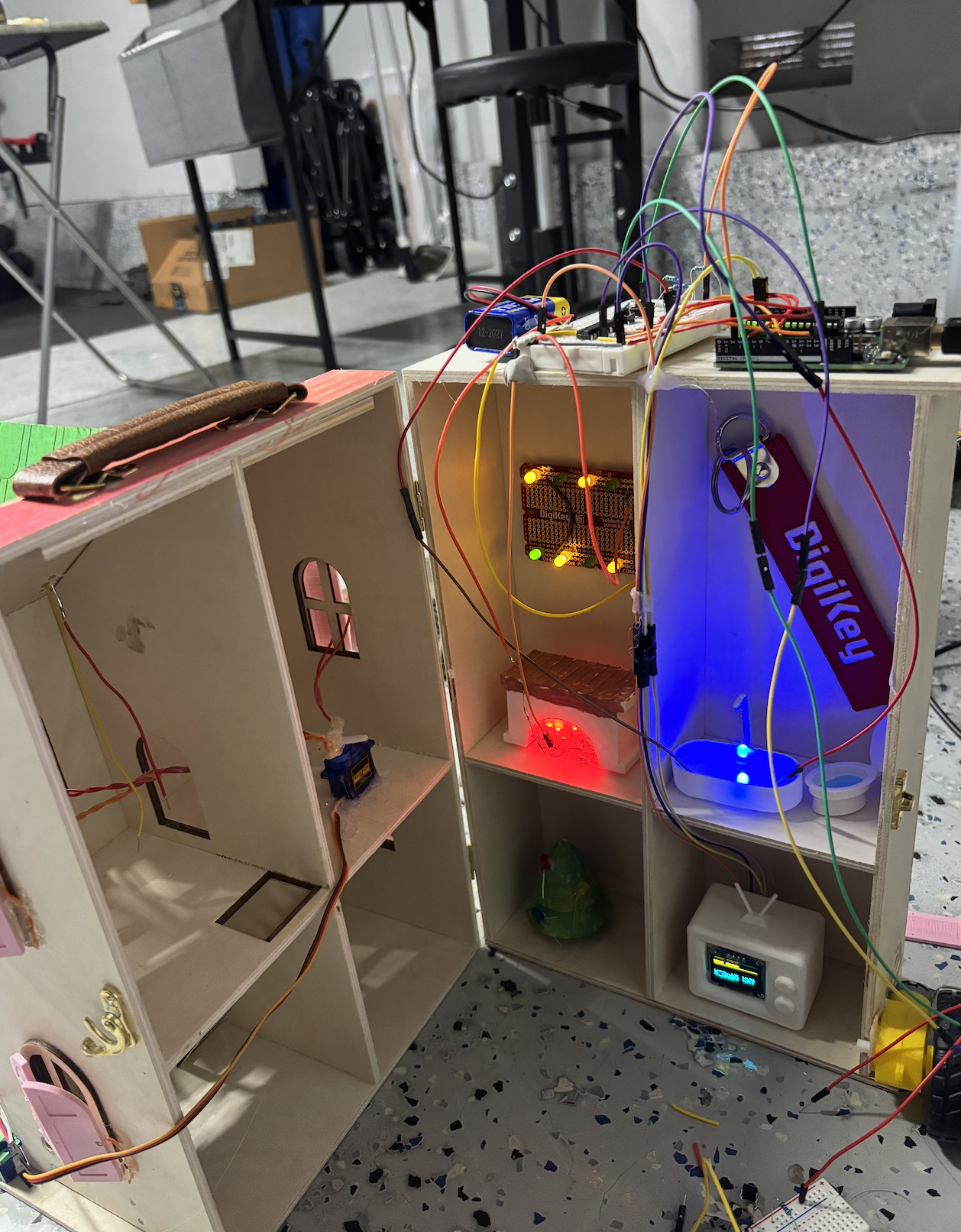
Our smart home offers innovative features such as self opening doors, controlled by external motors that are able to open upon electrical stimulation given when a homeowner is detected. This is a safety feature that enables ease of access to the owners of this residence, whilst blocking others out. Other than the entrance, the windows in the house are completely connected and is able to be opened remotely, which offers the ability to periodically open up windows to let in fresh air to every corner of the house. This is especially useful for homeowners who travel frequently, but don't want to come home to the house smelling unpleasantly, as windows can be opened and closed remotely and does not require manual input from users. Sensors detecting from outside the house will also close windows whenever it detects a possible threat. Other house amenities that are offered in our smart home include an LED fireplace that lights up, allowing residents to get cozy during holiday season, as well as a smart bathtub and toilet.
How we built it
Our team used Arduino UNO Q boards for controlling motors, servos, motion sensor, LEDs, and strings. We also put a wheel in order to enable opening and closing the house for show case. We also integrated the LED system by soldering bundles of lights together in order to systematically distribute current to all light sources concurrently. Fusion 360 was also used to create some of the additional furniture items that are instrumental to the ease of living in a smart home.
Challenges we ran into
There was one point where one of our Arduino boards wasn't working due to suspected water leakage into the circuit which could cause disturbances to the system the team was testing. It was also a challenge working with just the components that we were given, as the team thought of many brilliant ideas to implement, however, we were constrained by hardware and weren't able to acquire them through other channels during the timespan of this hackathon.
Accomplishments that we're proud of
We managed to successfully equip a house with multiple functionalities and 3d printed furniture despite challenges in connection and board issues. We've also designed furniture in fusion360 and print them with the least support possible.
What we learned
- How to work with Arduino Uno Q for its MCU functionalities without using Arduino libraries
- How to work with multiple components connected to a single micro-controller
- How to CAD and 3d print with the least support to minimize printing time
What's next for CACA HardHack26
Implementing more features for the house and make the connection more consistent.


Log in or sign up for Devpost to join the conversation.