-
-
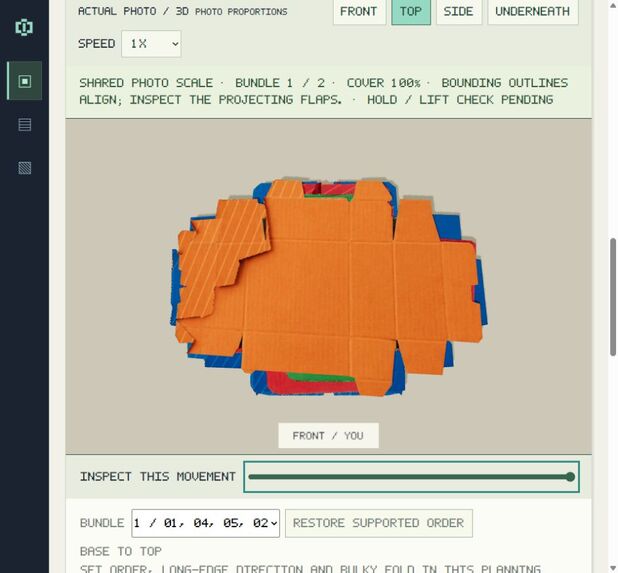
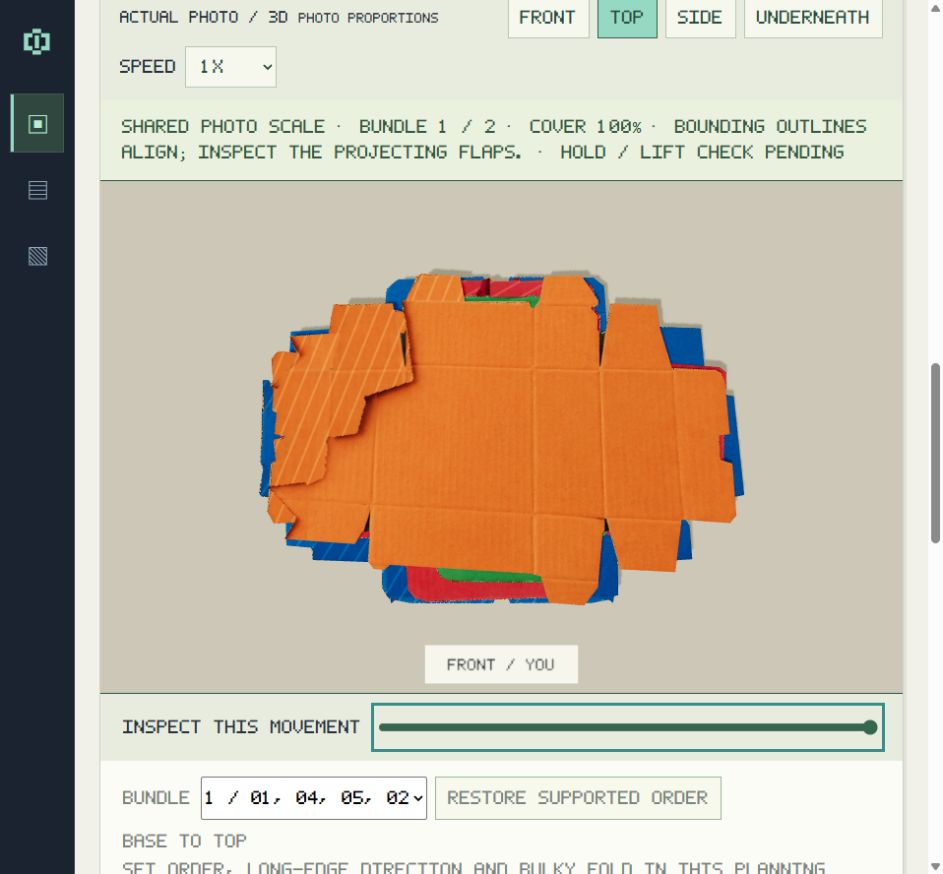
Full sheet outlines and shared image scale, with blue retained in the five-piece plan. Actual AWS demo, Top view.
-
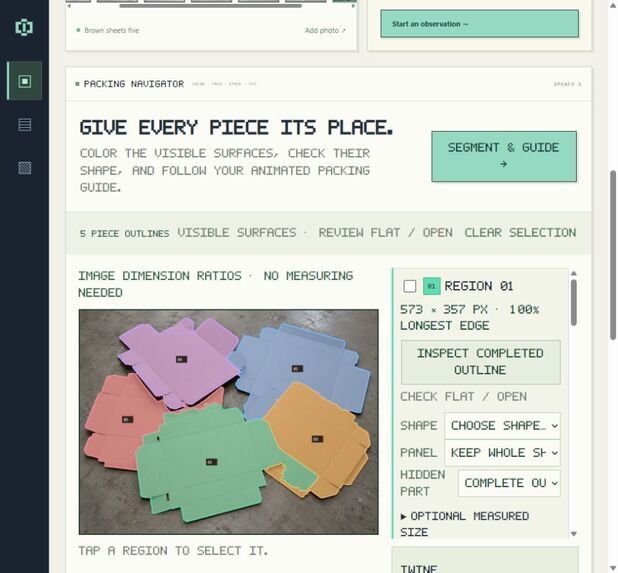
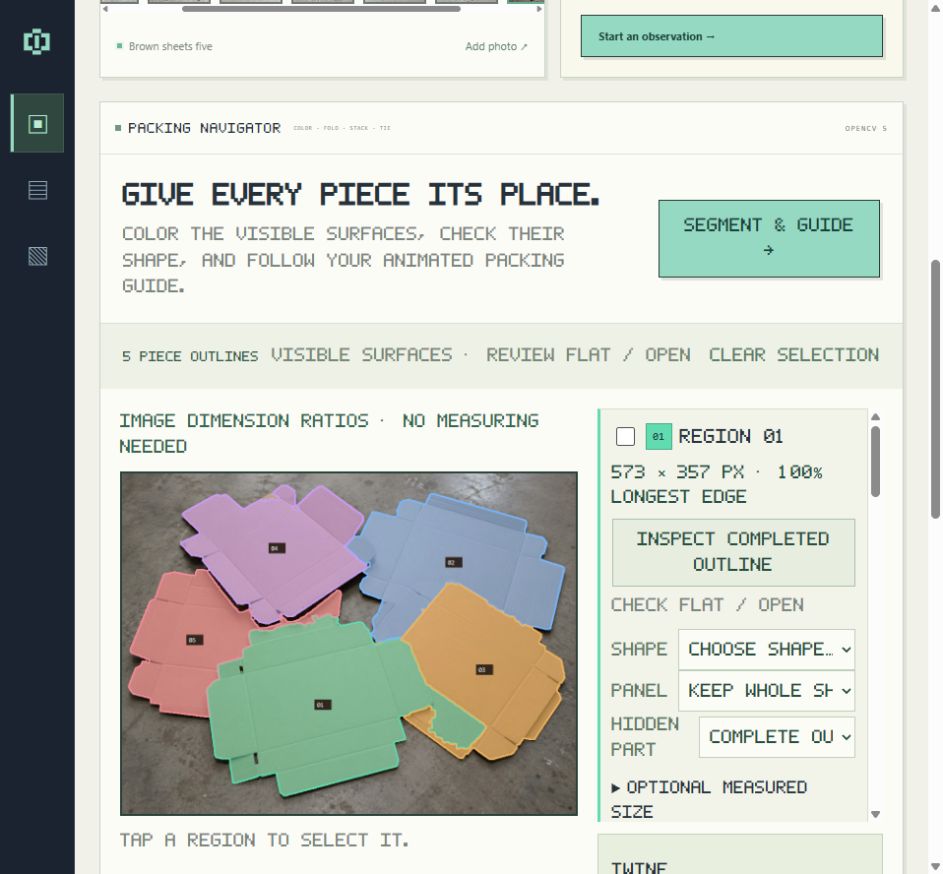
Unpainted cardboard: five sheet identities. Checked front flaps stay with their sheet. Actual AWS OpenCV 5 result.
-
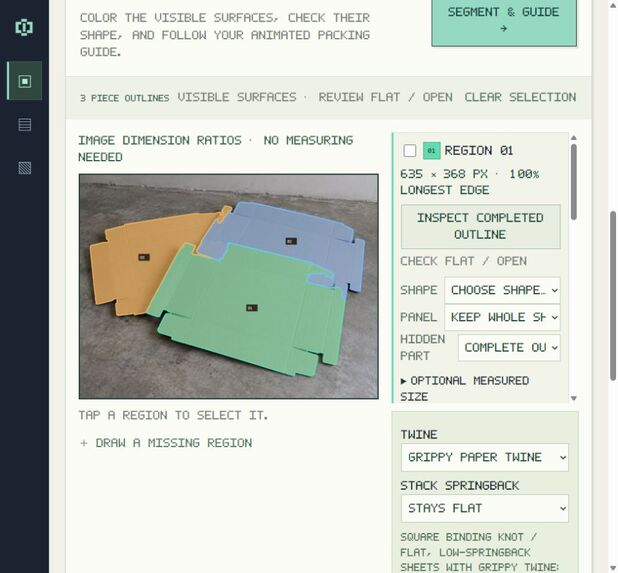
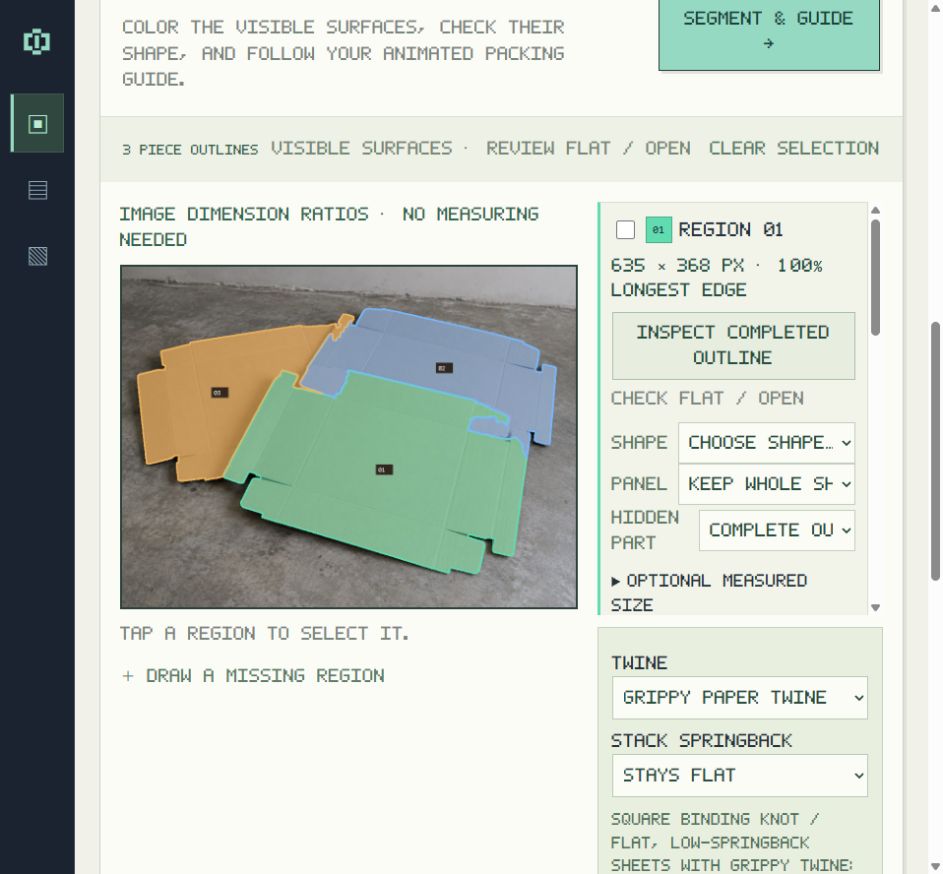
Unpainted cardboard: three sheet identities with visible flaps retained. Actual AWS OpenCV 5 result.
Why cardboard?
A flattened box is rarely a neat rectangle. It has flaps, slots, thick folds, and another sheet hiding half of it. A packing guide that loses those details can look convincing while showing the wrong thing.
BIND ZERO-X turns a cardboard photo into a guide for sorting, stacking, and tying the sheets. It is meant for the small, awkward job before recycling: deciding what belongs in one bundle, which way each sheet should face, and where the twine actually goes. The interface uses a pixel font and simple controls that also fit a phone screen.
What you can do
Choose a demo photo and press Segment & guide. The app separates visible surfaces, estimates obscured outlines, and asks you to check which regions are flat sheets or open boxes. Inferred areas are striped so that they remain distinguishable from observed pixels. An open box gets a flattening step and needs a new photo before the guide continues.
The packing view uses the original photo cutouts, including flaps and slots, rather than replacing every sheet with a rectangle. Dimensions come from a shared image scale; no ruler is needed for the default workflow. You can change the order and direction, inspect every selected piece, and move between bundles without losing smaller pieces from the plan.
Front, top, side, and underneath views show the same continuous twine route. The guide goes below the whole stack, around its edges, across the top, and into the knot. You select the twine material and whether the stack springs back. Those inputs choose between a square binding knot and a double-first-throw surgeon binding knot. The app asks for a different material when the selected twine is too slippery for this guide.
How it works
OpenCV 5.0.0 does the image analysis. Colored sheets use color and edge separation. Touching, unpainted sheets use OpenCV DNN with the OpenCV Zoo EfficientSAM-Ti ONNX model, followed by proposal filtering, neighbouring-object refinement, and watershed. Crease-aligned geometry proposes missing outlines separately from the observed label map.
A FastAPI service runs the analysis on Amazon EC2 in Tokyo. Requests enter through HTTPS API Gateway, a VPC Link, and an internal Application Load Balancer. AWS WAF and application limits bound traffic and expensive jobs. The browser polls private background jobs rather than holding an inference request open through the gateway. Three.js renders the photo-based guide; it does not do the segmentation.
Judges use a separate password-only demo account. The local operator account keeps MFA, and its credentials, captures, and private history are absent from the public deployment. Judge login details are in the submission's private testing instructions.
What changed during development
Two failures drove most of the later work. Creases in brown cardboard were being counted as separate sheets. A later attempt to make the stack tidier cropped sheets to their central panels and hid the shape that the user needed to see.
The current version keeps whole outlines and a persistent inventory. Completing one bundle advances to the next; exporting a plan includes every selected sheet. The twine wraps and knot also share one path model, fixing an earlier mismatch between the cross on the stack and the knot animation.
Results and remaining work
The AWS demo was checked in Chrome with all five colored sheets, including blue, and both bundle guides. On the supplied unpainted three-sheet and five-sheet images, regression checks returned three and five body identities and kept the checked front flaps attached to their sheet. Recorded EC2 inference times were 25.70 and 23.77 seconds, with a peak process footprint of about 881 MiB. These are two individual runs, not a throughput benchmark.
The recorded test run has 478 passes and one skip, covering the research code, application, authentication, job isolation, geometry, and guide flow. That count is not a segmentation accuracy score. The supplied images are demo fixtures, not an independently measured field dataset.
Dense overlaps and unseen shapes still need review. Photo proportions are not calibrated physical dimensions, and the app has not established friction, knot strength, or lifting safety. The next work is broader annotated image evaluation and physical bundle testing. For now, the useful result is a working, inspectable guide whose image evidence, inferred geometry, and simulated actions remain separate.
