-
-
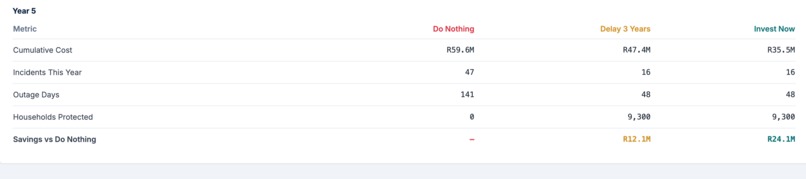
Scenario Comparison
-
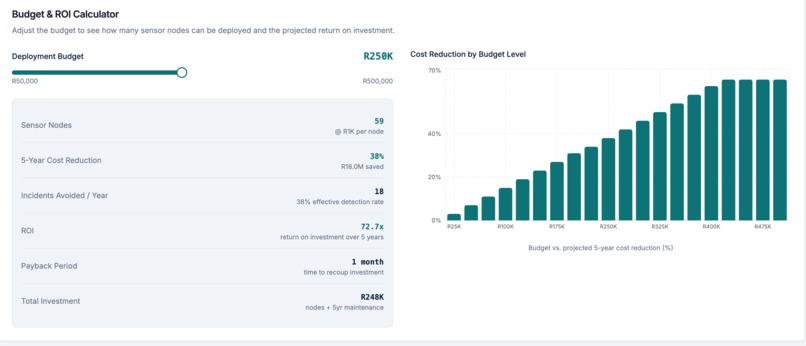
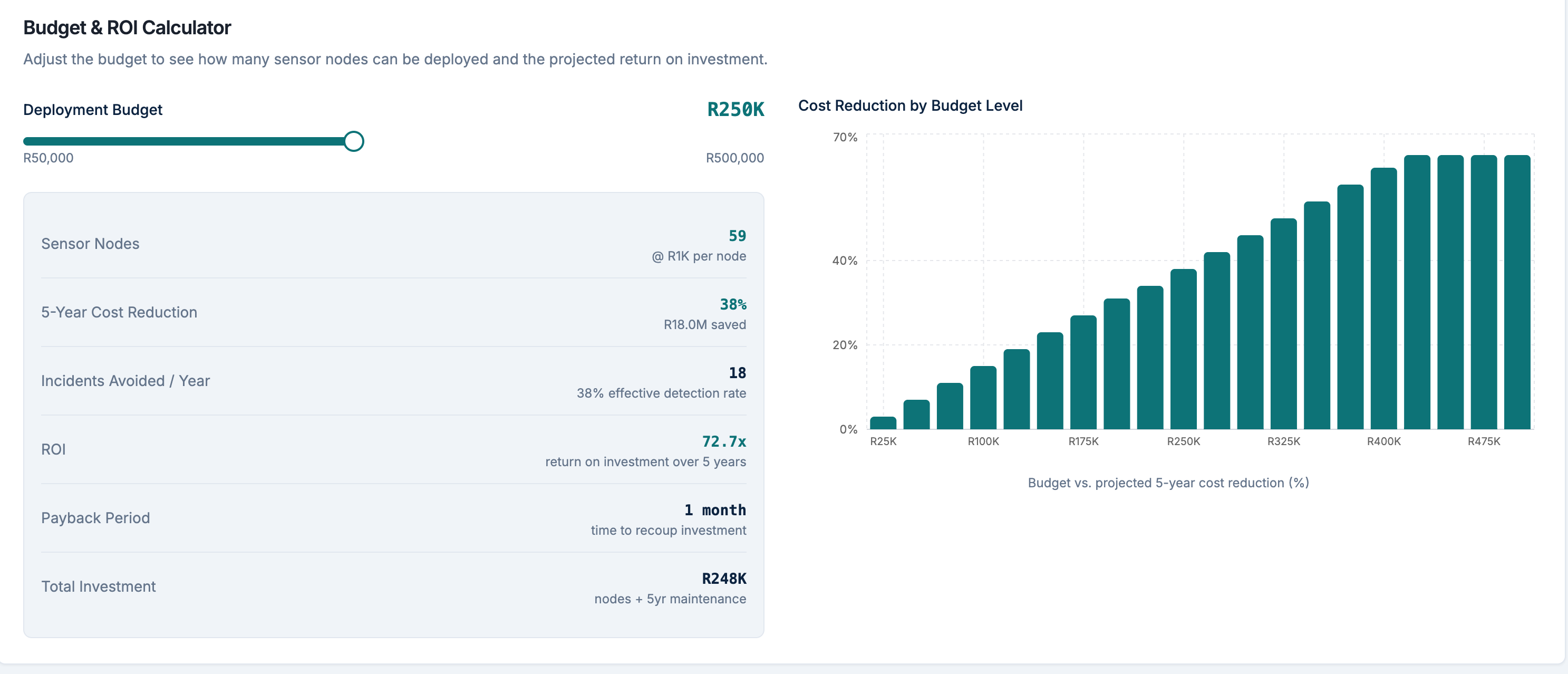
Budget & ROI Calculator
-
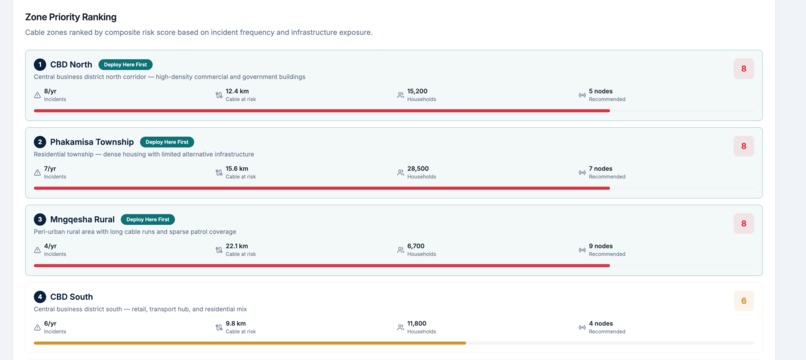
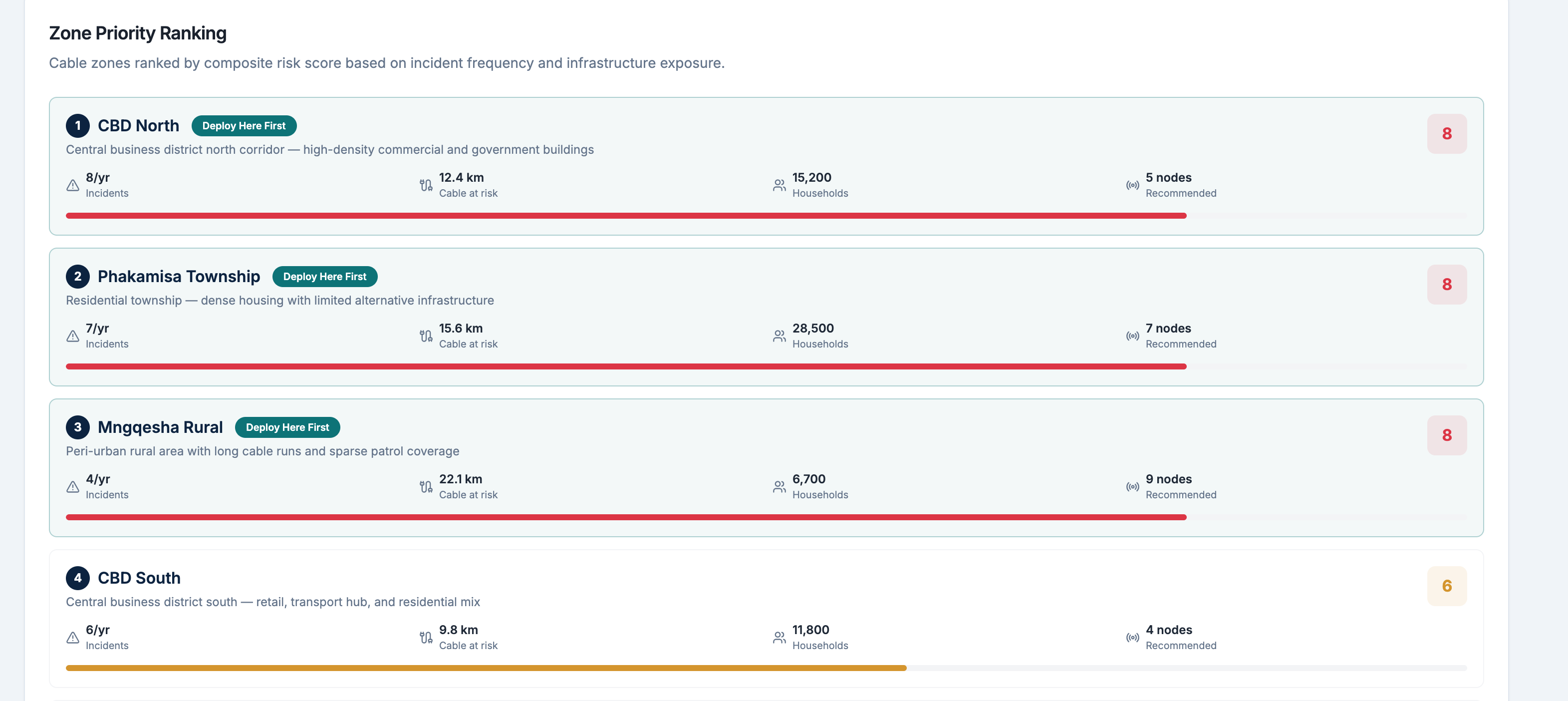
Zone Priority Ranking
-

Human Decision Required

Inspiration
A community letter reached us in May 2026 from Qonce, Eastern Cape: residents reporting repeated cable theft, days-long power outages, and no police response. Cwaita has family in the area and has lived through these outages directly. We didn't want to build a hypothetical hackathon project we wanted to build something that answers a real letter from real people.
The deeper problem we found wasn't just "cable theft happens." It's that municipalities keep choosing to do nothing, because the cost of inaction is invisible until the damage is already done. Buffalo City Metro Municipality (BCMM) has made arrests and recovered stolen copper, proving the response infrastructure exists but there's no early detection, and worse, no clear financial case being put in front of decision-makers showing what delay actually costs versus what prevention would save.
That gap the absence of a legible cost comparison is what CableGuard AI's hackathon submission addresses directly.
What it does
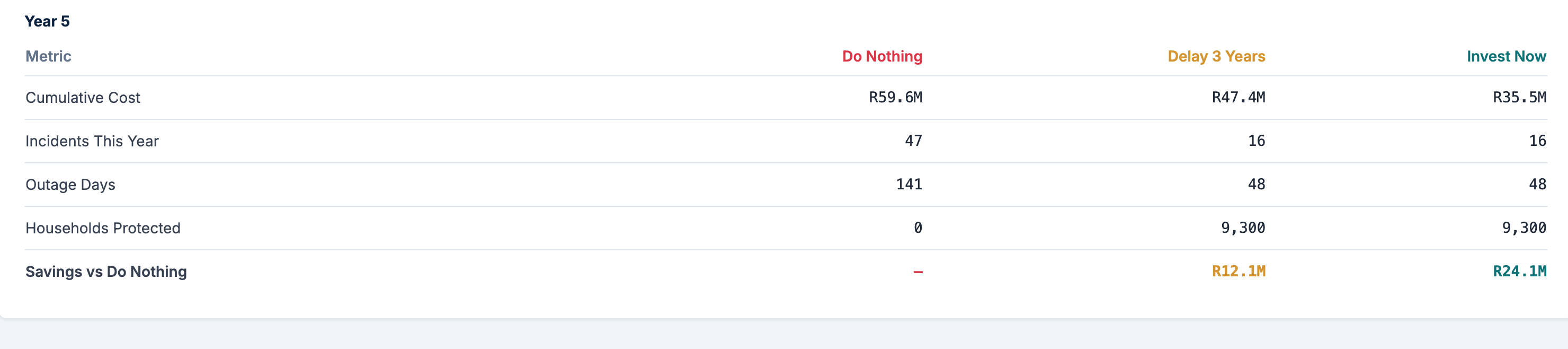
CableGuard AI's submission for this hackathon is a municipal decision-support simulator. It answers one question for BCMM officials: what happens if we do nothing, versus delay three years, versus invest now in a covert AI sensor network?
The dashboard models, for Qonce's 10 highest-risk cable zones:
Three intervention scenarios (Do Nothing / Delay 3 Years / Invest Now) projected across Year 1, Year 3, and Year 5 cumulative cost, incidents per year, outage days, and households protected A budget and ROI calculator slide deployment budget from R50K to R500K and see sensor node count, 5-year cost reduction percentage, incidents avoided per year, ROI multiple, and payback period update live Zone priority ranking all 10 cable zones in Qonce ranked by composite risk score (incident frequency + cable length at risk), with deployment recommendations per zone Human decision flag every page reinforces that the model recommends, it does not decide; municipal operators choose final deployment order based on operational and community factors the model can't see The intervention being modeled "Invest Now" is CableGuard AI itself: a buried, covert sensor network using vibration, current, and acoustic sensors with multi-sensor fusion AI to classify digging activity in real time, alert security teams via WhatsApp/SMS within 60 seconds, and operate on solar power so it survives the outages it's preventing. The simulator's entire job is to make the business case for deploying that system.
How we built it
We used a spec-driven development approach: full documentation (mission, roadmap, tech stack, scope, strategic analysis) was written before any code, so the build had a fixed target instead of drifting.
Stack: Next.js 14 (App Router) + TypeScript + Tailwind CSS, deployed on Vercel. The scenario engine is a TypeScript simulation layer that models cumulative cost, incident frequency, and outage days per zone under each of the three intervention strategies, using cost assumptions built from researched cable theft damage figures (~R200K+ per incident) and node deployment costs (~R1,200/node in component cost).
Build process: We used Claude Code inside Windsurf, working from a CLAUDE.md system file and a sequenced set of build prompts (project scaffold → data layer + simulation engine → dashboard UI → scenario comparison + ROI calculator → zone ranking → polish/deploy), so each step built cleanly on the last rather than producing one unreviewable mega-prompt.
Challenges we ran into
The biggest challenge wasn't technical it was reframing without abandoning. Our qualifier submission (62/100, the detection-and-alert system) was built around Challenge 5's framing before we knew the actual hackathon challenge briefs. When Challenge 6 ("Communities Decide Better") was revealed at kickoff instead, we had to decide fast whether to start over or adapt. We chose to keep the real system (the sensor network) intact and build the "Cost of Doing Nothing Simulator" as the lens the brief actually asked for which meant redesigning what we'd show, not what we'd built the case for.
A second challenge was numbers discipline. It's easy to model a dashboard that looks impressive but uses arbitrary figures. We grounded the cost model in: documented average cable theft damage (R200,000+ per incident, including replacement, labor, and outage cost), real per-node hardware cost (~R1,200, built from a bill-of-materials estimate, not a guess), and a 400:1 false-negative-to-false-positive cost ratio that we also use to justify our confidence threshold design (40/65/85%) in the underlying detection system.
Accomplishments that we're proud of
A working, deployed, interactive simulator (not a mockup) that a municipal official could actually click through and adjust A defensible cost model every number in the ROI calculator traces back to a documented assumption, not a guess Direct response to our own qualifier feedback: the judges asked for named tradeoffs (false negative vs. false positive cost) and architectural specificity. The 65-85% confidence threshold band and the 400:1 cost ratio in our techstack documentation are a direct answer to that note. Keeping a real community's problem at the center of a hackathon project, instead of inventing a synthetic one
What we learned
That a strong AI system isn't just a model it's a decision boundary. The most defensible part of our submission isn't the AI risk scoring, it's the explicit line we drew around what the AI is allowed to decide (flag, rank, recommend) versus what stays with a human (deploy, dispatch, prioritize a specific zone). That distinction came directly from our qualifier feedback, and building the simulator forced us to make it concrete in the UI itself see the "Human Decision Required" notice on the Zone Priority Ranking page.
We also learned that judges reward honesty about scope more than they punish it. Rather than implying a finished hardware network, we labeled the simulator as a decision-support tool modeling a system in development and that's a stronger, more credible story than overstating what two students built in seven days.
What's next for CableGuard AI
- Phase 2 (3 months): Build a physical ESP32 + sensor prototype, collect real vibration data in Qonce, train a TinyML classification model with Edge Impulse, and run a benchtop demo of actual detection not simulated.
- Pilot proposal: Use this simulator directly as the pitch document for a BCMM pilot conversation it's built to be the artifact we hand a municipal infrastructure manager.
- Security company partnership: Pursue an MOU with a King William's Town private security firm as a parallel, faster distribution path while municipal procurement (which is slow) proceeds.
- Funding: Apply to SEDA, NYDA, and Eskom Development Foundation using the cost model in this simulator as the justification.
Built With
- claude-code
- leaflet.js
- next.js-14
- react
- recharts
- tailwind-css
- typescript
- vercel

Log in or sign up for Devpost to join the conversation.