-
-
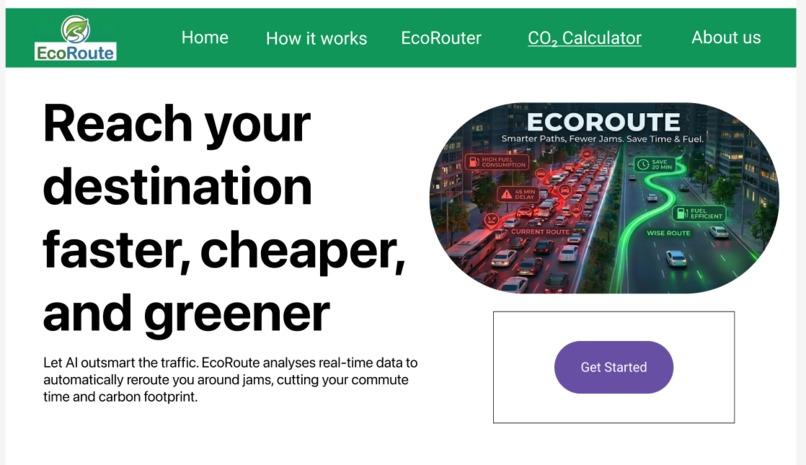
EcoRoute Home Page
-
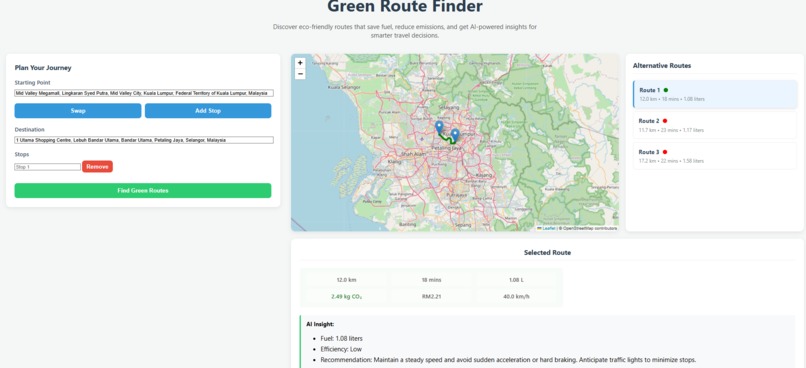
EcoRoute GreenRoute Demo


Inspiration
As cities grow and traffic congestion worsens, daily travel becomes slower, more expensive, and more harmful to the environment. We were inspired by the idea that small individual choices can create large collective impact—especially when it comes to transportation. Yet many people don’t realize the real carbon footprint of their travel routes. This motivated us to create an AI-powered solution that guides commuters toward greener, smarter, and more sustainable journeys, without compromising convenience.
What it does
EcoRoute is an AI-driven Green Routing platform that helps users find the most eco-friendly path from point A to B. It does this by:
- Analysing routes across multiple transport modes (walking, bus, train, car, rideshare).
- Calculating real-time CO₂ emissions for each route using distance, vehicle type, and transport mode.
- Recommending the greenest route that minimizes carbon footprint while still being practical.
- Providing users with clear comparisons, such as how much CO₂ they save by choosing one option over another.
- Offering a clean and interactive UI with maps, autocomplete inputs, and dynamic route suggestions.
How we built it
- We developed the project with a React frontend and an AI-supported backend that calculates CO₂ emissions for various travel modes. Key components include:
- Google Maps API for geolocation, route planning, and map rendering.
- Custom React components for input forms, real-time map updates, and step-by-step user flow.
- A backend service (Java) used for distance calculation, CO₂ estimation, and API logic.
- Optimized state management to ensure smooth, responsive route switching and emissions recalculation.
- Clean, modular UI/UX components to make the experience intuitive and user-friendly.
Challenges we ran into
- Integrating multiple Google Maps services (Places API, Directions API, Distance Matrix) while managing rate limits.
- Ensuring accurate CO₂ estimation formulas across different vehicle types and public transport modes.
- Handling asynchronous API calls and keeping the UI synced with updated route and emission data.
- Debugging React state issues, such as map rendering, input synchronization, and unexpected re-renders.
- Designing a layout that balances map visibility with input controls and data panels on smaller screens.
Accomplishments that we're proud of
- Building a fully functional prototype that calculates real-time CO₂ emissions and suggests greener routes.
- Successfully integrating multiple APIs and ensuring smooth interactions between frontend and backend.
- Creating a clean, minimalist UI that feels intuitive and professional.
- Turning our sustainability concept into a working product within a short hackathon timeframe. 5.Collaborating effectively as a team and overcoming technical hurdles together.
What we learned
- How to combine AI concepts with real-world routing and environmental sustainability.
- Deeper understanding of React components, props/state, and API integration.
- The complexity of accurate emission modeling and transport data processing.
- The importance of clear team communication and timeboxing tasks in a fast-paced hackathon setting.
- How user experience and environmental impact insights can work together to change travel behavior.
What’s next for KMPH
- Integrating machine learning to personalize green route recommendations based on user habits.
- Adding live public transport data such as bus occupancy, delays, and electric vehicle availability.
- Implementing gamification: rewards, streaks, and eco-points for choosing greener routes.
- Partnering with public transport agencies or city councils to promote sustainable mobility.
- Expanding the platform into a full eco-travel assistant that includes carpooling, e-scooters, last-mile mobility, and carbon offset programs.

Log in or sign up for Devpost to join the conversation.