C-Box
1/ Turning a disposable mask into a keeper
The A-Team is looking to solve the issue of mask accessibility for all citizens in the EU, be it health workers, professionals, students, pupils, retirees, etc. While the effectiveness of N95 masks is proved to last for 3 to 4 hours on average, medical personnel do not always use them for that long.
Supply chains are overstrained, trying to provide every hospital in the European Union with effective medical protection. Thus, the current “Use & Dispose” system is not sustainable in a time of pandemic. The logical solution would be to examine the possibility of sanitizing N95 masks in order to use them more than once.
Nevertheless, the structure of an N95 mask makes it a difficult task. Behind the protective virtues of N95 masks stands an entanglement of closely tied and very fragile polypropylene fibers. Those fibers create a net, which does not let viruses reach your nose and mouth.
The efficiency of N95 masks being assured by the electrostatic charge on the surface of the mask fiber, humidity and most chemical treatments create a risk of strongly damaging the filtration efficiency. Thus, in order to relieve supply chains and hospital stocks, we have worked on a solution to sanitize N95 masks without damaging their protective structure. Quite similarly, providing every EU-citizen with a single, disposable mask every day would represent a weekly need of 3.1+bn masks. Since N95 masks stocks are primarily dispatched to hospitals, we wanted to create a solution that would nevertheless work for any type of mask.
By the the way, we contacted the Seb Group which has expressed an interest in the project :
“Le Groupe SEB a été contacté et celui-ci a confirmé vouloir étudier plus en détail l'initiative jugée intéressante sur la base des premiers éléments échangés en utilisant ses plateformes d’open innovation Innovate with SEB et
Incubateur SEB@ECL en partenariat avec l’Ecole Centrale de Lyon”
(Translation : "The Seb Group has been contacted and has confirmed that based on first exchanges, it would like to
examine the initiative more in detail, using its open innovation platforms Innovate with Seb and the Incubateur
Seb@ECL, in partnership with Ecole
Centrale de Lyon” )
2/ Presentation of the C-box
The C-Box we designed aims at addressing the issue raised above.
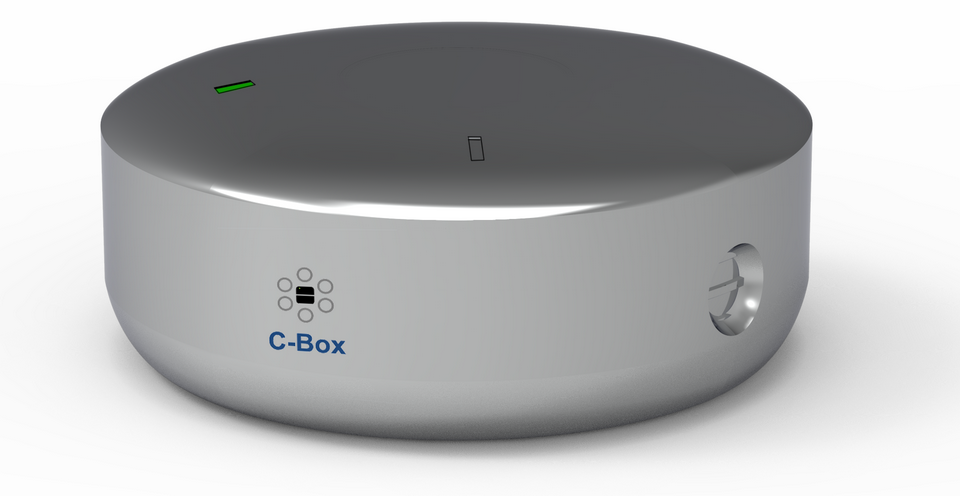
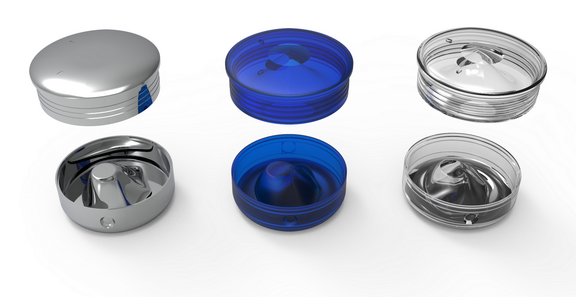
The C-Box is a hard compartment in which a mask can be introduced. The C-box is designed to be put inside an oven or a warm water bath. It deactivates the SARS-COV-2 virus present on the mask by the action of dry heat. The thermal properties of the box are chosen so that once it is exposed to the heat inside an oven (or bain-marie), the mask it contains undergoes the appropriate disinfection cycle, according to scientific literature (detailed in part 3).
Though the system deactivates the virus, it is our belief that the masks recycled should always be used by the same individual for sanitary reasons. Besides, masks have an acute memory of the face they were first worn on, which increases the risk of deterioration if it is worn successively by two people with different face shapes. Also, using someone else’s mask increases the risk of contagion.
Given the aforementioned importance not to exchange masks between persons, we imagined a system to sanitise individual, personal face masks. We believe that extending the average life expectancy of a mask (by allowing them to be reused) will allow for a more effective coverage of the European population.
The advantages go beyond the recycling of the protective face wearables. Appointing individual masks should enhance the sense of responsibility amongst their users : avoid friction, excess heat and moisture. This should further reduce the need for new masks.
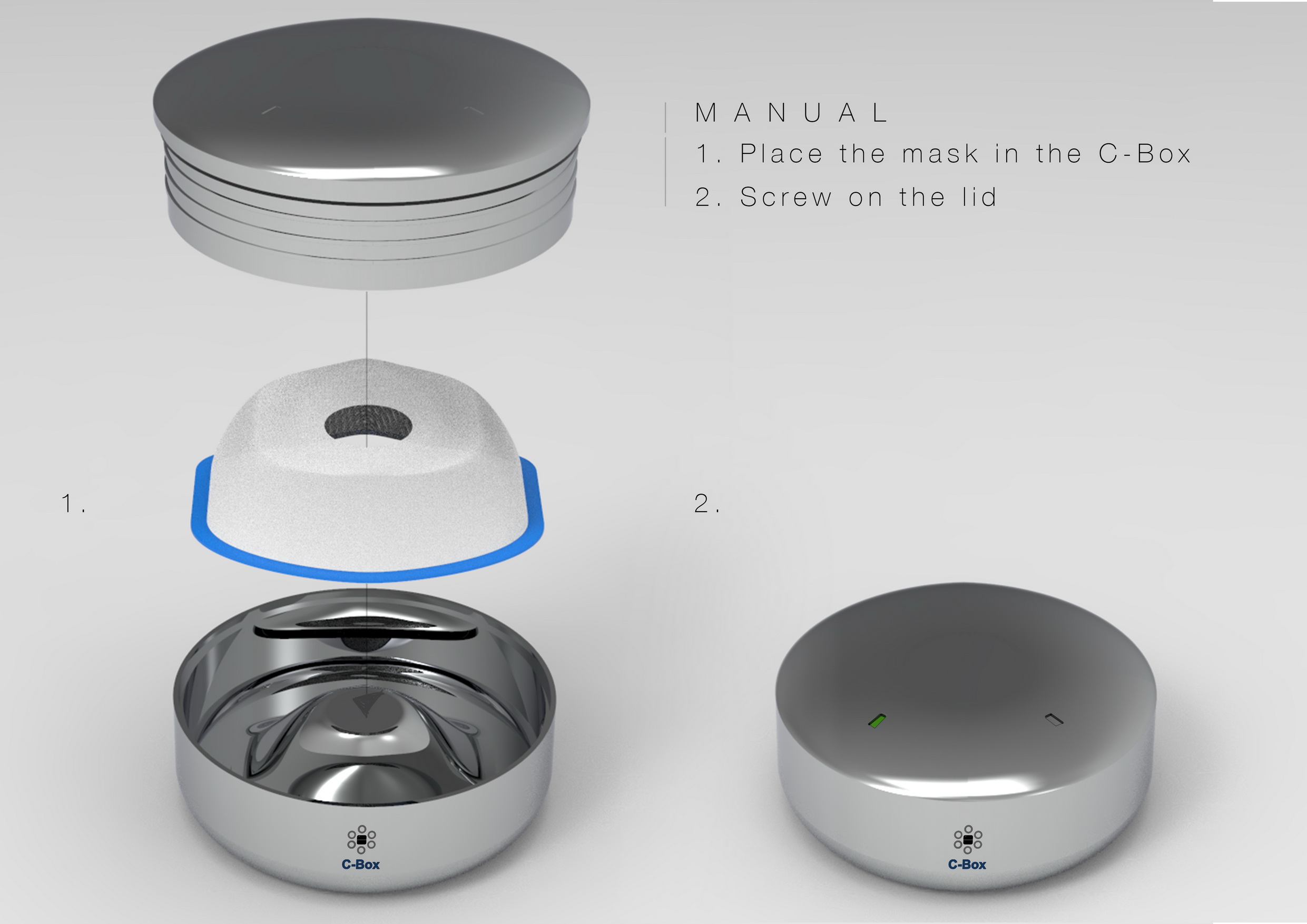
The C-Box consists of two elements. The lower element works as a prop for the mask to sit in. The upper element works as an airtight lid which needs to be screwed onto the lower element, in the same manner one would close a bottle of water.
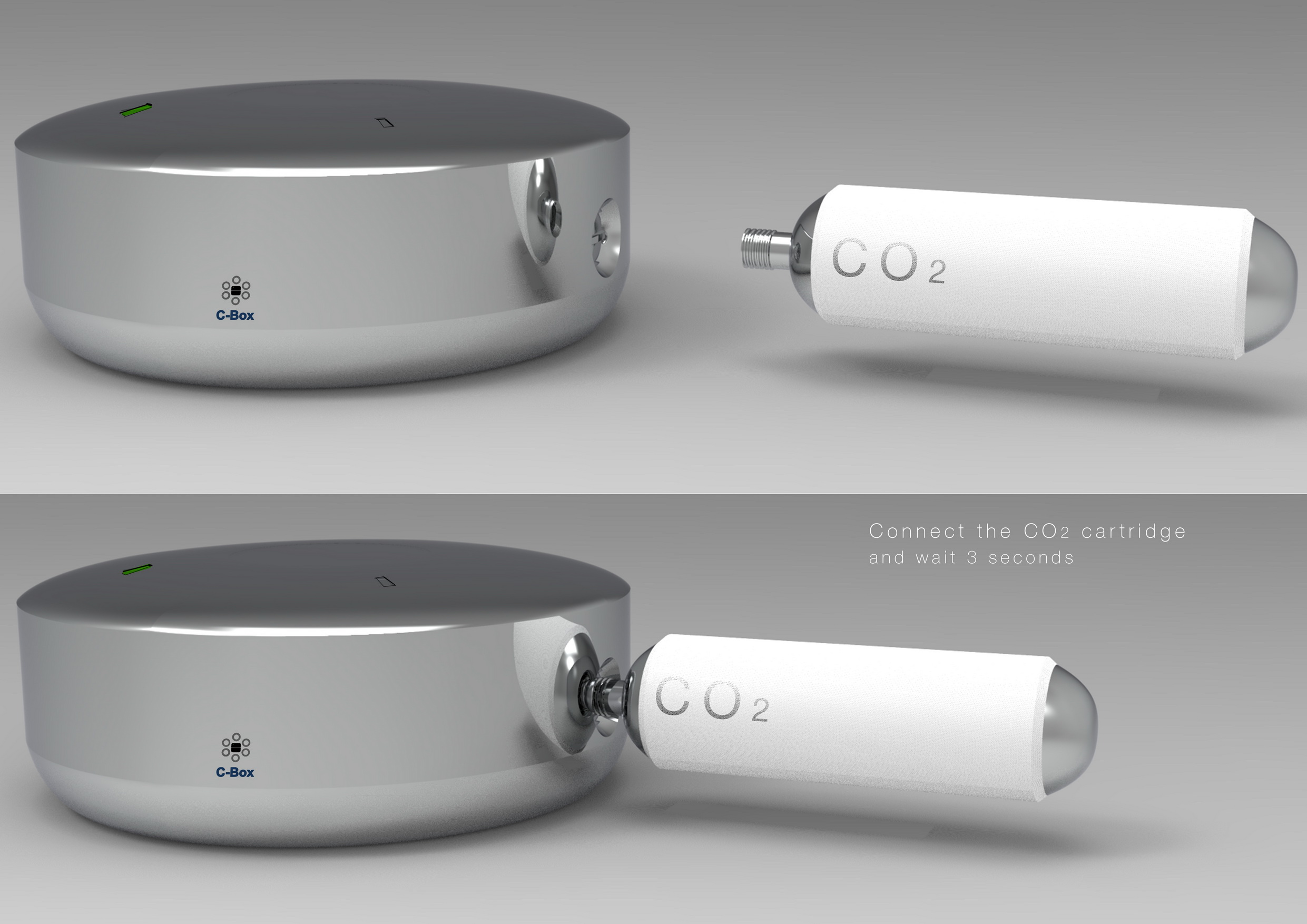
Once the mask is introduced and the box is closed, a cartridge nozzle allows a CO2 cartridge to connect easily. Indeed, in order to eliminate any kind of moisture present in the box and thus avoid damage to the structure of the mask while the thermal cycle is carried out, a 3 second release of CO2 gas inside the box before each use is necessary.
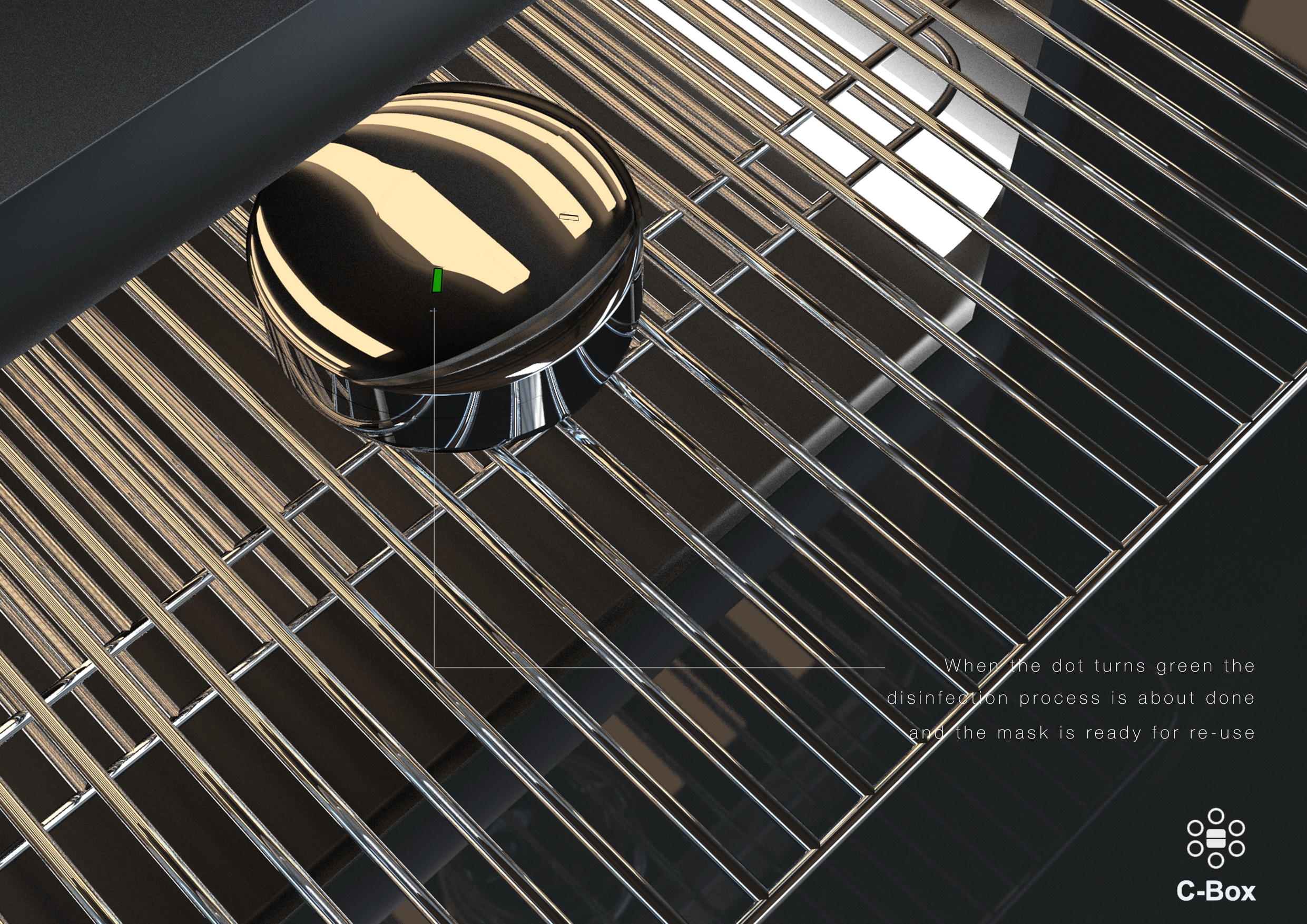
For the operation to be complete, the C-Box needs to be placed in an oven or a warm thermal bath (that can be achieved by many devices, such as bain-maries) for a precise time frame. A thermochromic pigment on the side of the C-Box will turn green once the sanitization cycle has been achieved in proper conditions so as to guarantee the sterilization of SARS-COV-2 is complete. The pigments will remain red otherwise.
The C-Box comes in various sizes, allowing to sanitise from 1 to 7 masks at the same time. This is to address the various needs that one may encounter in society.
3/ Why dry heat ?
The unprecedented pandemic of Covid-19 has created a worldwide shortage of respiratory protections, such as N95 respirators. The issue elicited a number of responses from the scientific community to examine diverse mask cleaning procedures.
The effectiveness of dry heat treatment to disinfect SARS-Cov-2 present on masks has been reported in several studies [1] [2] . In particular, a consortium of french scientists at CNRS (French National Centre for Scientific Research) and INSERM (public research organization in France entirely dedicated to human health) recently showed that a 70°C exposition to dry heat effectively inactivates a viral solution of SARS-Cov-2 deposited on masks [3]. The disinfection effectiveness of this treatment has been also shown with other viral species such as Murine coronavirus (M-Cov) [1].
Moreover, it has been shown that filter efficiency of FFRs is maintained after a one-hour exposition to 90°C dry heat [2], and another study led by the Stanford research center states that a 70°C dry heat treatment can be repeated up to 20 times before the filtering efficiency of the masks is altered [4]. This later result, which was confirmed by other papers [5], opens the way to multi-usage of masks.
According to scientific literature, an exposition to 70°C dry heat for 30 minutes appears to be a very effective way to realise a disinfection of SARS-CoV-2 present on masks, without affecting their filtration efficiency. Other experimental conditions are currently being explored, such as a 100°C exposition to dry heat [6]. If these future experiments report no degradation of the mask, the C-Box could even be used in pans of boiling water.
4/ Impact of the solution
4.1 Scalability of the solution
The C-Box allows every one to sanitize and reuse any kind of masks : N95, surgical masks, etc. As seen before, the C-Box is easy to use and is designed to provide everyone with a device to sanitise masks using common kitchen appliances. The scalability of the solution is thus achieved through the five following levers :
Adaptability to both personal and professional needs
- As the C-Box will come in various capacities (from individual boxes to devices with up to 5 compartments), it will address the needs of both individuals, small families, health professionals and even non-health workers
- Devices could be dispatched to factories, warehouses, hospitals, etc.,
- The only requirement is to possess an oven or any appliance capable of heating water
Low production costs and low selling price
- Estimated costs of production are as follows : €3 per box, €0,5 per CO2 trigger, €0,5per valve, €1 per adhesive for a total of €5 per box thermometer. A total of €5 per box
- The components necessary to produce the box are easily available in the kitchen appliance industry, the automotive industry, the bike industry, the gas industry, etc.
- Using a common price-to-cost standard of the market ratio (75%) to account for labor, distribution, marketing and
logistics expenses, a probable selling price per box would be €20
High production capabilities in Europe :
- The Small Appliances industry was identified as the most promising to
offer the necessary means of production
and expertise. In fact, the product requirements, materials used and
shapes envisaged are similar to those of pans
and similar cooking items. Those are produced widely in Europe.
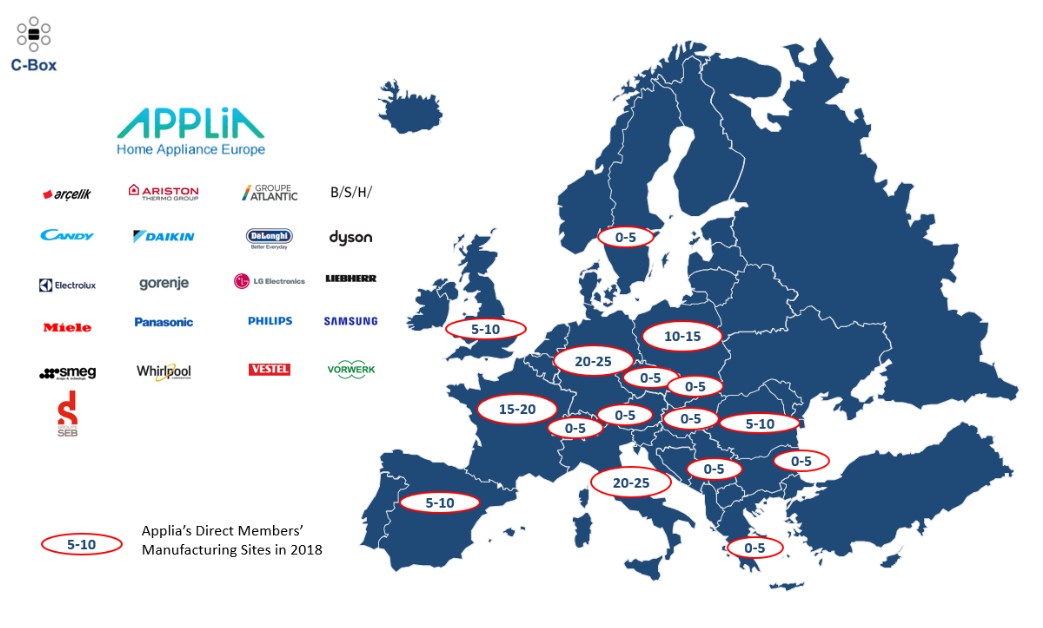
Please see below an estimate of the number of kitchen appliances production facilities for some countries in the
European Union:

- We contacted the Seb Group to share our project and received the following answer :
“Le Groupe SEB a été contacté et celui-ci a confirmé vouloir étudier plus en détail l'initiative jugée intéressante sur la base des premiers éléments échangés en utilisant ses plateformes d’open innovation Innovate with SEB et
Incubateur SEB@ECL en partenariat avec l’Ecole Centrale de Lyon”
(Translation : "The Seb Group has been contacted and has confirmed that based on first exchanges, it would like to examine the initiative more in detail, using its open innovation platforms Innovate with Seb and the Incubateur Seb@ECL, in partnership with Ecole Centrale de Lyon” ) - We have identified the automotive industry in Europe as a possible alternative to the Kitchen Appliance Industry to
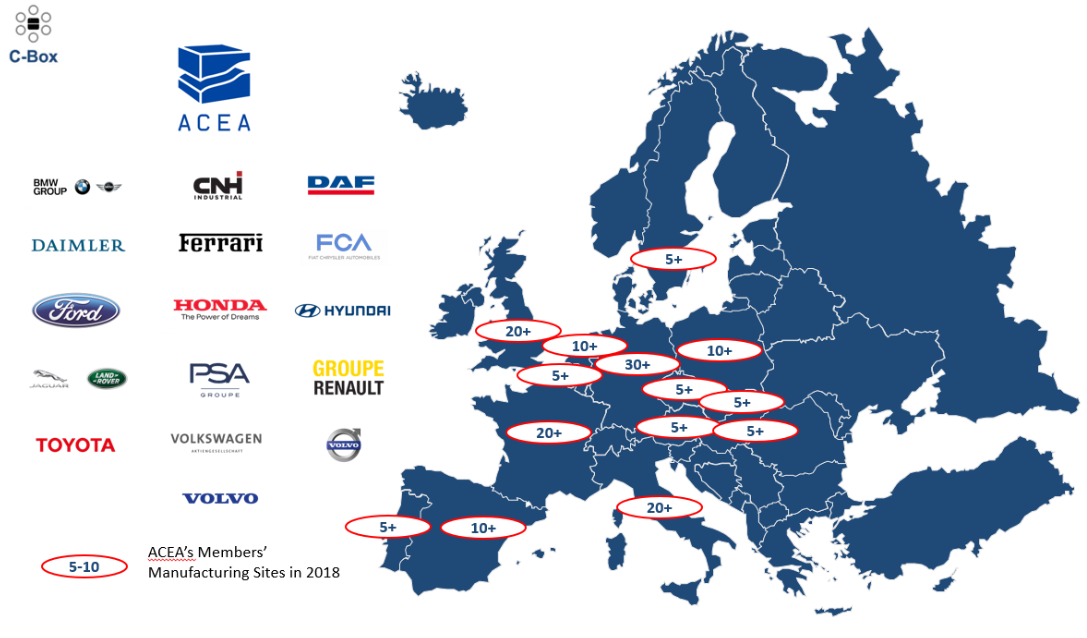
industrialise the production of the C-Box. An estimation of the number of assembly and production plants for main
EU countries is provided below, as per the ACEA’s figures (European Automobile Manufacturers Association).
- The Small Appliances industry was identified as the most promising to
offer the necessary means of production
and expertise. In fact, the product requirements, materials used and
shapes envisaged are similar to those of pans
and similar cooking items. Those are produced widely in Europe.
Please see below an estimate of the number of kitchen appliances production facilities for some countries in the
European Union:

Low ancillary costs for users :
- An oven is all you need to use the device
- A majority of European households have at least one oven (according to IPSOS : 81% of the French population had one in 2017). In Europe, the ownership rate for ovens can be easily estimated. According to APPLIA, 11.5m built in ovens are sold in Europe every year. With an average lifespan of 15 years (National Association of Home Builders), the estimated number of units is 172.5m out of 221.3m households (Eurostat), so an estimated rate of 78%.
- The cost to sanitize one mask is approximately €0.1, i.e. the cost of a CO2 cartridge
Rapid equipment and deployment rate: Allowing multiple use of the same masks will make it possible to provide the whole population with protective equipment.
4.2 Impact Assessment
Judging from the strong scalability of our solution, the possible solidarity channels we identify (between countries sharing complementary industries and resources) and the low costs necessary to deploy the C-Box, the following positive impacts stand out:
- Positive Impacts :
- 5-7 Fold reduction in the number of masks required to protect every person equipped with the C-Box
- Stronger protection of populations
- Reduced strain on supply chains
- Reduced strain on hospital stocks
- Lower costs than buying new masks
- Reduced pollution from disposing single-use masks
- Shorter lockdown periods
- Possible Negative Impacts :
- Though pollution from masks will be reduced, pollution from empty CO2 cartridges may rise. A study on short- circuit recycling and re-filling of the CO2 cartridges ought to be performed
- Possible increase in energy use
- Possible injuries from mishandling the product. However, we have taken care to select adequate materials to resist high temperatures in order to avoid fire, even in the unlikely event of excessive temperature being applied. The precautions needed to handle the product will be similar to those needed when using oven plates
5/ What we have done so far & Next Steps
The following steps have been achieved so far :
Literature Research :
- Identification of plausible sanitization methods for the virus
- Understanding of the structure and proper sanitization procedues of N95masks.
Population interview :
- Interview and understanding of nurses’, doctors’ and rescuers’ needs
- Interview and understanding of nurses’, doctors’ and rescuers’ needs
Sanitization process :
- Design of a procedure to sanitize N95 masks without affecting its filtration properties
- Design of a procedure to sanitize N95 masks without affecting its filtration properties
Prototype :
- Design of the C-Box allowing to sanitize one mask at a time
- Design of the C-Box allowing to sanitize one mask at a time
Scalability :
- Selection of industries, materials and processes for the prototype which we deem easily available.
- Interview with the Seb Group’s Innovation Director to discuss costs, prototyping, timing & go-to-market
procedures
6/ Our team
We are a team of passionate entrepreneurs, eager to bring down-to-earth, yet innovative solutions to address the burning issues of the world we live in.

7/ Bibliography
[1] Massey and al., 2020. Quantitative form and fit of N95 filtering facepiece respirators are retained and
coronavirus surrogate is inactivated after heat treatments
[2] Massey and al., 2020. Quantitative form and fit of N95 filtering facepiece respirators are retained after dry and
humid heat treatments for coronavirus deactivation
[3] Consortium de recherche français pour recycler les masques usagés :
https://lejournal.cnrs.fr/articles/masques-de-protection-la-piste-prometteuse-du-recyclage
[4] Stanford study : “ Can face masks be safely disinfected and reused ?”
[5] Dr. Lei Liao, Wang Xiao and al., 3/25/20. Can N95 facial masks be used after disinfection? And for how many
times?
[6] Viscusi and al., 2009. Evaluation of Five Decontamination Methods for Filtering Facepiece Respirators


Log in or sign up for Devpost to join the conversation.