-
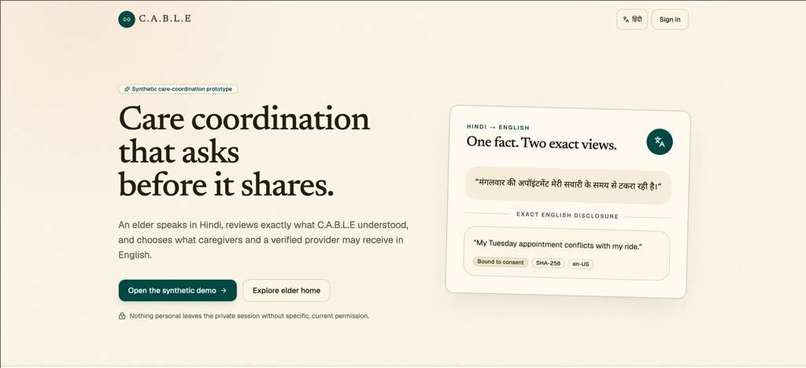
homepage
-
-
-
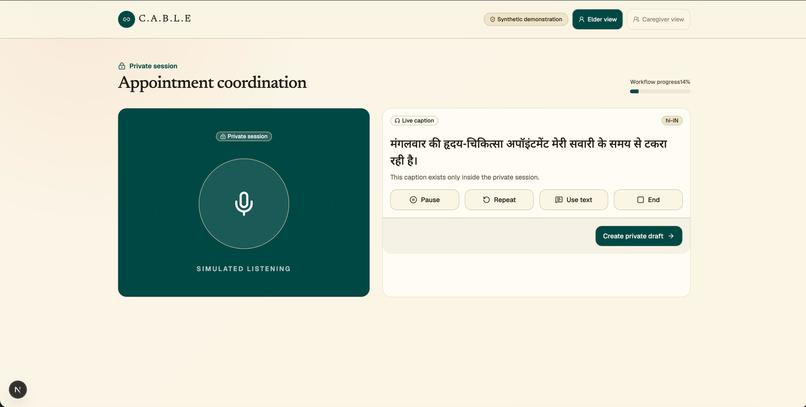
Conversation Page
-
Inspiration
Healthcare communication becomes difficult when the person receiving care, their family, and their provider do not share the same language.
An older adult may feel most comfortable describing symptoms in Hindi, while their caregiver or clinic communicates in English. Translation alone does not solve this problem. Important details can change, private information can be overshared, and the patient may never see exactly what another person receives.
We began with a simple question:
How can someone ask for help in their own language while remaining in control of their story?
That inspired C.A.B.L.E. — Consent-Aware Bridge for Language and Escalation.
C.A.B.L.E. is not another chatbot that immediately forwards a conversation. It creates a safe bridge between the person speaking, the caregiver supporting them, and the provider who may need to act.
What it does
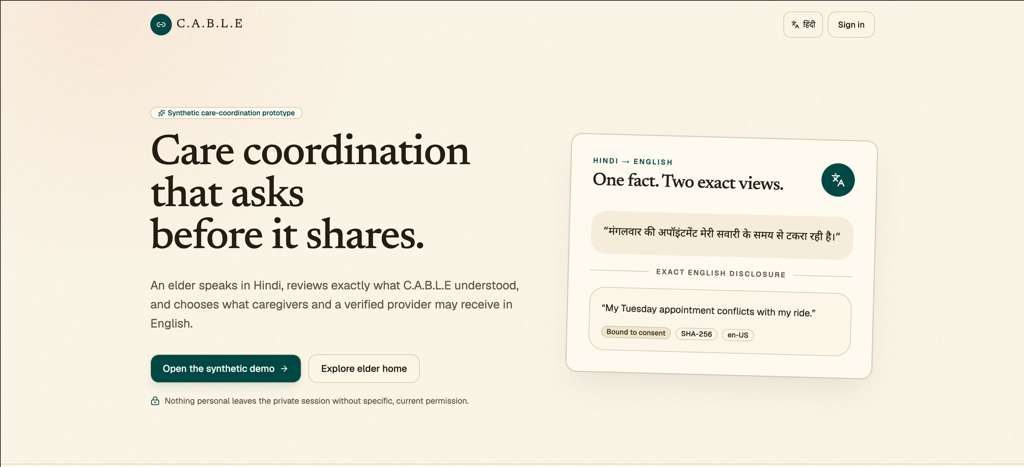
C.A.B.L.E. is a multilingual, consent-first voice care-coordination prototype.
A User can:
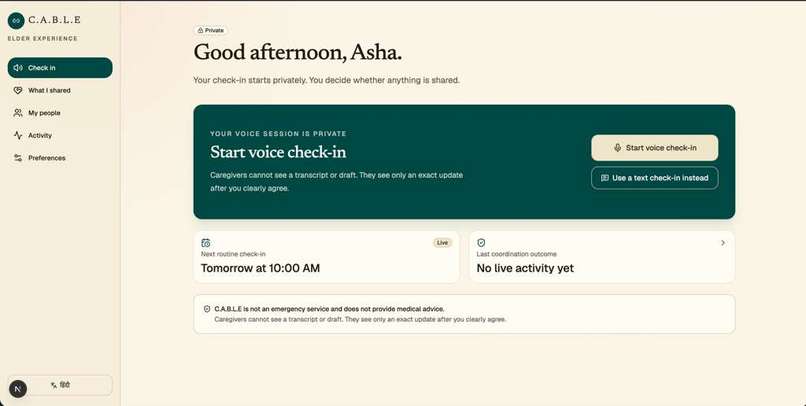
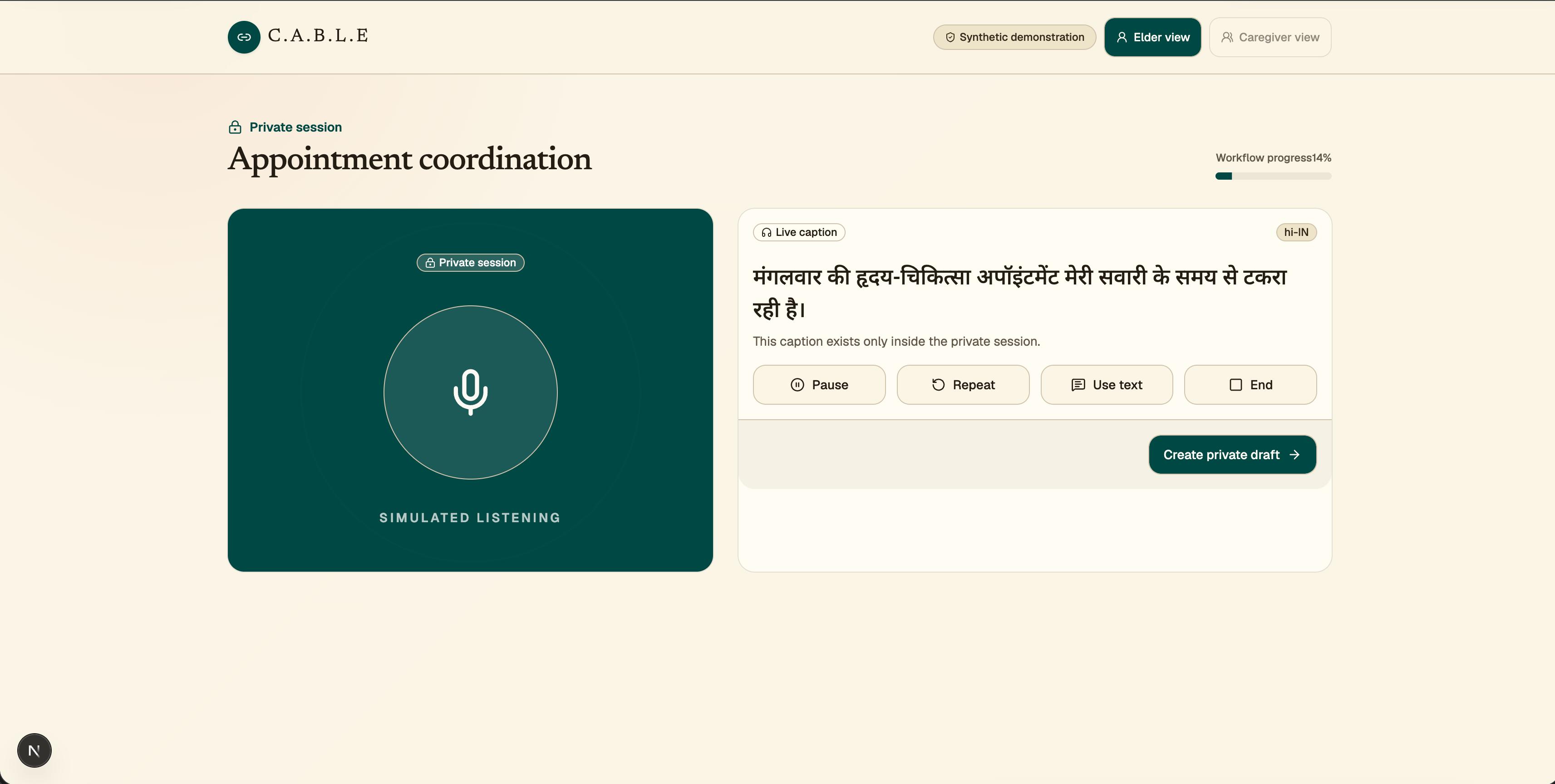
- Describe a care need naturally in English & Hindi.
- Review the extracted facts in English and Hindi.
- Correct anything the AI misunderstood.
- See the exact English disclosure proposed for her caregiver or provider.
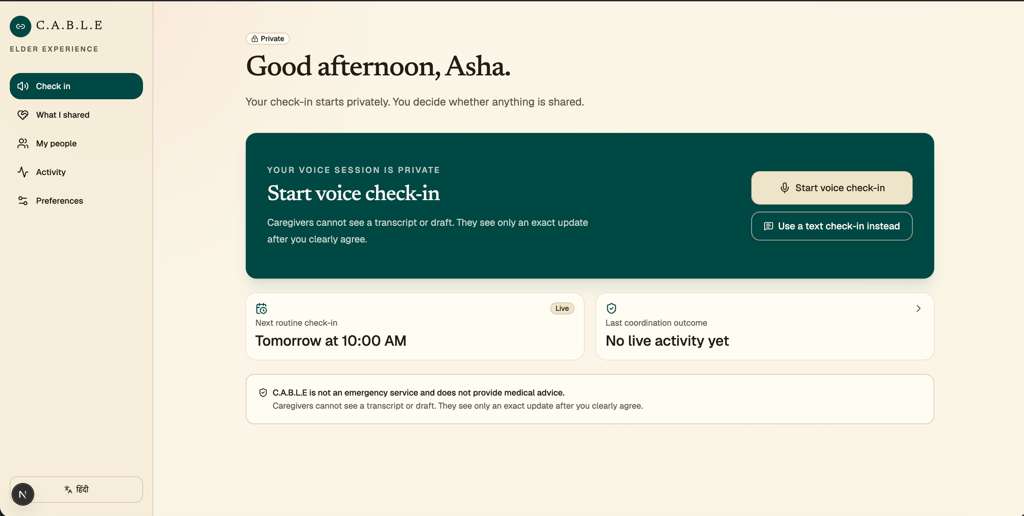
- Decide whether to share it.
- Revoke consent before an unfinished action is sent.
The system accepts only a clear yes or no when recording consent. An uncertain or ambiguous response remains pending.
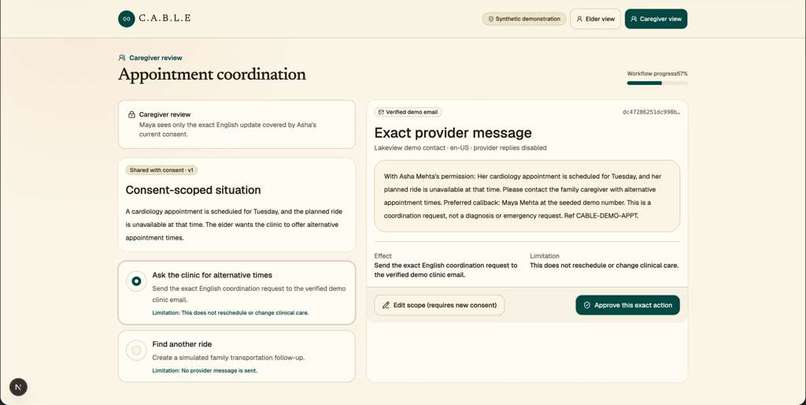
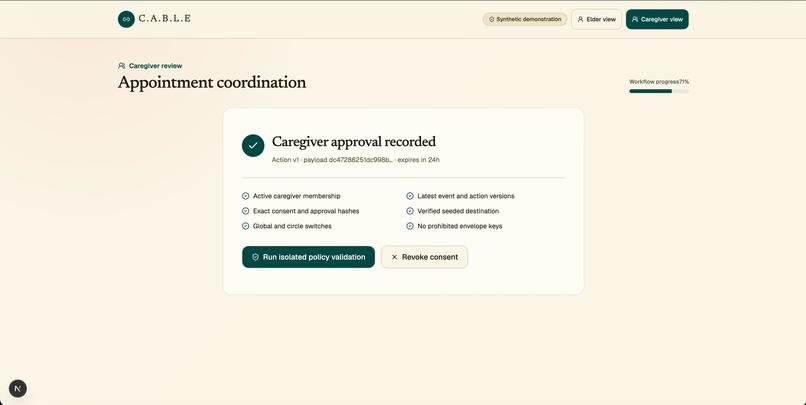
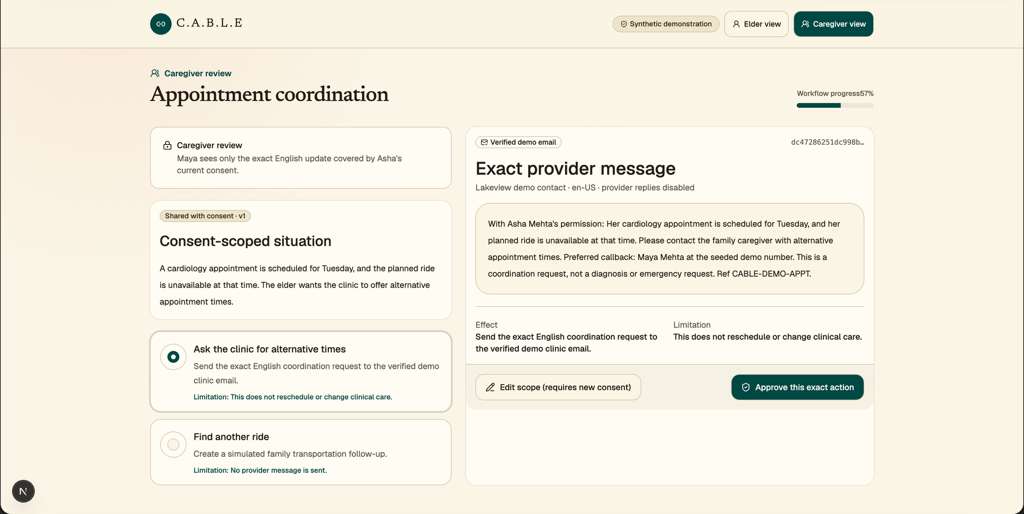
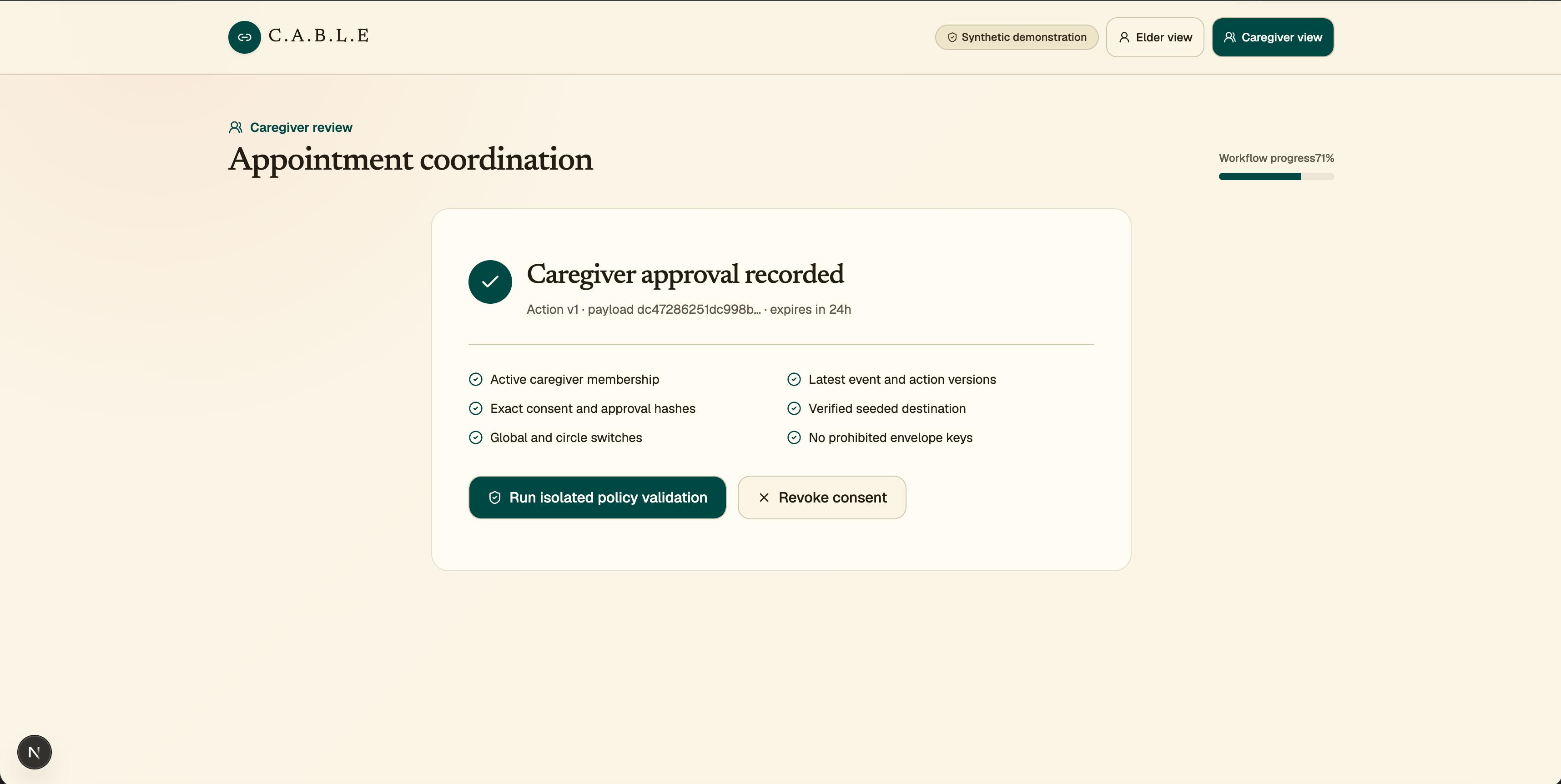
After a User approves a disclosure, her caregiver sees only the information covered by that consent. The caregiver can review a proposed action, edit it, and approve one exact version.
If the message changes, the previous approval becomes invalid. C.A.B.L.E. then validates the current consent, message version, recipient, approval, policy result, and safety controls again before permitting an external action.
C.A.B.L.E. does not diagnose, recommend medication, replace a clinician, or automatically contact emergency services.
How we built it
C.A.B.L.E. is built with Next.js 16, React 19, TypeScript, Convex, WorkOS AuthKit, ElevenLabs, Fireworks AI, Daytona, CopilotKit, Resend, Twilio, and Braintrust.
Voice and language
ElevenLabs powers the English and Hindi voice experience. The browser receives a short-lived signed session instead of an API key. Users have captions, mute and resume controls, and a text fallback.
C.A.B.L.E. does not store raw audio. Private conversation turns are temporary and subject to automatic retention cleanup.
Fireworks AI supports structured extraction, clarification, translation, and provider-message drafting. Model output is treated as untrusted data and must pass strict Zod validation. Invalid, oversized, timed-out, or clinically inappropriate responses fail closed to a deterministic or manual path.
Static safety and consent language is never freely rewritten by a model. Only explicitly allowed dynamic content can be translated.
Consent and workflow integrity
Convex is the authoritative workflow and data layer.
Care events and action proposals are versioned and immutable. Consent is bound to an exact disclosure version, while caregiver approval is bound to one exact action and payload hash.
If a fact, translation, recipient, or outbound message changes, unfinished consent and approval are invalidated. This prevents the system from obtaining permission for one message and sending another.
Every important workflow transition is preserved through an append-only audit chain.
Identity and access
WorkOS AuthKit manages authentication, organizations, roles, and memberships.
Protected server operations do not trust identity or role information supplied by the browser. The server re-establishes the current user, organization, membership, care circle, ownership, and permissions before returning protected information or accepting an action.
Human approval
CopilotKit assists caregivers in reviewing action proposals. It receives only consent-filtered information and cannot directly send an email or text message.
The AI can propose. A human must approve.
Policy validation
Daytona provides a short-lived, isolated sandbox for policy validation.
The sandbox receives a small, credential-free policy envelope—not the person’s name, transcript, contact information, message text, or API keys. Networking is blocked, execution is bounded, and cleanup is attempted after every validation.
Even after the sandbox passes, Convex repeats the authoritative checks before allowing an action to proceed.
Notifications
Resend and Twilio provide gated email and SMS adapters.
Notifications use immutable payloads, approved destinations, idempotency controls, verified webhooks, replay protection, and monotonic delivery states. Ambiguous SMS delivery results are not automatically retried, preventing accidental duplicate messages.
External actions remain disabled by default.
Evaluation
Braintrust powers our evaluation framework.
We created a credential-free suite containing 240 synthetic examples across consent, translation, safety, tenancy, prompt injection, hashing, policy enforcement, and notification delivery.
The evaluation data contains no real patient information.
Challenges we ran into
Translation is not the same as informed consent
It was not enough to translate a conversation. The user needed to confirm the underlying facts and see exactly what another person would receive.
We solved this by separating private input, fact confirmation, canonical English facts, disclosure preview, and version-bound consent.
AI output cannot be trusted automatically
A model can return malformed data, omit an important detail, change protected language, or generate inappropriate medical guidance.
We addressed this with strict schemas, bounded inputs, allow-listed translation slots, deterministic fallbacks, and fail-closed behavior.
Consent can become stale
Permission for one message should not authorize a later edited message.
We therefore bind consent and caregiver approval to immutable versions and canonical hashes. Any meaningful correction invalidates unfinished downstream authorization.
External actions are difficult to make safe
Email and SMS providers can time out after accepting a request, making automatic retries dangerous.
We designed an outbox workflow with leases, idempotency keys, delivery-state rules, immediate pre-send checks, and independent kill switches.
Privacy had to shape the architecture
Sensitive information could leak through logs, analytics, browser responses, evaluation traces, or sandbox payloads.
We designed redacted responses, temporary private turns, no raw-audio storage, consent-filtered views, generic lock-screen notifications, and credential-free evaluation data from the beginning.
Accomplishments that we're proud of
We are proud that C.A.B.L.E. is more than a conversational interface.
We built an end-to-end, consent-aware workflow that connects:
- Multilingual voice interaction
- Hindi fact confirmation
- Exact English disclosure previews
- Immutable consent and approval versions
- Role- and organization-aware access control
- Isolated policy validation
- Human-approved caregiver actions
- Idempotent notification delivery
- Append-only auditing
- Automated safety and accessibility evaluation
We also built three deterministic fictional scenarios that judges can explore without credentials, external accounts, or the possibility of contacting a real person.
The interface supports English and Hindi routes, keyboard navigation, captions, text fallback, reduced motion, high contrast, responsive layouts, and browser zoom up to 200%.
Most importantly, the user remains in control throughout the workflow.
What we learned
We learned that multilingual care coordination is not primarily a translation problem. It is a problem of meaning, consent, identity, and trust.
A technically accurate translation is not enough if the person never sees what will be shared. A caregiver approval is not meaningful if the message can change afterward. A secure model call is not enough if sensitive information appears in logs or external tools.
We also learned that responsible AI requires more than a system prompt. Safety must be enforced through schemas, immutable versions, authorization checks, policy gates, restricted tools, retention rules, and human approval.
Finally, we learned that the safest agent is not always the most autonomous one. In healthcare communication, the AI should help people understand and coordinate—not silently make decisions for them.
What's next for C.A.B.L.E.
Our next steps are to:
- Conduct user testing with multilingual families and caregivers.
- Review our Hindi consent language with qualified medical and language professionals.
- Add more languages and culturally specific communication patterns.
- Complete controlled live-integration testing with each external service.
- Expand accessibility testing with older adults.
- Explore optional scheduled check-ins and missed-response escalation.
- Study how personal baselines could surface meaningful changes over time without producing diagnoses.
- Work with clinicians, privacy specialists, and legal experts before using real health information.
- Develop integrations with existing provider workflows while preserving patient control.
Our long-term vision is to ensure that language never removes someone’s agency from their own care.
C.A.B.L.E. helps you speak naturally, understand exactly what will be shared, and decide who gets to act.
Built With
- ai
- braintrust
- convex
- copilotkit
- daytona
- elevenlabs
- fireworks
- next.js
- playwright
- react
- resend
- twilio
- typescript
- workos


Log in or sign up for Devpost to join the conversation.