-
-
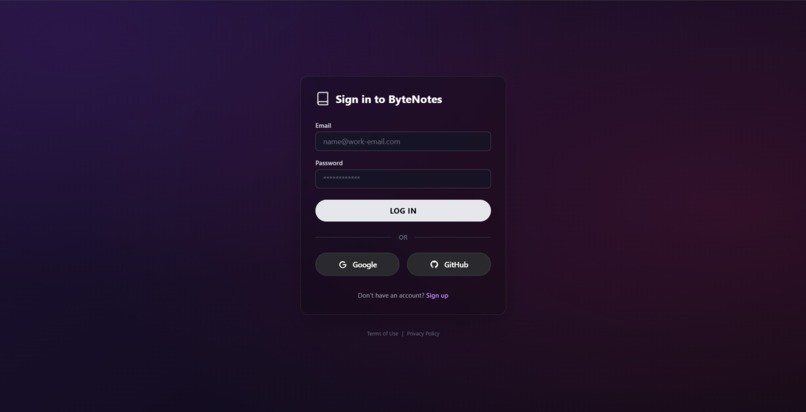
Login Page
-
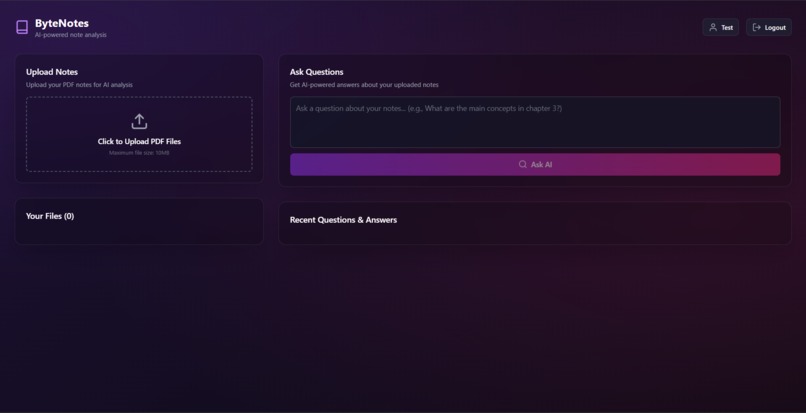
Dashboard
-
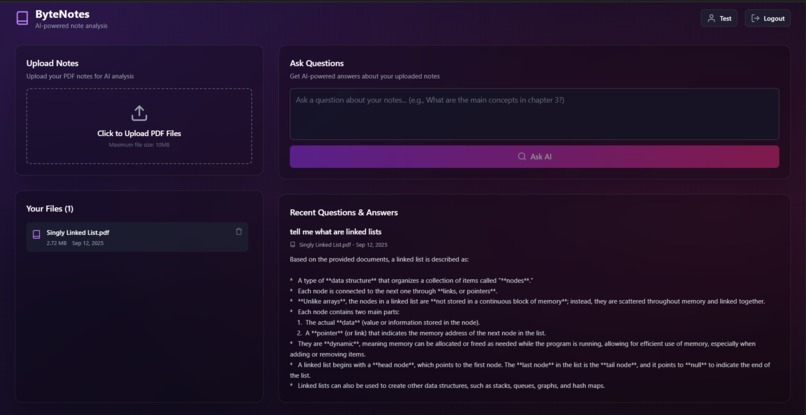
Upload PDFs and get instant AI-powered answers from your notes


🌟 Inspiration
As students, we often waste valuable time flipping through textbooks or scrolling endless PDFs while preparing for exams. Online AI tools can help, but they require internet, which isn’t always available. We wanted to create something that works offline, is fast, and helps students focus. That’s how ByteNotes was born—a study companion that transforms static notes into interactive Q&A.
📘 What it does
ByteNotes lets students upload their notes or textbooks in PDF format. Once uploaded, the app:
Indexes the content for quick retrieval.
Allows students to ask questions in natural language.
Provides summaries, key points, and direct answers from the uploaded material. All of this happens offline, powered by OpenAI’s gpt-oss models.
🛠️ How we built it
LangChain + FAISS for document chunking and vector search.
Hugging Face + gpt-oss-20B for reasoning and generating answers.
Streamlit for a simple, user-friendly web interface.
🚧 Challenges we ran into
Running large models locally required optimization.
Managing memory for big PDFs and embeddings.
Designing a clean, fast interface under time constraints.
🏆 Accomplishments that we're proud of
Built a fully offline AI assistant within limited time.
Created a tool that genuinely helps students revise faster.
Successfully integrated gpt-oss models into a real, usable app.
📚 What we learned
Hands-on experience with open-weight AI models.
How to combine embeddings + reasoning for better answers.
Importance of optimizing workflows for speed and usability.
🚀 What’s next for ByteNotes
Add voice input/output for a more interactive study experience.
Support for handwritten notes and scanned images using OCR.
Extend beyond students: professionals could use ByteNotes for research papers, reports, or manuals.
Explore lightweight deployment on mobile devices for true portability.
Built With
- faiss
- huggingface
- langchain
- python
- streamlit

Log in or sign up for Devpost to join the conversation.