Inspiration
My journey into programming, starting with Java, was initially met with significant struggle. Solving even simple problems felt insurmountable because I lacked a foundational understanding of how the code actually worked. The breakthrough came from a crucial piece of advice: focus on reading and understanding the basic syntax and then predicting the expected output. This shift in focus proved transformative. It forced me to engage with the code at a deeper level, building an internal model of its execution flow. The single most important question that guided this learning process was: "What does this code do?" Asking this question provided the necessary intent to dissect the code and accurately determine the outcome. This disciplined approach is what truly establishes the foundation for a key skill for any software engineer: the ability to read and comprehend code. I now follow this principle for learning any new language or technology. However, in the current landscape, the rise of AI code generation tools has made it common for new learners to bypass this essential step, relying solely on prompting tools to generate code without grasping the underlying logic. This situation directly inspired me to build a simple, dedicated platform. Its core purpose is to help learners cultivate this essential, foundational skill: learning to read code, understand the syntax, and accurately predict the expected outcome and most importantly leverage AI to learn faster!
What it does
Core Functionality and User Flow The platform guides the user through an engaging learning loop focused on code comprehension:
Concept Selection: The user begins by choosing a specific Go coding concept they wish to practice (e.g., slices, goroutines, interfaces, etc.).
Interactive Challenge: An AI assistant initiates an interactive chat session and provides a Go code snippet relevant to the chosen concept. Analysis and Prediction : The user's primary task is to analyze the snippet and predict its exact output. This directly reinforces the foundational learning principle: "What does this code do?" Instant Evaluation and Feedback: The user submits their predicted output for immediate, automated evaluation. If Correct: The platform confirms the correct understanding and moves on to the next challenge or concept. If Incorrect: The AI assistant provides a complete evaluation, detailing why the prediction was wrong, offering specific tips on the syntax/concept, and then presenting a new, related code snippet to build skills and correct misunderstandings immediately. Hands-on Verification: A crucial integrated feature is the "Go code executor" button within the chat. This allows the user to run the code snippet directly in the browser, without any local setup, to visually confirm its behavior. This serves as a powerful validation tool after the prediction and feedback cycle.
How I built it
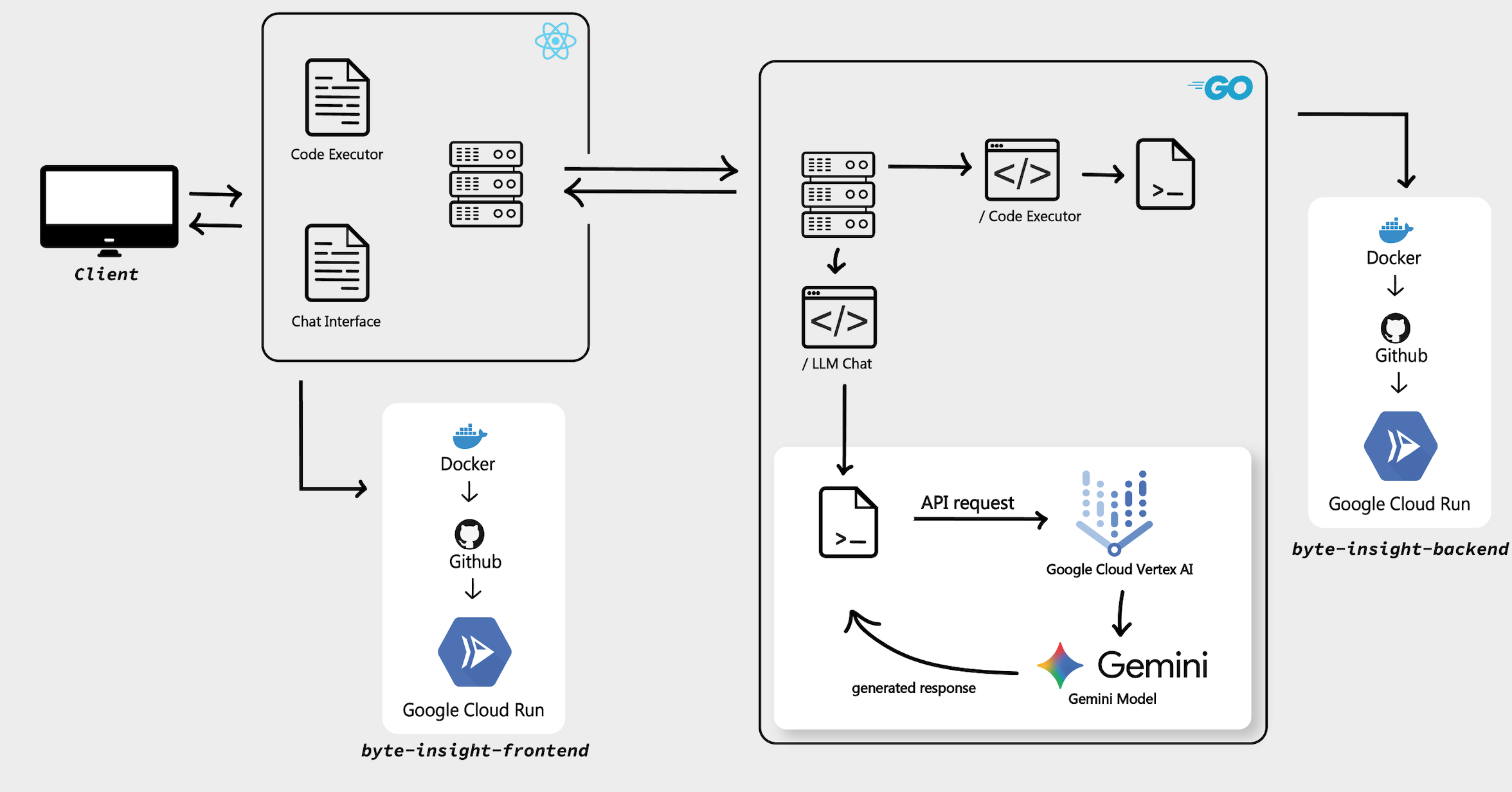
Byte Insight was built as a modern, decoupled web application using a Go backend to handle core logic and interact with the Gemini model via Google Vertex AI, which serves as the powerful AI assistant generating code challenges and providing detailed feedback. This deep AI integration is the core of the learning experience. The user interface is a responsive React frontend that manages the chat state and user routing. Both the frontend and backend are robustly deployed as independent, scalable serverless services on Google Cloud Run, ensuring high availability and cost-effective auto-scaling without manual infrastructure management. A crucial feature is an integrated Go code executor that allows users to test the AI-provided snippets directly in the browser before submitting their answers.
Accomplishments that I am proud of
I am most proud of building Byte Insight as a complete, cloud-native, AI-powered application that fully leverages the modern Google Cloud ecosystem. This approach not only enabled rapid development but also ensured the platform is robust, scalable, and cutting-edge.
Here are the key accomplishments I take pride in:
Seamless AI Integration with Gemini: Successfully integrating the core learning functionality by making direct API calls from the backend to the Gemini model via Google Vertex AI. This complex integration allows the application to deliver dynamic, high-quality, and personalized code snippets, evaluations, and learning feedback.
Achieving True Cloud-Native Architecture: Designing and deploying both the Go backend and the React frontend as independent, serverless services on Google Cloud Run. This strategic decision eliminated infrastructure overhead, provided automatic scalability to handle fluctuating user load, and demonstrated expertise in modern, decoupled application deployment.
Leveraging Go for Performance and Efficiency: Utilizing Go (Golang) for the backend was a deliberate choice that I am proud of. Go's concurrent nature and efficiency make it an ideal language for handling the low-latency API calls required to interact with the Vertex AI model and serve the real-time chat functionality, ensuring a fast and responsive user experience.
Building a Highly Maintainable System: By separating the frontend and backend and hosting them independently on Cloud Run, I achieved a highly modular and maintainable architecture. This allows for independent development, deployment, and scaling of the UI and the core logic, which is crucial for the long-term health of the project.
Creating a Unique Learning Tool: Moving beyond simple code generation to build a platform that focuses on the critical skill of code reading and comprehension. This showcases a practical application of AI not just for generating output, but for facilitating fundamental learning, which I believe is a significant contribution to programming education.
What's next for Byte Insight
The core plan is to extend the platform beyond Go to include more programming languages. This expansion can be efficiently achieved by leveraging the Gemini model via Google Vertex AI—the same powerful AI that drives the Go challenges.
Multilingual Content Generation: The Gemini model is inherently capable of handling multiple languages. The Go backend can be adapted to dynamically construct prompts that request code snippets, expected outputs, and tailored feedback for languages like Python, JavaScript, or Java.
Decoupled Language Modules: Structuring the new language content as separate modules or "concepts" within the existing React frontend routing will keep the architecture clean and scalable. 🚀 The Future Roadmap for Byte Insight The immediate future for Byte Insight focuses on two critical areas: expanding its educational reach by adding more languages, and building a personalized learning experience through user authentication and progress tracking.
🌐 Expanding Educational Reach: More Languages The core plan is to extend the platform beyond Go to include more programming languages. This expansion can be efficiently achieved by leveraging the Gemini model via Google Vertex AI—the same powerful AI that drives the Go challenges.
Multilingual Content Generation: The Gemini model is inherently capable of handling multiple languages. The Go backend can be adapted to dynamically construct prompts that request code snippets, expected outputs, and tailored feedback for languages like Python, JavaScript, or Java.
Decoupled Language Modules: Structuring the new language content as separate modules or "concepts" within the existing React frontend routing will keep the architecture clean and scalable.
Internationalization (i18n): Beyond just the code, the React frontend will require implementing an i18n system to translate the UI elements (buttons, menus, instructions) to fully support new user bases, ensuring a truly global user experience.
👤 Building Personalized Learning: State and Authentication Implementing user management is the next step in transforming Byte Insight from a challenge tool into a structured, long-term learning platform.
User Authentication: Implementing authentication is key. A modern solution like Google Identity Platform (or Firebase Authentication, which is built on it) is a strong choice. It integrates well with the Google Cloud ecosystem, allowing the React frontend to easily handle sign-up/login and obtain secure identity tokens.
State and Progress Saving (Go Backend): The Go backend will be responsible for validating these tokens and managing user data. A key-value store or a managed database (like Cloud Firestore or Cloud SQL managed by the Go service) deployed alongside the Cloud Run services would be used to:
Persist Learning Progress: Store which concepts the user has started, mastered, or struggled with.
Save Current State: Allow users to log out and log back in, returning exactly to the chat challenge they were on.
Customized Learning Paths: With saved state, the AI assistant can use the progress data to provide more personalized challenges, focusing on concepts where the user previously submitted incorrect answers or requesting a harder follow-up challenge once a concept is mastered.
Built With
- docker
- github
- go
- google-cloud-run
- google-gemini-api
- google-vertex-ai
- javascript
- react
- zustand

Log in or sign up for Devpost to join the conversation.