How can we make the non-capital area of Iceland a feasible place for young and educated people to live and work in?
How can living in the non-capital area of Iceland be marketed in the best way to attract young and educated people?
The Future of Remote Work
Non-capital areas already have powerful, well known marketing benefits including: small town atmosphere, good schools, health care, clean environment, low cost of living, low cost of real estate, quiet nights and close family and community ties.
Why are people not staying or settling in small towns to take advantage of these amazing benefits? We agree with the Icelandic government that a primary factor is the lack of professional jobs.
As of 2020 the state has required that 10% of new government jobs are specified as non-location specific or remote. This is an excellent top-level solution. People with remote work can more easily take advantage of the many benefits of smaller, non-capital communities.
However, sustainable, long term remote work requires more than just a technological solution. We believe that transitioning a highly skilled and effective workforce to a highly skilled remote workforce is the critical task.
But how can this be done without losing productivity, job satisfaction and the best workers?
In our research, we found that most remote work is performed on an ad-hoc basis without significant training or oversight related to the human performance element of work. Most office designs, workday scheduling, team structures and other head office focussed institutions use ideas from decades old science on how to work well. However, for remote work, this data does not yet exist. We believe that a technological solution is not fully addressing the human needs remote workers. Capacity and skill building is essential to help build a strong and effective remote workforce.
We are promoting a training and capacity building program, along with a targeted program of oversight and assistance to include, validate and support remote workers.
We believe that training before the transition and support throughout the work assignment are essential to success. Although many current workers also lack this training, we believe that the need is especially great in the remote work environment because there is less opportunity to pick up these skills through daily interaction.
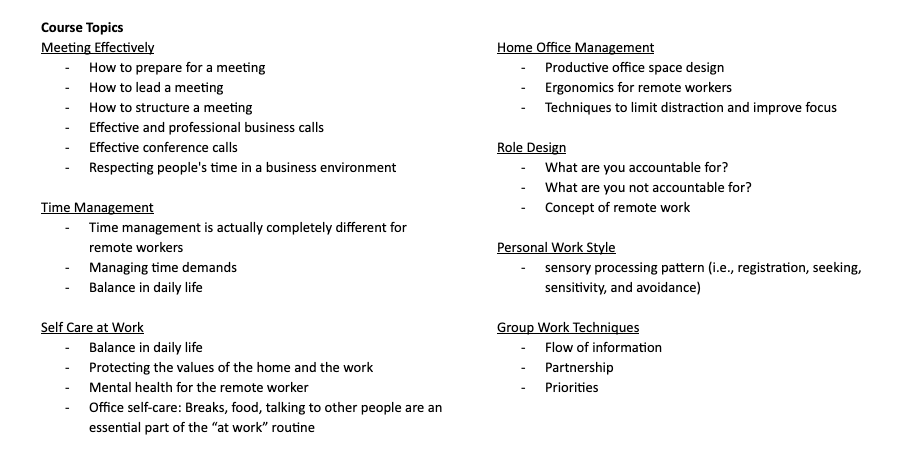
We have designed a scalable training program and follow up protocol to balance the deficiencies that remote workers may experience, reduce risk and justify managerial confidence in transitioning to remote roles.
This program contains two elements:
- Remote work training
- A dedicated remote worker support person/network
This does not replace or invalidate the need for trips to the head office or management oversight. Rather, it builds confidence in the team that the remote worker has all of the tools for success and includes a regularly instituted personal visit from an HR focused expert who is checking on the worker to ensure their needs are met, interpersonal challenges are identified early and problems can be effectively mitigated. We believe these two elements can deliver the maximum level of assurance to the remote worker, to the team and to the institution.
Over time, through this program, remote workers will be trained, and best practices will be gathered that not only strengthen the institution, but also the institutional knowledge and capability surrounding remote work.
We believe that Iceland is uniquely positioned to become a world leader in remote work.
Remote Work Training
Remote work training would be delivered to workers early in their onboarding process, or before they transition to a remote work role.
We believe this training could also achieve similar benefits for workers who are partially remote and students who are studying remotely.
This is a growing trend in all areas of society and the delivery and oversight of this program may be a valuable business in itself.
Remote Worker Oversight Person
The ministry or institution would visit each remote worker on a scheduled frequency to check on key aspects of worker well being and productivity.
The feedback and connection between the remote workers and support person can develop and strengthen the institution.
The ministry or institution would have a staff member or contractor in an HR role traveling to visit the remote workers and meet with them to ensure they are receiving the unique remote worker support that is not served in a traditional management/HR role.
This would include tips on best practices, advice on meetups and possible programs that might be running to connect and unify remote workers.
Potential Partnerships and Expanded Outcomes
This is a relatively new field and there is still the opportunity to develop world leadership in the modeling of remote worker care and effectiveness.
We believe this will become a greater emphasis in the study of HR and management.
This could be applied in both the public and private sector.
This is a job creating initiative due to the need for the support role. This is an expertise building initiative due to the data gathering and potential for long term studies. This may be developed in partnership with universities and colleges.
Where are the Benefits
Women working can be flexible. Young professionals can stay near friends and family. Middle age with families can be near good schools. Older leaders with grown children/grandchildren/parents to take care of can live near their families. And as for government institutions, every remote worker becomes a representative of the community connection to the institution, and equal job opportunities can be provided for men and women.
Decreasing barriers
Physical - handicapped people are not required to attend the office which may be difficult. Institutional - distance from Reykjavik is no longer a factor preventing the hire of the best workers. Cultural - small towns can be more equitably represented in national institutions. Social - the fabric of small communities is retained and strengthened.
Remote work hotline for workers to call if they are struggling.
What are the Effects on Managers?
We believe that this can increase management effectiveness of existing remote work relationships. Building best practices can also naturally standardize the principles of remote work which can make things easier to measure. Having tools and a regular check in can help with the need for in-person confidential conversations which may just involve complaining.
What are the Costs?
This remote worker empowerment program is very scalable. The scope, size and cost can be adjusted to fit any size organization or budget. At a smaller scale it may need to be provided by an external consultant.
Larger organizations will be able to deliver all program elements themselves, although they may choose to do so through a consultant or delivery partner (such as a university or HR consultancy).
How Feasible?
Assuming 10 training hours per worker this is 5000 man hours of training delivered per year. Assuming an average group size of 8 this is 625 hours of hosted training sessions. This is 63 2 - day training sessions delivered in one year. Approximately 126 days of training.
SMART
Specific Targeted to Remote workers - In the Icelandic public service: 2500 (10% of 25000) public sector jobs are required to be remote capable by 2024.
Measurable 500 additional workers must be trained and supported for each of the next 5 years. Training effectiveness is measured through surveys of trainees, managers and personal follow up.
Achievable 70 one-day training sessions per year can complete the goal. One or two persons could start immediately and accomplish this program for the entire Icelandic public sector.
Relevant This facilitates the government mandate of strengthening rural communities through increasing remote work roles. This also meets the broader industry trend towards remote work.
Time bound 2500 workers must be trained by 2024. New remote workers can be trained and ready within 6 weeks of hiring.
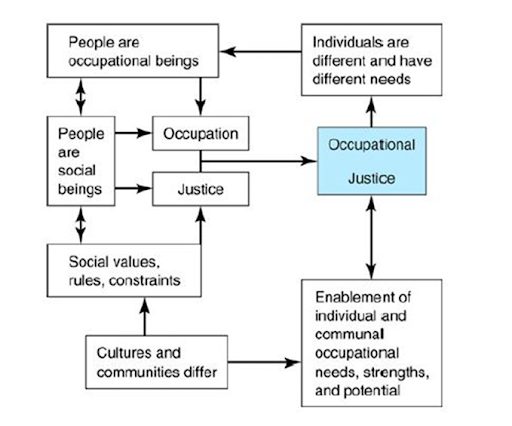
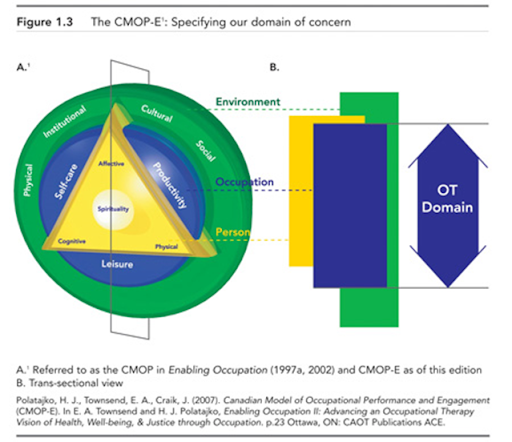
We are basing our idea on interviews, research and our academic background including the Canadian Model of Occupational Performance and Engagement (CMOP-E). COPM-E is a model which looks at the relationship between the person, the occupation and the environment. The outcomes are occupational performance and participation. Participation is based on occupational justice, empowerment and human rights. In CMOP-E occupation is the bridge between the person and the environment. It is based on occupational empowerment and a client-centered vision. The person can stand for: Residents (area), companies/organizations, communities, groups, families, individuals. The institutional aspect includes: Government agencies (Byggðarstofnun, Origo), their activities, finance, legislation and politics. It can affect decision making, working methods, laws, regulations, services and opportunities. Optimal performance occurs when a person’s abilities, occupational requirements, and environmental conditions interplay.
Built With
- cmop-e


Log in or sign up for Devpost to join the conversation.