-
-
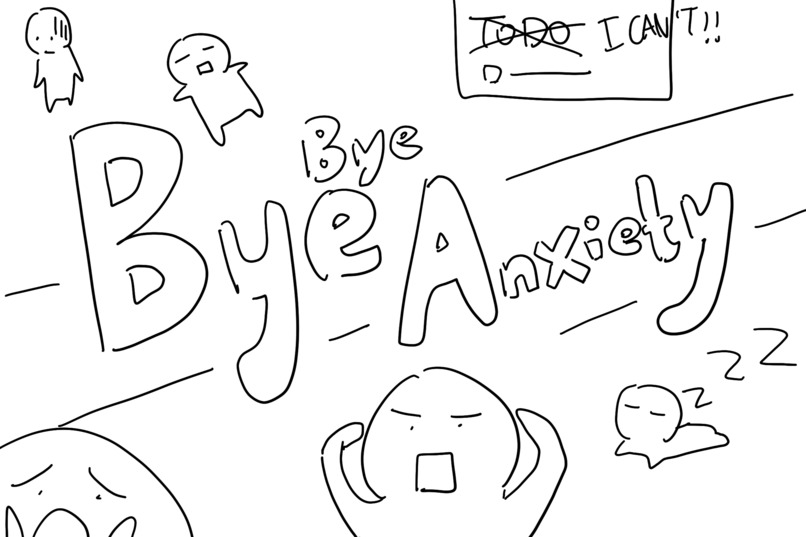
Front Page
-
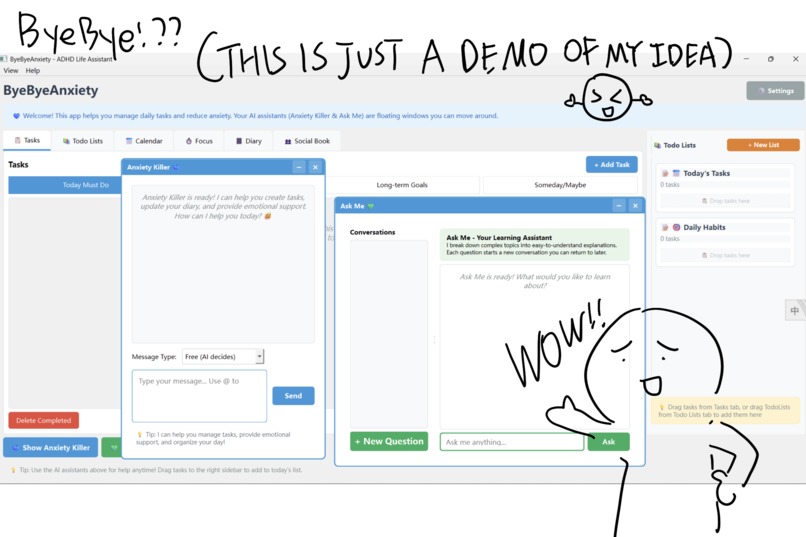
main Page
ByeBye Anxiety: AI-Powered ADHD Support Application
Inspiration
Just as ADHD is a lifelong condition, AI can help people who have or potentially have ADHD in various ways. We often see apps like "reduce procrastination" or "pomodoro focus timer" built for this purpose.
However, when we look at ADHD, we should also consider the potential ADHD population. They don't believe they have ADHD, but they still suffer from classic ADHD symptoms. A private, easy-to-use app that provides positive emotions and is suitable for everyone should exist for this reason.
When we expect ADHD patients to achieve their goals after using software - like successfully focusing through these features, completing what they need to do, or meeting their expectations - we need to be realistic.
But as an application that truly considers real-world situations, we can't only look at theoretical success - we must also acknowledge that failure is actually more likely in practice.
ByeBye Anxiety isn't just about "helping you complete your tasks so you're no longer anxious," but also "when you can't complete tasks, AI will help reduce your anxiety."
We help users by allowing them to seek help when they can't complete tasks, letting AI help them organize and formulate more suitable new plans. This addresses what users encounter more often than successful task completion: failure.
Background on ADHD
AI can help ADHD patients/potential ADHD patients live better lives. As a potential ADHD person myself, I believe I have an empathetic understanding of this condition.
ADHD is a lifelong disorder that interferes with the lives of many people who have it. Many ADHD patients can't recognize this before understanding the condition - they might only have "certain symptoms," so they don't think of themselves as having a mental illness. Plus, mental illness could bring some trouble to their lives, so they won't consider treatment for this condition. Women also show less obvious ADHD symptoms than men, so during childhood or adulthood, many women find it difficult to get proper treatment and instead receive criticism for not being "in control" of themselves.
In a sense, ADHD is just another way of paying attention. They're more distracted on regular tasks but more focused in certain areas they're passionate about. Therefore, this is a unique gift that ADHD brings, similar to a balance with what people without these disorders have. We can maintain this balance through AI application, allowing ADHD and potential patients to have psychologically healthy lives like others.
Most potential ADHD patients' understanding of ADHD might be more expressed in "symptoms." People might think they're just: lazy, procrastinating, easily distracted, unwilling to do things, having an impulsive personality, impatient, disliking sustained activities, liking to interrupt, talking a lot, preferring to scroll on screens to avoid doing things. They'll think this is their flaw or part of their personality, not a mental illness. So as a tool, we can't position it as an "ADHD-exclusive" help tool, but rather as an anxiety help tool for "everyone." ADHD symptoms often lead them to be disappointed in themselves, anxious about their lost sense of control, feeling guilty about themselves but unable to change all this. This usually brings about their learning anxiety and obstacles.
AI cannot act as a psychotherapist - we should let AI be completely a technological tool. AI can provide suggestions for users to perhaps seek real-world diagnosis and medication help, but in the program, AI should act as a complete assistant, just to help people live "normally."
In schools, we can see many people's mental health problems are serious, not only because of academic pressure, but also possibly because of many potential ADHD symptoms, plus people's guilt about their own helplessness, creating deeper negative emotions. Therefore, being able to still live under such circumstances is already very hard work. Such a tool can help students, or working people, when symptoms aren't very deep or under their personal needs, to get some help.
References:
- https://www.psychiatry.org/patients-families/adhd/what-is-adhd
- https://my.clevelandclinic.org/health/diseases/24741-adhd-in-women
AI can help ADHD through CBT (Cognitive Behavioral Therapy). Medication requires diagnosis by professional psychological personnel, and counseling also requires observation by psychological professionals. For example, some small self-harm behaviors that AI cannot see in data form. We can help them from a practical perspective based on user needs: for example, if they find themselves often procrastinating or unable to start things, we can help them customize the needs of each component group. They can look for components with corresponding functions based on actual problems they encounter, like an ADHD-exclusive toolbox.
CBT commonly uses these methods:
- Improving organization and time management abilities - ADHD patients need better time management help
- Reducing distraction - ADHD patients need to create environments that interfere with distractions
- Adaptive thinking and cognitive restructuring - ADHD patients need to reduce anxious self-perception and feelings of failure
- Managing procrastination - common problems like procrastination can increase motivation through reward mechanisms like breaking down tasks
Reference: https://zh.mindpeace.ca/adhdpsychotherapy/
Therefore, I can design a toolbox that includes these functions (combined with AI):
- Time management help (including scheduling, reducing procrastination)
- Attention help (helping focus)
- Positivity/negative emotion/anxiety help (providing emotional support)
This app needs to follow these principles:
- AI needs to ensure enough privacy for users, can't leak any personal information, making users feel safe enough. All information stored locally, users can change anytime
- Can't have built-in social or comparison features - this isn't an appropriate development path
- AI can't provide any psychological counseling help. When professional psychological personnel are needed, we can provide a partnership, letting users find professional psychological personnel on partner platforms
What it does
Based on my research, my specific design blueprint for this program is:
This is a computer + mobile program. (Note: This hackathon only implements a computer demo version)
Users will get life help from the app, thereby reducing anxiety.
Users can build all plans by chatting with AI.
Users get an assistant: Anxiety Killer. By chatting with this agent, AI will create tasks the user needs to do that day, tasks needed on some future day, long-term habit tasks that need to be completed, or just games, food, items they want to buy someday, or a todo list to store tasks.
The AI agent will analyze the user's language here, then create these tasks for the user. Users can also manually add themselves or make modifications.
Among them: calendar can set long-term tasks, can be set in advance: when should they start doing it (because most of the time we only consider deadlines, not when to start to finish on time).
Besides helping users build their plans, AI will also help users adjust their mood, provide emotional support, or discuss how to build the most suitable plan. Users can also @ any task, todolist, or anything at any time, letting the AI agent help with specific tasks (like breaking down small tasks, discussing how to complete or consequences of not completing).
When encountering tasks that can't be completed, users can discuss with AI, might discuss the worst situation that might happen currently and in reality. AI will help users reformulate the most feasible new plan and help users manage their anxious mood.
Future feature: AI agent might have daily specific conversation storage, can always find that day's chat records between user and AI.
Besides basic calendar, todolist and task completion functions, we also have basic focus pomodoro timer: Focus.
When users want to focus, they'll continuously earn points as rewards, because all users' focus is worthy, but it will only display at the end. Points can be used to draw stickers (random blind box quantity).
Future feature: Stickers as rewards can be pasted anywhere on calendar, todolist or diary as decoration. Might add recording of user focus time and percentage, made into trend charts so users can see their progress or recent status, gaining a sense of achievement.
We'll also have a Diary.
User's daily actions and chats will be summarized into a diary. Users can also write their own notes in the diary or modify summaries. Can freely ramble about things happening in life, which will also have "real sense of life." AI will directly check the diary when managing emotion tracking. Users can also check the diary anytime to see past events.
We'll also have a Social Book.
AI will add content through chatting, users can also create new people anytime. Then can manually input information for these people, like name, personal information, birthday, preferences, events that happened, notes, etc.
For birthday reminders, Anxiety Killer will mention and ask users a week in advance, then remind again the day before birthday.
Many things don't just happen on that day.
An AI agent independent from Anxiety Killer, Ask Me, will also provide help to users.
We'll preset prompts to let users get detailed and patient replies.
When users want to ask some professional knowledge or questions they want to understand, they can open the professional assistant anytime, anywhere. All difficult knowledge needs to be broken down into details for explanation, then questions need to first quickly answer results and essence, then slowly elaborate on details. AI won't refuse any user questions either - users can get the answers they want anytime, anywhere.
Future feature: Add information editability, can search specific conversation titles.
How we built it
Before making features, I first looked for the advantages of tools provided by this hackathon.
Claude's Features:
Can handle super long context
- One of my personal ways to cope with ADHD is writing a diary. Even if it's just recording what I eat everyday, it can ease my anxiety because I know there's a place to store my anxiety and memories. I've been writing for 4 years now, already 790,000 words, very useful for me. ADHD memory isn't very good because memory isn't concentrated, often need to keep thinking about one thing, or often forget. We help users by recording things so ADHD doesn't get anxious in life or receive more criticism because of this.
Network security
- Prevents information privacy leaks, can protect user privacy security, safeguarding rights of ADHD patients and potential patients.
Code generation
- This project implements demo with help from Claude Sonnet.
Content analysis
- Claude's ability is very suitable for helping break down ADHD users' needs and helping them summarize and analyze all content, thereby achieving the effect of helping their lives. Their anxious emotions expressed in text can also be detected by Claude. This is very friendly help.
API Challenges
In my past attempts using APIs, I found most APIs work with messages, like Gemini's output is in response.txt format. My previous idea was to let Gemini give text then I could get messages by intercepting content in specific symbol spaces. Or try to let API generate separate output documents.
In Claude's API doc, I saw we can separately intercept the last token and give Claude reply templates. I think this is very useful and very suitable as API help.
I plan to use Railtown as Python assistance. Python language is more convenient, and such tools are very suitable as help, can also create many different agents suitable for different scenarios.
Then I searched some self-identified ADHD patients' views on AI on social media:
Why ADHD patients like AI:
AI can immediately give answers and replies, and won't refuse ADHD patients' answers or give negative responses. ADHD hates waiting, likes to get results immediately, and AI can do this. ADHD attention also often scatters, they'll often have many questions, so asking AI and quickly getting results can let them quickly "end" a small thing, returning to track. (Note: ADHD can't even wait for deep thinking, we can put some built-in small program games or functions beside for ADHD to wait)
In learning, ADHD likes to understand the essence of things. They need to ask many whys to understand the logic of something, need to break this knowledge completely out. We can give AI some ADHD preset prompts, letting them better directly answer ADHD patients' questions, without ADHD needing to give AI many training words each time. Also, ADHD doesn't like reading large paragraphs of text, can let AI break things into small parts for teaching.
ADHD often has scattered ideas, and AI is good at summarizing their content, so they can get the recorded things they expect. This can help record for them. AI can also easily keep up with ADHD's jumping thinking, unlike other non-ADHD people, which can help ADHD have a sense of being understood.
AI often praises and compliments people. Although in programming this might be overly "flattering" or token-consuming, this is necessary emotional support for ADHD. They give them enough motivation to do many things by praising every little thing ADHD does.
ADHD likes new things. For AI, each generation is a kind of "new" content. Even though they might actually be a collection of randomness and trend probabilities, what they show is a kind of unprecedented new thing, making ADHD have expectations for them and hard to get bored.
Market Research
For such ADHD software, I'm definitely not an original creator - there are many similar products on the market. Like procrastination, we have pomodoro and tree planting, ADHD also has other products. So I simply investigated mainstream products' functions to look for possible innovation and development possibilities.
Tiimo: Calendar function. Includes manual priority and letting AI help with priority. Can put tasks into calendar as excellent time management tool. Also can focus, and give tools more personalized stickers. Their feature is after you input your task, they'll give many possible subtasks.
Neurolist: They also have break up task function. Their feature is compared to Tiimo where everything on the same page with too many choices creates more pressure, they chose pagination. Then pages also look relaxed. But the center is also the main theme of dividing tasks into small tasks.
For them, I think ideally users can directly input many ideas, and AI will directly summarize key points and help users directly make todolist. Because personally in my diary, I only need to write my schedule, I don't need to write so many possible times and other things - they actually make me feel this "adding schedule" task is difficult. So I hope users can input more simply. Also, I hope they can ask "whether need to break down," because many times users themselves are clearer how to break down tasks, or breaking down will create a feeling of many tasks.
Flow Club: They help through finding tutors for others' supervision, accountability mechanism can make users more responsible to complete things.
Focus Space: Flow Club + calendar function. Also finding other tutors and basic focus and schedule arrangement functions.
I personally won't use this type of software. Although this method is effective, it actually brings greater pressure and anxiety to ADHD because it adds others' expectations. So they'll gradually learn not to tell "others" about their tasks, making themselves feel safe. Among continuous "others' needs," they'll also feel bored, until they no longer feel uneasy about not being able to complete, they'll only feel failure and anxiety without motivation to continue such behavior. So I'll expect to give them motivation through encouragement, because ADHD is already difficult, they deserve praise for every little thing they do.
Saner: Can arrange tasks through conversation, very simple, also achieved my previous expected needs. They can just chat to create a todo list for users, also can upload and import files.
This app is very powerful, has achieved very good effects in arranging tasks, and they support all-in-one, meaning everything is in one app without needing to switch tabs back and forth, which is very useful. If talking about different directions, maybe they're very professional-oriented, as a "professional productivity tool," while I hope my function can care more about ADHD patients' mental health. Completing things is part of their life, and my tool is to make them no longer anxious because they can complete things in life.
Luna Task: This achieves what I just said about mental health. They have mood recording and also use that Eisenhower Matrix kind of calendar sorting. My favorite is their interpersonal relationship function - they added ability to record special information about friends related to oneself.
For lists, overly long lists are actually pressure. I hope to have ways to help users distribute tasks, like only needing to do one or two things per day. They can't do too much. Always being able to see future tasks is very stressful. So we can distribute many forms, then take out what "must be done today." Then each task or anxiety can discuss and analyze worst situations with AI assistant, like help analyze going to sleep now immediately and continuing tomorrow after waking up.
Goblin Tools: Toolkit, includes various useful functions like breaking down tasks, teaching, breaking down calendar, understanding emotions. They divided AI functions into a whole toolkit, which is good category breakdown. Users can know what they currently need. Pretty similar to my expectations for this app, though Goblin's specific characteristics of each tool aren't very clear because there's no actual description and use, but this is very suitable for various tasks.
Insumo AI: Can combine with calendar, intuitive calendar block distribution and other tasks. Also advanced calendar distribution function, can also view tracking.
Summary:
- Calendar function, summarizing tasks (Insumo AI, Luna Task, Focus Space, Neurolist, Tiimo). Advanced function is Saner, AI assistant, can directly arrange through text input
- Basic focus pomodoro timer (basically all have)
- Emotion recording function (long-term) (Luna Task)
- Learning help, breakdown function etc. (Goblin Tools)
- (Not including others' accountability assistance because I personally won't consider this type of product)
Among these, I think the function I'll need is "emotional support." I need AI's emotional support and encouragement for users. Their encouragement is mostly "completion" encouragement. But I need AI to have patience and support for users, whether they can or can't do it, or how they should do when they "didn't do it." So users can let AI rearrange through "seeking help."
In my personal life, I often arrange things I can't complete. Things should be completed, but because of procrastination I didn't really complete them, and at this time I must cut tasks then move them to the next day. This is a difficult thing that can bring anxiety. I hope my app can help them here.
Development Process
In the process of making the demo, I used Cursor's Claude AI as demo production tool, and through my own programming ability specified ideas and fixed bugs for improvements. Thanks to Claude's programming ability, could complete the entire demo in half a day. Claude AI can let more people complete their personal project demos in faster time, can also serve as a tool to help everyone visualize inspiration.
Unfortunately, I participated too late, didn't get Claude token in time, temporarily can only use Google Gemini for functional substitution.
We'll have simple toolkits for computer and APK. Currently we'll first make computer version functional demo for showing functions within limited time.
Challenges we ran into
There were indeed many challenges during the production process.
For example, at the most basic programming level, Railtown is a new thing, and this was my second time personally attempting AI API calls. Railtown's functionality really surprised me, and in building with Cursor, I learned a lot.
At the same time, a bigger challenge was the idea of the project itself. Many times we encounter "things other people have already done." Many interesting inspirations are discovered, but better projects have already appeared long ago. I won't be the only person who thought of these things. When I participated in a hackathon for the first time, I felt sad about this. But now I know that what they've completed will also be an opportunity for me to find new and more inspiration. Interestingly, when I was writing analysis of each software, every time I proposed a new improvement direction, I would find in the next tab their new features that matched the improvement plan I just wrote. But in the end, I still found the "special part" unique to my project.
I focused on user experience - what should I expect as a user? This led me to think about using "failure" as a theme. Using "real feelings" as a theme. Doing everything according to tasks is already extremely difficult for ADHD, so we need to give ourselves who fail a chance to continue without anxiety.
At the same time, when everything needs to be "completed someday," setting a "long-term" task might be more appropriate than just a deadline, because the deadline isn't the first day to start the task, and people still need things to complete.
Also, a personal challenge was that because I joined quite late, and school tasks have been quite heavy recently, all my work started at noon on Nov. 22nd, so the entire project only had half a day to proceed. However, I think I tried my best, and I really like this idea and project.
Accomplishments that we're proud of
I should have mentioned many times already - I really like this idea. Same as the previous section, I think even when I knew there were many people doing better than me, I didn't avoid this fact. Instead, I looked at their products, felt and analyzed them, and sparked my own ideas. This already makes me feel very accomplished.
Being able to help in this area through my personal experience - my app might at least provide more emotional support and help to users who feel similar to me - this also makes me very proud.
What we learned
During the process, I learned more deeply about ADHD and also learned about many similar products on the market. At the same time, in terms of code, I also got the opportunity to learn to use Railtown, which I find very meaningful.
The entire building process was also a learning process. Thanks to Claude Sonnet for working hard to answer all my questions :)
What's next for ByeBye Anxiety
For future possible feature additions, aside from the parts I designed in the features section but couldn't implement due to time constraints, I think for the future of this app, first we might need to rebuild more suitable computer and mobile versions - most people use phones more in their daily lives. Then maybe cloud transfer between phone and computer, but still need to ensure data security and privacy.
Then for the project itself, I think its expansion direction might be partnering with professional psychological platforms, thereby serving as an interface for people to learn about more psychological counseling that can help them. After all, many people might think needing mental health support is a flaw and thus be unwilling to do it. This tool can open a window for finding support while helping people in need, letting everyone understand themselves better.
In terms of programming, we might need better prompts and algorithms to let AI help manage time (like learning how to become a better assistant like Saner).
Also, although we always say we don't want software to be related to "profit," aside from government-supported projects, I personally think most "non-profit" projects should better achieve a win-win cooperation between users and creators. Only when both parties can benefit will there be better motivation and better features. So potential revenue directions might be stickers (also supporting artists' personal uploads, supporting original artwork), cooperative advertising for psychological counseling (possibly promotion for professional platforms), Claude partnership (using Claude's API, users might need to pay for better features).
Of course, right now this is just a demo and blueprint-level simple application. Thanks for this opportunity that allowed me to challenge myself to create this project.
Built With
- api
- claude
- cursor
- python
- railtown


Log in or sign up for Devpost to join the conversation.