-
-
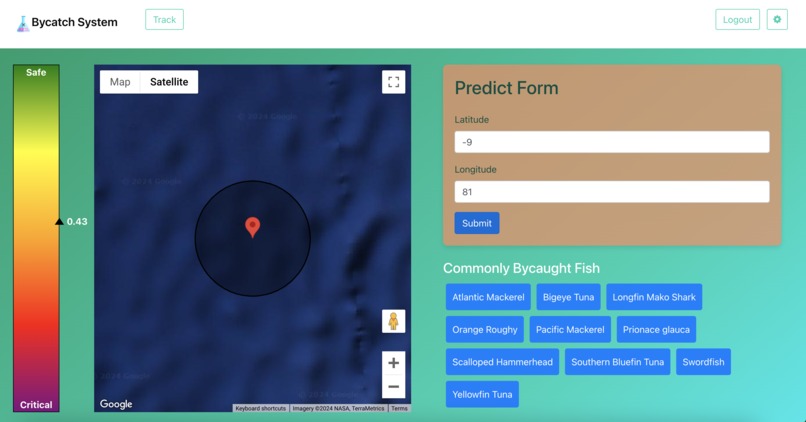
Main Tracker Page with Example Output

The Problem: Every year, millions of tons of marine life are unintentionally caught as bycatch, disrupting the balance of our ocean ecosystems. This is not just an environmental concern—it’s a crisis that impacts the livelihoods of those who rely on fishing. Imagine a fisherman casting his nets, hoping to catch a specific species, but instead hauling in countless unintended species. This disrupts the marine food chain and could lead to the collapse of entire ecosystems, affecting both marine biodiversity and the fishing economy.
The Story: Consider a fisherman in the Gulf of Mexico who relies on catching tuna to support his family. Without precise information on where to find them, he often ends up with a boat full of bycatch—species he didn’t intend to catch. These unintended catches aren’t just a nuisance; they represent a real threat to the marine ecosystem. If too many of one species are removed, it disrupts the entire food chain, which in turn affects the balance of the ocean and eventually impacts the fishing industry itself. This vicious cycle could lead to the collapse of marine biodiversity and the fishing economy.
The Solution - Bycatch Trakr: Bycatch Trakr is a web application designed to empower fishermen to make informed decisions that protect both their livelihoods and the delicate balance of the ocean. Bycatch Trakr provides real-time data on severity scores of bycatching, helping fishermen minimize the risk of bycatch. It’s like having a personalized guide that directs them to optimal fishing spots, reducing unwanted catches and promoting more sustainable fishing practices.
What Sets Us Apart: Bycatch Trakr’s uniqueness lies in its combination of advanced machine learning, data analytics, and geospatial mapping. We’ve created a predictive model that’s not just accurate but also easy to use. The app integrates real-time data from various sources, including satellite imagery and oceanographic sensors, providing fishermen with precise location-based insights. It’s designed for everyday fishermen, with an intuitive interface that works seamlessly, even in challenging conditions at sea.
Inspiration: Bycatch Trakr was inspired by the significant challenges fishermen face in targeting specific fish species while avoiding bycatch. We observed that the lack of precise location data and guidance often results in unintended catches, which harms both the yield and the marine ecosystem. The ocean is a complex web of life, where each species plays a crucial role in maintaining balance. Depletion of one species due to bycatch can disrupt the entire food chain, leading to dire consequences for marine life and, ultimately, for us.
What It Does: Bycatch Trakr helps fishermen determine the potential severity of bycatches in a specific location. This tool allows for quick and easy checks of fishing areas or paths of commercial and private fishing. The web app uses an AI model trained on one of the largest marine life datasets collected internationally to predict the relative severity of bycatch in an area; it uses information from our top 10 species, chosen based off factors such as impact on biodiversity and ecosystems. The app also provides information and direction for dealing with each of these species.
How We Built It: Bycatch Trakr was developed using advanced data analytics, machine learning, and geospatial mapping technologies. Our backend is powered by Flask, and our machine learning models are trained on historical fishing data, ocean conditions, and species distribution patterns. The frontend is designed to be user-friendly, ensuring that fishermen can easily access and understand the information, even in challenging environments. Both the database and web app were deployed and supported by Heroku.
Challenges We Ran Into: Integrating and processing vast and diverse datasets necessary for accurate predictions was one of the main challenges we faced. We had to combine data from satellite imagery, oceanographic sensors, and historical fishing records. Designing an interface that is both simple and informative for users with varying levels of technical experience was another hurdle. Additionally, ensuring our predictive model was reliable and actionable required extensive testing and validation.
Accomplishments That We're Proud Of: We are proud of creating a tool with the potential to make a significant impact on both the fishing industry and marine conservation. Our predictive model’s accuracy and the successful integration of various data sources were major milestones. Most importantly, we believe Bycatch Trakr can play a crucial role in reducing bycatch, preserving marine biodiversity, and supporting more sustainable fishing practices.
What We Learned: Throughout the development of Bycatch Trakr, we learned the importance of interdisciplinary collaboration. The project required expertise in data science, marine biology, and user experience design. We also gained a deeper understanding of the interconnected nature of marine ecosystems and the significance of providing fishermen with tools that benefit both their work and environmental conservation.
What's Next for Bycatch Trakr: Looking ahead, we plan to enhance Bycatch Trakr by incorporating real-time data from additional sources and expanding our geographic coverage. We aim to work closely with marine conservation organizations to refine our recommendations, ensuring they align with the latest ecological research. We also hope to pilot Bycatch Trakr in real-world fishing communities, gathering feedback to improve its effectiveness and usability. Our ultimate goal is to make Bycatch Trakr an essential tool for fishermen worldwide, promoting sustainable practices that protect our oceans and, by extension, our future.
Built With
- api
- css
- flask
- heroku
- html
- javascript
- jinja
- python
- sqlalchemy
- tensorflow

Log in or sign up for Devpost to join the conversation.