-
-
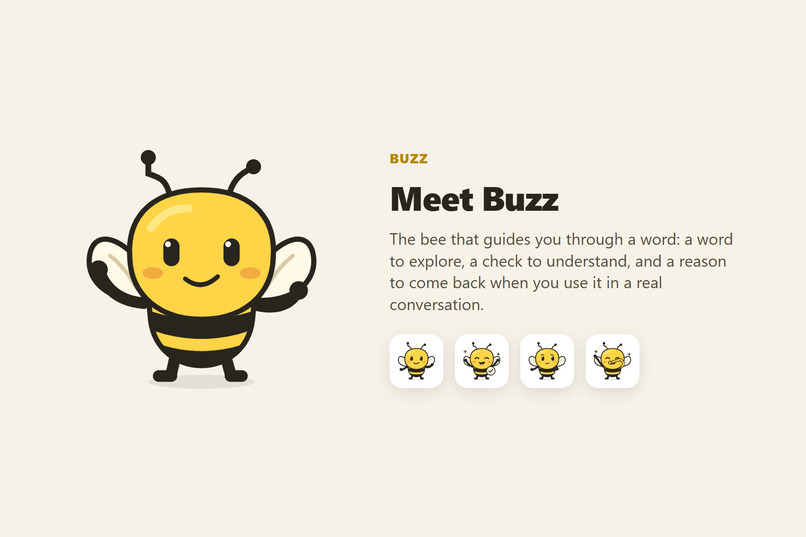
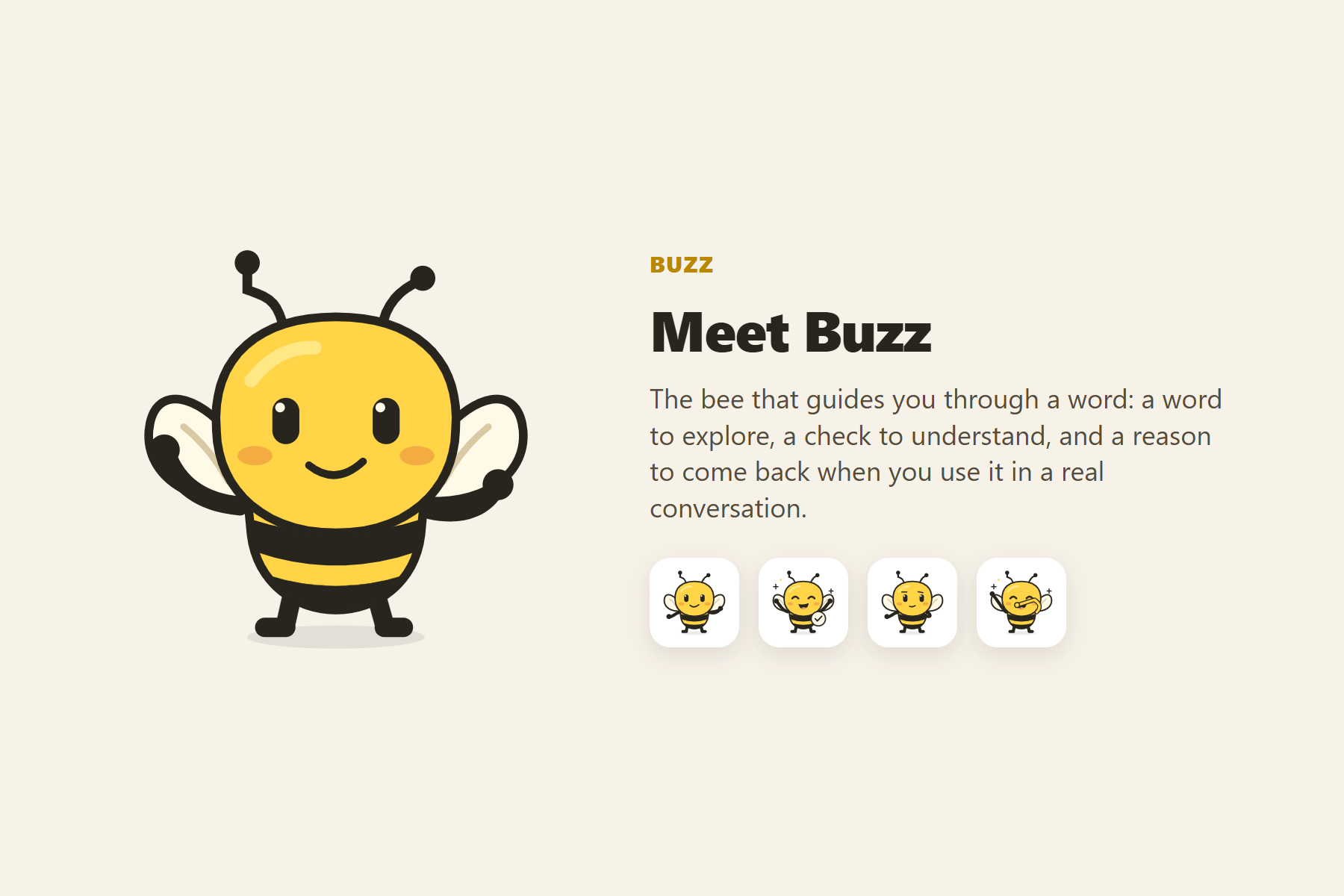
Meet Buzz, the bee that guides you from a new word to the day you actually use it.
-
-
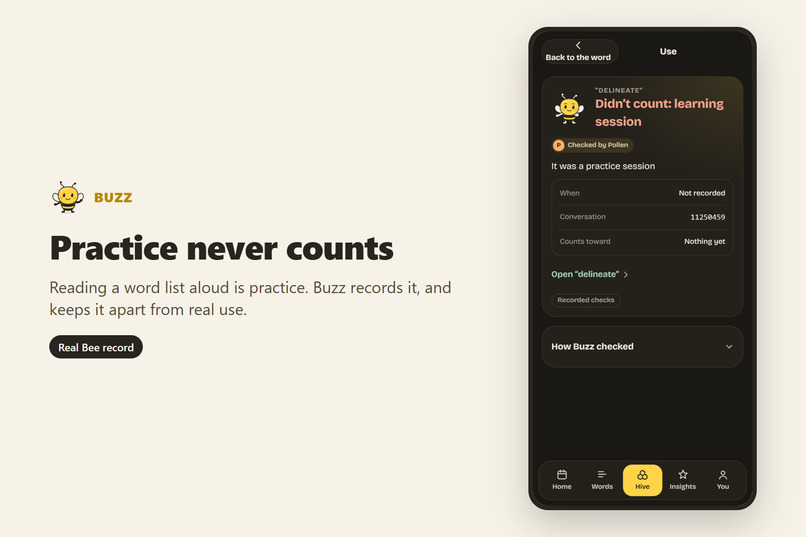
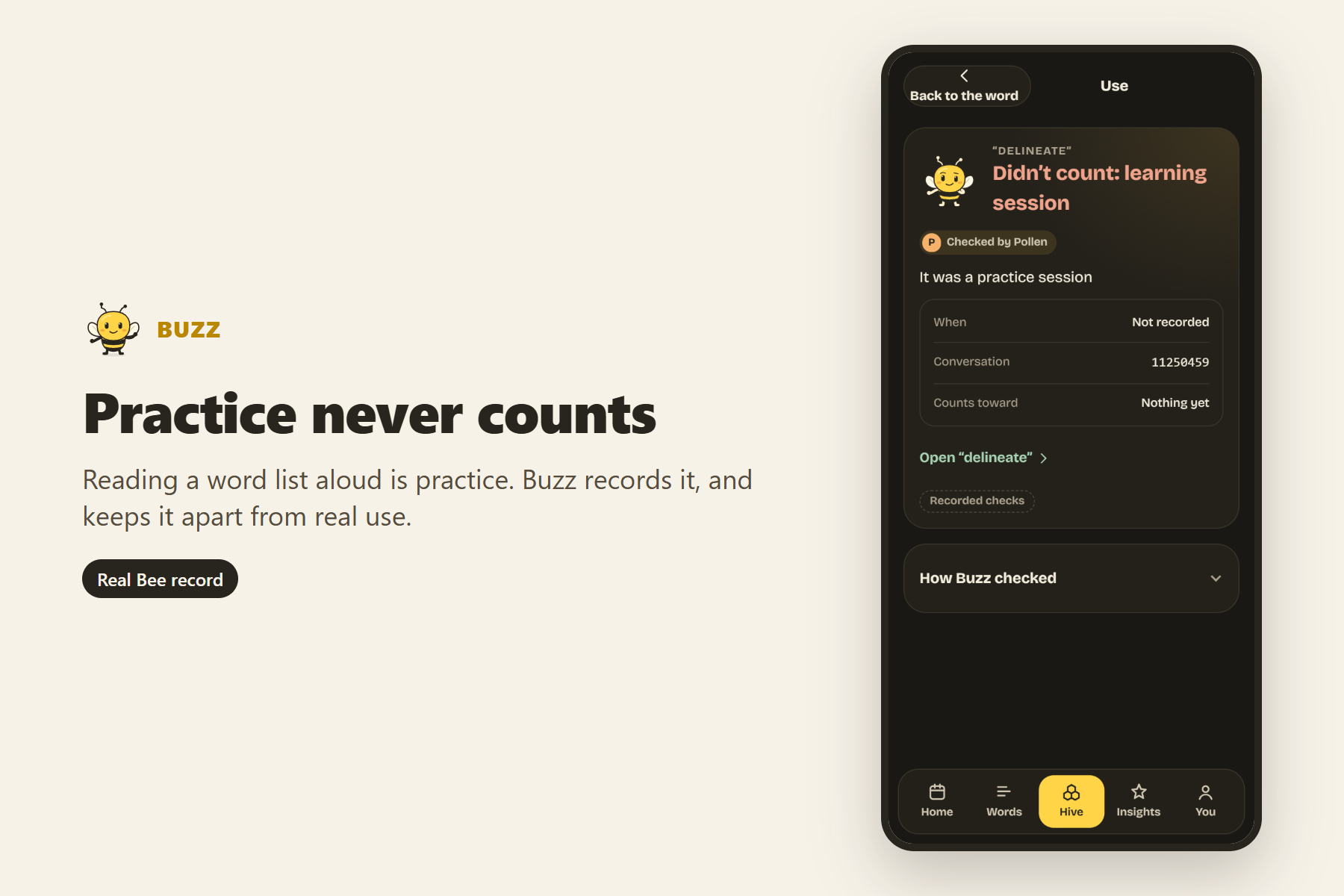
Practice never counts. Reading a word list aloud is recorded as practice, kept apart from real use.
-
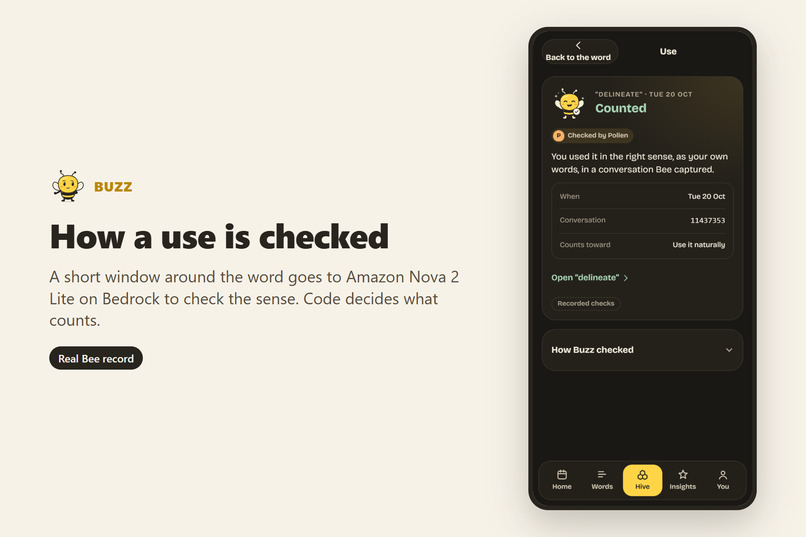
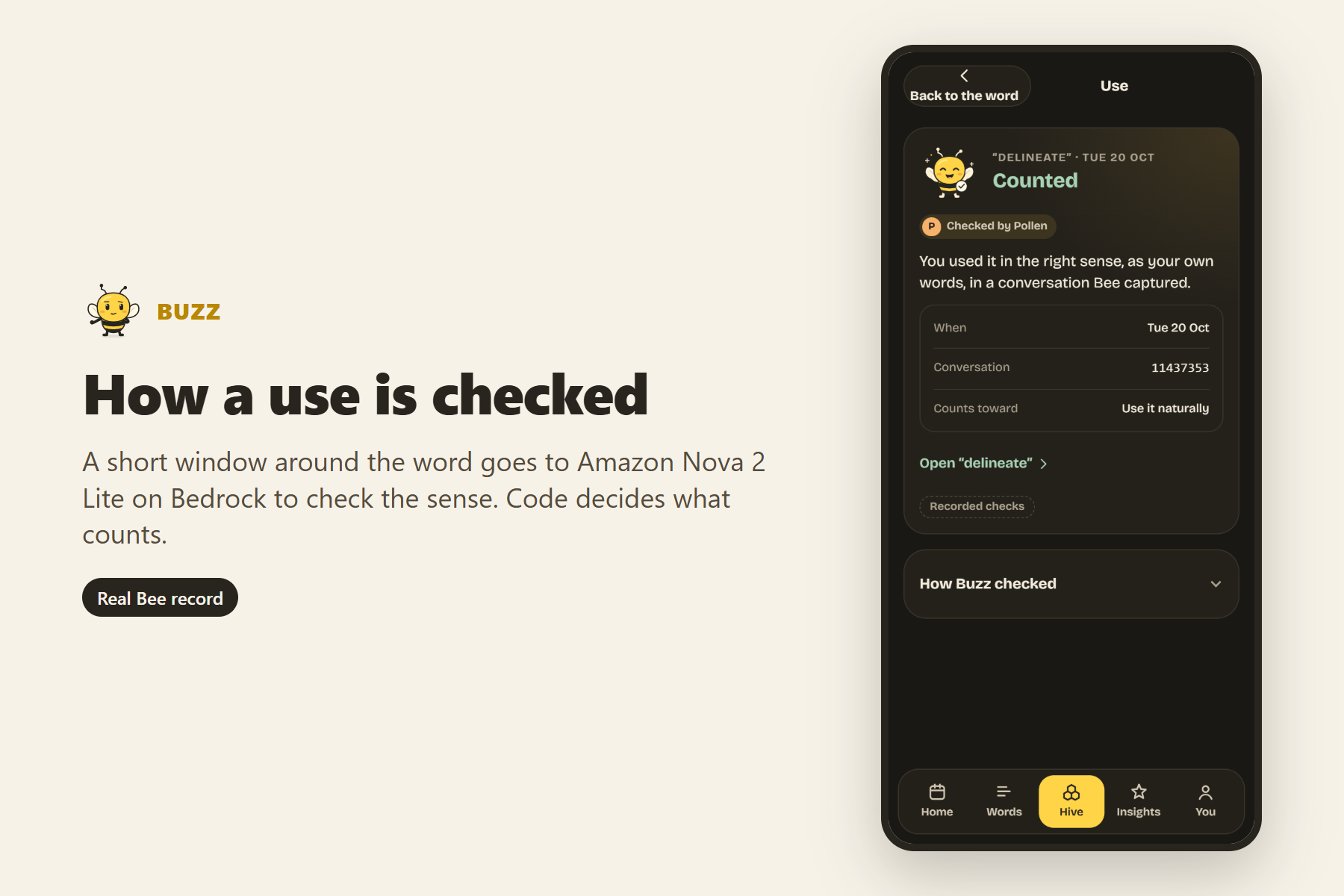
Each use opens its check: Amazon Nova 2 Lite on Bedrock judged the sense, and code decided what counts.
-
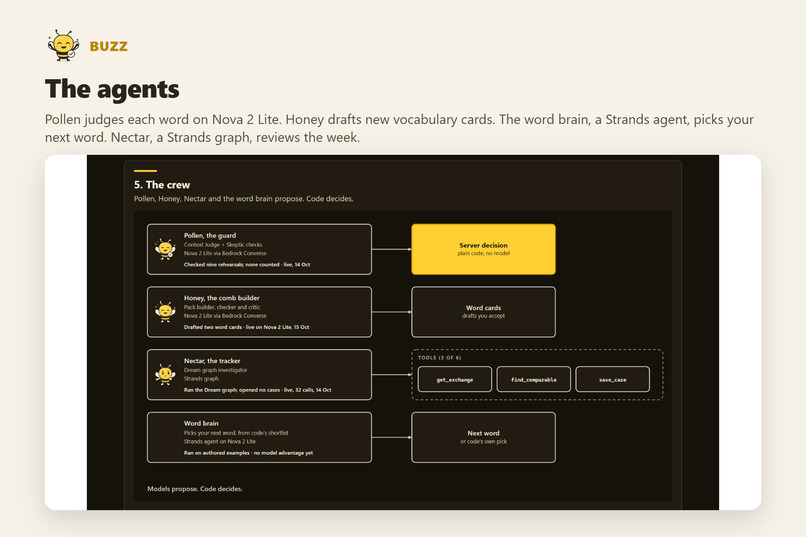
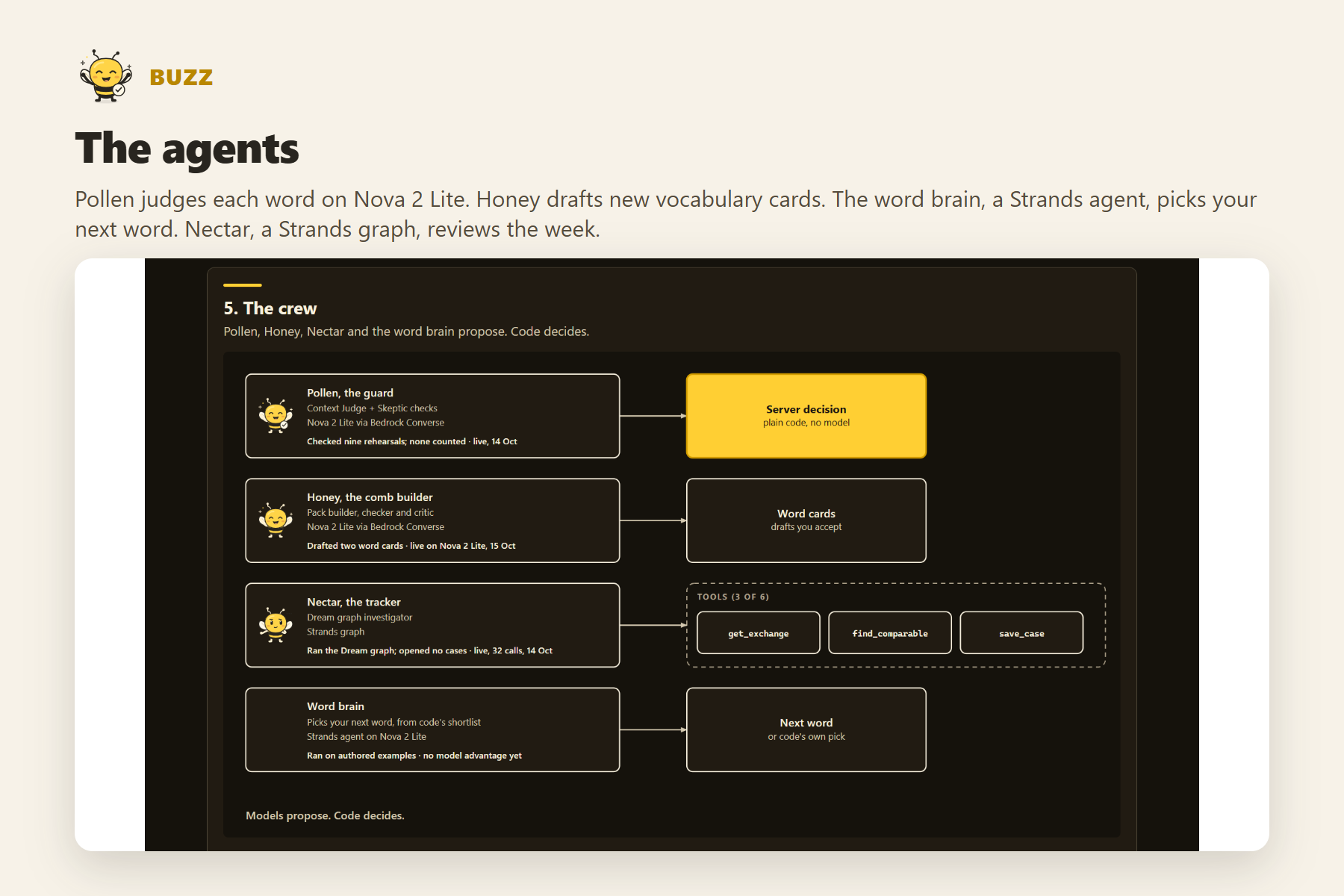
The agents: Pollen judges words on Nova 2 Lite, Honey drafts vocabulary cards, and Strands runs the word brain and the week review.
-
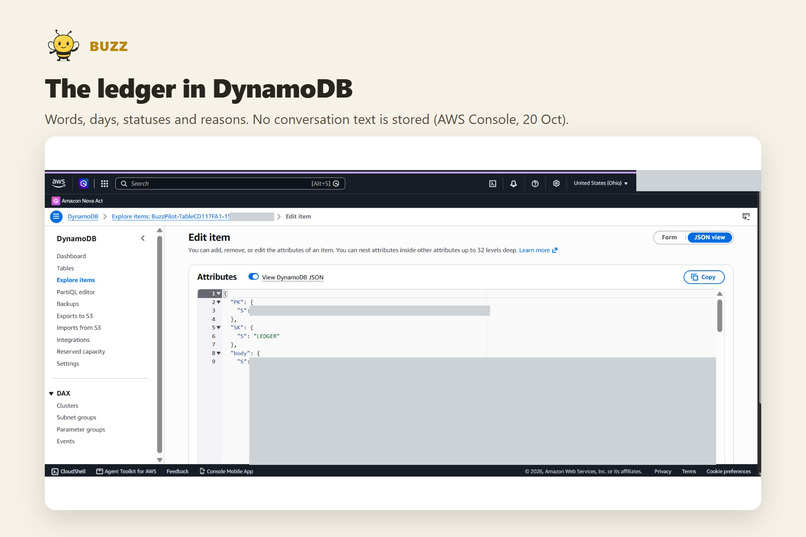
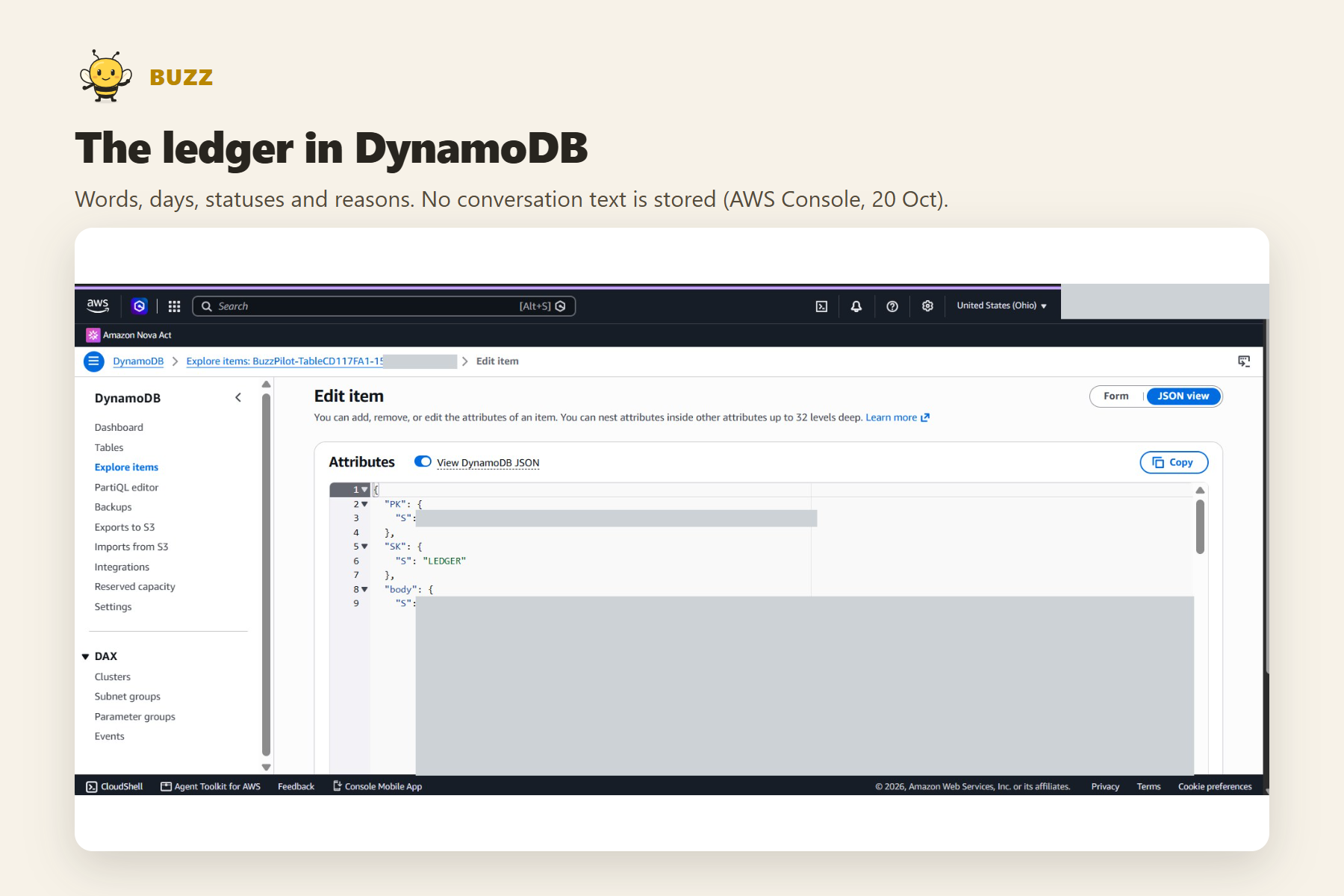
The ledger in DynamoDB: words, days, statuses and reasons. No conversation text (AWS Console, 20 Oct).
-
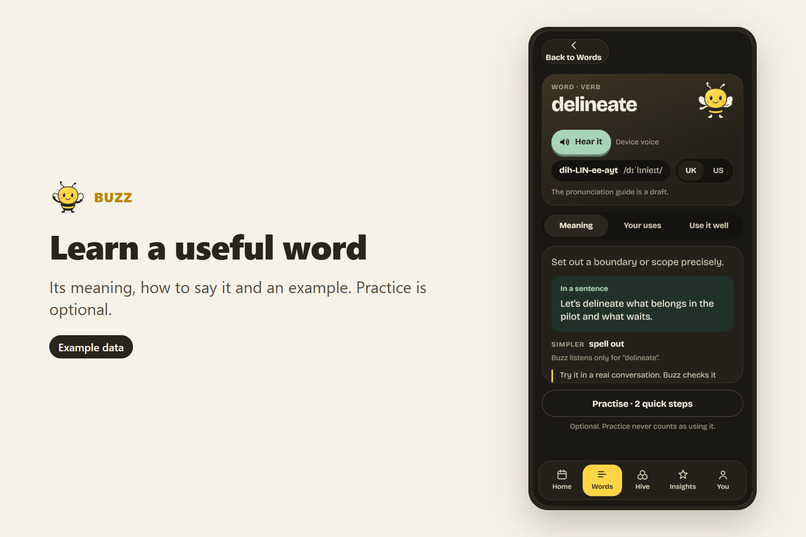
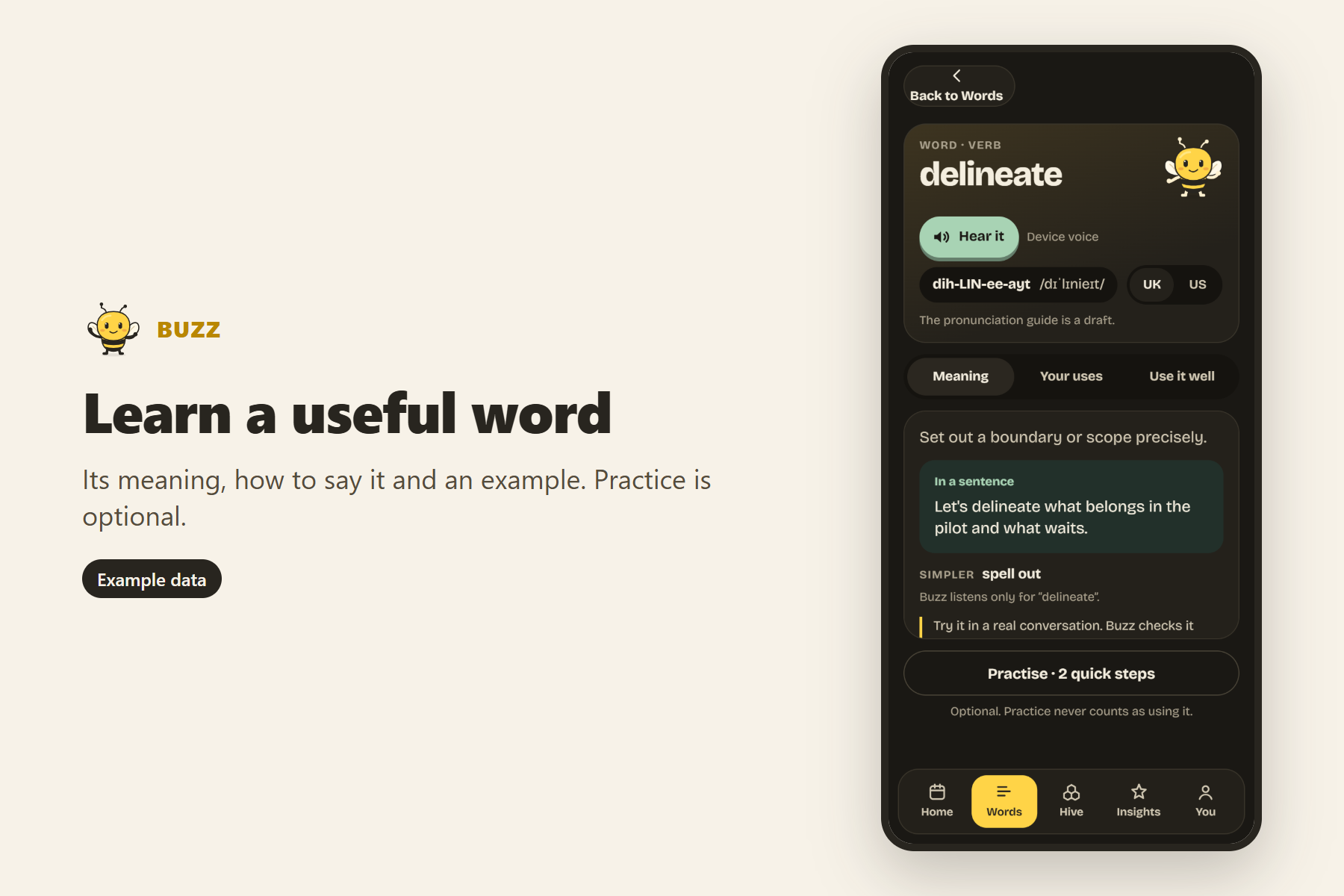
Learn a useful word: its meaning, how to say it and an example. Practice is optional. (Example data.)
-
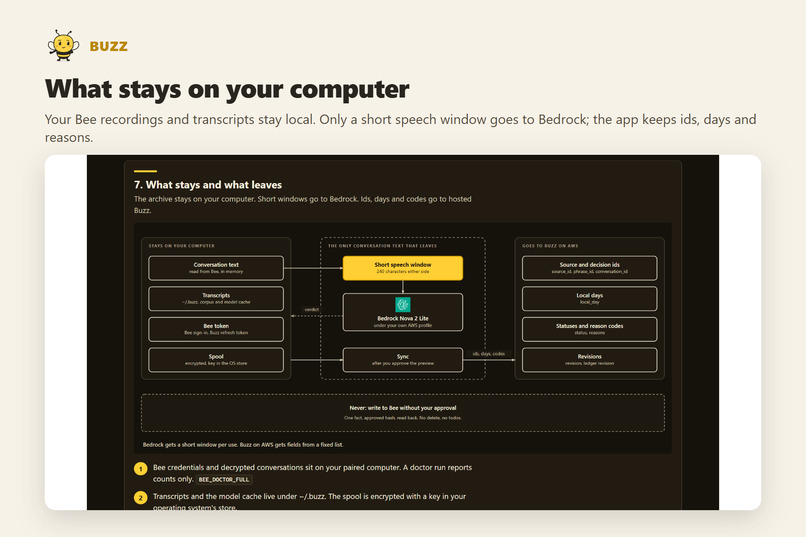
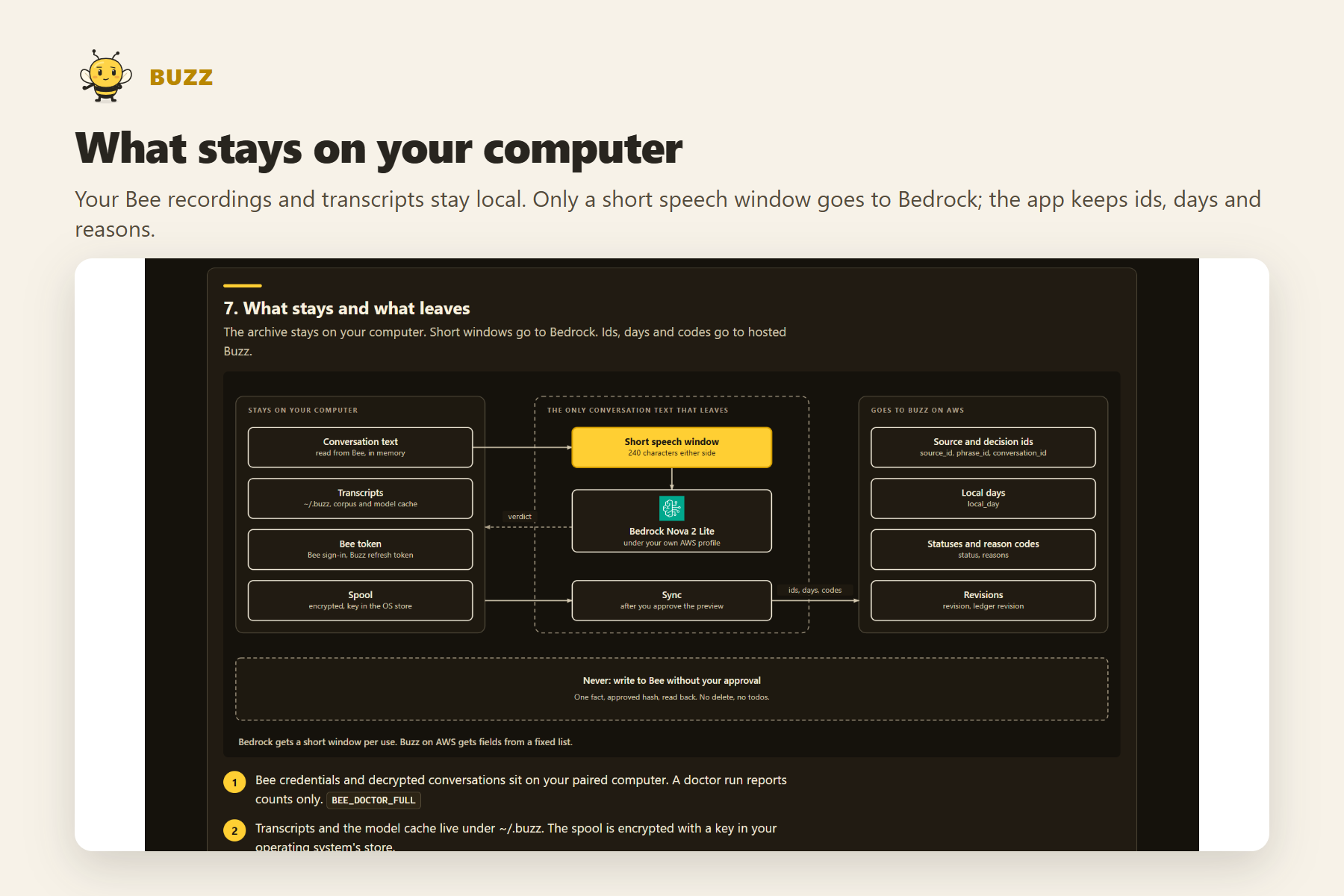
What stays on your computer: your Bee recordings and transcripts. No conversation text is stored in the app.
-
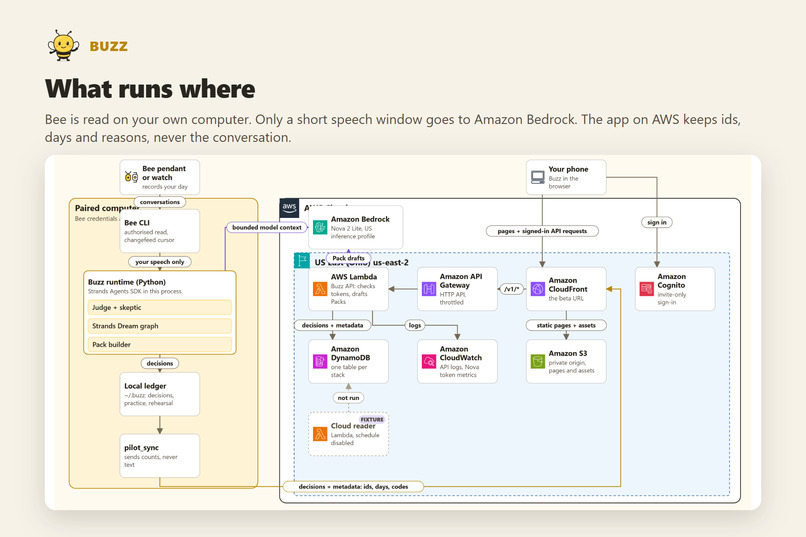
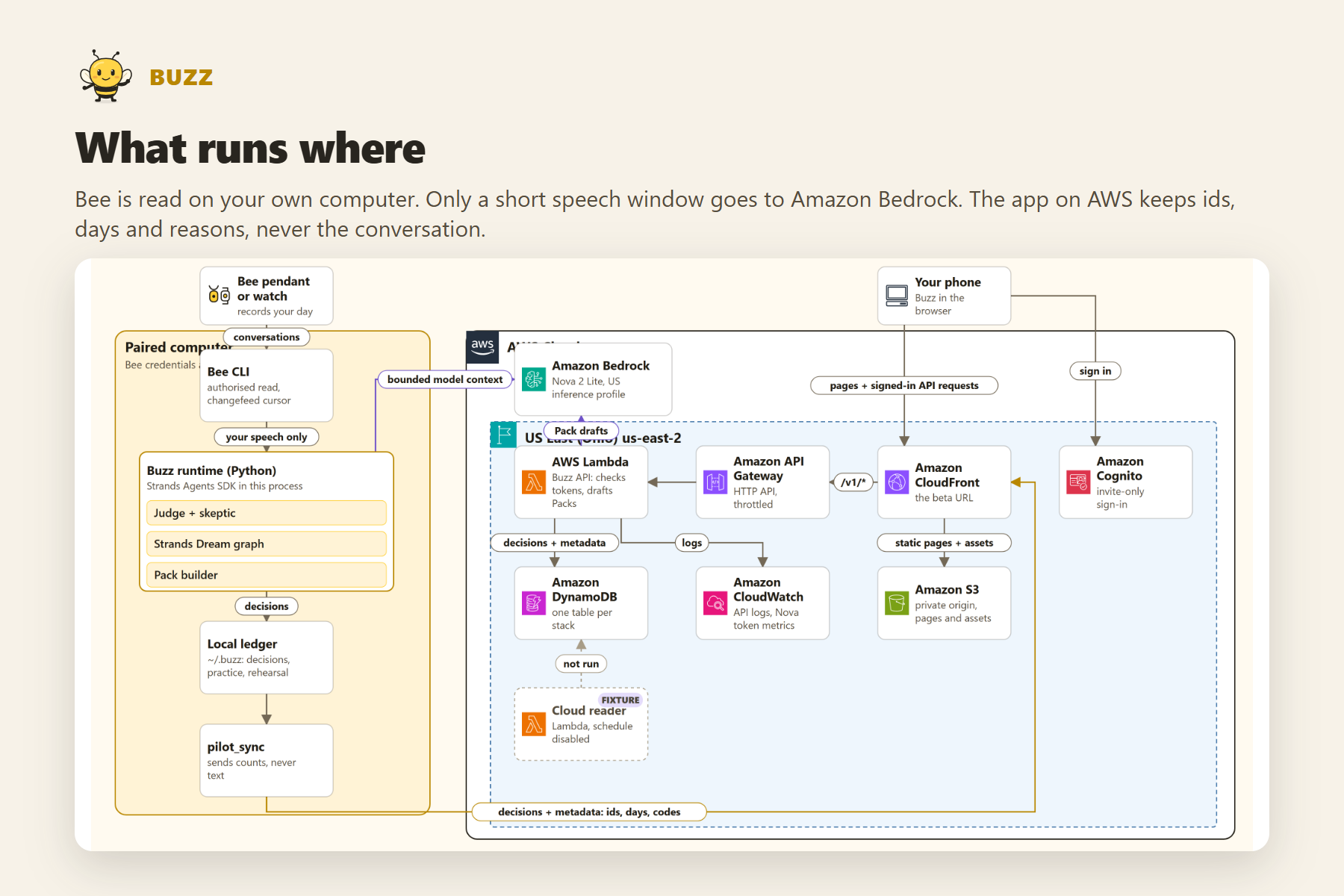
What runs where: Bee is read on your own computer, a short speech window goes to Bedrock, and the app on AWS keeps ids, days and reasons.
-
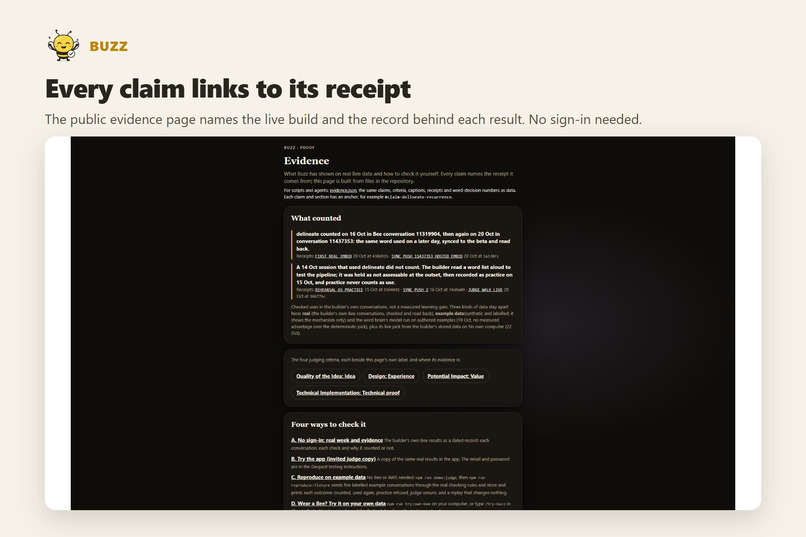
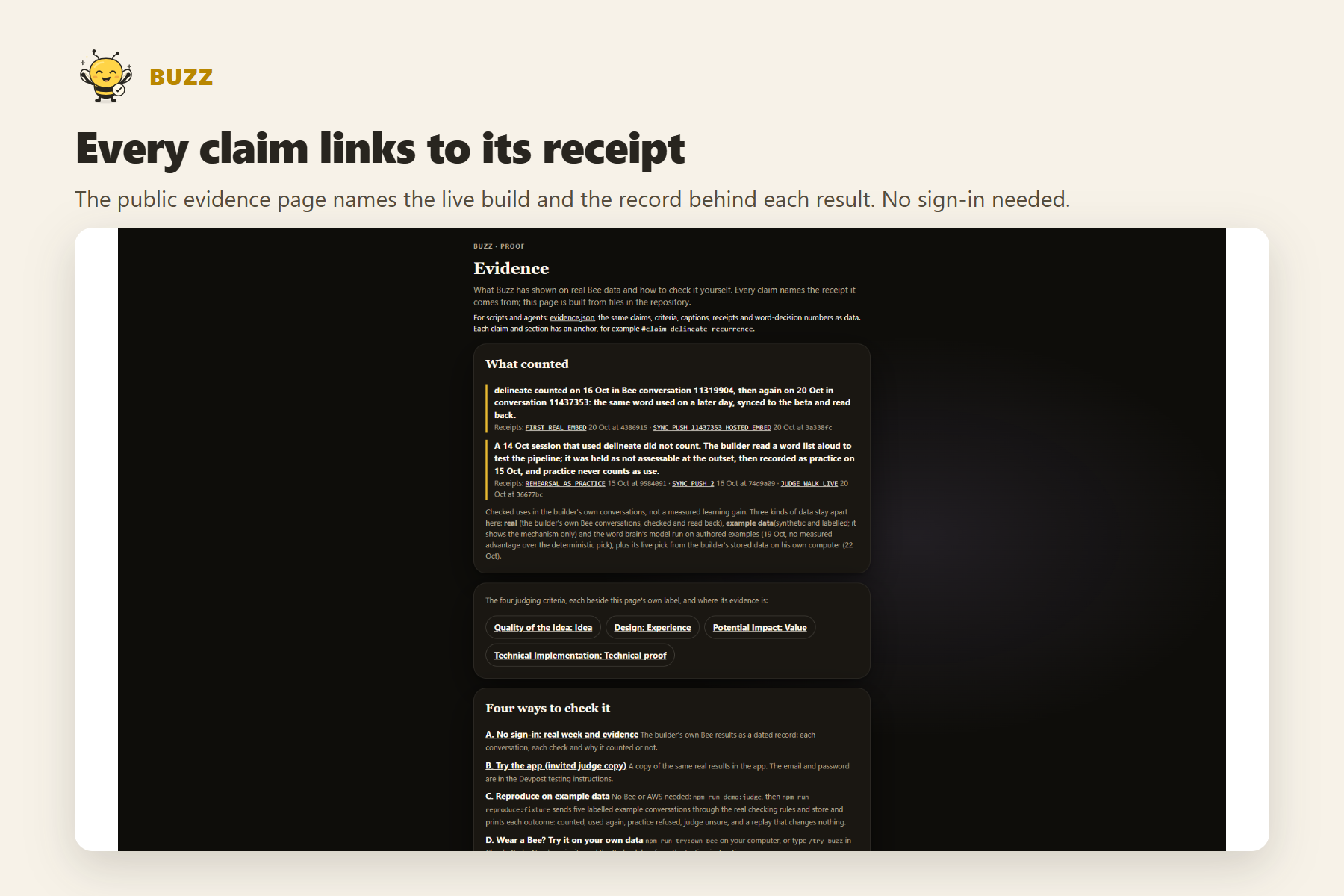
Public evidence page: every claim links to the record behind it. No sign-in needed.
-
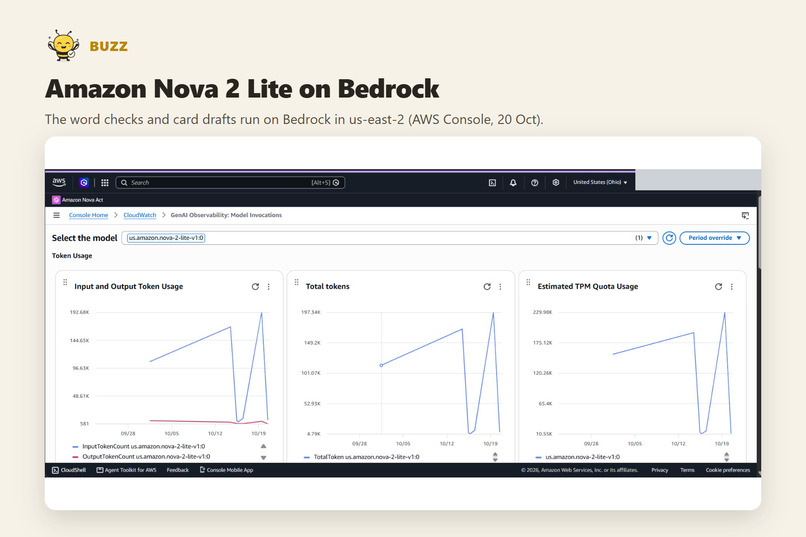
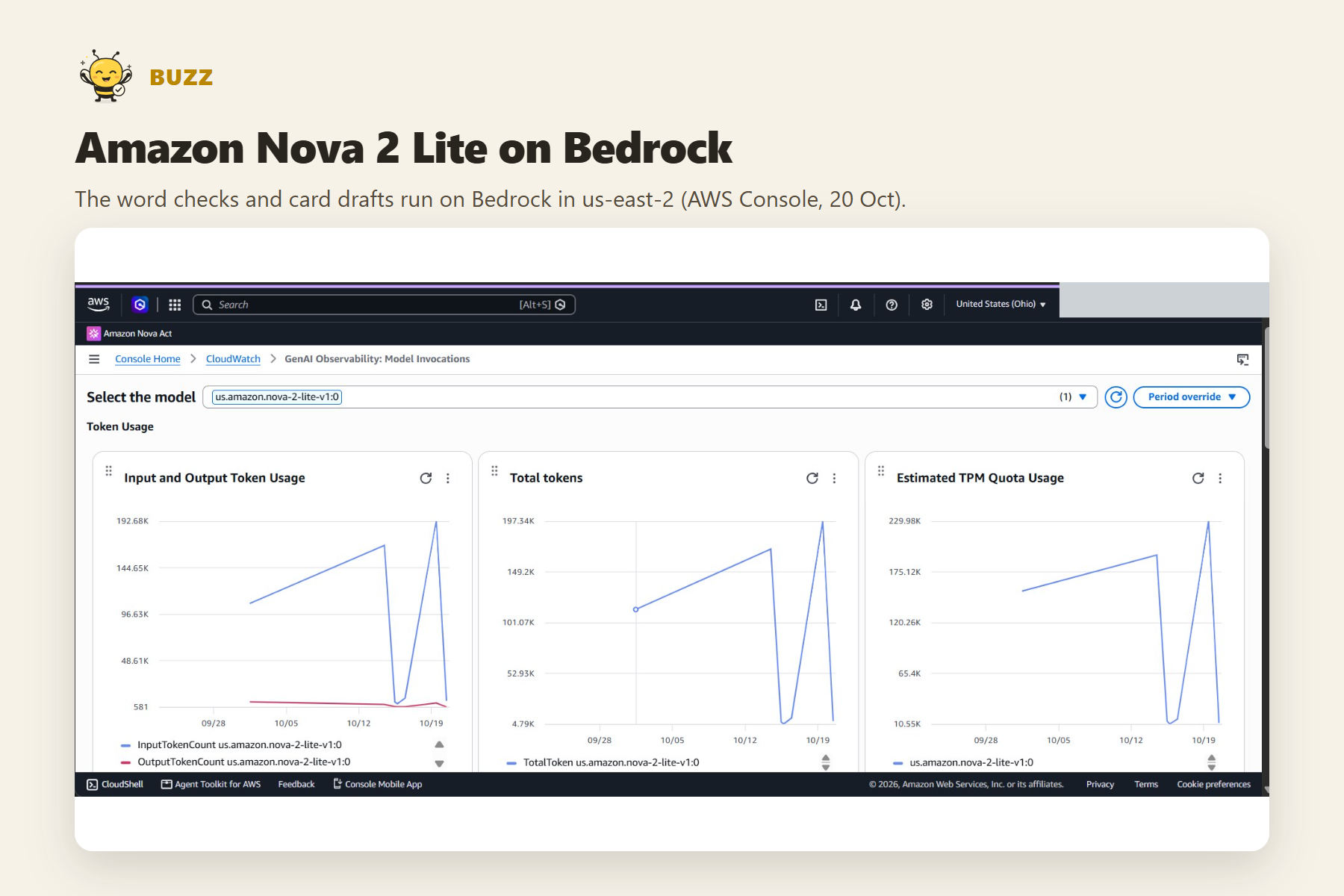
Amazon Nova 2 Lite on Amazon Bedrock runs the word checks and card drafts (AWS Console, 20 Oct).
-
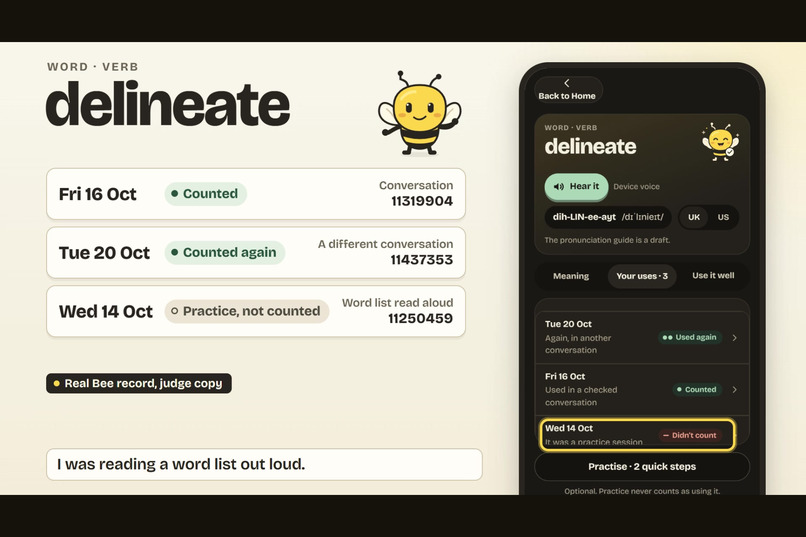
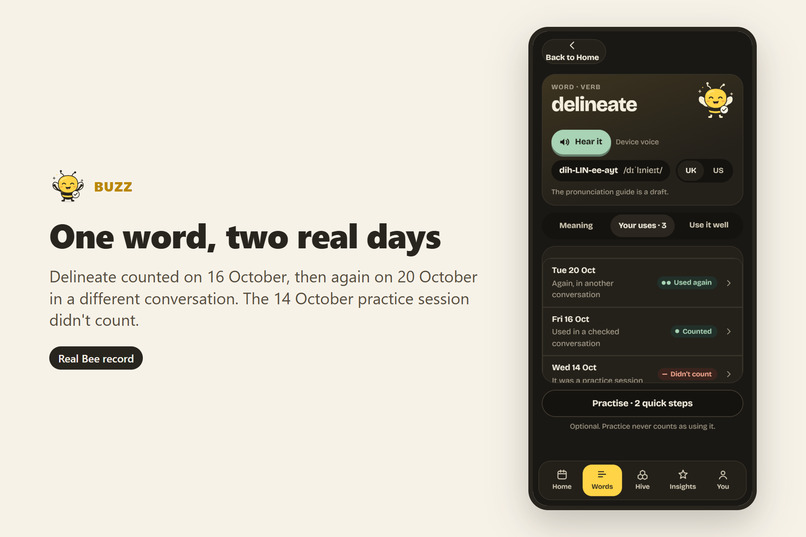
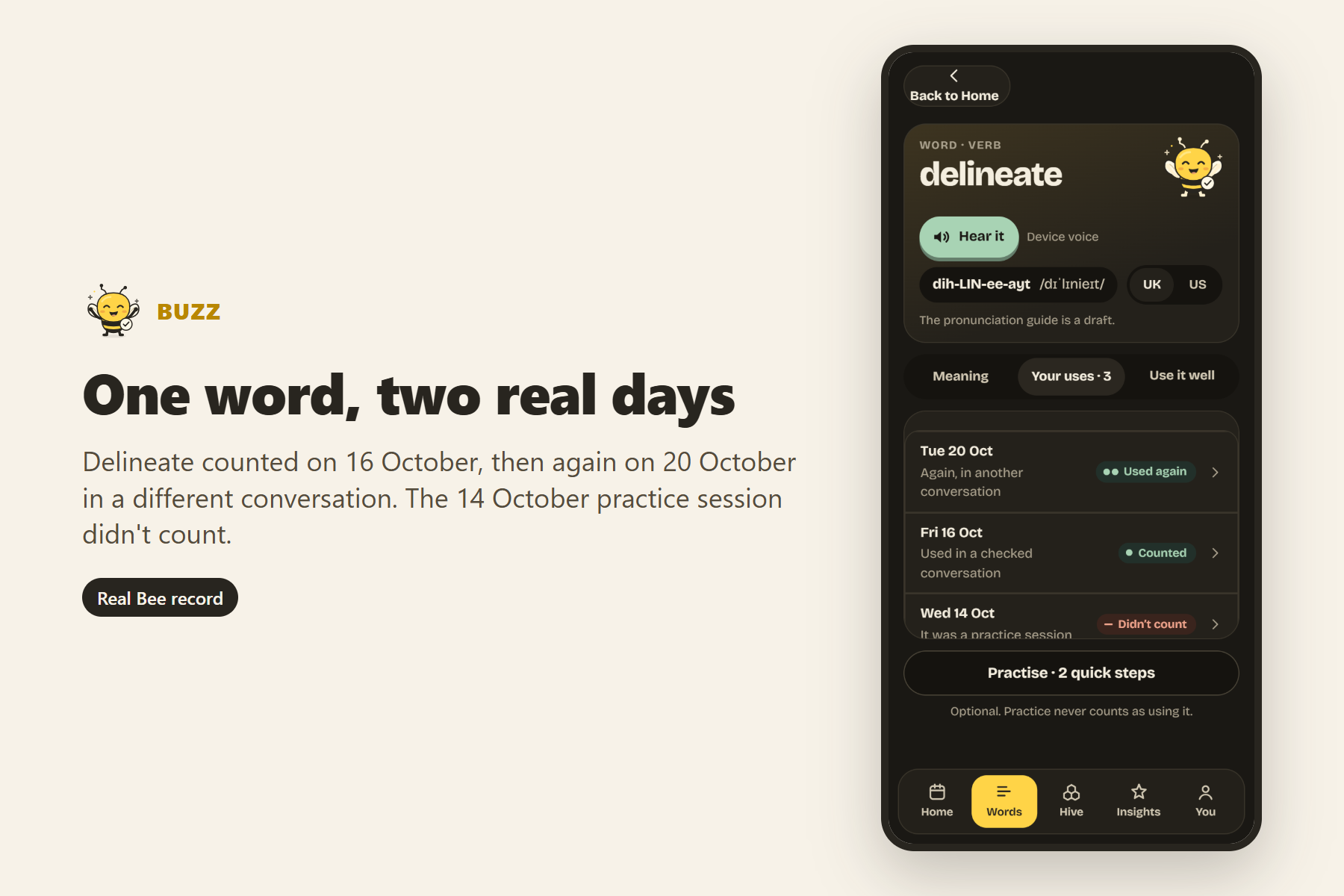
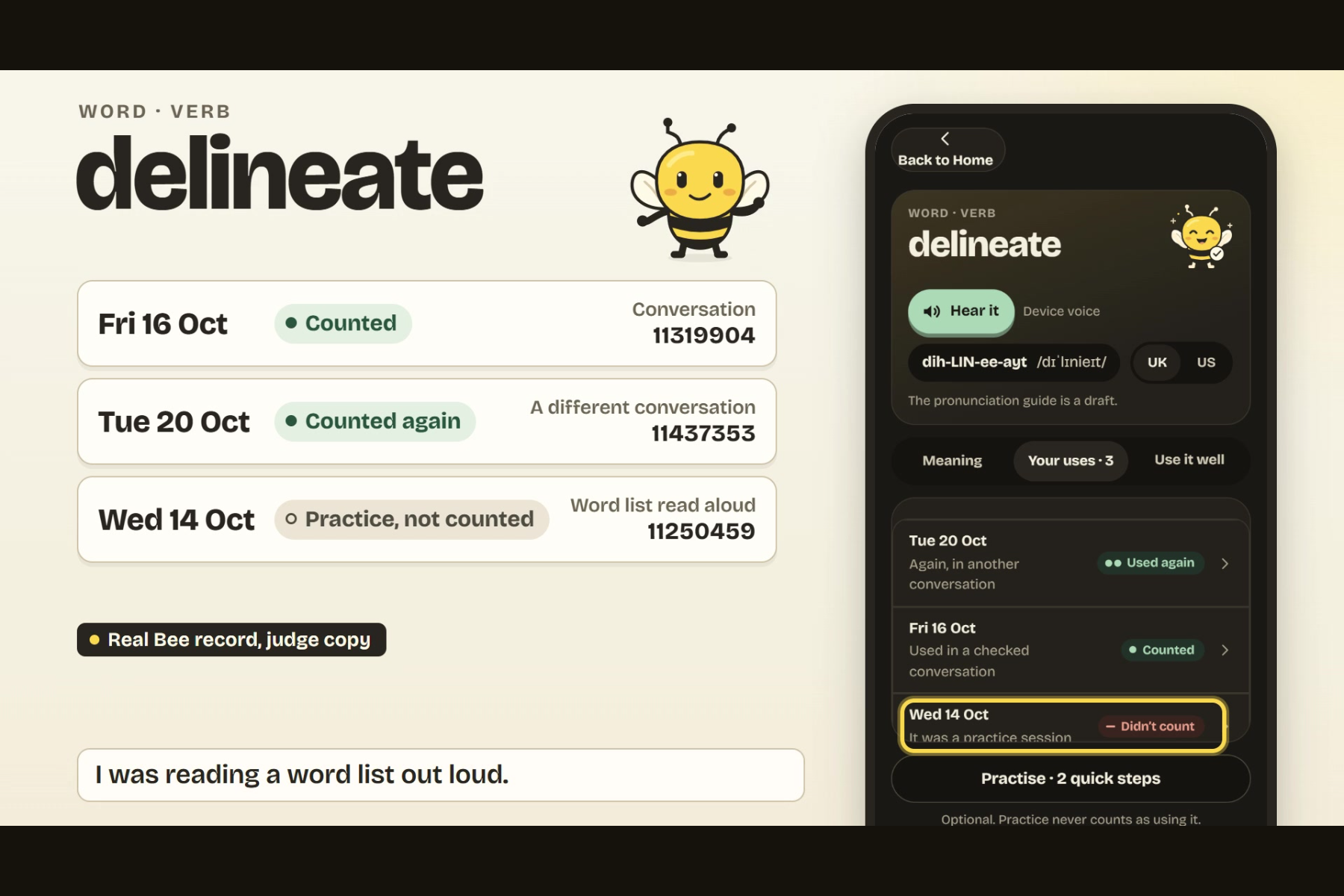
Real Bee record: "delineate" counted on 16 Oct, then again on 20 Oct in a different conversation. The 14 Oct practice didn't count.
-
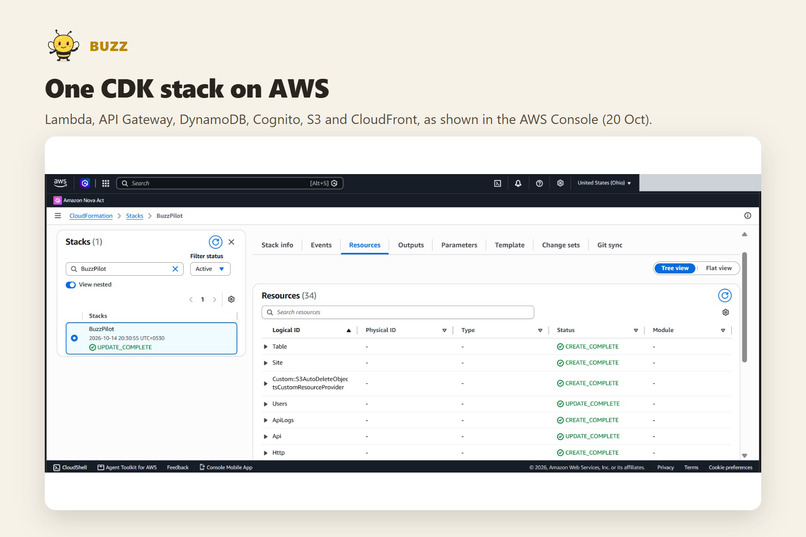
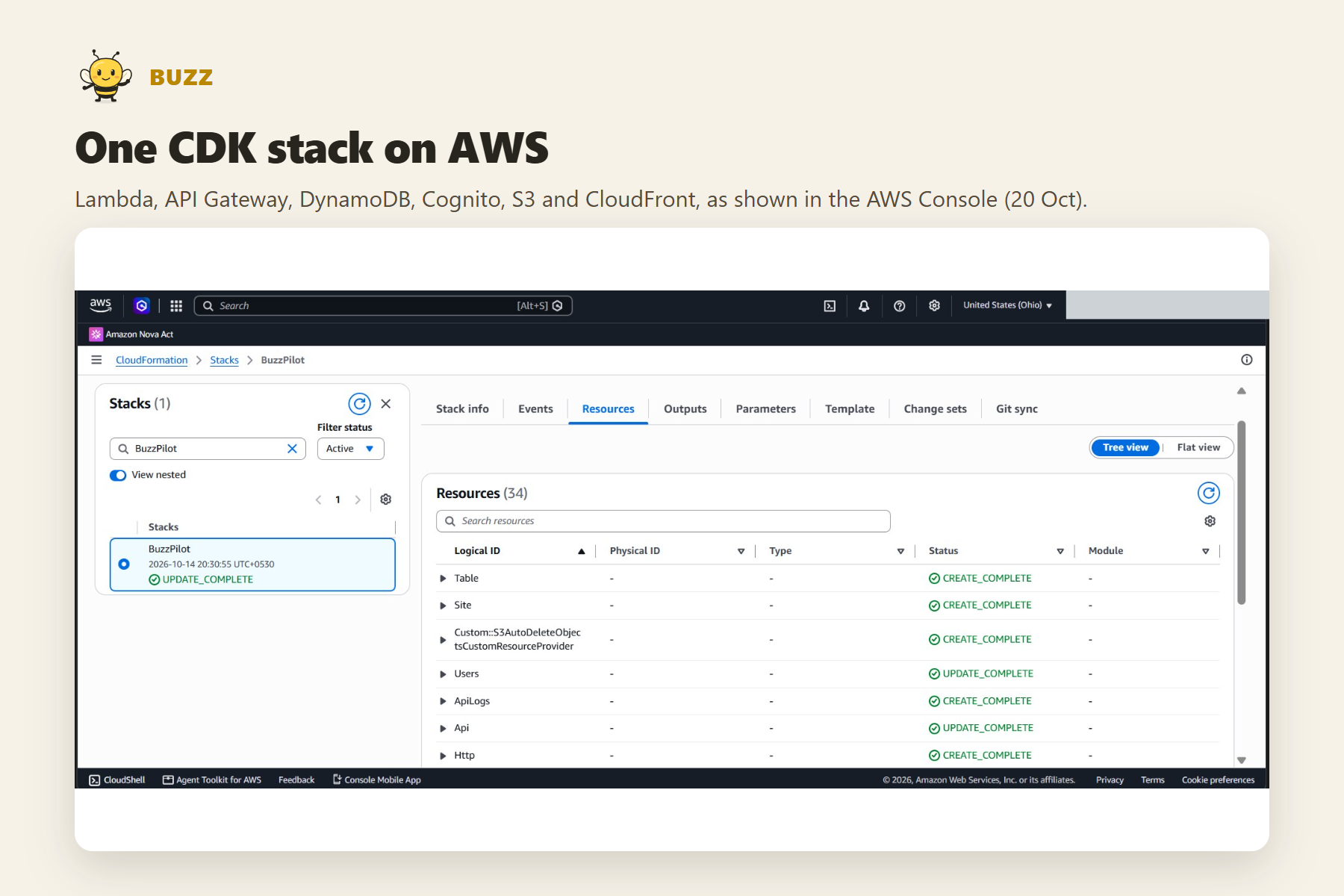
One AWS CDK stack: Lambda, API Gateway, DynamoDB, Cognito, S3 and CloudFront (AWS Console, 20 Oct).
Inspiration
We are Vignesh and Santhosh, two brothers.
We built Buzz around a question: after learning a word, how do you know whether it becomes part of the way you speak? Knowing a word on a screen and using it in a conversation are different things.
Duolingo inspired us: it made learning approachable, gave people a reason to come back and gave the experience a personality. If you've learned words in an app like Duolingo, you know the lesson part. Buzz is about what comes after: did you ever use the word?
Bee records your conversations. That made the question answerable.
What it does
Buzz helps professionals put useful vocabulary into everyday conversation. It gives you a useful word, then checks the conversations your Bee records and shows you, with a date and a reason, when you used it and when it returned on another day.
- Learn a word. Say what you want your words to do (find the main point, weigh a decision). Buzz offers a word with its meaning, how to say it and an example. Practice is optional.
- Talk as usual. Bee records your day.
- See what counted. Buzz finds the word in your own speech, checks you used it in the right sense, and shows each use with its day, its conversation and the reason it counted. Practice never counts. When a word comes back on a later day, in a different conversation, Buzz marks it "used again".
On real Bee data: delineate counted on 16 October, came back on 20 October in a different conversation, and a practice session on 14 October did not count. Over three days Buzz counted nine real uses for one wearer.
In the paired-computer app, Buzz also selects your next word and builds vocabulary card packs. Exact-approved Bee fact write-back connects the learning activity back to Bee. The hosted judge account presents a counts-only copy of the builder's checked results.
Bee, from conversation to app
Our Bee integration covers identity through bee me, cursor-based reconciliation through bee changed, finished
conversation list/get with speaker labels and timestamps, a bee stream connection that delivered an event, and
exact-approved fact creation and update with independent read-back. Buzz earns vocabulary credit from finished
conversations. The realtime capture probe is recorded separately.
On 21 October, the own-Bee setup synced 16 sources and read back all 16 matching revisions. The builder then opened the checked result in the hosted app. The fact lifecycle was completed across 20 and 22 October: create, read back, approve the closing-text update, then read back again.
Judges with their own Bee can use Claude Code, Codex, Cursor or another coding agent to follow our existing agent quick start. It runs on their paired computer, previews sanitized results and offers an approved sync to their own invited account. The same guide includes a read-only prompt for following the recorded proof without Bee access.
How we built it
| Component | Technology | Where it runs | Purpose |
|---|---|---|---|
| Bee reader | Python and the official Bee CLI | The wearer's own computer | Reads finished conversations; the Bee token and transcripts stay local |
| Word judge | Amazon Nova 2 Lite, Bedrock Converse API | Amazon Bedrock | Checks whether a word was used in the right sense |
| Word brain | Strands Agents on Bedrock | Own computer, calling Bedrock | Picks the next word from a shortlist that code builds |
| Card builder | Nova 2 Lite: builder and critic | Amazon Bedrock | Drafts and reviews new vocabulary cards |
| Week review | Strands Agents graph, seven stages | Own computer, calling Bedrock | Reviews recorded conversations in bounded, audited steps |
| API | Python (FastAPI) on AWS Lambda, API Gateway | AWS | Stores results and serves the app |
| Data | Amazon DynamoDB | AWS | Words, decisions and days; no conversation text |
| Sign-in | Amazon Cognito | AWS | Invite-only accounts |
| Web app | React, Amazon CloudFront and S3 | AWS | The phone app, the evidence page and the guide |
| Infrastructure | AWS CDK, one stack | AWS | Deploys all of it, with a budget alert |
How a word gets checked. Buzz reads your finished Bee conversations on your own computer and keeps only your speech. For each word you are learning, a short window of speech goes to Nova 2 Lite on Bedrock, which says whether you used it in the right sense. The model proposes; code decides. Practice, quotations and speech that isn't clearly yours never count, and each refusal keeps its reason. Approved results sync to the app as ids, days, statuses and reason codes. The paired computer retains the encrypted conversation archive. Hosted Buzz receives sanitized result fields (identifiers, dates, statuses, reason codes and revisions), while short speech windows are processed separately by Amazon Bedrock.
The agents. The word brain is a Strands agent that may only choose from a shortlist that code builds from the word list, your goal and the words you've used; if anything fails, the code's pick stands. The card builder drafts cards with Nova 2 Lite, code checks them (no duplicates, every example uses the word), and a second critic call reviews them before you accept the pack. In the local paired-computer demonstration, the word brain selected feasible from 18 candidates using three Nova 2 Lite calls and retained it through restart and reload. Honey produced six requested cards, all accepted and read back after restart. The seven-stage Strands graph made 35 live Bedrock calls over real Bee input with zero transport failures and stored three legacy coaching cases; its role outcomes are recorded in AWS_LIVE.md. Writing back to Bee happens only under your approval of the exact text, and Buzz reads every write back.
We wrote a short spec before each feature (requirements, design, tasks) and built it with Claude Code.
Challenges we ran into
Deciding what a use means was the hard part. A word can show up in a rehearsal, a quotation, the wrong sense, or someone else's speech. Matching text wasn't enough, and each of those cases had to stay distinct from the source all the way to the screen.
Bee shaped the product. Its speaker labels name the wearer and lump everyone else together, so knowing who said a word became its own step. Bee has no sign-in for other apps yet, so Buzz reads Bee on the wearer's computer and the app shows the results.
Making a seven-stage review graph auditable meant coordinating scoped tools, strict schemas and a bounded turn budget. Saved model responses helped us refine those boundaries. The graph then executed over real Bee input with 35 live calls and stored three coaching cases.
Accomplishments that we're proud of
A word that came back. Delineate counted on 16 October and again on 20 October in a different conversation, while the practice session on 14 October was correctly left out. Every use opens its conversation, its day and its reason.
Agents with saved results in the paired-computer app: feasible selected live by Strands, and six vocabulary cards for contingency, consensus, escalate, prioritise, viable and caveat. They were drafted, reviewed, accepted and retained after restart. The seven-stage Strands graph also executed on real Bee input and stored three legacy coaching cases.
A completed Bee fact lifecycle: exact-approved creation and independent read-back on 20 October, then an approved closing-text update of the same fact and read-back on 22 October.
Proof you can check. The evidence page links its typed claims to recorded runs and names its source candidate. The local next-word and Honey results have exact step-and-timestamp receipts in the proof ledger linked from the README.
What we learned
The model is the easy part. Deciding what counts, keeping practice apart from real use, and showing the reason for every result is where the product is.
What's next for Buzz
Pick your next word from what you actually talk about, using the purposes in your own conversations. Point the week review at vocabulary. Bring in a second wearer and more weeks of data. Make setting up your own Bee simpler as Bee opens access to other apps.
The ambition is a teacher wherever you go. Learn a useful word. See when it becomes part of your conversations. Next, we want to explore this approach across more languages, starting with those Bee supports.
Built with
Bee CLI, Amazon Bedrock, Amazon Nova 2 Lite, Strands Agents SDK, AWS Lambda, Amazon API Gateway (HTTP API), Amazon DynamoDB, Amazon Cognito, Amazon S3, Amazon CloudFront, Amazon CloudWatch Logs, AWS Budgets, AWS CDK, Python, FastAPI, React, TypeScript, Vite, pytest, Playwright, Claude Code.
Try Buzz
- Recorded Bee results
- Evidence and described screenshots
- Open the app; judge access is in the testing instructions in Devpost; the README starts with judge directions.
- Code repository (private, shared with the Amazon reviewers and devposttesting)
Hosted presentation release: 3bd24279fe21321942b240114beb59977eba4d82, deployed 23 October 2026; stack, Api, served BUILD_COMMIT and evidence source agree. Later main commits update repository documentation. The earlier RECOVER_DEPLOY_A414E63_1023 remains a historical read-back. Demo video: https://youtu.be/snPdAbp2g58
Built With
- amazon-api-gateway
- amazon-bedrock
- amazon-cloudfront
- amazon-cognito
- amazon-dynamodb
- amazon-nova
- amazon-web-services
- aws-cdk
- aws-lambda
- bee
- fastapi
- python
- react
- strands-agents
- typescript

Log in or sign up for Devpost to join the conversation.