
Inspiration
Big-purchase electronics research is fundamentally broken. We’ve all been there: 20 tabs open across Reddit, YouTube, and retail sites, trying to mentally calculate if a used iPhone 15 is a better "value" than a new iPhone 16. The problem isn't a lack of information; it's information density. Most comparison sites give you a spreadsheet of specs and leave the thinking to you. I wanted to build an opinionated decision engine that doesn't just show data, but translates that data into a clear "Buy" or "Skip" verdict.
What it does
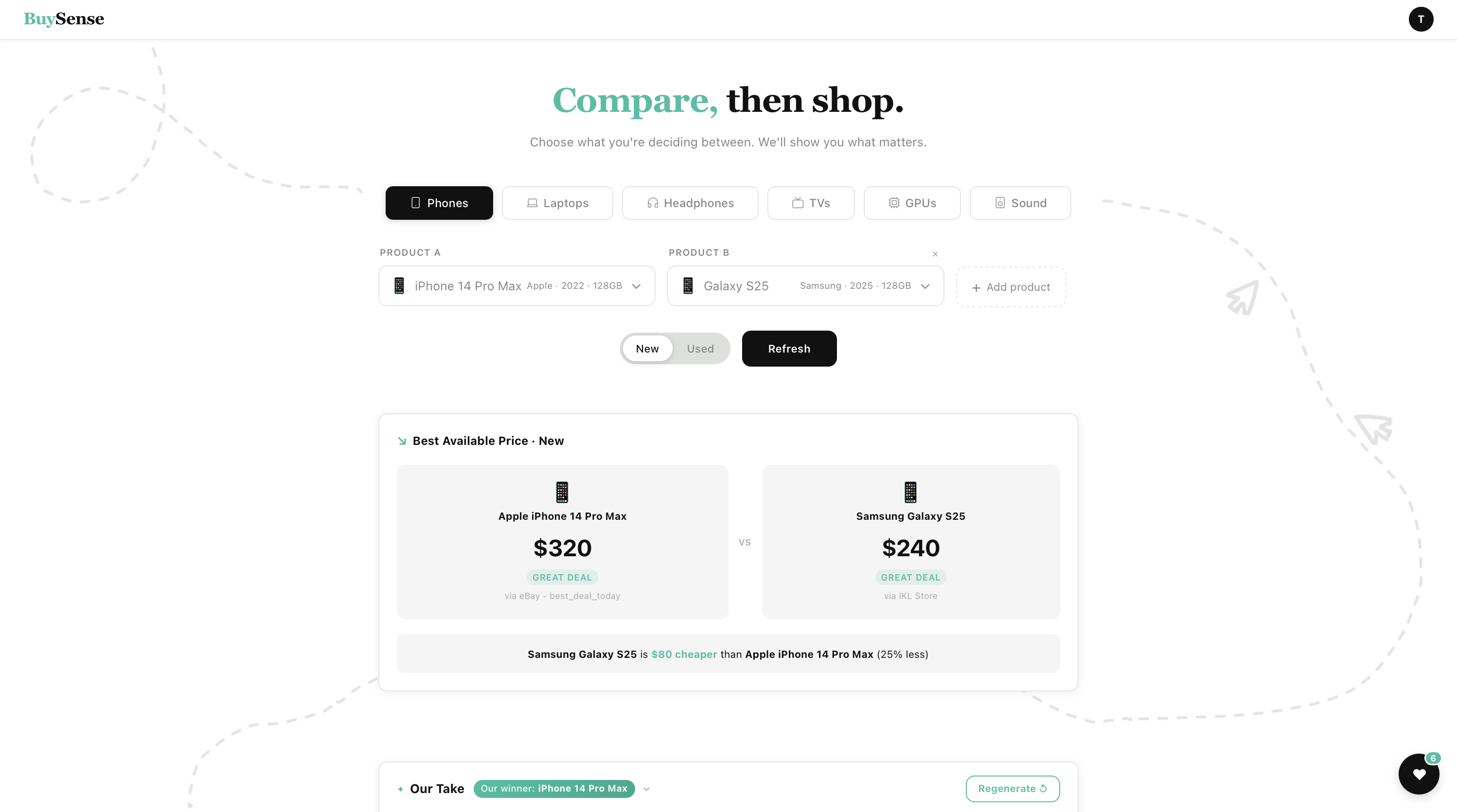
BuySense is an opinionated decision engine for electronics that collapses the fragmented research process into a single, actionable page by mirroring the natural purchasing flow. Instead of leaving users with dozens of open tabs, it fetches live market data via SerpAPI and uses Google Gemini to generate sharp "Buy or Skip" verdicts, complete with interactive citation chips that link directly to expert reviews. By integrating real-time price comparison with deep risk analysis, such as battery health assessments and seller checklists for used items, BuySense moves users beyond information density to a clear, data-backed purchase recommendation.
How we built it
BuySense is a full-stack web application designed around a single principle: reduce decision friction, not just display information.
On the frontend, I led development using React + Vite, with shadcn for composable UI primitives and Framer Motion to create fluid, seamless transitions between decision states. These animations guide users through a comparison-first flow that mirrors how people actually decide between purchases.
From a UX standpoint, BuySense inverts the traditional shopping journey. Instead of starting with endless specs and listings, users begin by selecting the decisions they’re trying to make. Information is progressively revealed, from high-level verdicts, to risk analysis, to curated reviews, collapsing what would normally require dozens of tabs into a single, coherent decision surface.
By the time users reach the listings page, they’re no longer browsing blindly. They arrive informed, context-aware, and confident in whether a purchase is worth making, directly addressing buyer’s remorse and cognitive load in high-cost electronics purchases.
BuySense uses a Node.js / Express backend to orchestrate data from multiple external sources into a unified decision pipeline. Supabase (PostgreSQL) stores normalized product data and curated resources, while SerpAPI provides real-time market listings and pricing signals. At the core of the system, Google Gemini powers the intelligence layer through carefully engineered prompts that perform retrieval-augmented generation (RAG) over product specs and real-world review snippets, enabling BuySense to generate clear, opinionated “Buy or Skip” signals from otherwise fragmented data.
Challenges we ran into
Aggregating electronics data was challenging due to inconsistent and unstructured formats across listings, reviews, and specifications, especially in the used market.
Accomplishments that we're proud of
Building and shipping a complete full-stack application solo, from product concept to deployment. Experimenting with new techniques such as web scraping and retrieval-augmented generation (RAG), while intentionally prioritizing UX and decision-focused reasoning over raw feature count.
What I learned
Great UX isn’t about adding more components or animations, it’s about removing unnecessary complexity. Designing BuySense reinforced the importance of guiding users through intuitive, decision-focused flows rather than overwhelming them with more information. On the technical side, I gained hands-on experience with web scraping and applying retrieval-augmented generation (RAG) to reason over unstructured data.
What's next for BuySense
BuySense aims to expand its data coverage to become a centralized platform for educating users on smarter purchasing decisions. Future work includes supporting more product categories and marketplaces, such as the used car market, where asymmetric information and issues like lemon law make confident decision-making especially difficult.
Built With
- javascript
- node.js
- postgresql
- rag
- react
- supabase
- ui
- ux


Log in or sign up for Devpost to join the conversation.