-
-
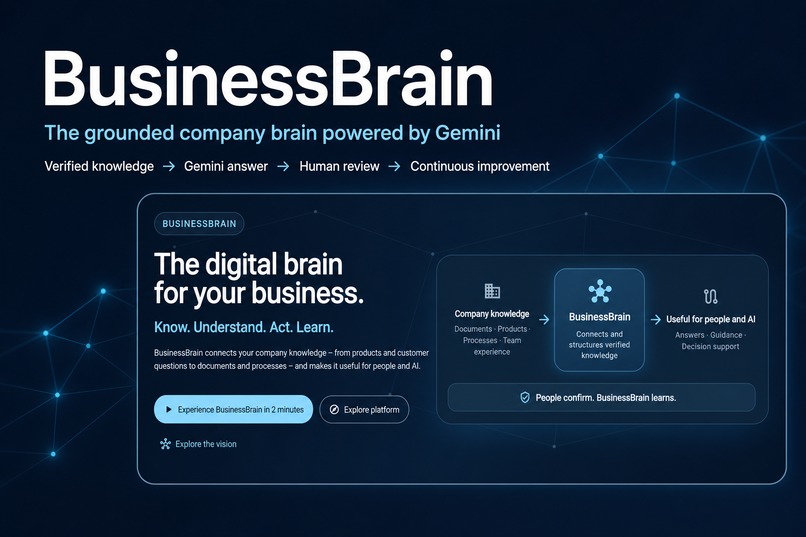
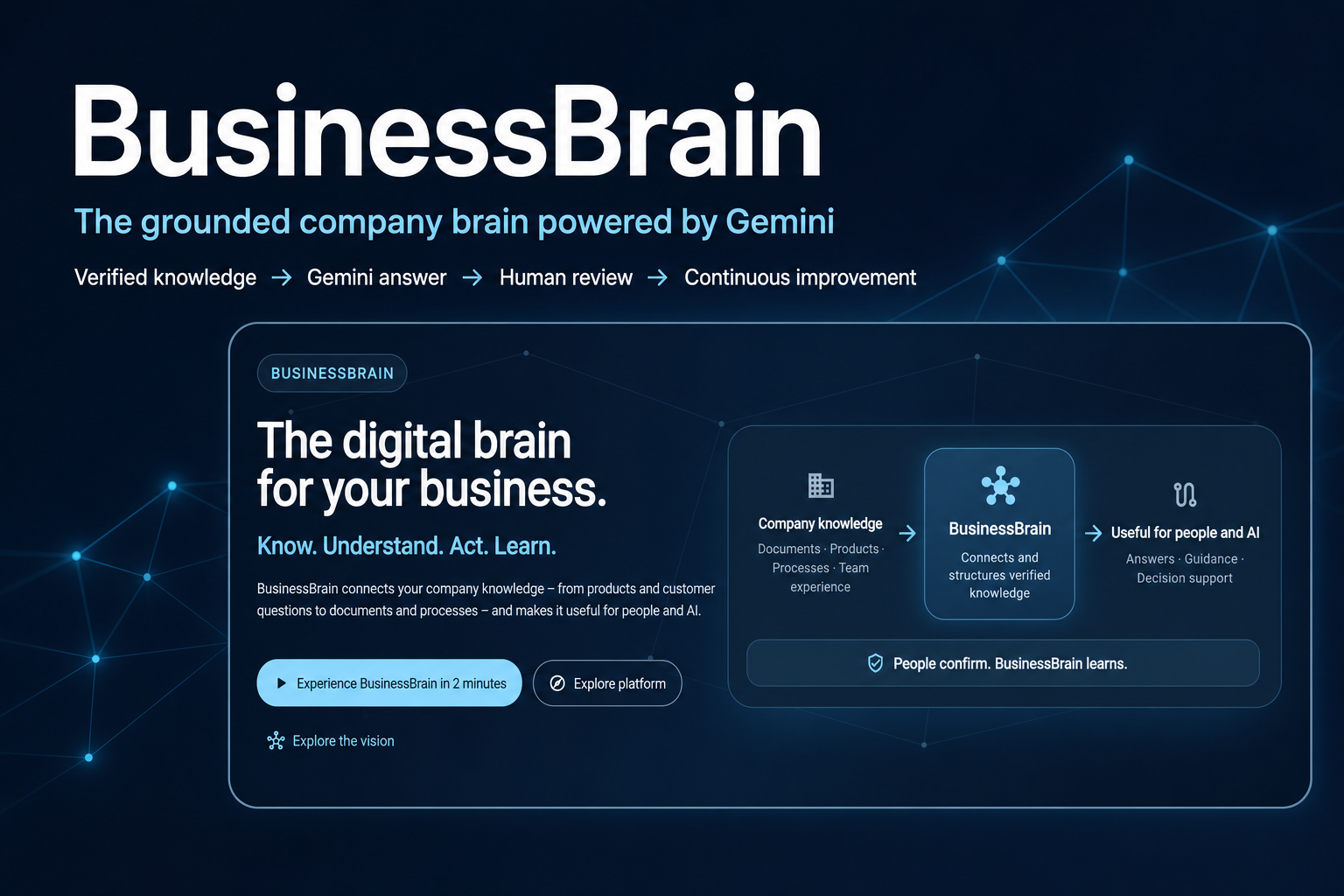
BusinessBrain turns verified company knowledge into reliable answers, guidance, and decision support for people and AI.
-
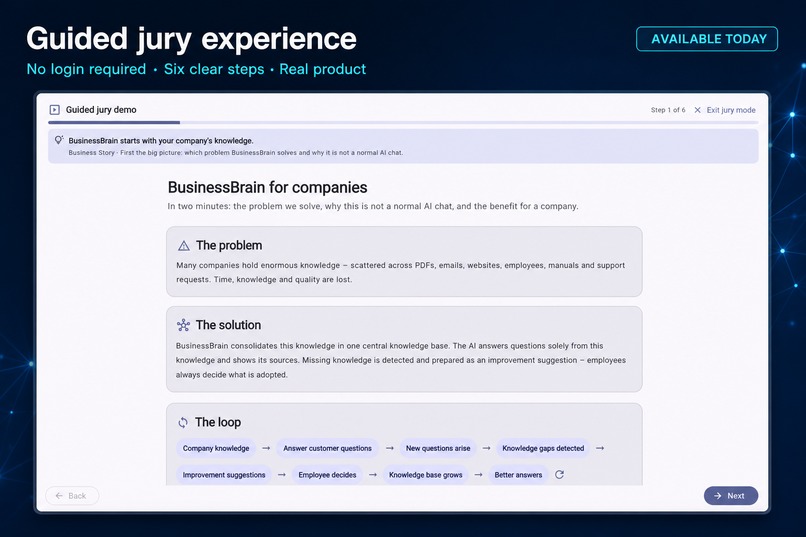
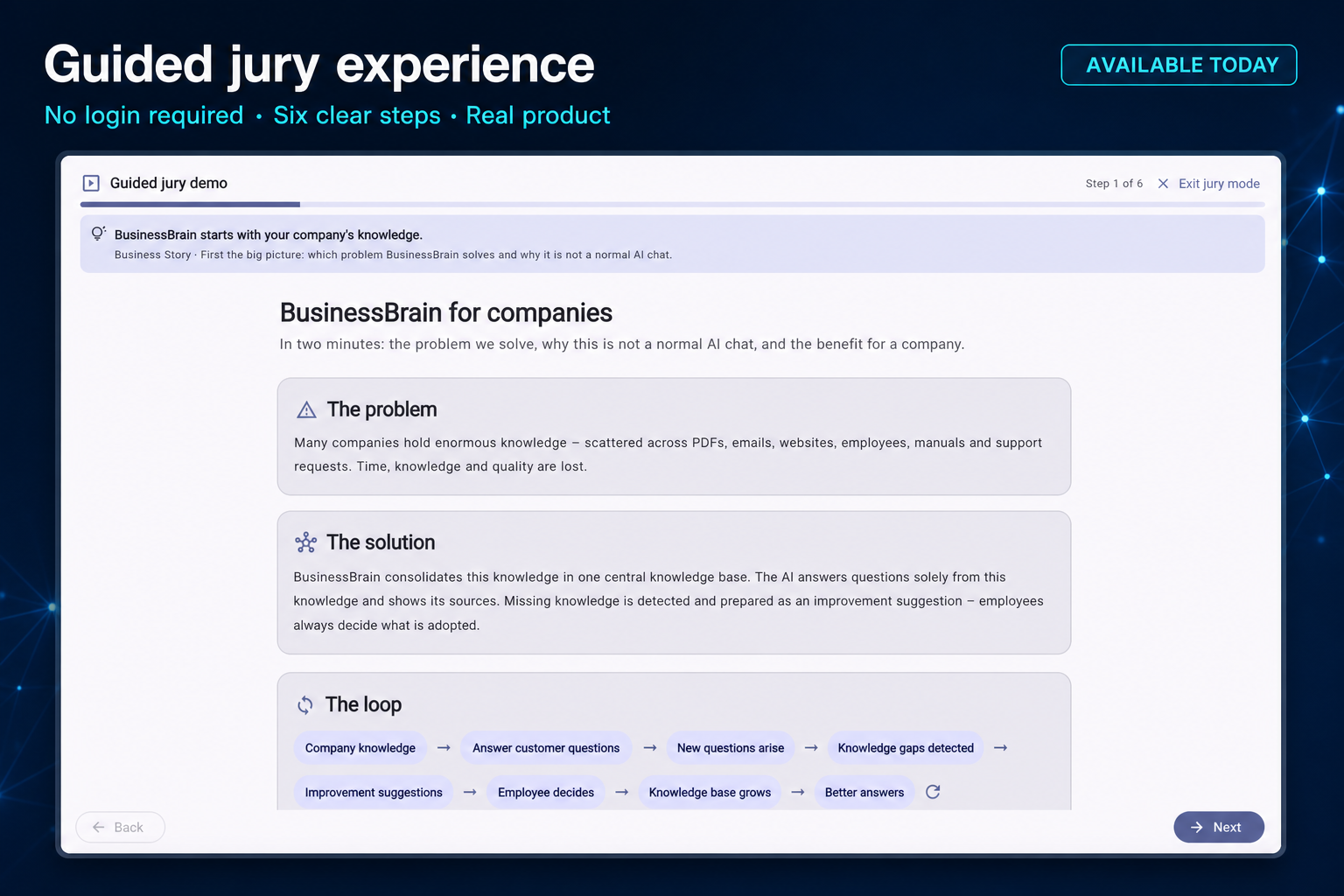
The guided jury experience explains the business problem, the solution, and the continuous knowledge-improvement loop.
-
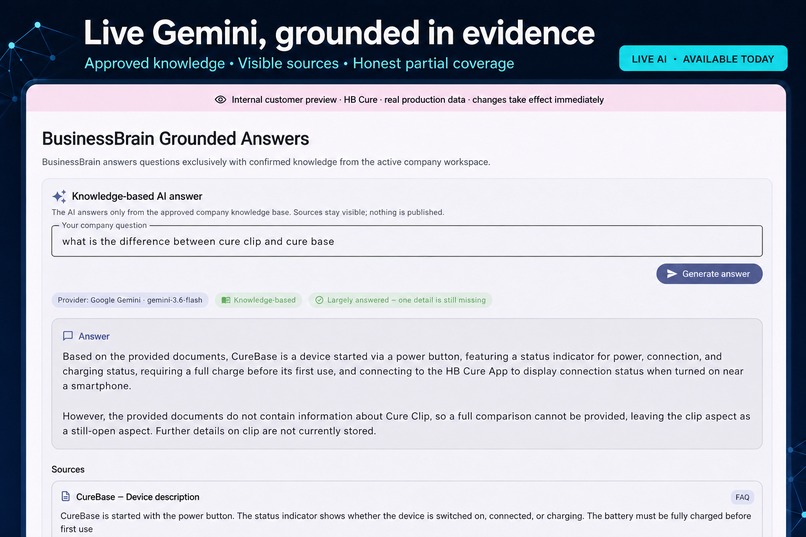
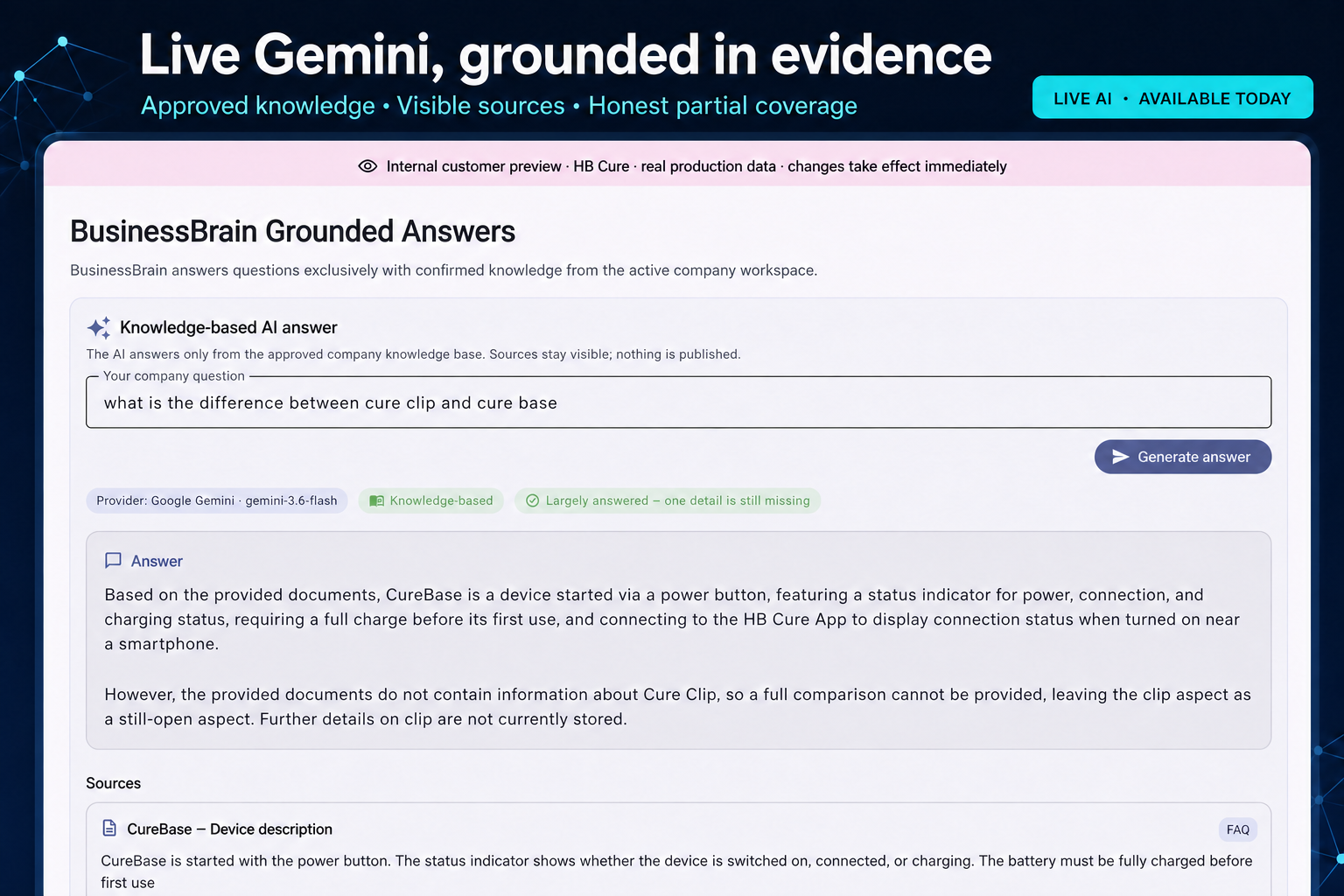
Google Gemini generates a grounded answer from approved HB Cure knowledge, displays the supporting sources,identifies missing information.
-
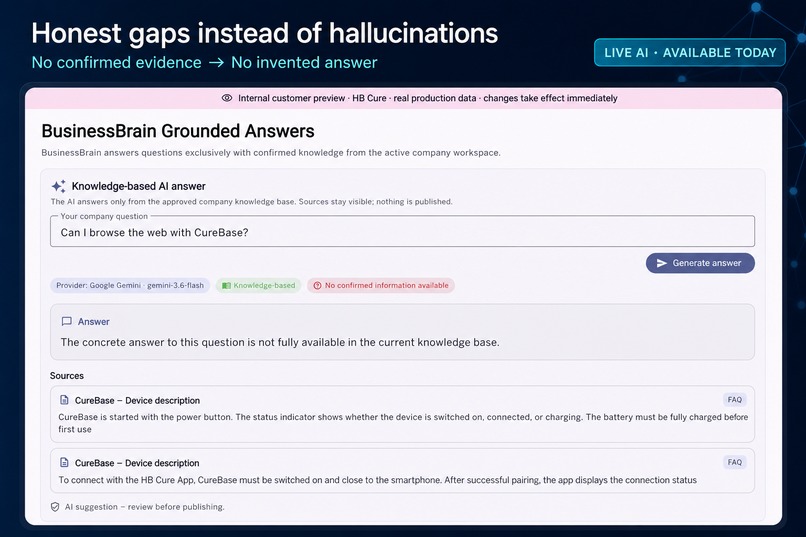
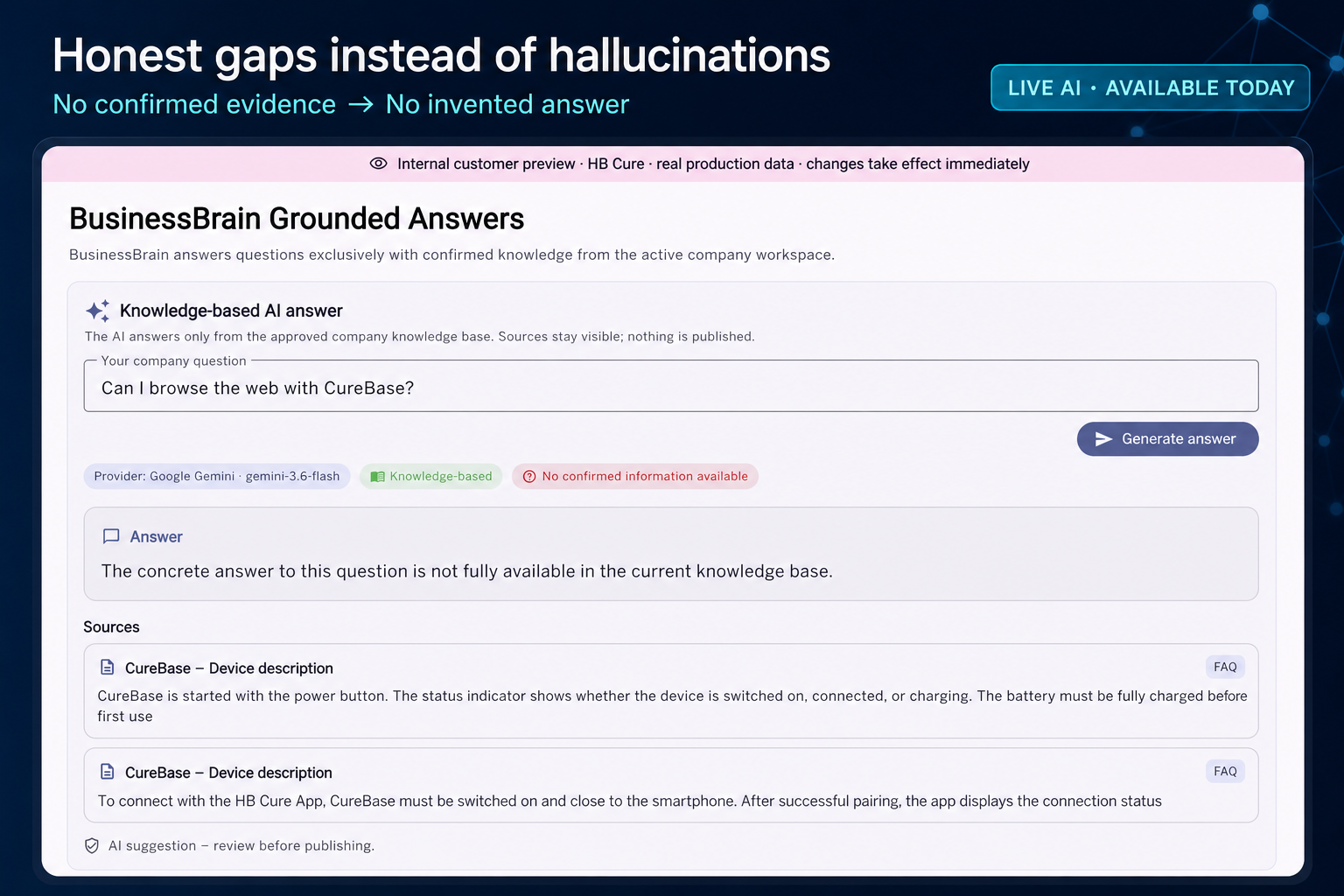
When confirmed knowledge is insufficient, BusinessBrain does not invent an answer. It exposes the knowledge gap for improvement.
-
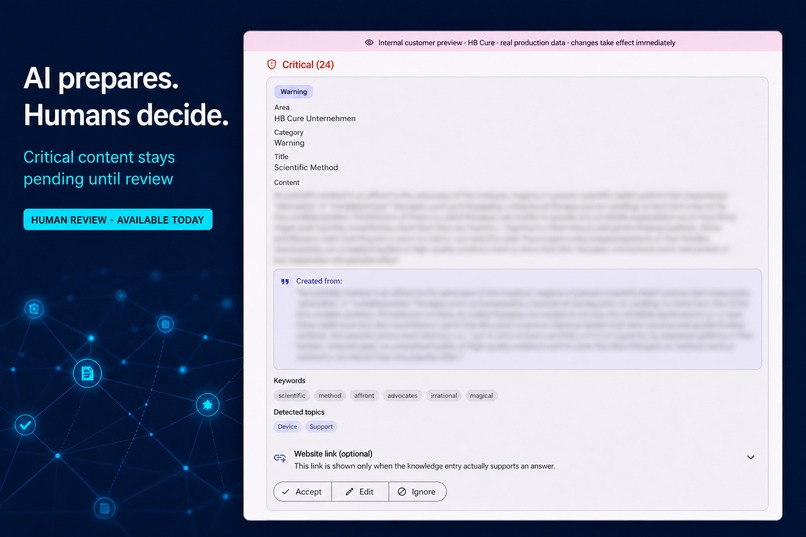
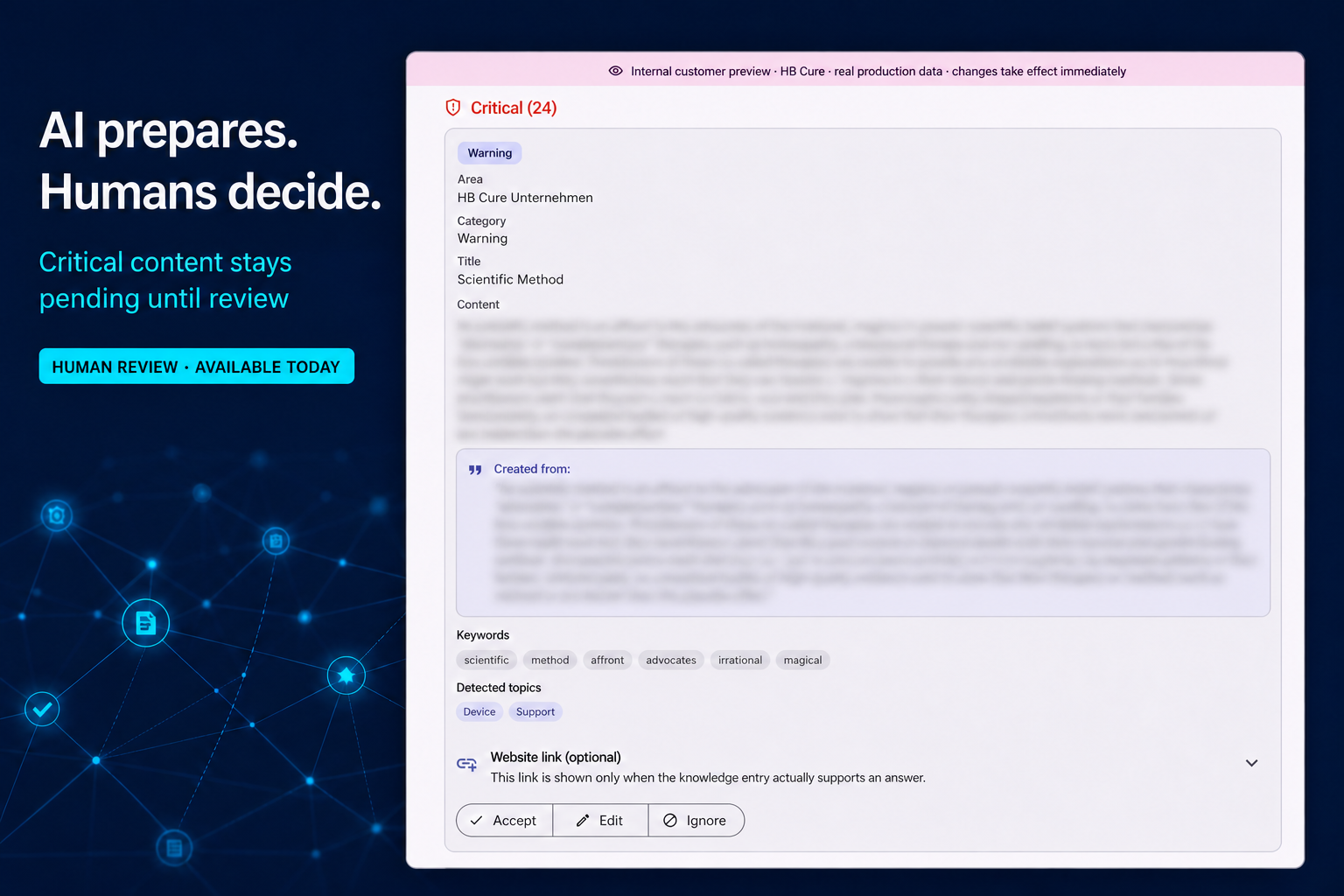
Potentially risky or conflicting content is flagged for human review. A responsible employee decides whether to accept, edit, or ignore it.
-
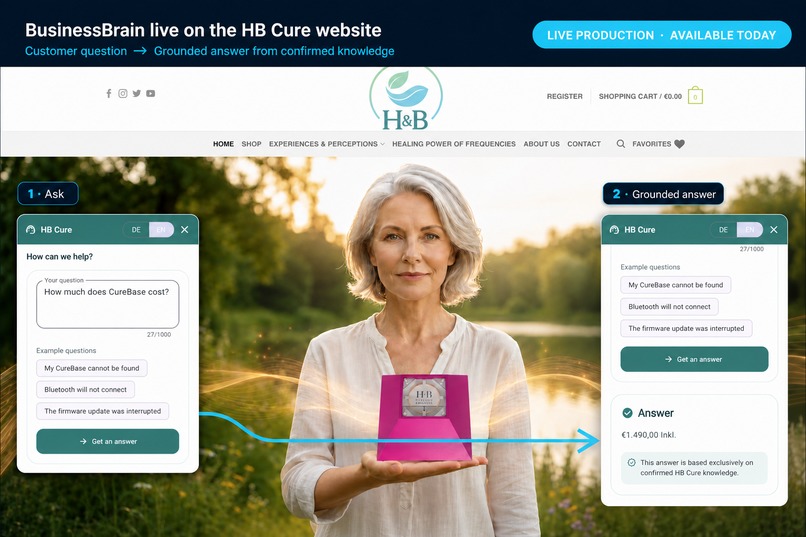
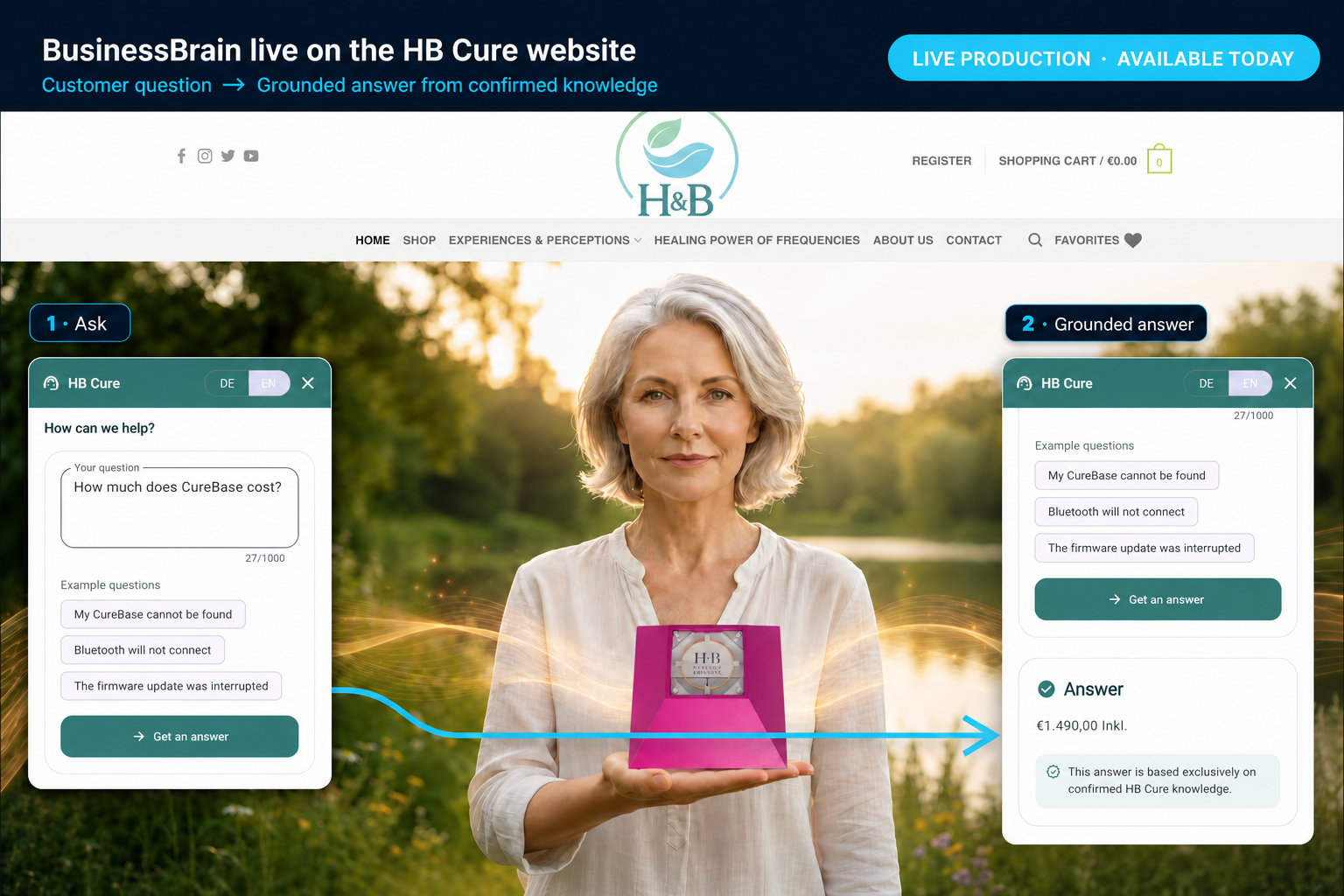
The BusinessBrain assistant is live on the HB Cure website, answering real customer questions exclusively from confirmed company knowledge.
-
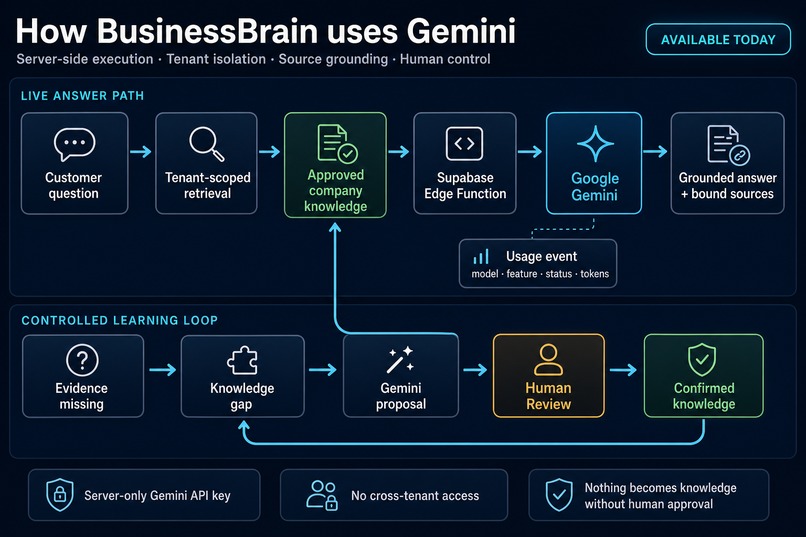
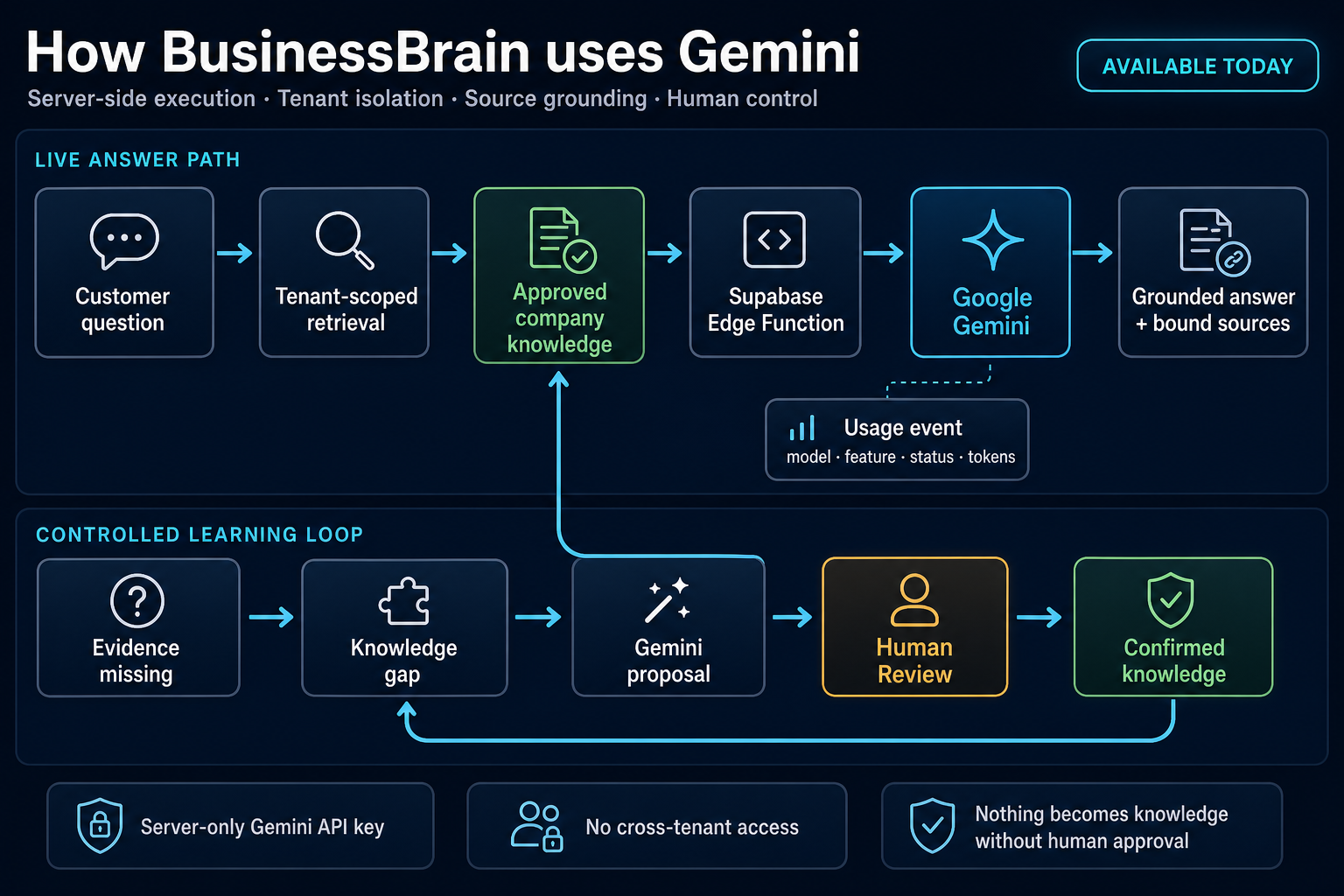
Server-side Gemini architecture with tenant-scoped retrieval, source-grounded answers, usage metering, and mandatory human approval .
Inspiration
Small businesses already possess most of the knowledge their customers and employees need. The problem is that this knowledge is scattered across documents, websites, emails, support conversations, and the experience of individual employees.
When somebody asks a question, the answer often depends on finding the right person. A generic AI chatbot can respond faster, but it may produce a confident answer that the business never approved. For health-adjacent products and other sensitive industries, that is not merely inconvenient — it can become a serious business risk.
BusinessBrain was inspired by a simple question:
How can a small business use generative AI without losing control over what the AI says?
Our answer is not another general-purpose chatbot. BusinessBrain creates a controlled learning loop around Gemini: verified company knowledge produces grounded answers, missing information becomes visible, employees review improvements, and the company’s knowledge becomes more useful over time.
What it does
BusinessBrain turns a company’s approved knowledge into a trustworthy AI-powered support and knowledge system.
A customer or employee can ask a question in German or English. BusinessBrain retrieves the relevant confirmed knowledge for that specific company and uses Google Gemini to formulate an answer within that evidence boundary.
The interface makes the AI execution transparent by showing:
- the AI provider
- the Gemini model
- a request ID
- evidence coverage
- the company sources connected to the answer
If the available evidence is insufficient, BusinessBrain does not ask Gemini to improvise. It returns an honest knowledge gap.
The missing information can then enter the Knowledge Builder. Gemini analyzes supplied material and prepares structured improvement proposals. An employee reviews, edits, accepts, or rejects those proposals. Only approved information becomes confirmed company knowledge.
This creates a continuous improvement loop:
Customer or employee question
              ↓
Retrieve approved company knowledge
              ↓
Gemini creates a grounded answer
              ↓
Answer and sources are shown
              ↓
Missing information becomes a knowledge gap
              ↓
Gemini prepares an improvement proposal
              ↓
A human reviews and confirms
              ↓
Future answers improve

The first real customer-facing BusinessBrain widget is already embedded on the Healing & Balance / HB Cure website.
BusinessBrain is therefore more than a chat interface. The product is the verified, human-controlled, and measurable learning loop around the model.
How we built it
BusinessBrain is built as a Flutter Web application with a modular, multi-tenant architecture.
The frontend is deployed through Cloudflare Pages. Supabase provides the backend foundation, tenant isolation, authentication, database security, and the server-side gateway to Gemini.
Gemini API calls run through a Supabase Edge Function. The Gemini API key remains on the server and is never exposed to the browser. The gateway validates requests, restricts the permitted model and browser origins, calls Gemini, and records the real usage metadata returned by the model.
Each executed Gemini request can be associated with:
tenant
feature
model
request ID
execution status
input and output token usage
Prompt and answer content are not stored in the usage events.
The application uses a provider-independent AI interface, but Google Gemini is the live production provider for the submitted product. Selecting Gemini never silently switches to mock AI. If a Gemini request fails, deterministic interface functionality may remain available, but mock content is never labelled as Gemini.
We reused an earlier generic Flutter/PWA business-workspace foundation. During the competition period, we built the BusinessBrain-specific product on top of it: the grounded Gemini answer path, knowledge-gap behavior, Gemini-assisted Knowledge Builder, human-review workflow, usage metering, anonymous jury experience, and the live HB Cure support integration.
Challenges we ran into
The hardest challenge was not calling a language model. It was defining what the model is and is not allowed to do.
We had to separate several responsibilities carefully:
deterministic retrieval finds relevant company knowledge
Gemini formulates and structures language
company rules define safety boundaries
humans decide what becomes confirmed knowledge
tenant boundaries prevent one company’s information from reaching another
Another challenge was making AI execution visible. A fluent answer alone can look like a static or simulated demonstration. We therefore expose the provider, model, request ID, evidence coverage, and sources directly in the interface.
We also needed the anonymous jury experience to work without login while remaining separated from production customer data. The jury workspace uses clearly identified synthetic demonstration data, while the same deployed architecture can execute real Gemini requests.
Finally, we had to distinguish honestly between three product layers:
functionality available today
deterministic or illustrative demo data
the future BusinessBrain vision
For example, Operations metrics are fixed demo data. Company Evolution and Community Radar are illustrative future concepts, not currently operating autonomous AI services.
Accomplishments that we're proud of
We are particularly proud that BusinessBrain is not only a presentation prototype.
The current product includes:
live Gemini execution in production
grounded answers based on approved company knowledge
visible sources and request-level traceability
honest knowledge-gap behavior
Gemini-assisted knowledge proposals
mandatory Human Review before knowledge confirmation
multi-tenant architecture and row-level security
per-tenant AI usage metering
an anonymous jury flow without login
a real customer-facing HB Cure website widget
an extensive automated test suite
Most importantly, the complete core loop can be demonstrated: ask a question, inspect the answer and sources, detect missing knowledge, prepare an improvement, review it, and make future answers better.
What we learned
We learned that an AI-native business does not need to remove humans from every decision.
Gemini can independently execute a real customer-answering workflow within verified knowledge and policy boundaries. Humans retain authority over knowledge approval and high-impact business decisions.
We also learned that trust requires more than saying an answer is “grounded.” Users need to see the evidence, understand when information is missing, and know which parts were generated by AI.
The long-term value is not the individual prompt or model call. It is the company-specific memory created from confirmed knowledge, customer questions, human decisions, and eventually measured outcomes.
What's next for BusinessBrain
The current grounded knowledge system is the trusted foundation for a much larger platform.
The next stages are intended to connect additional, clearly sourced business signals such as:
recurring customer questions
website quality and missing information
product feedback
customer interests and objections
market and competitor developments
previous decisions and their measured outcomes
BusinessBrain could then turn these signals into explainable recommendations and show the business its most valuable next steps, including the reason, supporting evidence, expected impact, urgency, and required effort.
Specialized AI agents could prepare research, comparisons, reports, and tasks. Low-risk work could eventually operate within predefined permissions, while publishing, spending, customer outreach, changes to confirmed knowledge, and strategic decisions remain under human control.
Our long-term goal is to give every small business a trusted intelligence that can observe, remember, recommend, coordinate, and learn — without requiring the business owner to become an AI expert.

Log in or sign up for Devpost to join the conversation.